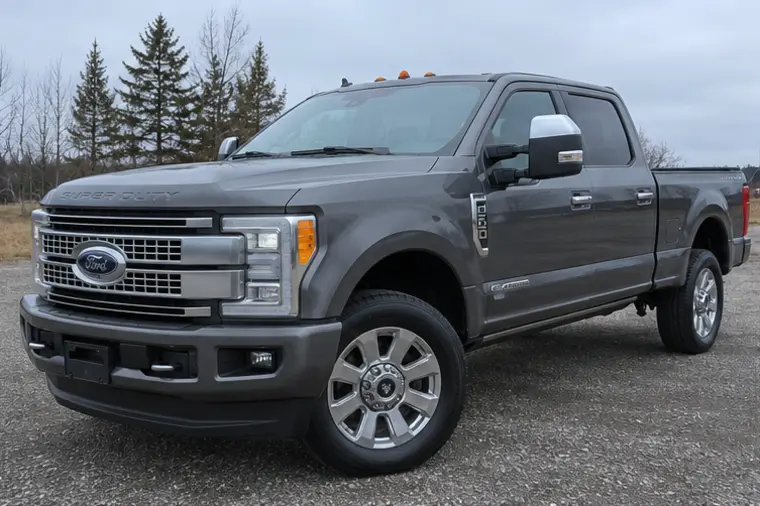
The F-250 is Ford's three-quarter-ton Super Duty pickup, commonly considered for work, RV towing and buyers who want HD construction without automatically moving to a one-ton truck.
MODEL-YEAR INTELLIGENCE
Research Ford F-250 by Model-Year Era
6.7L Power Stroke
Use the selected model year and canonical engine relationship as research context. Confirm the exact transmission, cab, bed, drivetrain, rear-wheel configuration, labels and manufacturer documentation on the truck.
Choose the engine and year range that matches your truck. These ranges organize research; confirm the exact equipment from its labels and records.
Research this model in detail
The model-year change can involve more than the engine
An F-250 comparison should identify both the powertrain era and the surrounding truck. Ford’s original 2005 towing guide, for example, describes revised 4x4 front suspension and steering, an integrated trailer-brake controller and a diesel torque increase. That is a reminder to inspect chassis and equipment differences alongside engine history, not a claim that every option was fitted to every truck.
The engine-era explorer below organizes the used-truck search. Verify the actual engine, transmission, build date and installed equipment for a transition-year or modified candidate. A later model’s output or service requirements must not be copied onto an earlier pickup simply because both are advertised as Power Stroke diesels.
For a dated current reference, Ford’s 2026 guide distinguishes the standard 6.7L at 475 hp and 1,050 lb-ft from the high-output version at 500 hp and 1,200 lb-ft, with a ten-speed automatic. Those are factory application references, not measured output for a used truck. Higher engine output does not independently establish greater payload or a higher rating for every hitch type.
A matched 2026 F-250 example separates package and hitch effects
The following selected U.S. Ford rows all describe a Regular Cab 4x4 F-250 with a 141.6-inch wheelbase, eight-foot box and 3.31 axle. The figures are in pounds. The two higher-GCWR branches require the F-250 High-Capacity Axle Upgrade Package (535). The table preserves conventional, fifth-wheel and gooseneck columns separately.
Notice that the standard and high-output package branches share a 20,000-lb conventional ceiling and a 21,600-lb fifth-wheel ceiling, while their gooseneck cells differ. Buying the high-output engine therefore does not produce an increase in every column. Conversely, the standard-output package branch differs substantially from the lower-GCWR standard row.
These are examples from the exact chart, not the rating of an unidentified Canadian truck. Ford’s footnotes account for a 150-lb driver and passenger and warn that configuration, accessories and additional people affect capability. Obtain the actual occupant/cargo allowance and axle ratings, then include the full installed working load. Do not infer a missing package from an axle ratio alone.
| 2026 engine / branch | GCWR | Conventional | Fifth-wheel | Gooseneck |
|---|---|---|---|---|
| Standard 6.7L; lower-GCWR row | 23,500 lb | 16,200 lb | 15,900 lb | 16,100 lb |
| Standard 6.7L; package 535 | 30,000 lb | 20,000 lb | 21,600 lb | 22,500 lb |
| High-output 6.7L; package 535 | 31,000 lb | 20,000 lb | 21,600 lb | 22,700 lb |
Choose the body around the loaded task and available space
Cab and bed selection should begin with people, equipment and trailer clearance. Confirm that the seats and storage suit the full crew, and that the chosen bed works with the planned connection. A long-bed reference should not be used to clear a short-bed fifth-wheel installation. Obtain the hitch manufacturer’s compatibility guidance for the actual combination.
Inspect a former work truck for the equipment it carries now and for the quality of previous installations. Toolboxes, tanks, plow mounts, bed hardware and other permanent additions belong in the weight and inspection record. An empty-looking bed does not prove that the truck retains its original available payload.
If an F-250 candidate fails a required load check, identify the limiting factor before proposing a fix. The answer may be a different factory configuration or an F-350, not an aftermarket part. Where two trucks both meet every limit, compare their actual condition, cab utility, access needs and operating costs rather than assuming that the higher badge is always better.
Make reliability and year selection application-specific
Treat the separate problems, reliability, best-year and years-to-avoid guides as research inputs, not verdicts on the truck in front of you. A model-year shortlist narrows inspection questions; it does not establish whether a particular engine, cooling system, transmission or chassis is sound. Keep the engine-specific brief together with the vehicle’s repair history.
One example of narrow evidence is Ford’s July 2005 05S34 owner letter, which addresses certain 2004 6.0L F-Series and Excursion vehicles. It describes harness and connector concerns, not every Power Stroke generation. A letter’s date, an affected model year and a current Canadian VIN completion result are three different things.
Ask for the current manufacturer VIN result and the completion records for applicable actions. Then investigate present symptoms independently. A repaired campaign can resolve its specified issue without proving an overall reliability ranking; a truck with fewer published campaigns is not automatically the better used purchase. This guide offers no failure-rate or guaranteed high-mileage claim.
Budget the actual duty, including time away from work
Separate acquisition, immediate corrective work, scheduled servicing and contingency when comparing an older F-250 with a newer candidate. Use written findings and local quotes for identified work. A seller’s repair expenditure is not automatically recoverable value, and an attractive asking price does not disclose what is needed before the truck can perform the assignment.
Fuel-economy expectations should distinguish loaded trips, unloaded distance and idle-heavy work. Where the seller provides records, check the period and use behind them. Do not present a single advertised MPG number as a dependable annual-cost forecast for another owner’s route. The same caution applies to estimates for tires, insurance, financing and resale.
For commercial use, ask which local shop can support the actual engine generation and what a compatible substitute would require during downtime. For recreational use, consider whether repairs could disrupt a fixed travel window. Neither question has a universal dollar answer. A sensible budget makes those assumptions visible instead of treating diesel torque as proof of low operating cost.
Finish with a two-stage purchase file
Before travel, request label photographs, configuration details, service and repair invoices, recall records and an honest description of current concerns. Confirm the claimed equipment against the appropriate model-year documents. If a key rating or drivetrain identity is unresolved, keep it on the question list rather than silently accepting the advertisement.
At inspection, have an independent qualified shop assess cold and warm operation, current and stored faults, leaks, braking, steering, suspension, tires and the trailer connection. Provide the intended use and relevant repair history in advance. A generic engine-only inspection is incomplete for a vehicle being purchased to carry a crew or tow a substantial trailer.
Before towing, verify the final loaded combination and retain the worksheet with the purchase records. Recheck it when changing the trailer, hitch or permanent equipment. Keep the engine, annual specification and commercial-listing paths distinct: this research can support a buying decision, but it does not establish available stock, an offer or the condition of a listed truck.
A configuration example: why two F-250s can have different limits
Ford’s 2024 U.S. pickup guide gives a useful configuration reference. For the standard 6.7L diesel, 3.31 axle, Regular Cab 4x4, 141.6-inch wheelbase and eight-foot box, its 23,500-lb GCWR row lists 16,200 lb maximum loaded conventional trailer weight. Other rows require different equipment and cannot be substituted simply because the model badge matches.
Use this as a guide-reading reference, not the rating for your truck. Check the year, installed equipment, passengers, cargo, payload, rear axle and hitch limits. The original table assumes a properly equipped vehicle and specified occupant allowances. Canadian buyers must confirm the actual truck’s documentation and labels.
| 2024 reference configuration | Guide value |
|---|---|
| Engine and axle | Standard 6.7L diesel; 3.31 |
| Cab / drive / wheelbase / box | Regular Cab / 4x4 / 141.6 in / 8 ft |
| GCWR | 23,500 lb |
| Maximum loaded conventional trailer weight | 16,200 lb |
Decide whether the higher-capacity configuration is worth seeking
If a candidate misses the job, first identify which constraint is binding. A different axle or factory package might change the towing reference; a different truck may be required when payload or axle load is the problem. Do not treat an aftermarket suspension accessory as equivalent to a factory-rated configuration.
Compare the price and condition of an appropriately configured F-250 with an actual F-350. Include the equipment you will add after purchase. This avoids buying a superficially suitable truck and discovering that the working configuration no longer fits the original load worksheet.
Record the powertrain era in the shortlist
Keep the engine, transmission and output version together in your comparison notes. Use the Power Stroke generation guide to select the correct engine inspection brief, then add the F-250-specific body and load checks. A newer engine rating should not be copied onto an earlier used truck.
For a frequently loaded purchase, ask the shop to inspect hitch mounts, bed installation, rear suspension and tire condition alongside the engine. Obtain a written list of immediate work before comparing the candidate’s price with another F-250 advertised as ready to work.
Model evolution & used-buying eras
Modern diesel examples commonly centre on the 6.7L Power Stroke, while older used trucks may use earlier Power Stroke generations with very different research needs.
Cab, bed and work configurations
F-250 configurations vary by model year and can include regular, SuperCab and crew cab bodies with different bed and drivetrain combinations.
Towing and payload
There is no single towing or payload number for every truck wearing this model badge. Ratings vary with model year, cab, bed, drivetrain, axle ratio, wheel configuration and factory equipment.
- Read the door-jamb payload label on the exact truck.
- Use the owner manual and manufacturer towing guide for the model year.
- Account for passengers, cargo, hitch equipment and trailer pin or tongue weight.
Used-buying checks
A diesel pickup should be assessed as a complete working vehicle, not only as an engine choice.
- Ask for dated maintenance and repair records rather than relying on a verbal summary.
- Evaluate a true cold start, warning lights, leaks, transmission behaviour and underbody condition.
- Confirm whether the truck has towed, carried commercial loads or been modified, and inspect accordingly.
- Verify emissions equipment, tires, suspension and the exact payload label on the truck itself.
Decide whether the F-250 covers the complete working day
Shortlist an F-250 for a combination of passenger use, bed cargo and towing only after counting everything carried at once. A truck that handles a lightly loaded trailer may have insufficient remaining allowance once a work crew, toolbox and heavier hitch are added. The diesel option's pulling performance does not answer that cargo question.
| F-250 purchase fork | Useful comparison |
|---|---|
| Daily crew transport | Rear-seat fit plus full-crew weight |
| Conventional trailer | Loaded tongue weight plus tools |
| Fifth-wheel plan | Installed hitch mass, pin load and rear axle weight |
When to cross-shop an F-350
If the intended load consumes the F-250's allowance, compare an actual F-350 configuration before spending on suspension accessories. Bring the same load worksheet to both trucks. If both satisfy every limit, compare condition, useful equipment and ownership cost rather than buying additional capacity you will not use. Inspect any former plow or work-body installation separately from engine condition.
Evidence note: manufacturer documents establish the specific facts and applications cited. Buying workflows and cost scenarios are DieselTrucks.ca editorial guidance. These pages do not publish measured failure rates or confirm the condition, recall status or capacity of a particular truck.
General educational content for Canadian diesel-pickup research. Verify the exact truck, model year, certification labels, owner manual and manufacturer documentation, and obtain qualified mechanical or towing advice where appropriate.
Sources & Further Verification
Use the exact model year, VIN, truck labels and current manufacturer documentation when moving from general research to a purchase or towing decision.