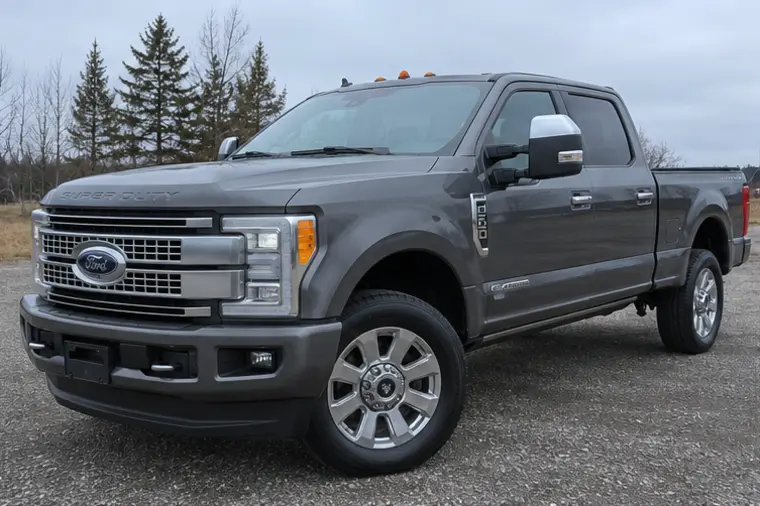
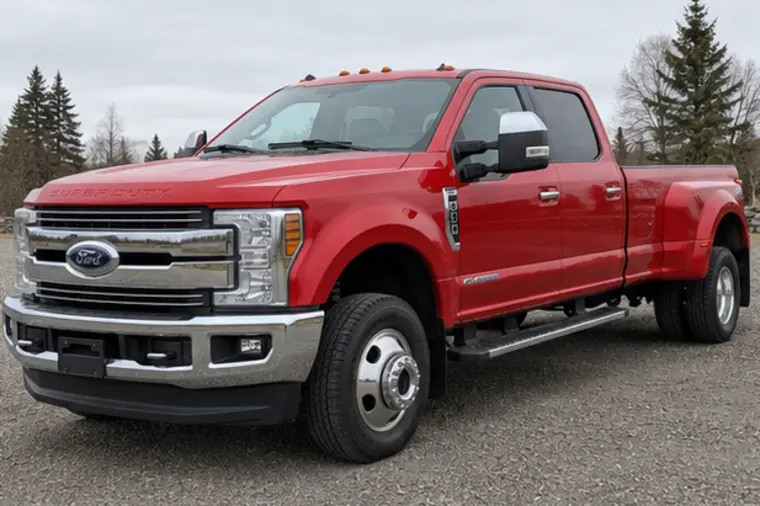
The 2022 Ford F-250 combines familiar engine choices with a meaningful cabin-technology change and year-specific towing details. That mix deserves a separate inspection plan: a larger screen does not establish better mechanical reliability, and unchanged headline towing limits do not make every 2021 table row interchangeable. Ford's recovered 2022 brochure and exact-year towing guide provide the equipment baseline. Later Ford recall documents supply a bounded fuel-system question, not a score for every truck. Use this guide to decide what evidence to request before purchase, then assess the actual candidate.
Reliability verdict: a later truck still needs an explainable history
A defensible 2022 purchase has consistent build identification, a documented service history, resolved safety questions and a satisfactory independent inspection. None of the manufacturer documents reviewed here measures failure rates across comparable 2021 and 2022 owners. Calling 2022 more reliable solely because it is newer would exceed the evidence. A familiar engine is not a guarantee of condition, and a newly available feature is not proof of a defect.
Separate three decisions: whether the equipment suits your use, whether this truck is mechanically sound, and whether its history is sufficiently explained. A candidate can pass one and fail another. For example, an apparently clean truck can still lack the required towing package; a correctly equipped truck can still have undocumented repairs. Do not let a favourable answer on one axis conceal an unresolved safety or identity question.
What changed for 2022: three different SYNC configurations
Ford's 2022 brochure identifies SYNC 4 as newly available on Super Duty. The trim matrix below prevents a used-truck advertisement from promising the same screen and phone features on every F-250. SYNC 3 remains a separate system; the new twelve-inch display is not simply a larger version fitted throughout the range.
At a viewing, test the actual screen, audio, phone connection, available cameras, steering-wheel controls and physical switches. Use a compatible phone and distinguish a pairing problem from a missing feature or expired connected service. Do not assume a subscription described in a new-vehicle brochure remains active after resale. Record intermittent faults and request a diagnosis rather than classifying every connectivity issue as a 2022 reliability defect.
| 2022 brochure branch | Screen | Trim/application boundary |
|---|---|---|
| SYNC | 4.2-inch LCD | Standard on XL |
| SYNC 3 | 8-inch touchscreen | Standard XLT; optional XL |
| SYNC 4 | 12-inch touchscreen | Standard Lariat, King Ranch, Platinum and Limited |
Exact powertrain identity remains essential
The 2022 brochure lists the F-250's 6.2L gasoline engine with a TorqShift-G six-speed automatic. The 7.3L gas and 6.7L Power Stroke diesel use TorqShift ten-speed automatics. The listed outputs remain 385 hp/430 lb-ft, 430 hp/475 lb-ft and 475 hp/1,050 lb-ft respectively. These pairings are not interchangeable with every F-350 or chassis-cab application.
Check the factory build data and installed component identification against maintenance invoices. An invoice described only as a transmission service is incomplete evidence if the fluid, procedure and actual transmission are unclear. Observe engagement and shifting at cold and normal operating temperatures, record the conditions of any hesitation or harshness, and have a qualified technician diagnose it. A test-drive symptom cannot establish a particular internal failure or a model-wide pattern.
24S78: some 2022 diesel trucks are inside an earlier build window
Ford's 20 December 2024 filing for 24S78 / U.S. 24V-957 includes a defined 2020–2022 6.7L Super Duty population built through 23 August 2021. Thus a 2022 model-year badge does not by itself put a truck outside the reviewed campaign. The filing describes aged biodiesel deposits, possible high-pressure pump wear and loss of motive power, with a PCM reflash intended to improve cooling.
Record production date, current Ford VIN result and any campaign completion documentation. Separately ask for fuel-system repair invoices and their diagnostic findings. A software completion entry is not a claim that the pump or injectors were replaced. Extended cranking, unusual noise, warning lights or reduced power need professional assessment regardless of campaign status. The U.S. document does not establish a Canadian VIN's inclusion, available remedy or completed repair.
Do not carry the 2020–2021 steering campaign into 2022 by assumption
The reviewed Ford 25S94 / U.S. 25V626 filing names certain 2020–2021 F-250 through F-450 vehicles; it does not name 2022 in that population. Do not label a 2022 candidate affected by that filing merely because it shares the broader platform. Equally, its absence from this one filing cannot certify that a truck has no other open campaigns.
Obtain a current Ford Canada VIN check covering the vehicle, not just the campaign numbers mentioned in an article. Then inspect steering, suspension, tires and modifications on their own merits. A damaged or altered component needs attention even when no recall applies. This is a selected primary-evidence review, not an exhaustive list of every recall or service bulletin issued for all 2022 configurations.
The 2022 towing rows contain real differences below the headlines
The reviewed Ford-hosted 2022 guide adds an explicit 3.55-axle, 23,500-lb-GCWR diesel branch tied to the electronic-locking axle without package 535 or Tremor. The high-capacity diesel Tremor alternative is 17,800 lb, versus 18,100 lb in the separately reviewed 2021 guide. Its 7.3L/4.30/24,900-lb-GCWR Tremor row prints 17,200 lb in the Crew Cab 4x4 short-box column—not the long box.
A previous edition of our 2022 towing guide misassigned that gas Tremor cell; it has been corrected against Ford's page 27. Retain the 159.8-inch wheelbase and 6.75-foot box with the value. A year-specific change in a rating is not evidence that either truck fails more often.
The guide retains a selected-configuration 20,000-lb conventional maximum and a 22,800-lb Regular Cab 4x2 diesel gooseneck maximum. Marked fifth-wheel applications retain the separate 19,000-lb hitch limit. Check the actual payload label, GVWR, axle ratings, tires and hitch as well as the exact table row; none of the headlines certifies an unseen Canadian VIN.
| Evidence to recover | Why it matters before purchase | Shortcut to reject |
|---|---|---|
| Factory package and axle record | Selects the correct GCWR and towing branch | Diesel badge means maximum capacity |
| Cab, drive, wheelbase and box | Keeps the rating attached to the intended body | Move a short-box Tremor value to a long box |
| Payload and axle labels | Checks the loads carried by this truck | Gooseneck headline proves fifth-wheel suitability |
Use prior duty to plan the inspection, not invent a lifespan
Ask how the truck was used: trailer type and loaded weights, regular journeys, idle-heavy work, storage periods and modifications. Compare those statements with dated invoices, kilometres and recorded engine hours. They help a technician choose follow-up checks, but do not create a universal conversion from hours to distance or a remaining-life calculation.
For diesel candidates, request a true cold start and a scan before codes are cleared, then observe hot operation and restart. Review cooling, leaks, exhaust-brake function, aftertreatment warnings and repair history. Inspect receiver and bed mounts, frame, suspension, brakes, tires and trailer wiring. Have body repairs and corrosion assessed independently of drivetrain condition. These are inspection recommendations, not a claimed list of frequent 2022 failures.
A practical document pack before making the decision
Collect VIN and production-label photos, factory equipment details, load labels, service invoices, repair orders, current campaign results and the independent inspection report. Keep original diagnosis and repair outcome together when major work was done. A statement that an expensive component was replaced does not explain why it failed or whether a related issue remained.
Use the exact owner literature and actual duty when assessing whether servicing is current. The sales brochure verifies equipment but is not a maintenance schedule; this review prescribes no service intervals from it. Ford's owner-literature lookup is the appropriate next source for that work. Ask for a clear list of verified needs and unresolved questions before valuing the candidate.
Walk away from a transaction if identity or safety concerns cannot be resolved or inspection is refused. This page does not verify active inventory, a seller, a dealer count, a price, financing or an offer. The linked catalogue and research pages do not replace vehicle-level due diligence.
Questions buyers ask about the 2022 F-250
Is 2022 the best year? The sources here do not supply exposure-adjusted reliability data to support that ranking. Judge the documented candidate, not a year label.
Does every 2022 F-250 have SYNC 4? No. Ford's brochure retains three distinct SYNC branches with different trim assignments. Verify the installed system and functions.
Does a 2022 diesel avoid the fuel-pump campaign? Not necessarily. The reviewed filing includes a defined 2022 population manufactured within its stated window; check the actual VIN.
Can I use the 2021 towing chart because the maximum is the same? No. The 2022 guide contains changed rows and conditions below the headline. Use its exact configuration and the truck's own labels.
Evidence note: manufacturer documents establish the specific facts and applications cited. Buying workflows and cost scenarios are DieselTrucks.ca editorial guidance. These pages do not publish measured failure rates or confirm the condition, recall status or capacity of a particular truck.
General educational content for Canadian diesel-pickup research. Verify the exact truck, model year, certification labels, owner manual and manufacturer documentation, and obtain qualified mechanical or towing advice where appropriate.
Sources & Further Verification
Use the exact model year, VIN, truck labels and current manufacturer documentation when moving from general research to a purchase or towing decision.
- Ford — 2022 Super Duty brochure (manufacturer document, external archive)
- Ford Pro — exact 2022 RV & Trailer Towing Guide
- Ford — 24S78 / U.S. 24V-957 filing
- Ford — 25S94 / U.S. 25V626 filing (2020–2021 scope, not assigned to 2022)
- Ford Canada — recall information and VIN lookup
- Ford Canada — owner-literature lookup
- Ford owner manuals