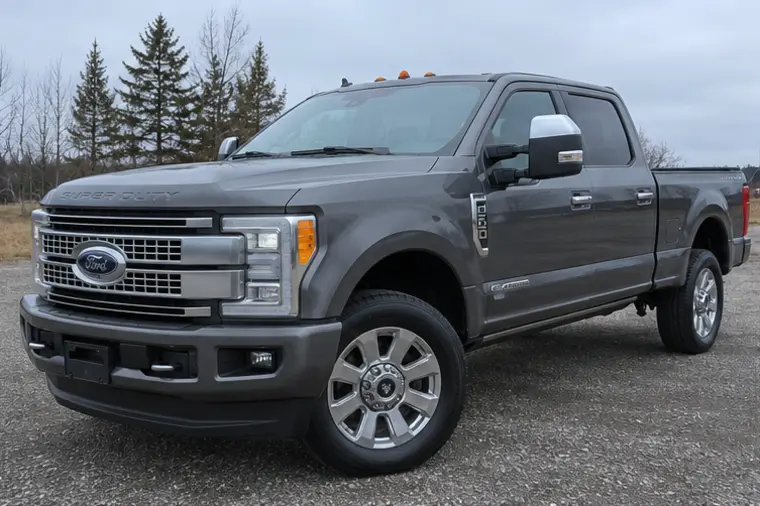
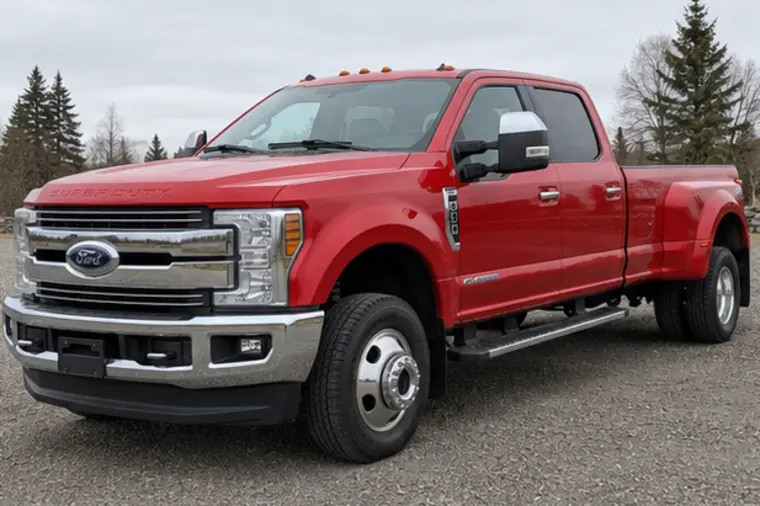
The useful distinction is not simply three-quarter-ton versus one-ton; exact payload, SRW or DRW, suspension and intended trailer all shape the choice.
| Decision factor | Ford F-250 | Ford F-350 |
|---|---|---|
| Typical role | Three-quarter-ton HD work and recreation | One-ton work, payload and heavier-trailer configurations |
| Rear wheels | Generally SRW pickup configurations | SRW and DRW choices depending on year and configuration |
| Daily use | May avoid capacity not required for the job | Added capability may bring size, ride or operating tradeoffs |
| Choose when… | Its actual payload covers people, cargo and hitch weight | The load analysis needs one-ton payload or DRW options |
2026 matched evidence: the F-350 advantage is configuration-specific
Ford's revised 2026 Super Duty towing guide lets a buyer hold the engine, cab, drive system, wheelbase, box and axle ratio constant. In the standard-output 6.7L diesel tables, a regular-cab 4x4 with the 141.6-inch wheelbase, 8-foot box and 3.31 axle is listed at 16,200 lb conventional towing as an F-250 and 20,000 lb as an F-350 SRW. That matched example shows a real class difference without turning either number into a badge-wide rating.
The same guide also shows why a headline maximum is a poor shopping filter. Ford publishes separate F-250, F-350 SRW and F-350 DRW tables, then changes results again by standard-output or high-output diesel, axle ratio, cab, wheelbase, box, tires and required packages. A buyer should reproduce the row for each candidate instead of transferring the matched example to a crew-cab short-box truck or an older generation.
Conventional, fifth-wheel and gooseneck decisions are separate
Do not use a conventional-towing row to approve an in-bed trailer. Ford's 2026 guide gives fifth-wheel and gooseneck values their own paired columns. It also lists nominal receiver capacities of 22,000 lb for the F-250, 25,000 lb for the F-350 SRW and 28,000 lb for the F-350 DRW, while warning that a receiver rating can exceed the maximum loaded-trailer rating of the actual truck. The lower applicable limit still governs.
Pin or tongue weight must fit inside the truck at the same time as occupants, tools, auxiliary tanks, bed caps and hitch hardware. Ford's notes use 10 percent conventional tongue weight and 15 percent fifth-wheel or gooseneck king-pin weight as planning assumptions, then require the combined load to remain within rear GAWR and GVWR. Use measured loaded-trailer weights whenever available; the percentages are not a substitute for weighing.
Payload and carried load usually settle the class question first
Start with the yellow payload label and the Safety Compliance Certification Label on the truck. Subtract people, personal cargo, work equipment, aftermarket accessories and installed hitch weight before adding the trailer's loaded connection weight. Repeat the arithmetic for both candidates. If the F-250 fails that simultaneous-load test, a published trailer rating cannot restore the missing truck-side allowance.
Ford's camper section illustrates that class equipment is not interchangeable. Its 2026 Camper Package adds selected springs, an SRW rear stabilizer bar and slide-in-camper certification; rear auxiliary springs are identified as an F-250 package item and standard on the F-350. That does not make every F-350 suitable for every camper. Ford still directs buyers to the specific truck's camper-loading document and configuration table.
Daily use: compare the two trucks you will actually drive
When both trucks pass the load calculation, daily fit becomes a legitimate tie-breaker. Compare the same cab and box, not a short-box F-250 against a long-box F-350 dually. Measure garage and jobsite clearance, confirm bed access with the intended hitch, drive the roads used most often and assess ride with the truck empty as well as carrying a representative load.
An F-350 SRW can keep a single-rear-wheel footprint while opening a different rating set; a DRW candidate adds rear width, two additional road tires and inner-tire inspection. Those costs may be worthwhile for the right carried load, but they are not free capability. If the F-250 passes with useful reserve and is easier to park, service and use unloaded, choosing it is not a compromise in itself.
Reliability and maintenance follow the year and powertrain, not the door badge
For same-year F-250 and F-350 pickups with the same engine and transmission, many powertrain service questions overlap. That does not create a statistical reliability tie, and this comparison does not assign one. Campaign eligibility, calibration, axle, transfer case, steering, brake and chassis hardware can still differ by build, package and application. Check the VIN and the exact service literature rather than relying on a model-class reputation.
For a used candidate, compare cold-start behaviour, fluid leaks, warning history, emissions-system status, transmission operation, front-end wear, tires, brakes, hitch installation and evidence of previous commercial or heavy-trailer use. Price deferred work before valuing the larger badge. A well-documented F-250 that passes the job calculation can be a better purchase than an F-350 whose condition or configuration is unknown.
Normalize used-truck comparisons by model year
Do not compare an older F-350 to a newer F-250 using the 2026 tables. Super Duty engines, output, transmissions, frames, packages, emissions equipment and towing charts changed across generations. Record the model year, cab, wheelbase, box, drive system, engine, axle code, GVWR and wheel configuration for each used truck, then open that year's Ford guide and owner literature.
Modifications need separate treatment. Added springs, air bags or different wheels may affect how a truck sits or handles, but they do not rewrite the certification label, axle ratings or Ford's original configuration row. Ask for part records and installation evidence, inspect for interference or overloaded tires and calculate the truck from its documented limits.
Which Super Duty class fits which buyer?
Choose the smallest verified configuration that carries the full recurring load with the reserve appropriate to the work. Move up because the calculation, wheel configuration or body requirement supports it—not because an unqualified maximum is larger. The table below is a screening guide; the candidate truck's labels and matching Ford row remain the decision evidence.
| Buyer or job | Start with | Move the comparison when… |
|---|---|---|
| Moderate conventional trailer and frequent unloaded driving | F-250 in the required cab/box | People, cargo and tongue weight leave inadequate reserve |
| Fifth-wheel or gooseneck RV | Both exact F-250 and F-350 SRW rows | Loaded pin weight or an applicable rating eliminates the F-250 |
| Heavy bed load or slide-in camper | Payload labels and camper documents | The F-350 configuration provides the required certified allowance |
| Load points toward dual rear wheels | F-350 DRW | Confirm rear width, six-tire upkeep and the exact DRW row |
Questions buyers ask before choosing
Does the F-350 always tow more? No. Ford's tables overlap, and results change by configuration and hitch type. The F-350 family offers higher-capacity configurations, but the actual rows must be compared.
Can air bags make an F-250 equivalent to an F-350? No. They may change loaded stance, but they do not change the truck's certified GVWR, GAWR, tire limits or towing-guide identity.
Is the F-350 automatically the safer purchase? No badge proves condition, repair quality or load fit. Safety depends on selecting a compliant configuration, maintaining it, using suitable hitch equipment and operating within every applicable limit.
A matched configuration shows why the badge matters
Ford's 2024 towing guide lists a standard-output 6.7L F-250 SRW regular-cab 4x4 with an 8-foot bed and 3.31 axle at 16,200 lb conventional towing in the cited row. A comparably described F-350 SRW row lists 20,000 lb. These are specific guide entries with conditions, not universal model capacities.
The useful lesson is that sharing an engine does not make the two trucks' rated combinations identical. Other packages and cab, axle or hitch choices need their own rows. Use the correct year and market documents and the actual truck labels rather than applying this difference to every used F-250 and F-350.
Decide between F-350 SRW and DRW explicitly
An F-350 comparison is incomplete until the rear-wheel configuration is specified. Compare SRW where it meets the carried-load requirement and DRW where the actual load leads you toward suitable higher-capacity configurations. Include width, parking and the maintenance of six road tires in the DRW ownership plan.
If the F-250's label covers occupants, cargo, hitch and loaded trailer transfer with the margin you need, it can remain an appropriate purchase. If it does not, a higher-output engine or suspension accessory is not the answer. Move the comparison to a configuration that passes the actual limits.
For used trucks, compare condition and history with equal care. The F-350 badge does not prove it has had an easier life or that its hitch, tires and steering are sound. A qualified inspection and the correct documents remain necessary on both sides.
How to choose
An F-250 may fit moderate HD use, while an F-350 can add payload and configuration options. Verify actual labels and do not assume every F-350 is automatically the better tow vehicle.
- Define the real trailer and loaded pin or tongue weight.
- Estimate passengers, tools and cargo carried in the truck.
- Compare exact payload labels and manufacturer documentation.
- Inspect used condition, maintenance history and modifications.
Make the capacity difference concrete
Compare actual label photographs using the same people, cargo and hitch assumptions. If the F-250 leaves insufficient room for the trailer's loaded connection weight, an F-350 configuration belongs on the shortlist. If both pass, the decision shifts toward condition, equipment and daily use.
An F-350 badge does not prove every rating exceeds every F-250 configuration. Check the exact towing-guide entries and axle limits, then compare the cost of initial work. Suspension accessories on the smaller candidate should not be counted as a replacement for documented capacity.
| Purchase situation | Decision path |
|---|---|
| Crew, tools and moderate trailer | Calculate the simultaneous load on each truck |
| Heavier fifth-wheel | Compare remaining pin allowance and rear axle results |
| DRW requirement | Investigate the appropriate F-350 configuration |
Evidence note: manufacturer documents establish the specific facts and applications cited. Buying workflows and cost scenarios are DieselTrucks.ca editorial guidance. These pages do not publish measured failure rates or confirm the condition, recall status or capacity of a particular truck.
General educational content for Canadian diesel-pickup research. Verify the exact truck, model year, certification labels, owner manual and manufacturer documentation, and obtain qualified mechanical or towing advice where appropriate.
Sources & Further Verification
Use the exact model year, VIN, truck labels and current manufacturer documentation when moving from general research to a purchase or towing decision.