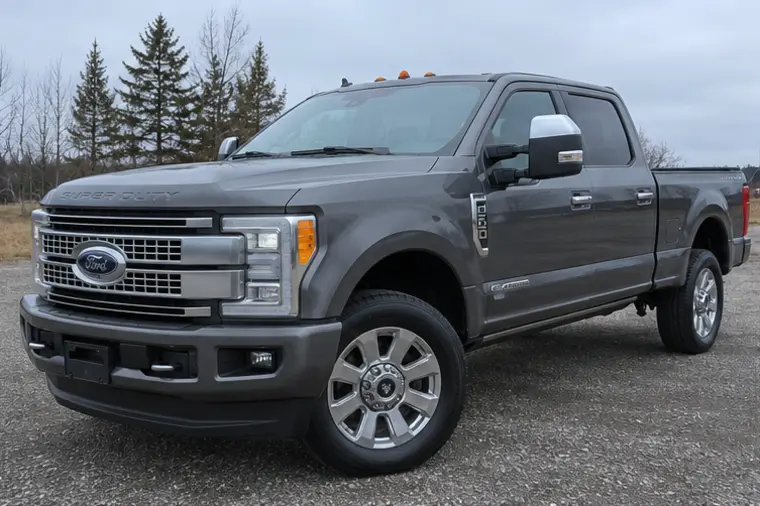
For a used F-250 diesel buyer who specifically wants a six-speed automatic, start by comparing a well-documented 2019 truck. That is our equipment-based shopping benchmark, not a claim that 2019 has the lowest failure rate. Choose a different year when its configuration, condition or ownership evidence better fits the job.
The verdict: choose the equipment era, then the individual truck
Our starting recommendation is deliberately narrow. A buyer seeking a diesel F-250 with a six-speed transmission can use 2019 as a reference vehicle, then compare actual candidates against it. Ford's 2019 brochure identifies the 6.7L diesel and TorqShift six-speed combination. It also describes an aluminum body and cargo box over a steel frame. These are identifiable equipment characteristics, not proof of trouble-free ownership.
The benchmark helps you ask a useful question: what does a different truck add, remove or leave uncertain? A newer date on the registration is not enough. Nor is a seller's assurance that an older truck comes from the good years. Ask for the engine, transmission, build information and repair file before arranging a long trip to view it.
There is no defensible universal best year in the evidence reviewed here. We do not have comparable Canadian repair-frequency data adjusted for kilometres, work hours, maintenance, modifications and application. Our recommendation is an editorial shopping method. It can change when the candidate evidence changes; it is not a statistical reliability award.
A shortlist by buying objective
The table is not a best-to-worst ranking. It separates shopping objectives that are often mixed together. If you do not actually prefer a six-speed, the reason for starting with 2019 weakens. If your work requires equipment a particular truck lacks, its reputation should not keep it on the shortlist.
Avoid filtering advertisements so tightly by one year that you lose better-supported neighbouring candidates. Compare a small number with similar cabs, drivetrains and intended work. An evidence-rich vehicle outside your initial year range deserves consideration; a preferred-year truck with unresolved faults does not deserve an automatic exception.
| Buyer objective | Starting point | What would change the choice |
|---|---|---|
| Prefer a documented six-speed diesel configuration | Use a 2019 F-250 6.7L as the comparison benchmark | Unresolved steering symptoms, weak service history or unsuitable load limits |
| Specifically want the newer diesel and ten-speed combination | Compare a correctly identified 2020 diesel with later candidates | Campaign status, actual transmission behaviour and ownership evidence |
| Already considering a 2015–2016 truck | Judge that candidate's records and inspection before extending the search | A turbo-related sales claim without the installed-part history |
| Considering an older 6.0L or 6.4L truck | Arrange an engine-specific assessment before treating the price as value | Missing diagnosis, undocumented modifications or inadequate repair contingency |
What changed around the 2020 diesel boundary?
Ford's 2020 Packaging Guide identifies a third-generation 6.7L diesel paired with the new ten-speed automatic. The 6.2L gasoline F-250 retained a six-speed, so a generic advertisement for a 2020 Super Duty transmission is not sufficient identification. The guide is an original Ford publication available through a dealer-hosted archive.
For the buyer, this is a genuine reason to compare 2019 and 2020 separately. It is not evidence that more gears are inherently less reliable, that a first-year combination should always be avoided, or that increased output automatically improves the ownership decision. Request the correct maintenance and diagnostic information for the actual powertrain.
During a professional inspection, ask that cold and warm operation be assessed and any reported shifting concern documented. Do not ask the seller to clear codes or reset adaptations to make a demonstration feel better. A changed driving impression after such an intervention is not the same as a diagnosed and verified repair.
How to treat the 2015–2016 alternative
Ford's replacement turbo-kit description distinguishes its 2015–2016 application from pre-2015 hardware in performance capability. That supports a limited component distinction; it does not demonstrate that those model years fail less often. Ford also limits the kit's validated application. This is not a recommendation to retrofit a different truck.
If a seller uses the turbo change as the main reason to buy, ask whether the truck retains its original specification, has received a replacement, or has other changes. An invoice should identify the part and why it was fitted. A part number without the original diagnosis leaves a different uncertainty from a documented repair with satisfactory follow-up.
For an older candidate, inspect the entire vehicle alongside the engine. Cab condition, structural repairs, accessory wiring, tires, brakes and the intended trailer connection still matter. Do not let a favourable engine-era story consume the whole inspection budget while the systems needed for the next job remain unchecked.
Year-specific checks that can overrule the shortlist
Ford TSB 19-2274 addresses a defined steering-oscillation concern on 2017–2019 F-250/F-350 4WD trucks. Ford's 19S48 announcement concerns certain 2017–2019 electrically released tailgates, including vehicles in Canada; mechanical releases are excluded. Neither document says every 2019 F-250 has the concern. Check the equipment and repair evidence rather than assuming applicability from the year alone.
The U.S. 24S78 filing identifies a defined 2020–2022 6.7L population for a fuel-pump-related loss-of-power risk and a software remedy. The 25S94 filing identifies certain 2020–2021 trucks for an upper steering-shaft concern. These are campaign screening leads, not Canadian VIN determinations or a reason to blacklist every truck in those years.
Ask a Ford dealer to establish current applicability and completion for the specific Canadian vehicle. Separate a completed campaign from the condition inspection: paperwork for programming does not certify the present health of every fuel-system component. Steering instability or a loss-of-power complaint warrants professional assessment, not an attempt to reproduce a dangerous event on a test drive.
Best and worst choices for your actual use
For regular loaded work, define the assignment before comparing years: occupants, carried tools, installed accessories, trailer type and expected travel. Obtain the candidate's labels and applicable towing information. A truck that cannot accommodate the assignment within its limits is the wrong purchase even if its service history is excellent. Compare the F-350 where the load requires it rather than assuming a later F-250 solves the problem.
For personal use with occasional towing, decide which conveniences you will genuinely use. A camera, hitch arrangement or cab layout can affect day-to-day suitability, but verify the installed equipment. Do not pay for an advertised package without confirming that the features you need are present and operational on that particular truck.
For seasonal or remote use, ask where the vehicle will be serviced and what happens if it cannot return from a job. The best purchase may be the candidate with a clearer repair history and a practical support arrangement. A lower advertised price is not a complete ownership budget when the unresolved work and substitute-vehicle options are unknown.
Turn the shortlist into a pre-purchase decision
Start with documents: VIN, build and equipment information, service invoices, campaign records and modification history. Ask the seller to identify the last significant fault and how it was resolved. Read invoices in sequence. Repeated visits for the same symptom deserve an explanation even when many new parts appear in the file.
Next, commission an independent inspection with permission to retain the findings. Ask for a cold start where practical, electronic diagnosis appropriate to the vehicle, a physical assessment and a safe operational check. Record what could not be tested. An inspection has a scope and a date; it is not a guarantee that an intermittent fault will appear during the appointment.
Finally, obtain a written repair plan. Distinguish immediate work from routine catch-up maintenance and optional improvements. Ask whether further diagnosis could expand the estimate. Compare candidates using purchase cost plus known required work, while keeping unresolved exposure separate instead of disguising it as an exact prediction.
When to choose another year or walk away
A 2019 candidate loses its preferred status when you cannot establish the condition, configuration or repair history needed for your decision. A 2020 candidate can be the better purchase when its equipment is useful, inspection is satisfactory and campaign status is clear. Neither conclusion establishes a population-wide reliability result.
Our strongest rejection criteria concern the transaction and vehicle, not a date range: refusal of an independent inspection, unresolved safety symptoms, inconsistent identity information, or major work whose scope cannot be explained. A buyer with specialist support may accept a diagnosed project that a daily work-truck buyer should decline. State that distinction before negotiating, not after the truck is needed for work.
F-250 best-year questions
Is 2019 proven to be the most reliable F-250 diesel? No. It is a clear equipment-based comparison point for a buyer who wants the documented six-speed diesel combination. The sources reviewed do not establish a Canadian year-by-year failure ranking.
Should every first year of a changed powertrain be excluded? No. A design boundary tells you to verify the correct equipment, service requirements and evidence. It does not supply a failure probability. Inspect the candidate and assess any applicable campaigns.
Can an older truck be the better buy? Yes, if its condition, configuration, support and total known commitment fit your requirements better. That is a candidate-level decision. Do not convert it into a claim that every truck from the same year is superior.
Evidence note: manufacturer documents establish the specific facts and applications cited. Buying workflows and cost scenarios are DieselTrucks.ca editorial guidance. These pages do not publish measured failure rates or confirm the condition, recall status or capacity of a particular truck.
General educational content for Canadian diesel-pickup research. Verify the exact truck, model year, certification labels, owner manual and manufacturer documentation, and obtain qualified mechanical or towing advice where appropriate.
Sources & Further Verification
Use the exact model year, VIN, truck labels and current manufacturer documentation when moving from general research to a purchase or towing decision.
- Ford 2019 Super Duty brochure — original Ford publication, archived by Zigwheels
- Ford 2020 Super Duty Packaging Guide — original Ford publication, dealer-hosted copy
- Ford 2015–2016 6.7L diesel turbo replacement kit — limited design comparison, not reliability data
- Ford TSB 19-2274 — 2017–2019 F-250/F-350 4WD steering oscillation
- Ford 19S48 announcement — specified 2017–2019 electric tailgate latches, including Canada
- Ford 24S78 / U.S. 24V-957 filing — defined 2020–2022 Super Duty population
- Ford 25S94 / U.S. 25V626 filing — defined 2020–2021 steering shaft population
- Ford owner manuals