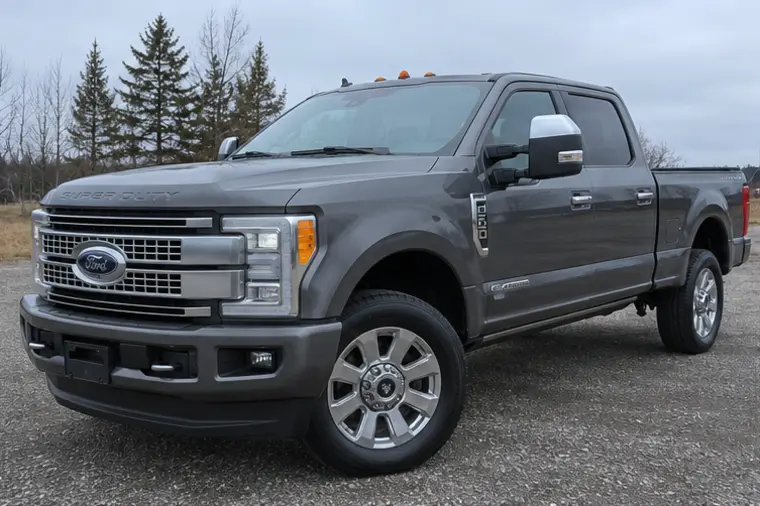
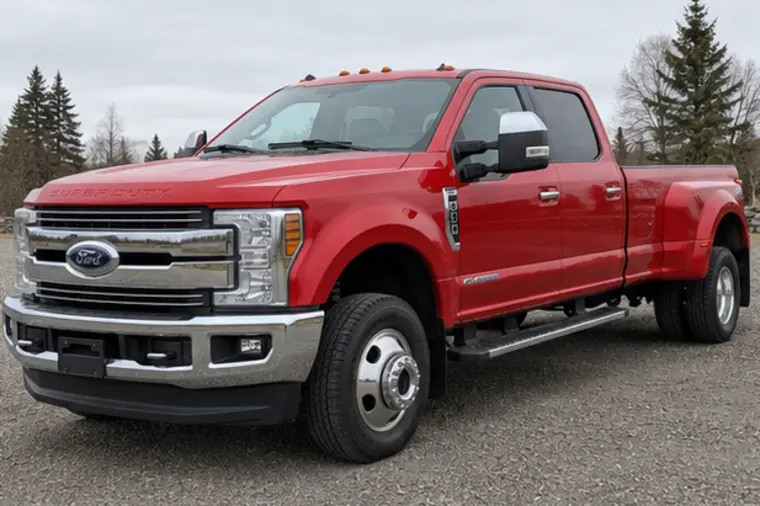
A 2021 Ford F-250 needs a build-specific assessment, not a verdict borrowed from the whole Super Duty family. Ford's exact-year brochure distinguishes three engine choices and two transmission families. Later manufacturer recall filings add two different production windows that can matter to a 2021 candidate. Neither a model-year badge nor a warning-free test drive resolves those questions. This guide uses the recovered 2021 brochure, the exact-year towing guide and Ford-authored U.S. campaign documents to organize the buying decision; it does not produce a reliability score, failure rate or Canadian VIN determination.
Verdict: verify the individual 2021 truck before choosing the year
The useful distinction is between a documented truck and an unresolved one. A candidate merits further consideration when its identity, service invoices, repair history, current campaign check and independent inspection agree. A newer registration date, lower odometer reading or attractive trim cannot replace those records. The reviewed evidence does not support ranking 2021 above 2020, calling it the best year, or promising a particular lifespan.
Treat conflicting information as a specific investigation: an invoice for a different transmission, unexplained fuel-system replacement, an altered steering assembly or missing certification label each needs its own answer. Ask the inspecting technician to distinguish an observed defect from a maintenance recommendation and from an unanswered history question. Do not convert every inspection item below into a known 2021 design defect.
What carries over—and which transmission actually belongs in an F-250
The 2021 brochure continues the 2020-era three-engine pickup lineup. Its diesel output remains 475 hp and 1,050 lb-ft; those numbers are not a new 2021 increase. The exact 2021 pairings below matter more than a generic claim that all updated Super Duty trucks have ten-speeds. In particular, the brochure assigns the 6.2L F-350 a ten-speed but the 6.2L F-250 a six-speed. Do not transfer the adjacent model's equipment.
Match the candidate's engine and transmission identification with its factory build record before selecting service literature or interpreting a repair invoice. Swapped components and inaccurate advertisements are possible explanations for a mismatch; neither should be silently accepted as factory equipment. Factory output ratings describe the original application, not measured wheel output or remaining mechanical life.
| 2021 F-250 engine | Factory output | Brochure transmission |
|---|---|---|
| 6.2L gasoline V8 | 385 hp / 430 lb-ft | TorqShift-G six-speed |
| 7.3L gasoline V8 | 430 hp / 475 lb-ft | TorqShift ten-speed |
| 6.7L Power Stroke diesel V8 | 475 hp / 1,050 lb-ft | TorqShift ten-speed |
Two recall windows: model year is not production date
Ford's 24S78 / U.S. 24V-957 filing, submitted 20 December 2024, identifies affected 6.7L Super Duty vehicles built from 19 February 2019 through 23 August 2021. Separately, the 25S94 / U.S. 25V626 filing, submitted 22 September 2025, identifies certain 2020–2021 F-250 through F-450 vehicles built from 19 February 2019 through 30 September 2020. These are different populations.
For a 2021-labelled truck, record the actual production date and ask Ford to resolve both campaigns against the VIN. The date window is a screening aid, not proof of inclusion or exclusion for a Canadian vehicle. A completed action also does not establish that unrelated mechanical faults are absent. Retain the dated VIN result and matching repair order.
| Ford campaign | Scope to check | Separate candidate question |
|---|---|---|
| 24S78 | Defined diesel population; later production cutoff | Was any fuel-system repair diagnosed and documented? |
| 25S94 | Defined steering-shaft population; earlier production cutoff | What inspection or repair does the VIN record show? |
| Canadian applicability | Current Ford Canada VIN lookup | Do the campaign and completion records match this truck? |
Fuel-pump evidence: software action and repair history are different
The 24S78 filing describes deposits from aged biodiesel that can increase high-pressure pump wear, generate metal debris and cause loss of motive power. It lists possible extended cranking, engine warnings, noise and reduced power. Its stated remedy is a PCM software reflash intended to improve pump cooling; it is not a statement that every included truck receives a new pump.
Ask whether the truck only received the campaign update or also required a mechanical repair. If a repair occurred, request the original complaint, diagnostic findings, itemized parts and follow-up invoice. A vague assurance that the fuel system was fixed leaves those questions open. Symptoms need professional diagnosis and cannot identify this campaign by themselves. This U.S. filing does not establish current Canadian remedy availability or the condition of an unseen truck.
Steering-shaft evidence does not equal an oscillation diagnosis
The 25S94 filing concerns possible separation of the upper steering-column shaft and consequent loss of steering. Ford identifies no instrument-cluster message or other advance warning in that filing. Therefore, a quiet dashboard cannot clear the issue. Its described remedy includes inspection and either modification or replacement according to the result; obtain the actual campaign work record.
Do not relabel a shaft-retention concern as the older 2017–2019 steering-oscillation bulletin. A 2021 truck with wandering, play, vibration or unusual steering feel still needs a complete assessment of tires, alignment, joints, mounts and any modifications. If safe control is in doubt, stop the test and arrange professional assessment rather than trying to reproduce a failure on a public road.
Towing and payload: carryover maxima are not a service history
Ford's independently reconciled 2021 towing guide gives F-250 conventional positions from 12,300 to 20,000 lb and in-bed positions from 12,200 to 22,800 lb. The upper endpoints match the reviewed 2020 guide; that comparison does not establish identical ratings for every configuration. The 22,800-lb maximum is a qualifying Regular Cab 4x2 diesel gooseneck position, not a fifth-wheel rating. Marked fifth-wheel applications remain limited by the 19,000-lb hitch rating.
Use the exact cab, box, drive, axle, engine, tire and package row, including High-Capacity Trailer Tow Package 535 where specified. Then check the actual payload label, GVWR, both axle ratings, tires, wheels and hitch. No published maximum reveals how the previous operator loaded the truck.
Inspect bed attachment points, receiver, frame rails, rear suspension, trailer wiring and brakes for evidence that warrants further investigation. Ask for the former trailer's loaded weights and use pattern if available, but label undocumented recollections as such. A clean hitch is not proof of light duty, and hitch wear alone cannot establish overloading.
Inspect the installed equipment, not another F-Series brochure page
Ford's 2021 Super Duty equipment chart lists SYNC 3 with an eight-inch centre screen on specified trims; the separate 2021 F-150 material must not be used to promise that truck's SYNC 4 features here. Verify the fitted screen, cameras, trailer controls and switches in person. Trim names alone do not establish which optional equipment a used example contains.
During an independent inspection, cover cold starting, diagnostic codes before clearing, hot restart, cooling, fluid leaks, shift engagement and changes under normal use. On the diesel, include exhaust-brake operation and aftertreatment warnings or modification history. Inspect body repairs separately from the frame, brake lines, mounts and hitch areas; concealed surfaces may require additional access. These are candidate checks, not measured failure frequencies for the model year.
Buying checklist and the remaining maintenance-source limit
Before a viewing, obtain VIN, production label photos, build details and dated invoices. At the viewing, reconcile kilometres and recorded engine hours with the stated use; have a technician explain inconsistencies instead of applying a universal hours-to-kilometres conversion. Record the engine/transmission combination, drive, axle, tire size and load labels. Keep the campaign check separate from the mechanical inspection report.
Ask specifically about fuel-system diagnosis, software updates, steering work, transmission repairs, emissions changes and collision repairs. Obtain estimates for verified needs before deciding, and decline a transaction where identity or safety concerns remain unresolved. Catalogue links here do not establish active inventory, a seller, a dealer count, a price, financing or an offer.
The exact 2021 owner manual was not recovered during this review. The manufacturer-authored 2021 brochure supplies the verified equipment evidence, but it cannot replace operating instructions or a duty-specific service schedule. Use Ford's owner-literature lookup for the correct manual before servicing; no oil, filter, fluid or regeneration interval is prescribed here.
Common 2021 F-250 questions
Is 2021 more reliable than 2020? The documents used here establish equipment and particular campaign scopes, not comparable ownership exposure or failure rates. They cannot support that ranking.
Does every 2021 F-250 have a ten-speed? No. The exact-year brochure lists a six-speed with the F-250's 6.2L gas engine; identify the actual powertrain before evaluating transmission records.
Does a later build date settle the recall question? No. The filings have different production windows, and a current manufacturer VIN check is still necessary. Neither a U.S. filing nor this guide confirms a Canadian VIN's status.
What is the practical purchase threshold? Consistent identity, explainable records, a satisfactory independent inspection and resolved safety questions—not a score derived from the model year.
Evidence note: manufacturer documents establish the specific facts and applications cited. Buying workflows and cost scenarios are DieselTrucks.ca editorial guidance. These pages do not publish measured failure rates or confirm the condition, recall status or capacity of a particular truck.
General educational content for Canadian diesel-pickup research. Verify the exact truck, model year, certification labels, owner manual and manufacturer documentation, and obtain qualified mechanical or towing advice where appropriate.
Sources & Further Verification
Use the exact model year, VIN, truck labels and current manufacturer documentation when moving from general research to a purchase or towing decision.
- Ford — 2021 Super Duty brochure (manufacturer document, external archive)
- Ford — 2021 RV & Trailer Towing Guide (manufacturer document, external archive)
- Ford — 24S78 / U.S. 24V-957 fuel-pump filing
- Ford — 25S94 / U.S. 25V626 steering-shaft filing
- Ford Canada — recall information and VIN lookup
- Ford Canada — owner-literature lookup
- Ford owner manuals