The redesigned 2023 Ford F-250 needs a different buying review from the 2017–2022 generation. Ford introduced a 6.8L gasoline engine and a separate high-output diesel, made ten-speed automatics standard, and changed the towing tables. Meanwhile, later safety records identify specific hardware and software populations that a badge or a clean test drive cannot resolve. This guide combines Ford's Canadian towing literature, its exact 2023 owner manual and U.S. recall records reviewed on 15 September 2026. Those documents support an inspection plan—not a model-year reliability score.
Reliability verdict: verify the redesigned truck, not a first-year stereotype
The evidence does not justify calling every 2023 F-250 unreliable because it begins a redesigned generation, or reliable because its predecessor was familiar. Manufacturer specifications describe equipment and capability; recall records identify safety conditions in defined populations. Neither supplies exposure-adjusted failure rates, a predicted lifespan or a ranking against 2022.
A defensible candidate has identifiable factory equipment, a traceable service history, current VIN-specific campaign information and an independent inspection. In particular, distinguish gasoline from diesel fuel-system questions, identify the rear axle rather than assuming every single-rear-wheel truck shares it, and verify completed software work by campaign number. The important answer is whether this truck's outstanding questions are resolved.
What changed: four engine branches and ten-speed automatics
Ford Canada's 2023 guide identifies the new 6.8L gas V8 as standard on XL, a revised 7.3L gas offering, the standard-output 6.7L diesel and a separate high-output 6.7L diesel. It states that ten-speed automatics are standard across the range and that 4x4 is standard on XLT and above. Do not carry the 2022 F-250's 6.2L/six-speed combination into a 2023 equipment description.
The figures below are engine-output specifications, not proof of towing suitability or durability. The high-output label matters when selecting a rating row. Request the factory build record and component identification; aftermarket tuning does not make a standard-output truck a factory high-output configuration.
| 2023 branch | Verified Ford Canada equipment fact | Buying implication |
|---|---|---|
| 6.8L gasoline | 405 hp; 445 lb-ft; new XL standard engine | Different engine from the earlier 6.2L |
| 7.3L gasoline | 430 hp; 485 lb-ft | Do not repeat the 2022 475-lb-ft value |
| 6.7L diesel, standard output | Separate branch from high output | Select its own GCWR and towing rows |
| 6.7L diesel, high output | 500 hp; 1,200 lb-ft | Verify factory identity, not an advertisement |
Two 2023 hardware campaigns require different checks
NHTSA's exact-model-year records identify Ford 23S22 / U.S. 23V344 for certain 2023 Super Duty steering-column upper-shaft bolts that may be absent or insufficiently tightened. The recorded remedy is inspection and tightening or installation of missing bolts. This is not the same campaign or population as the older 25S94 steering-shaft filing discussed in our 2020–2021 guides.
Ford 23S49 / U.S. 23V595 instead concerns certain 2023 F-250 and F-350 single-rear-wheel vehicles with the specified 10.5-inch rear axle. An improperly heat-treated left rear shaft may break, potentially causing loss of drive or rollaway. The recorded action is a shaft date-code inspection and replacement where required. An inspection-only completion can therefore differ from a replacement invoice; ask what the actual result was.
These U.S. records do not establish a Canadian candidate's inclusion or completion. Obtain the current Ford Canada VIN result and applicable repair orders. Loose steering, abnormal axle behaviour or unexplained repairs need professional assessment independently of whether a campaign applies.
25S75 is a gasoline low-pressure pump question, not the earlier diesel filing
The U.S. record for Ford 25S75 / 25V455 is classified under gasoline fuel delivery and describes possible low-pressure pump failure and stalling. Its remedy distinguishes Super Duty pump replacement from PCM software work for other vehicles in the broad campaign. Do not apply the other models' software-only remedy to an affected Super Duty by reading only the campaign headline.
The record reviewed on 15 September 2026 reports owner letters mailed on 27 July 2026. That date is neither Canadian VIN confirmation nor proof that a candidate was repaired. This campaign must not be conflated with the 24S78 diesel high-pressure-pump deposit filing for an earlier, bounded population. Match fuel type, campaign number, current instructions and the actual repair order.
Trailer-module and camera updates are part of the used-truck review
Ford 26C10 / U.S. 26V104 addresses certain vehicles whose integrated trailer module can lose communication, with possible loss of trailer lighting or braking functions. The U.S. record describes a dealer or over-the-air module update. For a towing candidate, obtain campaign status and have the trailer connection, lights and brake-controller operation checked safely; a high published towing rating does not establish functioning trailer electronics.
Ford 26C37 / U.S. 26V489 is separately scoped to certain trucks with an eight-inch SYNC screen. The described fault can let the home-screen menu obstruct the reversing-camera image. As retrieved on 15 September 2026, the record still says remedy availability was anticipated during September, following interim letters in August. We do not turn that forecast into a claim that a remedy is available now.
These are selected relevant records, not an exhaustive list of every recall or bulletin. Other camera, display and previous-repair campaigns appear in the exact-year lookup. A screenshot showing no warning or an old all-clear printout does not replace a current VIN check.
The Canadian 2023 towing table separates fifth-wheel from gooseneck
Ford's reviewed pages 27–28 publish separate hitch columns. For the package-535 high-output diesel Regular Cab 4x2 with an eight-foot box, 3.31 or 3.55 axle and 31,000-lb GCWR, the table gives 22,300 lb fifth-wheel and 23,000 lb gooseneck. The guide calls code 535 the F-250 High-Capacity Axle Upgrade Package. Neither value applies simply because a truck has a diesel engine.
The high-output diesel Tremor branch is different: Crew Cab 4x4 short box, 3.55 axle and 28,300-lb GCWR, with 19,500 lb fifth-wheel and 20,000 lb gooseneck. Its conventional entry is 18,200 lb. Keep all three hitch values together with that configuration; do not borrow the Regular Cab maximum.
These exact Canadian table examples do not certify a particular VIN. Check payload, GVWR, rear GAWR, tires, installed hitch and actual loaded weights. The adjacent 2022 guide uses a different table structure and a separate fifth-wheel hitch cap; it is not a substitute for the redesigned truck's selector.
| Verified 2023 example | Fifth-wheel | Gooseneck |
|---|---|---|
| HO diesel; Regular Cab 4x2; 8-ft box; 31,000 GCWR; package 535; 3.31/3.55 | 22,300 lb | 23,000 lb |
| HO diesel Tremor; Crew Cab 4x4; short box; 28,300 GCWR; 3.55 | 19,500 lb | 20,000 lb |
Use the exact owner manual to interpret diesel service history
Ford's 2023 Canada/U.S. owner manual separates diesel and gasoline schedules. Its diesel section describes use-dependent oil-change reminders and shorter intervals as duty becomes more severe. The diesel normal-service footnote sets ceilings of one year, 24,000 km or 450 engine hours; those are maximum limits, not an instruction to wait that long regardless of the reminder or special operating conditions.
Request dated oil and filter invoices together with kilometres, engine hours and the truck's prior work pattern. The manual treats heavier towing, extended idling and difficult operating conditions differently from light highway use. A low odometer alone does not establish light duty. Have the appropriate schedule checked against the actual vehicle and use rather than applying one generic interval to all engines.
For diesel particulate-filter operation, the manual explains why repeated short journeys may require more favourable driving conditions for regeneration. It also warns that ignoring regeneration instructions can cause clogging and that the exhaust becomes extremely hot. This is operating guidance, not a diagnosis of frequent 2023 failures. Do not attempt a forced regeneration or use a test drive to clear an unexplained warning; have the fault assessed and follow the manual's safety instructions.
A focused pre-purchase evidence pack
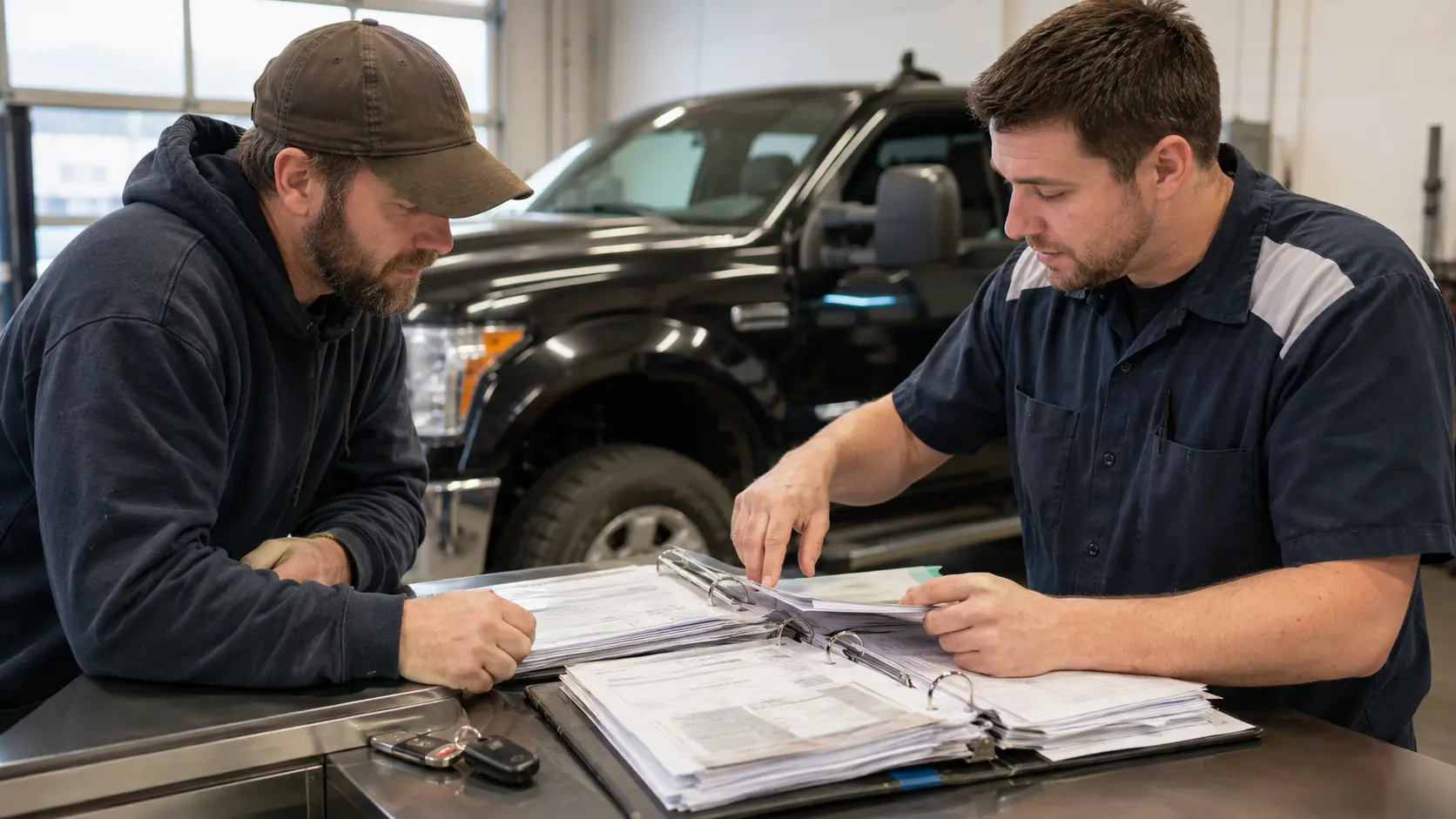
Bring the build record, certification and payload-label photographs, current campaign result, maintenance invoices and repair orders to an independent technician. Ask for a cold-start and warm-operation assessment, scan results before codes are cleared, leak and cooling checks, and inspection of steering, axle, brakes, tires and hitch installation. Test the fitted camera and trailer systems without assuming that optional equipment is present.
Reconcile any campaign completion entry with its precise action: inspection, component replacement or software update. A repair record can explain work performed but cannot guarantee future reliability. If identity, safety or service-history questions remain unresolved, defer the purchase. This guide verifies no active inventory, seller, dealer count, price, financing or offer.
Questions buyers ask about the 2023 F-250
Should I avoid every first-year truck? The reviewed sources do not support that blanket verdict. The redesign creates specific equipment and evidence checks, not a universal failure prediction.
Does the 500-hp diesel have the same towing rating in every cab? No. Standard-output versus high-output identity, body, drive, axle, GCWR, packages and hitch type determine the applicable row.
Does a software update prove all recalls are finished? No. Steering and axle campaigns involve different actions, and newer or equipment-specific campaigns may require separate work. Check the candidate's current VIN status.
Is this a complete reliability database? No. It is an individually researched buying guide built from exact-year owner and capability literature plus selected safety records. It supplies neither a failure-rate dataset nor Canadian VIN certification.
Evidence note: manufacturer documents establish the specific facts and applications cited. Buying workflows and cost scenarios are DieselTrucks.ca editorial guidance. These pages do not publish measured failure rates or confirm the condition, recall status or capacity of a particular truck.
General educational content for Canadian diesel-pickup research. Verify the exact truck, model year, certification labels, owner manual and manufacturer documentation, and obtain qualified mechanical or towing advice where appropriate.
Sources & Further Verification
Use the exact model year, VIN, truck labels and current manufacturer documentation when moving from general research to a purchase or towing decision.