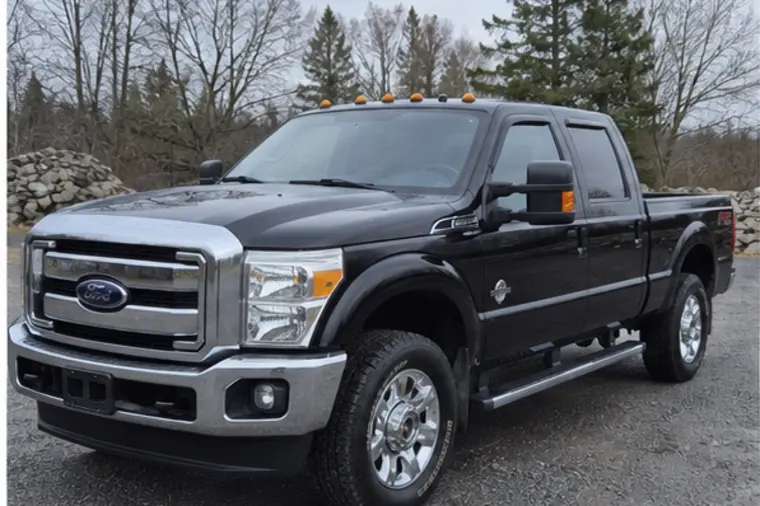
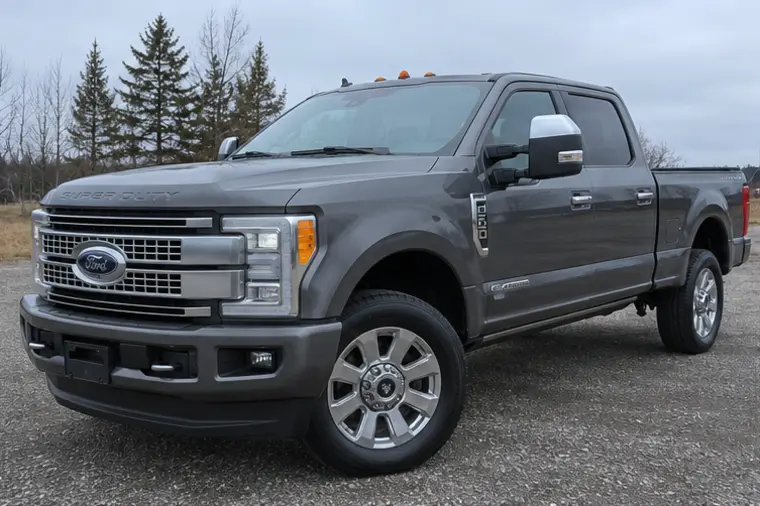
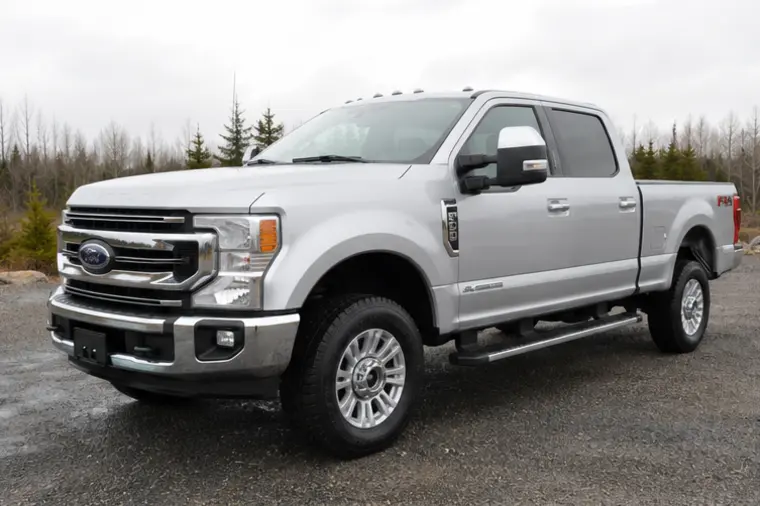
The 6.7L Power Stroke is central to modern Ford Super Duty research, but it has evolved across model years and should not be treated as one fixed specification.
The 2026 standard-output and high-output branches remain separate
Ford's 2026 Super Duty pickup guide lists the standard 6.7L Power Stroke at 475 hp at 2,600 rpm and 1,050 lb-ft at 1,600 rpm. It lists the high-output version at 500 hp at 2,600 rpm and 1,200 lb-ft at 1,600 rpm. The guide pairs the pickup lineup with a ten-speed automatic, but output choice still does not identify cab, box, drive, axle, GVWR package or hitch rating.
The same summary shows available maximum towing of 38,600 pounds for the standard engine and 40,000 pounds for the high-output engine. Those are not engine-only ratings: Ford identifies gooseneck and package requirements and says maxima vary with cargo, configuration, accessories and passengers. The configuration tables, labels and footnotes must remain attached to any number used for a purchase.
These are 2026 U.S. pickup-guide figures. They do not backdate the current ratings to an earlier truck, establish a chassis-cab calibration, certify a Canadian VIN or prove that the higher-output version is more reliable.
| 2026 pickup branch | Factory output | Published available max towing | Boundary |
|---|---|---|---|
| 6.7L standard output | 475 hp / 1,050 lb-ft | 38,600 lb | Gooseneck maximum when properly equipped |
| 6.7L high output | 500 hp / 1,200 lb-ft | 40,000 lb | Requires the 40K Gooseneck Tow Package |
| Any candidate | Verify installed branch | Use exact configuration row | Payload, GVWR, GAWR and hitch limits still apply |
A headline tow number is the end of a configuration path, not the start
Ford publishes separate conventional and fifth-wheel/gooseneck matrices for F-250, F-350 SRW, F-350 DRW and F-450 DRW pickups. Cab, wheelbase, box, drive, axle ratio, GVWR equipment and engine branch change the applicable row. In many rows the binding value is far below the headline maximum even though the truck carries the same 6.7L family name.
Start with the trailer's loaded weight and tongue or pin load, then add passengers, cargo, hitch hardware and accessories. Compare the result with the actual truck's payload, rear GAWR, GVWR, tire limits, hitch limits, GCWR and the exact matrix cell. More engine torque cannot restore payload or axle margin that the loaded combination does not have.
Keep conventional, fifth-wheel and gooseneck ratings distinct. A fifth-wheel value must not be copied into a conventional-trailer decision, and an F-450 pickup row must not be assigned to a chassis cab. If a listing provides only a maximum claim, treat the exact rating as unresolved until the build and labels are reconciled.
The 2011 and 2026 documents are historical endpoints, not interchangeable manuals
Ford's 2011 diesel supplement documents an early 6.7L application and separates F-250/F-350 SRW, F-350 DRW pickup, F-450 pickup and chassis-cab GCWR rows. The 2026 guide documents a later pickup lineup with standard and high-output branches and different configuration matrices. Together they demonstrate revision and application boundaries; they do not supply a complete year-by-year specification history.
Do not transfer the 2011 maintenance schedule, capacities, fuel guidance or towing table to a 2026 truck. Do not apply a current output or tow rating to a 2011 candidate. Retrieve the exact model-year owner information, diesel supplement, towing guide and current service literature for the vehicle under review.
For used-truck research, record year, pickup or chassis cab, model, SRW or DRW, output branch, transmission, axle and relevant packages. That identity line should precede every quoted specification, maintenance instruction and parts decision.
| Document | What it establishes | What it cannot establish |
|---|---|---|
| 2011 diesel supplement | Early application, operation and dated service context | Modern output, schedule or towing ratings |
| 2026 pickup towing guide | Current documented pickup outputs and configuration matrices | Earlier trucks, chassis cabs or Canadian VIN certification |
| Candidate file | Installed identity, records and observed condition | Family-wide failure rate or guaranteed life |
Recall 24V957 has a defined population and a software remedy
Ford's updated 24V957 filing covers defined 2020–2022 6.7L Super Duty populations. It describes high-pressure fuel-pump wear associated with aged biodiesel deposits and identifies extended cranking, a check-engine light, noise and reduced power as possible warnings. That population is not every 6.7L engine, and the filing is not a measured failure rate for the family.
The January 2026 remedy filing says dealers reflash the powertrain and transmission control modules to increase pump cooling and prevent deposit formation. The filing classifies the remedy type as software, inspect and replace, but the described owner remedy is not an automatic fuel-pump replacement. A completion record should state what was actually performed on the VIN.
For a Canadian purchase, use current Canadian and manufacturer VIN records and retain the dated results. Keep applicability, remedy completion, unrelated fuel-system repair history and present mechanical condition as separate findings. A completed campaign does not erase a current symptom, while an open or inapplicable result does not diagnose one.
Use a reproducible purchase and service file
First, identify the truck and installed output branch from original build information rather than a listing headline. Capture the certification, payload and tire labels, then select the matching owner material and towing matrix. Record any modification, replacement engine, calibration change or missing label as an unresolved boundary.
Second, organize maintenance and repair evidence by date, kilometres or miles, engine hours when available, complaint, diagnosis, work performed and follow-up result. Ask a qualified shop to reconcile repeated fuel, cooling, aftertreatment or transmission visits with a current scan and road test. A parts invoice is useful evidence of work; it does not by itself prove the original cause or the condition of adjacent systems.
Third, compare the candidate with the actual assignment: trailer and hitch type, loaded pin or tongue weight, people and cargo, terrain, climate, idle time, downtime tolerance and local service access. A lower-output truck with a coherent evidence file may fit better than a higher-output truck with unresolved identity or condition. This is a decision method, not a reliability ranking, best-year verdict or lifespan forecast.
| File section | Evidence to retain | Buying gate |
|---|---|---|
| Identity | Year, application, output branch, axle and packages | Configuration cannot be reconciled |
| Campaigns | Dated VIN result and exact remedy performed | Applicability or remedy remains unclear |
| Condition | Current scan, inspection, road test and repair sequence | Material symptom remains undiagnosed |
| Load fit | Exact matrix row, labels and loaded worksheet | Any binding rating lacks margin |
Standard output and high output are different specifications
For a documented pickup reference, Ford’s 2024 towing guide lists the standard 6.7L diesel at 475 hp and 1,050 lb-ft, and the high-output version at 500 hp and 1,200 lb-ft. Both sit within a ten-speed pickup lineup. These are 2024 pickup figures, not a specification for every 6.7L engine or a chassis cab.
The buying implication is to compare the complete configuration before paying extra for output. If two candidates already satisfy the same trailer and payload requirements, the additional engine rating does not settle their relative condition, warranty position or ownership cost. Ask for the original build information when an advertisement simply says “6.7 diesel.”
| Reference application | Horsepower | Torque |
|---|---|---|
| 2024 Super Duty pickup, standard output | 475 hp | 1,050 lb-ft |
| 2024 Super Duty pickup, high output | 500 hp | 1,200 lb-ft |
A documented fuel-system campaign to check
Ford’s U.S. 24S78 filing identifies a defined population of 2020–2022 6.7L Super Duty trucks. It describes fuel-pump wear associated with deposits, possible metal debris and loss of motive power. The filing names extended cranking, warning lights, noise and reduced power as possible warnings. It is a recall document, not a measured lifetime failure rate for all 6.7L engines.
For a Canadian purchase, check current Canadian and manufacturer VIN records and obtain dated completion evidence. Ask the inspecting shop to distinguish a completed campaign from unrelated fuel-system repair history; one does not prove the other. Avoid turning a model-year headline into a verdict on an individual truck.
Compare a maintained truck with a maintained truck
Build a shortlist around documented service and a reproducible inspection, not an assumed hierarchy of odometer readings. Request invoices that identify the work, date and kilometres, then ask which unresolved conditions would prevent the truck from doing your intended job. A repair invoice that names a replaced part is more useful when it also records the diagnosis and follow-up result.
Include the transmission, cooling system, aftertreatment and chassis in the inspection brief. A low engine-noise level during a short drive cannot establish their condition. If the seller has recently cleared warnings or cannot explain a change in operating behaviour, resolve that uncertainty before assigning a purchase budget.
Where this engine is used
Applications include Ford Super Duty pickups such as the F-250, F-350 and pickup-configured F-450, with exact availability varying by year and market.
Evolution over time
Major hardware, output and transmission changes across the engine's production life make generation-specific research important.
Output ratings, calibrations, turbocharging, emissions systems and supporting hardware can differ. Compare a specific model year and configuration rather than treating the engine name as one unchanging specification.
Output and transmission context
Horsepower and torque ratings can change by year, calibration and application. Transmission pairings also evolve and may differ between standard-output, high-output, pickup and chassis-cab configurations. Verify the exact powertrain instead of applying one current rating to every used truck.
Work and towing context
The engine is only one part of a tow vehicle. Cab, bed, axle ratio, transmission, cooling package, payload label, SRW or DRW configuration and hitch setup determine how the complete truck fits a workload.
Maintenance and emissions context
Modern diesel ownership includes the DPF, DEF and EGR systems as well as the engine itself. Usage pattern, maintenance, warning history and previous modifications are relevant when evaluating a used truck.
Build the service plan from the exact model-year owner documentation and the truck's records. Cold weather, extended idling, short trips, dust and frequent towing may change inspection priorities.
Questions for a used-truck inspection
Ask what work the truck performed, whether service intervals are documented and whether the powertrain or emissions system has been modified.
- Ask for dated maintenance and repair records rather than relying on a verbal summary.
- Evaluate a true cold start, warning lights, leaks, transmission behaviour and underbody condition.
- Confirm whether the truck has towed, carried commercial loads or been modified, and inspect accordingly.
- Verify emissions equipment, tires, suspension and the exact payload label on the truck itself.
Reliability assessment across changing 6.7L applications
Keep the truck's model year and pickup or chassis-cab application at the top of the inspection file. The 6.7L name covers multiple revisions; a later specification, service interval or repair anecdote cannot be applied automatically to an early truck. Use the original documentation and confirm the installed powertrain when replacement work is claimed.
Ford's 2011 supplement distinguishes engine and secondary cooling-system service. That is a useful early-application check: ask the shop which circuits and records were assessed, rather than accepting an undifferentiated coolant-service statement. It does not justify applying 2011 coolant products or intervals to every later 6.7L.
Build separate questions for fuel-system history, aftertreatment warnings and transmission behaviour. Ask for written findings when diagnosis remains open. For commercial duty, compare the proposed short-trip or idle routine with the correct owner's guidance, and include repair access and downtime in the buying decision.
Distinguish engine family from documented application
A 6.7L Power Stroke spans multiple truck and transmission updates. Ford's 2011 diesel supplement and 2024 pickup towing guide are two documented reference points, not interchangeable specifications. Use the exact truck year to select the maintenance and load documents.
| Research layer | Buyer output |
|---|---|
| Engine and application | Correct diesel supplement and installed-component identity |
| Transmission | Matching service specification and repair record |
| Aftertreatment and duty | Warning history compared with the normal operating week |
Investigate repeated repairs as a sequence
For fuel, cooling or emissions work, identify whether the same symptom prompted several visits. Ask the inspecting shop to reconcile invoices with current codes and operating observations. A later replacement component may be documented and useful, but its presence alone does not establish the condition of adjacent systems or the truck's remaining load capacity.
Evidence note: manufacturer documents establish the specific facts and applications cited. Buying workflows and cost scenarios are DieselTrucks.ca editorial guidance. These pages do not publish measured failure rates or confirm the condition, recall status or capacity of a particular truck.
FIND TRUCKS USING THIS ENGINE
Connect the engine to a model year and exact truck.
Engine-family research is one part of the configuration. Use the explorer to connect model, year, transmission, cab, bed and rear-wheel context.
General educational content for Canadian diesel-pickup research. Verify the exact truck, model year, certification labels, owner manual and manufacturer documentation, and obtain qualified mechanical or towing advice where appropriate.
Sources & Further Verification
Use the exact model year, VIN, truck labels and current manufacturer documentation when moving from general research to a purchase or towing decision.