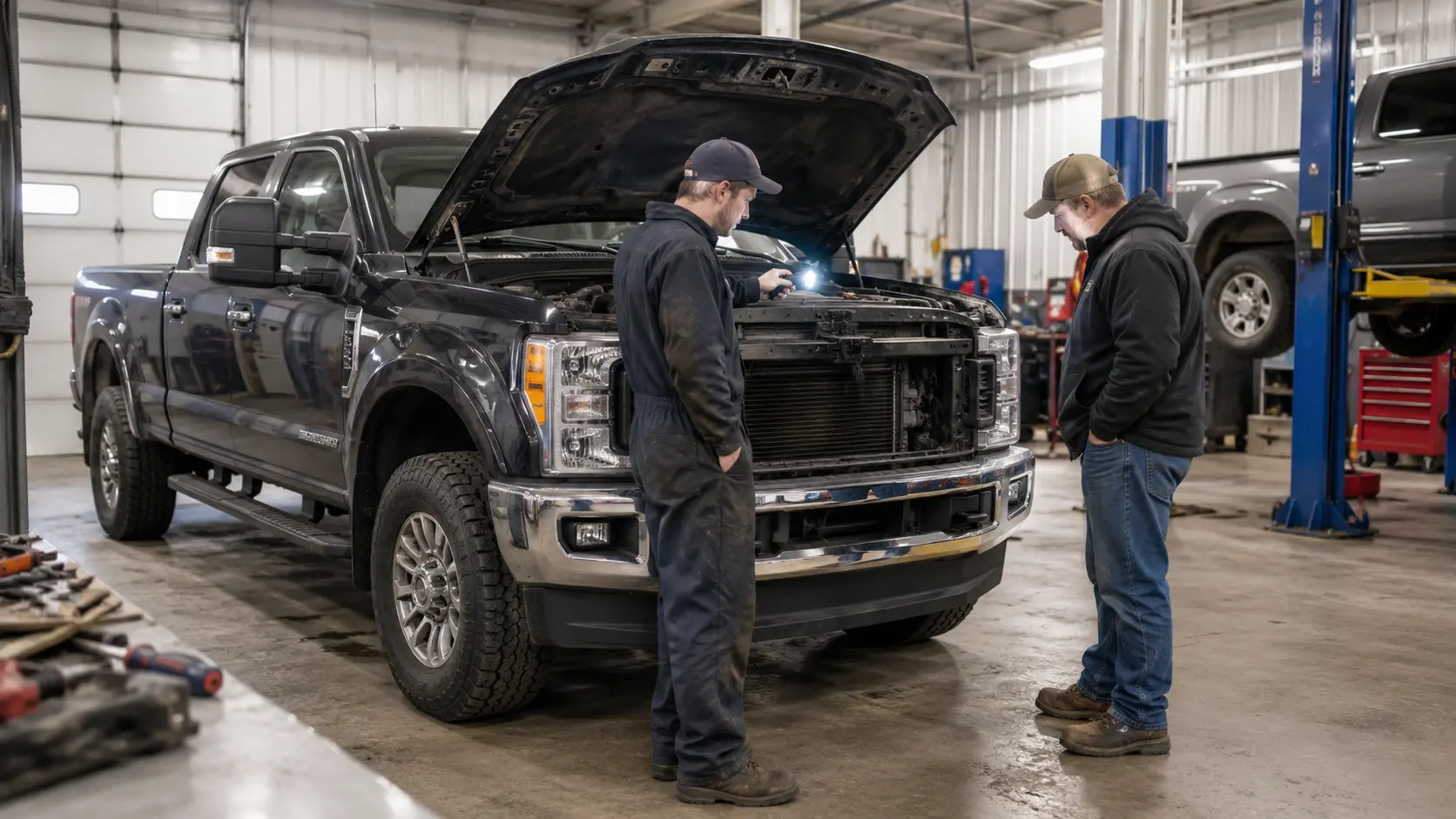
DieselTrucks.ca separates manufacturer material, general editorial explanation, user-supplied information, verification needs and editorial catalogue records.
Manufacturer specifications
Technical ratings are tied to model year and configuration. Pages direct readers to certification labels, owner manuals, towing guides and official specification material rather than applying one maximum to a model family.
Seller-provided information
Marketplace details such as condition, equipment, service history and asking price remain seller-provided unless independently verified. Catalogue profiles are editorial references and do not establish vehicle availability, a dealer relationship or a market trend.
Editorial comparisons
Comparisons explain decision factors and avoid unsupported winner scores, reliability rankings and fabricated failure rates. Material uncertainty is stated instead of filled with invented precision.
Planning tools
Calculators use numbers supplied by the visitor or clearly labelled examples. Outputs are educational estimates and do not certify capacity, value, financing or legal compliance.
Configuration intelligence
Configuration profiles connect make, model, verified model-year research eras and user-selected details. They are research pathways—not factory build sheets. Exact transmission, axle ratio, payload and towing ratings remain unknown until supported by the truck's labels and authoritative documentation.
User input and unknown values
A value entered by a visitor is labelled as user supplied. Editorial model-year context is distinguished from truck-specific verification. Unknown and needs-verification states are preserved rather than replaced with guesses or numerical confidence scores.
VIN, recall and history limits
DieselTrucks.ca does not decode VINs or report VIN-specific recall or vehicle-history status. Buyers are directed to Transport Canada, manufacturer lookup resources, service documentation and qualified inspection for current verification.
Vehicle catalogue
Vehicle profiles provide configuration, imagery and planning references. They are not seller submissions or active offers, and their reference values are not market statistics.
Review and update methodology
A review date changes when factual content, sources or substantive editorial guidance is checked—not merely when a shared template changes. Material corrections are incorporated into the relevant permanent guide and its reciprocal research links are rechecked.
How to read evidence on a guide
Manufacturer manuals and technical publications support their stated applications and procedures. Recalls and bulletins are scoped evidence, not population-wide reliability measurements. The original decision tables, inspection worksheets and cost calculations on DieselTrucks.ca organize buyer questions; they do not represent inspections of particular vehicles.
| Information type | How readers should use it |
|---|---|
| Model-year manufacturer material | Match the stated vehicle and configuration |
| Editorial worked calculation | Replace the stated assumptions with supported inputs |
| Seller or visitor information | Retain its source and verify material claims |
| Unresolved technical detail | Keep it unknown until suitable evidence is available |
What a review date means
A dated guide indicates that substantive wording, source context or buyer guidance was reviewed. It does not mean every linked manufacturer page is continually monitored or every vehicle record was independently inspected. Follow the linked official resource for current VIN status, requirements or a particular truck's technical documentation.
General educational content for Canadian diesel-pickup research. Verify the exact truck, model year, certification labels, owner manual and manufacturer documentation, and obtain qualified mechanical or towing advice where appropriate.