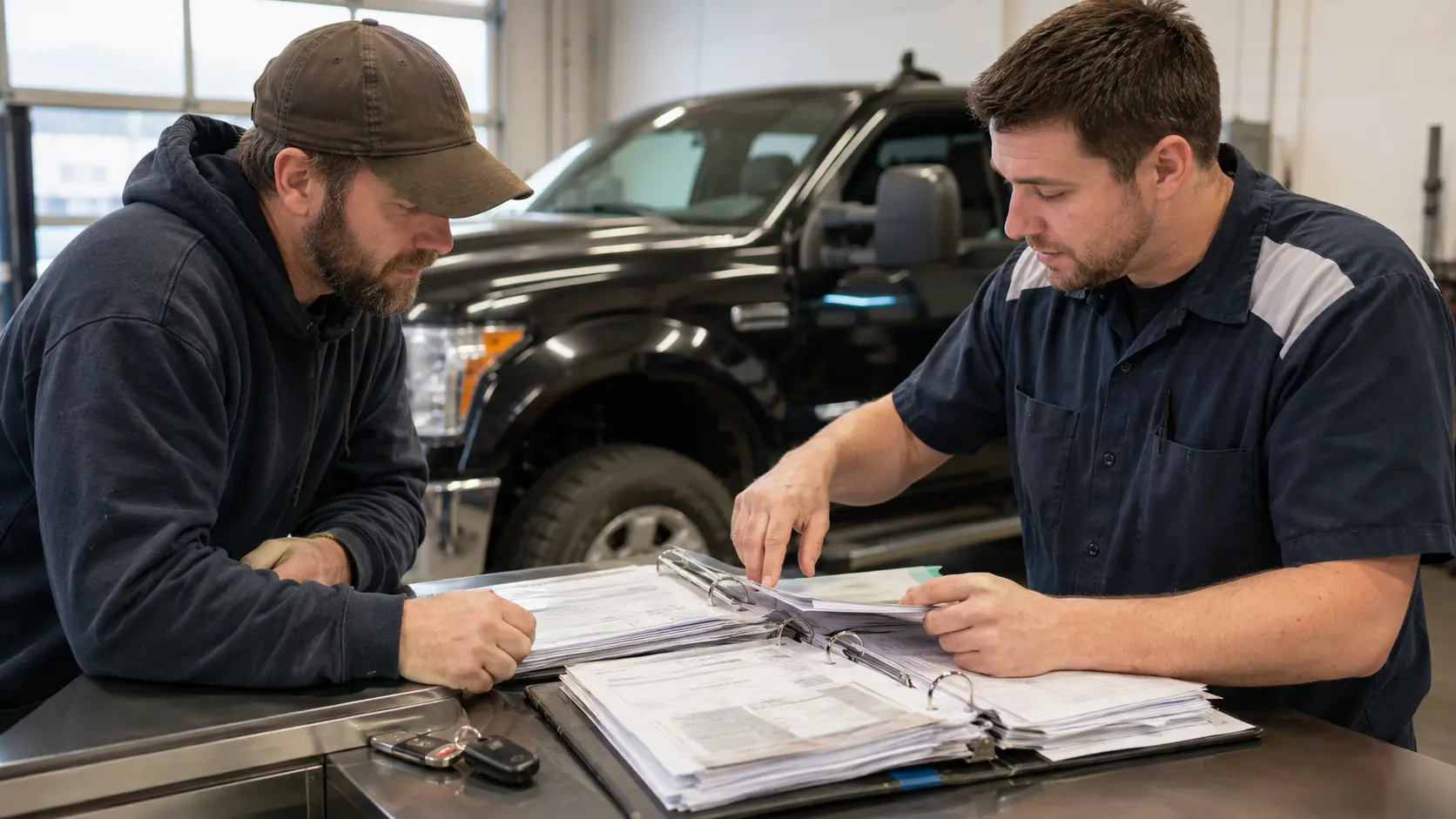
The 2025 Ford F-250 needs a purchase review that starts with current safety status, not a model-year reliability score. Its four familiar engine branches do not make every configuration interchangeable, and the current U.S. records include a brake campaign with an explicit instruction not to drive affected, unrepaired vehicles. Researched on 15 September 2026, this guide separates that safety gate from towing-table changes, ordinary operating guidance and the evidence needed to judge one Canadian candidate.
First gate: resolve 25C26 applicability before arranging a test drive
Ford 25C26 / NHTSA 25V401 concerns certain 2025 Super Duty vehicles whose brake-booster pushrod retaining spring may be missing. The pushrod could disconnect from the brake pedal and cause sudden loss of braking. The U.S. record advises owners of affected vehicles not to drive until repaired; it describes inspection and repair of the pedal assembly and letters mailed on 20 June 2025.
This is not a statement that every 2025 F-250 is subject to that instruction. Check the actual VIN through Ford Canada's recall process and obtain current dealer guidance and completion evidence before moving an affected candidate. A reassuring pedal feel, a short demonstration or a seller's generic claim that recalls are done does not establish that this particular action is complete.
If the candidate is affected and unrepaired, do not road-test it to see whether the problem occurs. Follow Ford's instructions for repair arrangements. Uncertain applicability should be resolved with Ford before proceeding, not converted into either a blanket clearance or a blanket condemnation of the model year.
What the exact 2025 configuration evidence does—and does not—change
Ford Canada's 2025 Super Duty towing supplement identifies four engine/output branches, each paired with a TorqShift ten-speed automatic. Standard-output and high-output diesels remain separate choices; a 6.7L badge alone does not establish the higher output. Record the engine, output, cab, box, drive, axle, GVWR, GCWR and factory towing packages from the candidate's build evidence.
The output pairs carry over from the preceding guide, but selected towing cells do not. That is a documented capability difference, not proof of a redesigned engine or improved mechanical durability. This review does not assert a complete trim-change chronology from a towing supplement.
| 2025 engine branch | Ford Canada output | Identification implication |
|---|---|---|
| 6.8L gasoline V8 | 405 hp / 445 lb-ft | Do not assign 7.3L ratings |
| 7.3L gasoline V8 | 430 hp / 485 lb-ft | Match axle and body row |
| 6.7L standard-output diesel | 475 hp / 1,050 lb-ft | Separate from high output |
| 6.7L high-output diesel | 500 hp / 1,200 lb-ft | Package and load limits still apply |
Three hardware campaigns require different repair evidence
The exact-model-year U.S. response also identifies shifter, fuel-line and driveshaft actions. Keep their components and remedies distinct from the brake-pedal campaign. A steering-column repair is not a driveshaft inspection, and neither establishes fuel-system condition.
Ford 25S44's record reports that its covered vehicles have been repaired. That is the status of that U.S. campaign record, not certification of a Canadian VIN or a reason to ignore an actual leak. The component field classifies diesel delivery hoses, lines and fittings; it does not establish that every diesel is affected or turn a return-line connector defect into a fuel-pump failure.
The public summaries do not provide a complete parts/build-date applicability matrix. Obtain the current VIN-specific action and invoice rather than guessing membership from the model badge or a registration date.
| Ford / NHTSA action | Recorded component concern | Evidence to request |
|---|---|---|
| 25S20 / 25V163 | Improper column-shifter weld; detachment can prevent shifting to Park | Steering-column serial inspection and replacement if required; letters 28 April 2025 |
| 25S44 / 25V306 | Cracked fuel-return-line connectors can leak into the engine compartment | Fuel-return-line replacement record; do not infer Canadian clearance |
| 26S13 / 26V119 | Driveshaft friction-weld failure can separate rear shaft and lose drive | Driveshaft serial inspection and replacement if required; letters 6 April 2026 |
Instrument cluster, trailer module and camera software are separate checks
Ford 25S88 / 25V540 describes an instrument-panel cluster that can fail at startup and omit speed or warnings. The action is an IPC software update through a dealer or over the air; the record reports letters mailed on 5 September 2025. A functioning display during one visit does not itself document completion.
Ford 26C10 / 26V104 addresses loss of Integrated Trailer Module communication, potentially interrupting trailer lighting or braking. Its recorded remedy is an ITRM software update, with letters mailed on 25 March 2026. Verify the truck's applicable action and the actual trailer connection before towing; a maximum trailer rating cannot establish electrical function.
Ford 26C37 / 26V489 is equipment-specific: an eight-inch SYNC screen's home menu may obstruct the reversing-camera image. The reviewed record still calls the remedy anticipated in September 2026. That wording is not proof that an update is available today, installed on this truck or applicable to every screen. Ask for current Ford guidance rather than treating every software campaign as one update.
Use the 2025 owner's transmission guidance without dismissing faults
Ford's exact 2025 online owner section explains that some brief shift sensations can be part of normal transmission operation and that calibration changes may alter shift feel. It also directs owners with concerns to a Ford-authorized dealer. This is operating context, not a diagnosis that every harsh shift, delay, warning or loss of drive is normal.
After any applicable safety restriction has been resolved, have a qualified inspector assess the candidate's actual symptoms and retained diagnostic information. Record when a symptom occurs, whether cold or warm, and what previous repair or software work was performed. Do not clear codes merely to produce a clean demonstration or infer transmission failure rates from one invoice.
The same owner guidance calls for the brake pedal to be held fully when shifting while stationary, and for Park, the parking brake and vehicle shutdown before leaving. These precautions do not replace the repair required by a defective column-shifter campaign. Ford's separate brake guidance also notes reduced braking efficiency when brakes are wet; it cannot explain away a missing retaining spring.
The 2025 Tremor example shows why copying 2024 ratings fails
For the high-output diesel Tremor Crew Cab 4x4 with the 6.75-foot box, 159.8-inch wheelbase, 3.55 axle and 28,300-lb GCWR, Ford Canada's 2025 guide lists 18,900 lb fifth-wheel and 19,900 lb gooseneck. Its conventional position is 18,200 lb. Do not reuse the preceding year's 19,500/20,000-lb in-bed pair for this 2025 row.
A different high-output Regular Cab 4x2, eight-foot-box configuration with 3.31 or 3.55 axle, 31,000-lb GCWR and package 535 has the 22,300-lb fifth-wheel and 23,000-lb gooseneck positions. Those numbers are neither Tremor ratings nor a universal diesel allowance.
The full 2025 table also contains blanks and selected GVWR-dependent alternatives. Preserve them instead of borrowing another year's populated cell. Match the actual payload label, GVWR, front/rear GAWR, tires, hitch and loaded trailer/pin weights before use; a towing maximum does not establish available payload or Canadian VIN certification.
Reliability verdict: a conditional purchase, not a durability ranking
The reviewed primary material supports targeted safety and configuration checks, not a comparison of failure probability against 2024 or 2026. Seven records returned by one model-name query are not seven defects present on every truck, and recall counts cannot rank engine durability. Long-term service life also cannot be established from this evidence.
A defensible candidate has matching identity records, resolved applicable safety restrictions, understandable service and repair history, suitable capacity and an independent inspection without unexplained material faults. Ask for kilometres and engine hours, duty history, maintenance invoices, modification history and current campaign results. The selected online owner sections do not constitute a full maintenance schedule; no oil or transmission-fluid interval is invented here.
The verdict remains open when those facts are missing. A lower asking price does not resolve uncertain brake safety or unexplained driveline repairs, and this article supplies no actual price, seller, availability or financing offer.
Buying checklist and remaining evidence limits
Before viewing: obtain the VIN, build/configuration information and current Ford Canada recall results. Specifically resolve any 25C26 instruction before arranging vehicle movement. At document review: separate each applicable campaign's completion from routine service invoices and unrelated software work.
At inspection: only after safety clearance, assess the fitted systems, leaks, steering, braking, tires, corrosion, hitch installation, cold/warm operation and diagnostic findings. For towing: use the exact 2025 Canadian chart and real load measurements, then verify trailer lighting and braking function.
This is an independently researched year guide, not an exhaustive service-bulletin catalogue or Canadian campaign certification. The U.S. API can be sensitive to model naming, and the selected summaries do not supply every build window. Use the linked model overview for broader generation context and keep this year-specific decision separate from generic problems and best-year advice.
Evidence note: manufacturer documents establish the specific facts and applications cited. Buying workflows and cost scenarios are DieselTrucks.ca editorial guidance. These pages do not publish measured failure rates or confirm the condition, recall status or capacity of a particular truck.
General educational content for Canadian diesel-pickup research. Verify the exact truck, model year, certification labels, owner manual and manufacturer documentation, and obtain qualified mechanical or towing advice where appropriate.
Sources & Further Verification
Use the exact model year, VIN, truck labels and current manufacturer documentation when moving from general research to a purchase or towing decision.