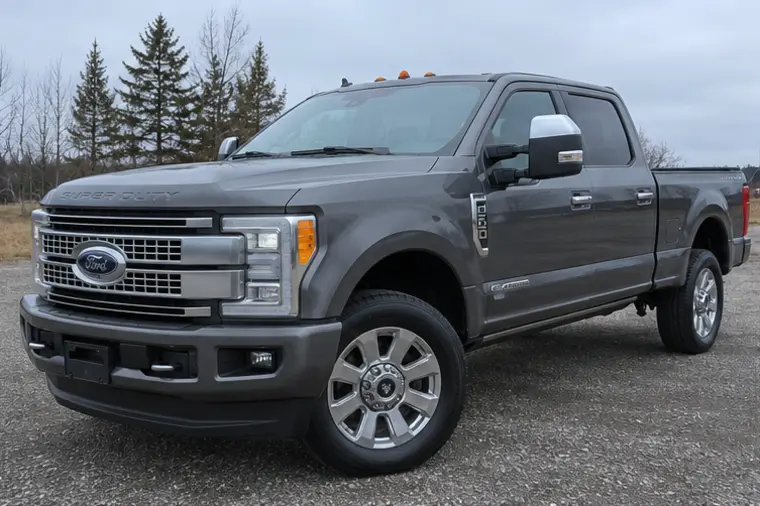
Ford F-250 problems depend on the truck's model year, diesel engine, equipment and repair history. Start with documented campaigns and symptoms, then assess the individual truck. A steering bulletin for a 2017 four-wheel-drive pickup says little about the engine condition of a 2002 7.3L truck, and a recall population is not a prediction that every included vehicle will fail.
F-250 problem checklist by year and equipment
Use this table to identify questions for the seller and inspecting technician. The documents establish particular conditions and affected populations; they do not provide a whole-model reliability ranking. Build dates, installed equipment and VIN applicability matter even within the listed model years.
The last two rows are inspection categories, not allegations of a manufacturing defect across all F-250s. Keep them separate from the named manufacturer documents when judging a seller's answer. A dated repair order with findings is more useful than “they all do that” or “everything has been fixed.”
| Concern | Documented scope | What to verify before buying |
|---|---|---|
| Sustained steering oscillation | Ford TSB 19-2274: 2017–2019 F-250/F-350 4WD | Symptom history, diagnostic invoice and current steering/axle condition |
| Unintended tailgate opening | Ford 19S48: specified 2017–2019 trucks with electric tailgate release | Electric versus mechanical release, VIN applicability and completed campaign record |
| High-pressure fuel-pump concern | Ford 24S78 / U.S. 24V-957: defined 2020–2022 6.7L population | VIN campaign status, fuel-system diagnosis and repair records |
| Steering-column upper-shaft separation | Ford 25S94 / U.S. 25V626: defined 2020–2021 population | Current manufacturer VIN instructions and inspection/remedy completion |
| Engine-specific starting, cooling or emissions concern | Depends on 7.3L, 6.0L, 6.4L or 6.7L application | Exact engine identification, diagnostic findings and correct service history |
| Corrosion, tire wear or hitch damage | Individual truck condition and use | Underbody inspection and assessment of towing/work history |
2017–2019 steering oscillation: distinguish the symptom from the cause
Ford's September 2019 TSB 19-2274 addresses sustained steering-wheel oscillation on specified 2017–2019 F-250 and F-350 four-wheel-drive trucks after rough pavement or an expansion joint at higher road speeds. It identifies a particular diagnostic condition involving steering-linkage damper lag or lash. It is a technical service bulletin, not a blanket recall or a count of how many trucks develop the symptom.
For a buyer, the useful questions are whether oscillation occurred, what a qualified shop diagnosed, what was repaired and whether it recurred. A receipt for a steering damper alone does not document the condition of every steering and suspension component. Ask the technician to assess the actual truck, including the effects of tire changes, lifts, wear and alignment, using current service information.
Do not deliberately strike rough pavement at speed to reproduce a frightening symptom during a buying visit. If the truck has unresolved steering instability, arrange professional evaluation before a road test or towing. Treat the seller's description, an old bulletin and the current inspection as different pieces of evidence rather than accepting one as a substitute for the others.
2017–2019 electric tailgate release: equipment changes applicability
Ford's 19S48 announcement covers certain Super Duty trucks with electric tailgate-latch release equipment and explicitly includes Canadian vehicles. Water entering the release-switch circuit could cause an electrical short and unintended latch release. The announcement excludes vehicles with a mechanical tailgate-release handle. The presence of the correct equipment therefore matters as well as the model year.
Record whether the candidate has the electric release, ask about previous unexpected opening and request VIN-specific completion information from Ford. Also inspect the tailgate's present operation and condition. A replacement tailgate or handle makes the repair history worth clarifying, but it does not by itself establish whether the campaign was completed correctly.
An older announcement describes a campaign at its issue date. The buying decision needs the current manufacturer record and instructions for the individual VIN. Secure cargo independently and resolve an unreliable latch before putting the truck to work; a tailgate is not a substitute for proper cargo restraint.
2020–2022 6.7L fuel system: campaign status and repair scope
Ford's 24S78 / U.S. 24V-957 filing identifies a defined 2020–2022 Super Duty diesel population. It describes deposits associated with aged biodiesel affecting high-pressure fuel-pump operation, with pump wear and possible loss of motive power. Listed warning signs include extended cranking, a check-engine light, noise and reduced power. These symptoms can also require diagnosis for other causes.
Ask two separate questions: is this VIN included in an outstanding campaign, and has this particular truck already had a fuel-system problem? A campaign completion entry answers the first question only to the extent of the documented remedy. It does not explain every earlier breakdown, the condition of all downstream components or the quality of an unrelated repair.
Request the diagnostic report and itemized invoice when a seller mentions pump or injector work. Have a diesel technician explain whether contamination was found and how the documented repair addressed it. Do not use a model-year list from a U.S. filing as confirmation of Canadian VIN coverage. Ford's current Canadian lookup or dealer record is the appropriate next step.
2020–2021 steering shaft: check the newer campaign too
Ford's September 2025 U.S. filing 25V626, manufacturer campaign 25S94, concerns certain 2020–2021 F-250 through F-450 vehicles built in a specified period. It describes an upper steering-column shaft that may separate, potentially causing loss of steering. The filing states that a dashboard warning may not precede the separation; the absence of a warning light is therefore not a campaign check.
Ask Ford to confirm current applicability and remedy completion for the candidate VIN. Do not confuse this shaft campaign with the older 2017–2019 steering-oscillation bulletin: the years, components and underlying conditions differ. An invoice referencing one does not establish that the other has been addressed.
A used truck can acquire a new recall after years of ownership. Recheck status near purchase and retain the result with the inspection records. This guide identifies relevant published evidence; it is not an exhaustive live recall report for any individual vehicle.
Separate diesel-engine problems by Power Stroke generation
An F-250 badge spans very different diesel systems. The 7.3L and 6.0L applications discussed in Ford's period supplements use engine oil in injector actuation, making the correct lubrication history part of a starting and running assessment. Ford's 2009 supplement describes diesel particulate-filter operation for the F-Super Duty 6.4L application. These are different systems to investigate, not interchangeable explanations for every hard start or dashboard message.
Use the VIN, emissions label and vehicle documents to establish the engine before choosing an inspection scope. On an older truck, review oil and fuel-filter records, starting behaviour and any major repair paperwork. On a truck with exhaust aftertreatment, ask for diagnostic findings behind recurring warnings and verify that the factory equipment and calibration are present. A cleared light is less informative than the original codes and the work that resolved them.
Avoid diagnosing an engine from smoke colour, a video or an oil-cap demonstration alone. Ask a qualified technician which measured tests the symptoms justify. This is especially valuable when the seller describes a major modification as a permanent cure without identifying the original fault, parts used or follow-up checks.
Inspect the whole F-250, including the expensive non-engine parts
A diesel engine that starts cleanly can sit in a truck with poor steering, corrosion, worn tires, damaged wiring or a stressed hitch installation. Ask for an underbody inspection that distinguishes surface corrosion from areas requiring closer structural assessment. Fresh coating is a reason to request earlier photographs or inspect beneath accessible edges, not proof that the frame is sound or unsound.
Look for agreement between claimed use and physical condition. Hitch wear, bed damage, accessory wiring and a heavily worn driver's position can justify questions about work duty and idling. None proves abuse on its own. Combine the observations with service dates, odometer progression and the owner's explanation rather than converting one mark into a verdict.
For the transmission, obtain the exact unit identification and service history for that model year. Describe cold and warm behaviour to the inspector and retain diagnostic results. Do not assume the maintenance requirements of a later ten-speed apply to an earlier truck simply because both have a 6.7L diesel.
How to turn the findings into a buying decision
Divide the inspection into unresolved safety or identity concerns, diagnosed repair items and routine maintenance. Resolve the first category before committing. For diagnosed work, obtain an itemized local estimate covering the actual parts and labour scope, taxes and expected availability. Routine maintenance belongs in the ownership budget even when the seller calls the truck “ready to go.”
Price alone cannot settle an unknown major fault. If the seller permits a proper inspection and the repair scope is understood, compare the purchase plus immediate work with another candidate in similar configuration and condition. If the evidence remains incomplete, keeping the truck off the shortlist is a reasonable decision. This approach avoids pretending that a single average repair cost fits every F-250.
For a working truck, include time unavailable. Ask the shop about its diagnostic schedule and parts lead time, then identify whether a suitable substitute truck could perform the job. The cheapest advertised candidate may be expensive if it cannot reliably cover the work you have already booked.
Questions buyers ask about F-250 problems
Are all 2017–2019 F-250s affected by the steering bulletin? No. The cited bulletin specifies four-wheel-drive trucks and a defined symptom. Applicability and diagnosis must be checked for the individual vehicle; the document does not establish a failure rate.
Does a completed recall make an F-250 reliable? It documents a particular campaign action. It does not certify the rest of the engine, transmission, chassis or maintenance history. Keep recall confirmation alongside an independent inspection.
Which F-250 years should I avoid? A problems guide should not turn selected campaigns into a blanket blacklist. Compare the exact engine era, campaign status, condition and ownership evidence. The model overview and generation guides provide context for building that shortlist; a claimed universal best or worst year would need stronger comparative evidence than the documents cited here.
Can I use a U.S. recall number for a Canadian truck? It can help identify the issue to discuss with Ford, but it does not establish Canadian VIN applicability or completion. Use current Canadian manufacturer information for the actual truck.
Evidence note: manufacturer documents establish the specific facts and applications cited. Buying workflows and cost scenarios are DieselTrucks.ca editorial guidance. These pages do not publish measured failure rates or confirm the condition, recall status or capacity of a particular truck.
General educational content for Canadian diesel-pickup research. Verify the exact truck, model year, certification labels, owner manual and manufacturer documentation, and obtain qualified mechanical or towing advice where appropriate.
Sources & Further Verification
Use the exact model year, VIN, truck labels and current manufacturer documentation when moving from general research to a purchase or towing decision.
- Ford TSB 19-2274 — 2017–2019 F-250/F-350 4WD steering oscillation
- Ford 19S48 announcement — specified 2017–2019 electric tailgate latches, including Canada
- Ford 24S78 / U.S. 24V-957 filing — defined 2020–2022 Super Duty population
- Ford 25S94 / U.S. 25V626 filing — defined 2020–2021 steering shaft population
- Ford 2003 7.3L supplement — engine lubrication and injection
- Ford 2007 6.0L diesel supplement — F-Super Duty fuel and lubrication sections
- Ford 2009 diesel supplement — F-Super Duty 6.4L and DPF sections
- Ford owner manuals