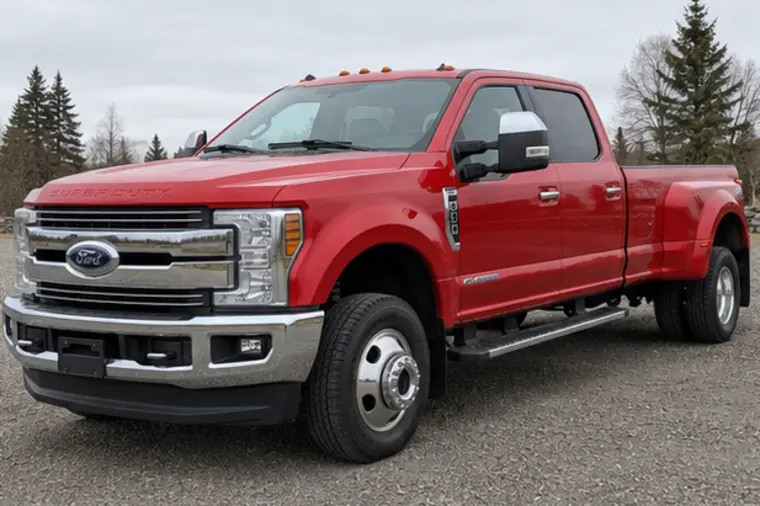
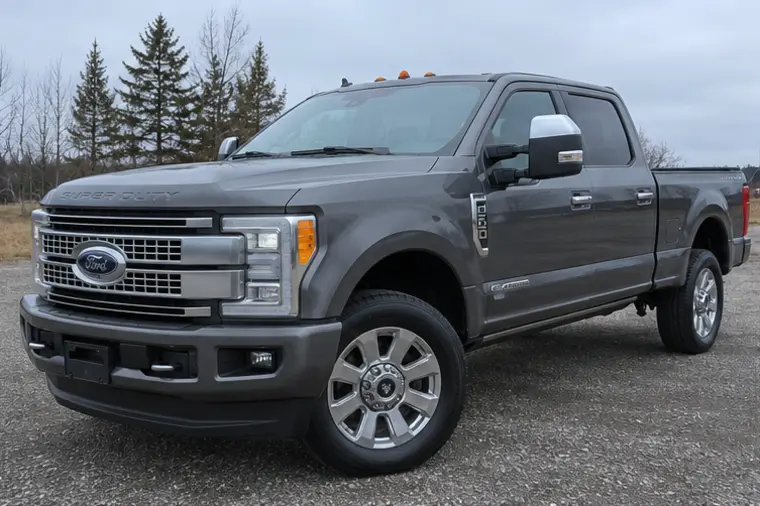
The 2019 Ford F-250 is the third and final model year before the 2020 Super Duty update, but that calendar position is not a reliability verdict. Ford's exact 2019 guide carries the 6.7L Power Stroke pickup rating of 450 hp and 935 lb-ft used in 2018 while publishing a distinct, revised 2019 configuration matrix. Ford service bulletin 19-2274 and campaign 19S48 also include narrowly defined 2019 applications. Those records give a buyer specific questions to investigate; they do not report a controlled failure rate, establish an individual Canadian VIN result or make every truck equivalent. Judge the actual candidate through identity, service and repair history, modifications, campaign status, current operation and an independent inspection.
Reliability verdict: 2019 needs a candidate-level answer
The reviewed primary documents do not justify calling every 2019 F-250 reliable or unreliable. They establish factory output, configuration limits and bounded service and campaign checks, but not exposure-adjusted rates for engine, transmission, steering, electrical or aftertreatment failures. This guide therefore does not assign a score, rank 2019 against another year or promise a lifespan.
A stronger candidate has matching VIN/build evidence and labels, dated maintenance and repair invoices, compliant factory emissions and chassis systems, clean cold and hot operation, stable steering, functioning towing equipment, verified campaign status and a qualified independent inspection. Pause for missing records, active warnings, deleted emissions equipment, unexplained tuning, unresolved steering symptoms, damaged towing hardware or a seller who blocks inspection. Model year can organize the evidence; it cannot replace it.
| Decision lane | Evidence that helps | Reason to pause |
|---|---|---|
| Identity | VIN, build data, labels and equipment agree | Altered or unexplained configuration |
| History | Dated service and repair invoices match kilometres and duty | Long gaps or generic assurances |
| Operation | Clean cold start, scan, hot restart and road test | Warnings, leaks, harsh shifts or unstable steering |
| Campaigns | Current VIN lookup plus repair documentation | Applicability inferred from model year |
| Inspection | Independent diesel, chassis and body review | Inspection restricted or replaced by a seller checklist |
What is genuinely specific to 2019
Ford introduced the high-strength-steel frame and aluminum-alloy body for the 2017 redesign. The 2019 truck is the third year of that architecture and the final pre-2020 model year. Ford's exact 2019 towing guide rates the pickup 6.7L Power Stroke at 450 hp at 2,800 rpm and 935 lb-ft at 1,800 rpm—the same published values shown in the reviewed 2018 guide. That carryover means there is no source-supported output increase to invent for 2019, and unchanged factory numbers do not prove unchanged condition or durability.
The 2019 guide still varies F-250 data by engine, axle ratio, GCWR, cab, drive, wheelbase, box, tire equipment, GVWR package and hitch method. Ford also offered the 6.2L gasoline V8. Confirm each candidate's actual engine, transmission, axle, drive system, body configuration, payload label and installed towing hardware; the year and badge alone do not establish them.
TSB 19-2274 has a narrow steering-complaint boundary
Ford TSB 19-2274 addresses some 2017–2019 F-250 and F-350 four-wheel-drive vehicles that exhibit sustained steering-wheel oscillation after rough pavement or an expansion joint above 72 km/h (45 mph). The bulletin associates that defined condition with excessive lag or lash in the steering-linkage damper and gives technicians a specific service procedure. It excludes two-wheel-drive trucks and says it does not apply when the complaint does not match the stated event.
A technical service bulletin is not a recall, a prevalence study or proof that a candidate needs the listed repair. Review steering, suspension, alignment and tire invoices; identify lifts, oversized tires and altered steering parts; and road-test safely without deliberately provoking instability. Any looseness, vibration or oscillation needs diagnosis by a qualified technician rather than an assumed damper-only fix.
Campaign 19S48 depends on equipment and VIN
Ford's 19S48 announcement covers select 2017–2019 F-250, F-350 and F-450 trucks equipped with an electric tailgate latch-release switch. Water entering the switch wiring could cause unintended release. Trucks with a mechanical-release handle are expressly excluded. Ford reported 29,953 vehicles in the Canadian campaign population, but that total does not show whether one 2019 F-250 is included or repaired.
Identify the candidate's actual release hardware, inspect latch operation and wiring condition, review repair documents and check the VIN through Ford Canada's current recall channel. A trim name, advertisement or model-year assumption is insufficient. Secure cargo independently even when the campaign is closed; campaign completion does not certify loading practice or current latch condition.
Powertrain, aftertreatment and modification checks
For a 6.7L candidate, require a true cold start, diagnostic scan and a drive long enough to assess hot operation. Observe cranking, idle quality, smoke, turbo response, exhaust-brake operation, cooling, leaks, warning messages, transmission behaviour and aftertreatment status. Reconcile oil, fuel-filter, coolant and other maintenance evidence to the exact truck's Ford material and duty; a later Power Stroke schedule is not automatically 2019 evidence.
Deleted emissions hardware, undocumented tuning, altered fuel systems, lift components, oversized tires and changed steering parts complicate legal compliance and diagnosis. Heavy bed or receiver hardware may show useful equipment or demanding prior use; neither conclusion should be assumed. Inspect workmanship and supporting records, then price only verified correction—not a generic reputation.
The 2019 towing matrix preserves hitch and load distinctions
Ford's exact 2019 F-250 diesel matrix includes an 18,500-lb gooseneck position for a qualifying configuration. The same top row is limited to an 18,000-lb fifth-wheel hitch rating. Other published F-250 positions are lower and depend on axle ratio, GCWR, cab, drive, wheelbase, box, tire equipment, the optional 9,900-lb GVWR Package and Trailer Tow Package. Super Duty family headlines—including higher F-350 ratings—are not F-250 ratings.
Inspect the receiver, bed mounts, frame, rear axle, springs, brakes, tires, wheels, wiring and payload label. Ford requires kingpin or tongue load, occupants and cargo to stay within rear GAWR and GVWR. A maximum loaded trailer rating does not show what a used truck hauled, certify remaining payload or override a lower component, label or hitch limit.
| 2019 source fact | Valid use | Invalid shortcut |
|---|---|---|
| 450 hp / 935 lb-ft diesel | Exact-year factory pickup output | Wheel power, condition or lifespan |
| 18,500-lb gooseneck position | Qualifying configuration and hitch method | One rating for every F-250 |
| 18,000-lb fifth-wheel hitch limit | Separate boundary on the top row | Gooseneck and fifth-wheel are interchangeable |
| Rear GAWR and GVWR requirements | Independent carried-load gates | Trailer rating supersedes labels |
Body, frame and chassis inspection
Inspect the aluminum-alloy body and steel frame as different systems. Check panel repairs, paint match, seams, tailgate fit, bed mounts and dissimilar-metal contact areas; separately examine frame rails, crossmembers, cab mounts, hitch points, brake and fuel lines and the underbody for collision damage, deformation and regional corrosion. Ask whether previous repairs used suitable materials and documented procedures.
Road-test the truck empty under safe conditions. Check steering centring, brake feel, wheel-bearing noise, driveline vibration, transmission shifts, four-wheel-drive engagement, exhaust brake, cameras, trailer connector and warning systems. Equipment pictured or listed in Ford literature is not proof that an individual truck has it or that it works.
2019 F-250 buying checklist
Record the VIN, market, build date, engine, transmission, axle ratio, cab, wheelbase, box, drive system, GVWR package, tire size, payload label and towing equipment. Obtain current Ford recall status, dated service and repair invoices, lawful ownership history, scan results, cold-start evidence and an independent diesel, chassis and body inspection. Reconcile kilometres and engine hours with documented duty instead of treating either number as a universal life limit.
Price known work only: tires, brakes, steering or suspension correction, leaks, overdue service, emissions diagnosis, damaged hitch hardware and body or frame repair. This guide publishes no inventory, seller, dealer count, price, financing or offer. Walk away when material uncertainty cannot be resolved or when access needed to assess the truck is refused.
Frequently asked questions
Is the 2019 F-250 reliable? The reviewed primary sources provide no universal reliability score or failure rate. A particular truck can be a defensible candidate when its identity, records, campaign status, operation and independent inspection agree.
Did diesel output increase for 2019? Not in the reviewed Ford guides. Both 2018 and 2019 publish 450 hp and 935 lb-ft for the pickup 6.7L Power Stroke; that is a source comparison, not durability evidence.
Does TSB 19-2274 apply to every 2019 truck? No. It requires an F-250/F-350 4WD and the bulletin's defined sustained-oscillation complaint.
Does every 2019 F-250 have campaign 19S48? No. Ford limits it to select electric-release tailgates and excludes mechanical handles. Check the individual VIN and repair evidence.
Can this page confirm Canadian VIN status or a truck for sale? No. It publishes neither a candidate VIN result nor inventory, seller, dealer, price, financing or offer.
Evidence note: manufacturer documents establish the specific facts and applications cited. Buying workflows and cost scenarios are DieselTrucks.ca editorial guidance. These pages do not publish measured failure rates or confirm the condition, recall status or capacity of a particular truck.
General educational content for Canadian diesel-pickup research. Verify the exact truck, model year, certification labels, owner manual and manufacturer documentation, and obtain qualified mechanical or towing advice where appropriate.
Sources & Further Verification
Use the exact model year, VIN, truck labels and current manufacturer documentation when moving from general research to a purchase or towing decision.
- Ford Canada Media Center — 2017 Super Duty generation introduction
- Ford — 2018 RV and Trailer Towing Guide (manufacturer document archive)
- Ford — 2019 RV and Trailer Towing Guide (manufacturer document archive)
- Ford TSB 19-2274 — 2017–2019 F-250/F-350 4WD steering oscillation
- Ford 19S48 announcement — select 2017–2019 electric tailgate releases
- Ford Canada — recall information and VIN lookup
- Ford owner manuals