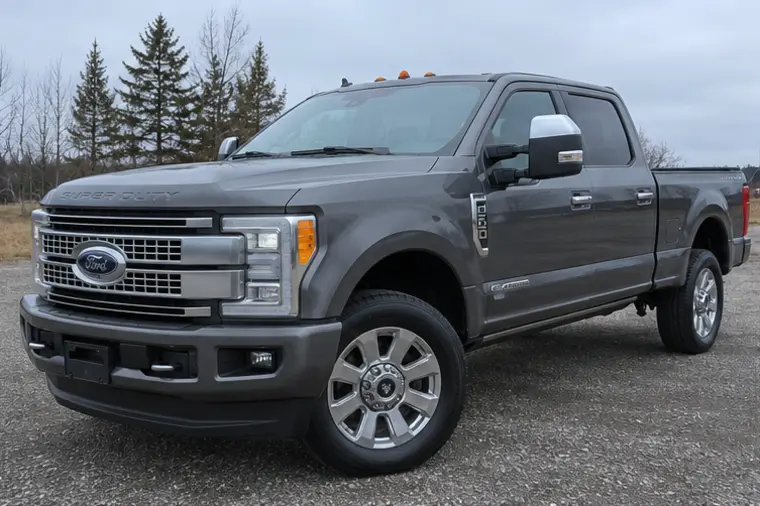
F-250 reliability is a question about a particular diesel powertrain, vehicle history and next assignment, not one score for every truck wearing the badge. Use documented concerns to direct an inspection, then judge whether the candidate's condition and support plan meet your tolerance for repair and downtime.
Reliability verdict: separate the truck from its reputation
A well-supported F-250 diesel can be a credible work-truck candidate, but the reviewed sources do not establish a universal lifespan, annual repair bill or best-year failure rate. Our buying recommendation is to favour verifiable maintenance, a satisfactory independent assessment and a realistic support arrangement over a broad claim that one engine or year is indestructible.
Three different questions need answers. Is the vehicle currently fit for the assignment? What documented concerns deserve attention on this configuration? If something fails, can the owner manage the repair and interruption? A clean inspection helps answer the first question. Campaigns and service information guide the second. Your operating plan determines much of the third.
Do not confuse low observed mileage with a complete operating history. Ask about work hours where recorded, previous assignments and long periods of storage, without inventing an hours-to-kilometres conversion. Missing information should remain a visible uncertainty. It is not proof of misuse, but it prevents a confident comparison with a candidate whose history is better documented.
What the available evidence can and cannot measure
Frequency, severity and exposure are separate. A serious steering defect merits attention even without a comparable failure-rate denominator. A routine maintenance item may occur more predictably but have a very different consequence. Counting documents treats those unlike events as equivalent and can mislead a buyer into ranking model years on paperwork volume.
Our verdict therefore uses evidence strength and unresolved exposure, not stars or a manufactured percentage. A stronger candidate has explainable repairs, clear equipment identification and no unresolved findings that conflict with its intended use. A weaker candidate requires assumptions to bridge gaps that matter to the purchase.
| Evidence | Useful conclusion | Conclusion it cannot establish alone |
|---|---|---|
| Original Ford equipment publication | Which powertrain or feature a specified model offers | How often that component fails in Canadian service |
| Safety recall filing | Defined population, concern and stated campaign action | Whether this Canadian VIN is affected or repaired today |
| Technical service bulletin | A documented symptom and applicable diagnostic or repair direction | The percentage of all owners who will experience it |
| Candidate service and repair history | What was recorded for this truck and when | That every unrecorded item was neglected or that future failures are impossible |
| Independent inspection | Condition observed within the appointment's scope | A warranty or a complete forecast of remaining life |
Engine and transmission boundaries change the questions
Ford's 2019 equipment publication pairs the diesel with a six-speed automatic; its 2020 guide identifies the updated diesel and ten-speed combination. This is why an F-250 reliability assessment must identify the transmission as well as the engine badge. Do not combine reports from gasoline and diesel applications into one powertrain conclusion.
Earlier engines require their own service context. Ford's 6.0L supplement connects correct oil viscosity and service with injector actuation. Its 2009 F-Super Duty 6.4L guidance distinguishes particulate-filter soot regeneration from ash that regeneration does not remove. These facts explain why a generic diesel-service receipt may not answer the relevant ownership questions.
Ask the inspecting shop what information it needs for the actual engine. For a candidate with an engine or turbo replacement, identify what was changed and what remained. A new major component does not reset the age, use or condition of the transmission, chassis, wiring and other systems. Nor should a properly documented replacement automatically count against the truck.
A focused issue timeline, not a failure-rate league table
Ford TSB 19-2274 covers specified 2017–2019 F-250/F-350 4WD steering oscillation. The 25S94 U.S. recall filing identifies a different steering-shaft concern on a defined 2020–2021 population. Similar words in a complaint do not make these the same defect or justify carrying one repair procedure across both groups.
The 24S78 U.S. filing identifies fuel-pump wear associated with aged biodiesel deposits in a defined 2020–2022 6.7L population, with potential loss of power. Its stated remedy is a PCM update addressing pump cooling. That programming action should not be described as replacement of the truck's fuel system.
These documents identify issues worth investigating, not an exhaustive list of F-250 faults. Check current Canadian VIN applicability and repair status with Ford. A completed campaign does not remove the need to investigate a present symptom, and the absence of one named campaign does not establish that another candidate is mechanically sound.
Read symptoms as diagnostic leads
When a seller reports hard starting, an intermittent warning, unusual shifting or steering movement, preserve the description and circumstances. Was it cold or warm? Did it occur before or after recent work? Has the same complaint returned? Do not turn a symptom into a parts diagnosis because a forum post describes something similar.
Request the shop's original findings and final verification, not just a list of components replaced. A completed repair should have an explainable chain from complaint to diagnosis to work performed to result. Where the symptom remains intermittent, ask what could and could not be confirmed. That answer is more useful than a blanket assurance that nothing showed up today.
Do not deliberately provoke steering instability or loss of power on public roads. Ask a qualified professional to assess whether and how an operational check can be performed safely. A vehicle with an unresolved safety-related symptom should not be accepted for normal work merely because the seller offers a discount or says it has always behaved that way.
Repair quality matters more than a receipt count
Sort the history into maintenance, diagnosed repairs, campaign work and modifications. Several invoices may document one successful staged repair, or repeated unsuccessful attempts at the same fault. Read the dates, kilometres, stated cause and subsequent complaint together before deciding which story the file supports.
For substantial engine or fuel-system work, ask what investigation established the cause and whether the scope addressed it. Keep this at the evidence level: do not demand an arbitrary list of replaced parts or assume every concern requires a complete assembly. The inspecting specialist should explain the appropriate scope for the observed condition and equipment.
Ask who performed the work, what records remain and whether any stated warranty transfers to a new owner. Obtain current written terms rather than relying on an advertisement. If the repair history is incomplete, price and timing decisions should reflect that uncertainty; do not assign a precise remaining lifespan to compensate for missing evidence.
Owner use and commercial availability
Write down the truck's next assignment in practical terms: route length, loaded days, idle-heavy work, seasonal storage, remote travel and access to service. Ask the shop to match the applicable maintenance guidance to that use. Do not transplant an interval from another engine generation or assume the seller's old schedule suits your different duty cycle.
A commercial owner should distinguish repair cost from lost availability. Identify who can tow or recover the vehicle, whether a substitute can handle the actual trailer and load, and how jobs will be covered during diagnosis. A manageable mechanical repair can still create a difficult operating interruption when the business has no alternative vehicle.
Get local information about appointments, diagnostic capability and parts support for the candidate. Do not treat an online average as a guaranteed Canadian repair price or duration. Keep confirmed expenses separate from an owner-selected contingency. That produces a useful decision range without pretending to know the probability or cost of the next failure.
An inspection brief that produces usable evidence
Include load suitability in that assessment. Reliability does not create payload or towing capacity, and a diesel badge does not establish the rating of the particular truck. Confirm the actual configuration and labels against the intended assignment. If the candidate does not fit, compare another configuration or model rather than treating a suspension accessory as a substitute for the required rating evidence.
- Identify the VIN, engine, transmission, drivetrain and installed work equipment; record any unresolved identification issue.
- Provide the shop with service history and seller-reported symptoms before the appointment, not after an apparently clean result.
- Request an appropriate cold-start assessment, diagnostic scan, physical inspection and safe functional checks; retain the report and limitations.
- Verify the specific systems your assignment uses, including trailer connections, brake controls and fitted accessories, rather than assuming a general inspection covers them all.
- Separate urgent findings, required repairs, maintenance catch-up and optional improvements in the estimate.
- Ask how repairs will be verified and which uncertainties remain before the purchase is finalized.
Stronger and weaker periods: what we can honestly say
The documented 2019 and 2020 equipment boundary supports comparing those configurations separately. The selected 2017–2019, 2020–2021 and 2020–2022 concerns support targeted screening within their scope. They do not establish that one whole period is best or worst for reliability. Our separate best-year guide explains an equipment-based shortlist without turning it into a failure ranking.
The strongest purchase is the one whose evidence supports your use and risk tolerance. The weakest is the one that requires unresolved safety symptoms, unexplained major repairs or unsuitable configuration to be overlooked. This remains true whether the vehicle falls inside a popular year range or outside it.
F-250 reliability questions
How many kilometres will an F-250 diesel last? No credible individual lifespan follows from the sources reviewed here. Inspect condition, review actual use and budget for identified needs instead of treating a round mileage target as a promise.
Does a recall mean the truck is unreliable? It identifies a safety concern and an affected population. Establish applicability, completion and present condition. Recall presence alone cannot supply a comparative reliability score.
Does no warning light mean a clean truck? It is only one observation. History, professional diagnosis and physical inspection still matter. Do not accept cleared warnings as evidence of a successful repair.
Is a repaired truck worse than one with no invoices? Not necessarily. A documented diagnosis and verified repair can reduce uncertainty. A blank file tells you less; it does not prove the vehicle never needed work.
Evidence note: manufacturer documents establish the specific facts and applications cited. Buying workflows and cost scenarios are DieselTrucks.ca editorial guidance. These pages do not publish measured failure rates or confirm the condition, recall status or capacity of a particular truck.
General educational content for Canadian diesel-pickup research. Verify the exact truck, model year, certification labels, owner manual and manufacturer documentation, and obtain qualified mechanical or towing advice where appropriate.
Sources & Further Verification
Use the exact model year, VIN, truck labels and current manufacturer documentation when moving from general research to a purchase or towing decision.
- Ford 2019 Super Duty brochure — original Ford publication, archived by Zigwheels
- Ford 2020 Super Duty Packaging Guide — original Ford publication, dealer-hosted copy
- Ford 2007 6.0L diesel supplement — F-Super Duty fuel and lubrication sections
- Ford 2009 diesel supplement — F-Super Duty 6.4L and DPF sections
- Ford TSB 19-2274 — 2017–2019 F-250/F-350 4WD steering oscillation
- Ford 25S94 / U.S. 25V626 filing — defined 2020–2021 steering shaft population
- Ford 24S78 / U.S. 24V-957 filing — defined 2020–2022 Super Duty population
- Ford owner manuals