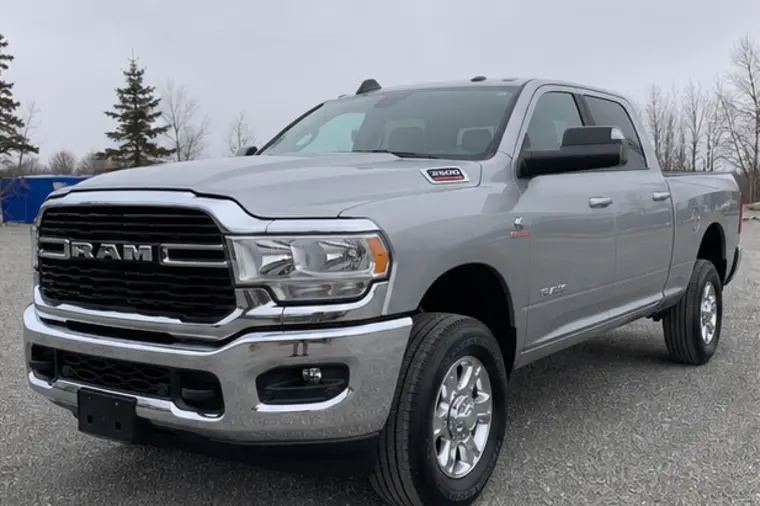
The RAM 2500 is a three-quarter-ton diesel pickup serving contractors, farmers, recreational towers and owners who want an HD platform without every one-ton compromise.
MODEL-YEAR INTELLIGENCE
Research RAM 2500 by Model-Year Era
6.7L Cummins
Use the selected model year and canonical engine relationship as research context. Confirm the exact transmission, cab, bed, drivetrain, rear-wheel configuration, labels and manufacturer documentation on the truck.
Choose the engine and year range that matches your truck. These ranges organize research; confirm the exact equipment from its labels and records.
Research this model in detail
RAM 2500 buying verdict: identify the generation and prove the load
The RAM 2500 Cummins is worth considering when a documented diesel configuration fits your recurring towing or work requirement. It is not automatically the right purchase for someone who needs maximum carried weight, mainly drives short unloaded journeys, or cannot establish the condition of a used truck. Make the first decision about the complete pickup and its intended job; make the second about the engine generation and ownership budget.
For a family trailer, write down passengers, luggage, hitch hardware and the loaded trailer connection weight before choosing trim. For a work truck, add permanent tool storage, auxiliary equipment and the actual crew. A truck that fits the trailer-weight chart can still be unsuitable once those items are aboard. The appropriate alternative may be a gas 2500, a properly configured 3500, a lighter trailer or a different cab and equipment package—not a modification intended to conceal the mismatch.
Three dated powertrain anchors, not one universal Cummins specification
Cummins dates its Dodge pickup introduction to 1989 and the launch of the 6.7L to 2007. These milestones help separate older 5.9L candidates from later 6.7L trucks, but they do not identify every mid-year engine, transmission or emissions configuration. A seller's model-year description should be reconciled with the truck's build information and installed equipment before you order parts or compare output.
The January 2025 Cummins release identifies a new pickup engine system rated at 430 hp and 1,075 lb-ft, paired with an eight-speed automatic. Its chassis-cab application is separately rated at 360 hp and 800 lb-ft. RAM Canada's 2026 pickup reference confirms the 430/1,075 pairing; neither figure belongs on every older RAM 2500 advertisement.
The 2025 release also describes changed fuel-system and valve-train hardware and revised filter access. That makes generation identification important when reviewing service invoices. It does not establish a measured reliability improvement or a maintenance-cost saving. Keep the launch description separate from the service history of the particular truck.
Current towing context without combining incompatible maxima
RAM Canada's 2026 reference advertises up to 20,000 lb of diesel towing and separately up to 3,590 lb of diesel payload. Those are base-configuration maxima, not a promise that a single equipped truck can achieve both together. The site separately lists a higher gas payload maximum. Do not use the gas number on a Cummins candidate, or use an advertised diesel trailer maximum to infer its remaining cargo allowance.
Record the exact cab, bed, drive system, axle and vehicle rating package. Obtain the matching year-specific towing guide and candidate labels, then account for passengers and permanent equipment. For an in-bed trailer, confirm the hitch installation, bed-clearance requirements and loaded pin weight. For a conventional trailer, confirm the receiver and all connecting components as well as the truck's limit.
Take the candidate out of the shortlist if those documents cannot establish its fit. An attractive trim or an air-levelling accessory does not resolve missing evidence. The separate annual towing guides below hold the detailed configuration research; this parent guide is not a replacement for that matrix.
Use pattern, fuel economy and daily ownership
The official 2026 owner handbook distinguishes diesel operating guidance from gasoline break-in guidance. Its diesel section calls for warming before load, avoiding prolonged idling and selecting a gear that avoids lugging. It also cautions that light-duty operation can extend the period before full efficiency. This is operating context, not an instruction to overload the truck or drive an arbitrary regeneration route.
For your purchase decision, record how long a normal journey lasts, how often the trailer is attached and whether the truck sits through cold periods. Ask the inspector to evaluate starting, warning messages and the installed emissions equipment against the correct manual. Do not turn a seller's explanation of 'normal diesel behaviour' into a diagnosis without examining the truck.
There is no single useful RAM 2500 mpg or L/100 km number across these generations and jobs. Compare fuel receipts over a known distance with trailer use, idling and season recorded. An unloaded highway figure should not become the budget for winter towing. Use a range in your cost worksheet and keep a separate allowance for service and repairs.
High-mileage inspection: turn claims into dated evidence
High mileage is a reason to inspect the whole vehicle, not a reliable prediction of remaining engine life. Start with a chronology of ownership, use, service and major repairs. Compare odometer readings across invoices and obtain engine-hour information when the truck records it. Missing records increase uncertainty; a thick folder is useful only when it identifies the vehicle, work and dates.
Arrange an independent diesel-capable inspection before committing. Request a cold start where practical, a scan with retained findings, a road test that reaches normal operating temperature, and an underbody inspection. Ask the technician to explain unresolved leaks, steering or suspension wear, warning messages and evidence of altered emissions or powertrain equipment. These are inspection subjects, not assertions that every RAM develops the same defects.
For a transmission replacement or engine repair, establish what was replaced, by whom and why. A component invoice does not prove the initiating fault was resolved or that unrelated systems are healthy. Reconcile any applicable campaign with the manufacturer using the VIN; a U.S. model-year recall list cannot establish Canadian applicability or completion.
Keep the parent decision separate from the dedicated problems, reliability, best-year and years-to-avoid pages. Those guides are routes to more focused evidence, not reasons to collapse different questions into a single unsupported ranking.
What should the ownership budget and shortlist include?
Separate immediate catch-up work from routine ownership. Price the inspection findings locally, using the actual engine and transmission, and include tires, brakes, batteries and chassis work rather than budgeting only for engine oil. Ask which service items are due by time, distance or operating conditions in the correct schedule. Do not apply a current eight-speed service quotation to a different older transmission.
Compare at least one alternative that performs the same job. A RAM 3500 deserves consideration when the 2500's carried-load reserve is inadequate; a gas HD deserves consideration when its capability is sufficient and diesel ownership adds little value to your use. For another brand, match cab, bed, drivetrain, wheel layout, condition and workload before comparing the purchase figures.
Which year should you buy? Start with the generation that meets your requirements, then compare verified condition and records within it. How long will it last? These sources do not support a guaranteed kilometre lifespan. Is a high-mileage example a bargain? Only a candidate-specific inspection and a complete ownership budget can support that judgement.
Research is not a statement of stock or an offer. Use the commercial destination only for any inventory actually available there; this guide does not establish seller availability, prices or dealer counts.
Separate diesel payload from gas payload
RAM Canada’s 2026 capability page lists different maximum payload figures for its gas and diesel engine families. The gas model’s advertised payload must not be copied into a Cummins truck’s buying calculations.
These are manufacturer maxima for properly equipped base configurations, not simultaneous ratings for every truck. Options, people and cargo change what is available. Use the exact candidate’s labels and applicable guide to establish its working allowance.
| 2026 RAM 2500 manufacturer reference | Published figure |
|---|---|
| High-output 6.7L Cummins | 430 hp; 1,075 lb-ft; eight-speed automatic |
| Maximum diesel payload | 3,590 lb / 1,627 kg |
| Maximum diesel towing | 20,000 lb / 9,071 kg |
| Maximum gas payload | 4,580 lb / 2,077 kg |
Put the 2025 powertrain transition in context
The eight-speed-era truck needs different transmission research from an older used 2500. When comparing candidates, record the installed powertrain rather than treating “Cummins automatic” as a complete description. Ask the servicing shop for the matching schedule and evidence of work due during your ownership period.
If an older truck is significantly cheaper, compare the complete acquisition and service plan. A lower price is useful only after unresolved repairs, tires, body condition and the intended load are included. Conversely, buying the newest engine version does not establish that the chosen configuration has the required payload.
Decide when to compare a 3500
If loaded hitch weight, tools and occupants use up the 2500’s allowance, compare a real 3500 configuration with the same worksheet. Keep cab and bed needs in the exercise so that a capacity gain does not create a daily-use mismatch.
For a fifth-wheel purchase, take the hitch model and installation requirements to the seller and shop. Establish the complete setup before relying on the trailer’s advertised dry weight or the truck’s maximum towing headline.
Model evolution & used-buying eras
Used examples span 5.9L and 6.7L Cummins eras, different emissions generations and multiple transmission pairings.
Cab, bed and work configurations
Cab, bed, drivetrain and suspension choices influence payload, ride and trailer suitability; confirm the exact configuration rather than assuming from the model badge.
Towing and payload
There is no single towing or payload number for every truck wearing this model badge. Ratings vary with model year, cab, bed, drivetrain, axle ratio, wheel configuration and factory equipment.
- Read the door-jamb payload label on the exact truck.
- Use the owner manual and manufacturer towing guide for the model year.
- Account for passengers, cargo, hitch equipment and trailer pin or tongue weight.
Used-buying checks
A diesel pickup should be assessed as a complete working vehicle, not only as an engine choice.
- Ask for dated maintenance and repair records rather than relying on a verbal summary.
- Evaluate a true cold start, warning lights, leaks, transmission behaviour and underbody condition.
- Confirm whether the truck has towed, carried commercial loads or been modified, and inspect accordingly.
- Verify emissions equipment, tires, suspension and the exact payload label on the truck itself.
Separate engine choice from the 2500 load calculation
The Cummins option attracts towing buyers, but the available occupant/cargo allowance still belongs to the exact RAM 2500. Compare the labelled allowance after accounting for a crew, bed storage and hitch equipment. A heavier trailer connection can make this calculation decisive before engine output enters the discussion.
| RAM 2500 use | Candidate evidence |
|---|---|
| Crew and tools | Seating requirement and complete carried weight |
| Recreational towing | Loaded trailer and connection weights |
| Former work truck | Hours, auxiliary equipment and service chronology |
Read the transmission history with the truck year
The 2500 badge spans historical Dodge and later RAM records. Identify the actual transmission and use its maintenance requirements rather than assuming all Cummins automatics share fluids or service procedures. When the intended pin load leaves too little room, compare a RAM 3500 with the same passenger and cargo assumptions. Accessories that improve ride or levelling do not establish a new vehicle rating.
Evidence note: manufacturer documents establish the specific facts and applications cited. Buying workflows and cost scenarios are DieselTrucks.ca editorial guidance. These pages do not publish measured failure rates or confirm the condition, recall status or capacity of a particular truck.
General educational content for Canadian diesel-pickup research. Verify the exact truck, model year, certification labels, owner manual and manufacturer documentation, and obtain qualified mechanical or towing advice where appropriate.
Sources & Further Verification
Use the exact model year, VIN, truck labels and current manufacturer documentation when moving from general research to a purchase or towing decision.