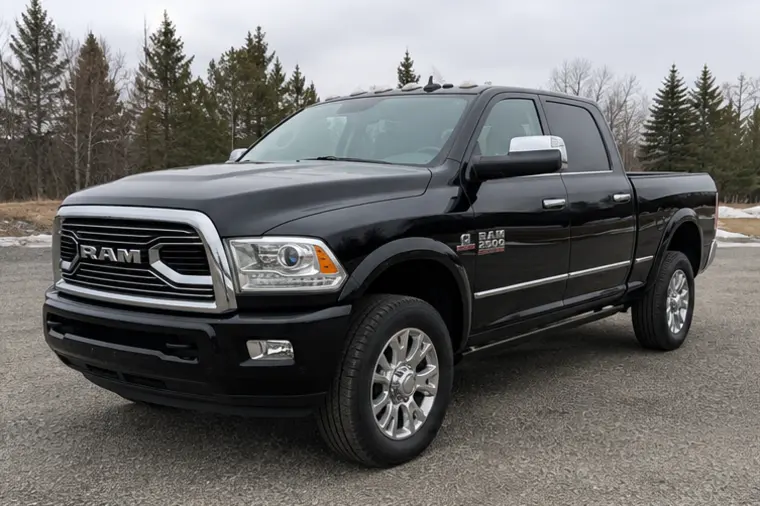
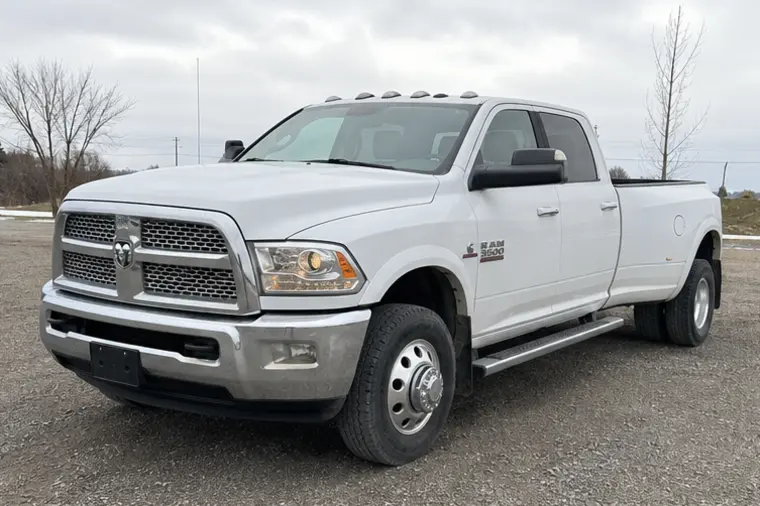
RAM 2500 and 3500 buyers should compare suspension, payload label, axle, cab, bed and rear-wheel configuration for the intended job.
| Decision factor | RAM 2500 | RAM 3500 |
|---|---|---|
| Typical role | Three-quarter-ton HD work and recreation | One-ton payload and heavier towing configurations |
| Rear wheels | SRW pickup focus | SRW or DRW, subject to model year and configuration |
| Daily use | Capacity/comfort balance for moderate HD jobs | Extra capacity only helps when the job requires it |
| Choose when… | The certification label leaves adequate payload reserve | Loaded pin weight, cargo and passengers need more reserve |
The 2026 diesel comparison is about more than the engine
RAM's current Canadian diesel pages cite the revised pickup output of 430 hp and 1,075 lb-ft with an eight-speed pairing for the relevant 2500 and 3500 applications. Their capability figures remain configuration-dependent. The shared current powertrain does not make the trucks equivalent for carried load.
RAM's overview distinguishes the 2500's link-coil rear suspension from the 3500's two-stage longitudinal leaf springs. That is a specific model distinction, not proof that every trim has the same ride or that a particular diesel truck carries the largest published payload.
Do not put the gas payload headline on a Cummins truck
The 2026 RAM 2500 capability page separates gas and diesel maxima. Its maximum diesel payload is 3,590 lb, while the gas headline is higher. Neither should replace the individual candidate's payload label, and the maximum diesel payload should not be assumed to coexist with every maximum towing configuration.
Calculate the load of occupants, work gear, hitch equipment and loaded trailer pin or tongue weight. If it leaves insufficient margin in the 2500 candidate, compare suitable 3500 SRW and DRW configurations. A 3500 still needs all the same rating checks, including axle and hitch limits.
For older RAM trucks, identify the actual engine and transmission before importing current specifications. The revised 2025-onward pickup powertrain is a meaningful boundary; it is not the specification for every earlier 6.7L truck.
How to choose
The 2500 may offer the right work/recreation balance; the 3500 broadens payload and DRW options for heavier trailers and loads.
- Define the real trailer and loaded pin or tongue weight.
- Estimate passengers, tools and cargo carried in the truck.
- Compare exact payload labels and manufacturer documentation.
- Inspect used condition, maintenance history and modifications.
Separate suspension and payload questions
RAM 2500 and 3500 differences vary by generation and configuration. Compare the exact payload label, rear axle rating, suspension, cab, bed and drivetrain rather than relying on class shorthand.
Choose by loaded use
A 2500 can fit many jobs when its labels leave adequate reserve. A 3500 becomes relevant when payload, pin weight or DRW availability demands it; bigger is not automatically better for every daily-use pattern.
Start with the load, not the 2500 or 3500 badge
The useful RAM 2500 versus 3500 question is whether a specific configuration carries and tows the recurring load with adequate margin. Write down passengers, tools, bed cargo, hitch hardware and the trailer's measured or defensible loaded connection weight. Compare that same worksheet against both trucks. A family maximum is not a shortcut for the door labels, rear-axle limit, tires, hitch and combined-weight limit on a candidate.
The 3500 family adds higher-rated SRW branches and DRW configurations, but that does not make every 3500 the stronger answer for every job. A lightly equipped 2500 and a premium 3500 can differ substantially in curb weight, ride, turning needs and available payload. Normalize cab, bed, drivetrain, powertrain and equipment before attributing a difference to model class.
| First question | Evidence that answers it |
|---|---|
| Can the truck carry the working load? | Candidate payload and axle labels plus people, cargo and connection weight |
| Can it tow the loaded trailer? | Exact-year configuration row, hitch rating and loaded trailer evidence |
| Does the 3500 add useful margin? | Matched SRW comparison before considering a DRW branch |
| Will it work every day? | Road test, dimensions, parking, ride and service plan |
2026 evidence shows why maxima cannot be compared alone
RAM Canada's 2026 Heavy Duty matrix publishes a 10,530-to-20,000-lb trailer range for RAM 2500 configurations. The 10,530-lb endpoint is a gas Power Wagon Crew Cab short-box 4x4, while the 20,000-lb endpoint is a high-output Cummins Crew Cab long-box 4x2 branch. Those are different trucks, and the numbers between them are discrete configuration cells rather than an adjustable rating.
The same Canadian matrix publishes RAM 3500 branches from 14,560 lb in one gas SRW Crew Cab long-box 4x4 row to 36,610 lb in a high-output Cummins DRW Regular Cab long-box 4x4 row. The 3500's higher ceiling comes from a different complete configuration, including rear wheels, GVWR and GCWR. It does not mean a used 3500 can tow 36,610 lb or that a 2500 is universally capped at one headline number.
| 2026 official branch | Published trailer position | What it establishes |
|---|---|---|
| 2500 gas Power Wagon Crew Cab short-box 4x4 | 10,530 lb | The 2500 range includes package-specific lower cells |
| 2500 HO Cummins Crew Cab long-box 4x2 | 20,000 lb | The 2500 maximum belongs to a defined diesel branch |
| 3500 HO Cummins Regular Cab long-box SRW 4x4 | 26,080 lb | A specific SRW 3500 can extend the in-family range |
| 3500 HO Cummins Regular Cab long-box DRW 4x4 | 36,610 lb | The overall maximum requires the stated DRW branch |
Separate 3500 SRW from 3500 DRW
A 3500 SRW is the meaningful first comparison when a buyer wants more payload or trailer margin without moving immediately to dual rear wheels. Compare it with a similarly configured 2500 using the same cab, bed, drivetrain and powertrain where the source permits. If the recurring pin load, bed cargo or rear-axle calculation still does not fit, the DRW branch becomes a separate decision rather than an automatic upgrade.
DRW changes width, tire count, rear-axle loading options and how the truck behaves in parking, narrow access and unloaded use. It can be appropriate for heavier in-bed hitch loads, but the buyer still needs the exact labels, compatible hitch and loaded combination. Never transfer a DRW row to a 3500 SRW or treat a 3500 badge as proof of dual-rear-wheel capacity.
Payload and rear-axle allowance often decide first
For a travel trailer, fifth-wheel or gooseneck, calculate the loaded connection weight and place it on the truck with passengers, tools, auxiliary fuel, hitch hardware and bed cargo. Compare the result with available payload, rear-axle rating, tire capacity and the installed hitch. Trailer weight alone cannot show whether the truck carries the load legally or comfortably.
This is where a 3500 may provide useful margin even when two candidates publish similar conventional trailer figures. Conversely, a 2500 may cover a moderate bumper-pull or work trailer without the width and daily-use changes of a DRW truck. Use separate conventional and in-bed hitch rows where the manufacturer provides them; never infer a fifth-wheel or gooseneck split from a combined value.
- Weigh the loaded truck and trailer by axle when practical.
- Keep tongue or pin weight distinct from total trailer weight.
- Confirm hitch, bed clearance and turning geometry for the actual trailer.
- Leave working margin for changing cargo, fluids and passengers.
Compare load allowance before Cummins output
Use identical passenger, tool and hitch loads on the two candidate worksheets. A RAM 2500 that covers ordinary bed work may leave insufficient allowance for a heavier fifth-wheel's pin load. A RAM 3500 introduces additional configurations, including the SRW/DRW choice in applicable pickups.
Keep transmission identity and service history separate from model class. More output does not establish more available payload, and a newer badge does not show whether required maintenance was done. Select from the actual trucks' load fit and documented repair exposure.
| Buyer priority | Comparison that resolves it |
|---|---|
| Daily crew use | Cab fit, actual allowance and road-test condition |
| Frequent fifth-wheel | Loaded pin weight, rear axle weight and hitch fit |
| Business body | Completed truck and body documentation |
Keep powertrain and model class as separate selectors
The 2026 matrix uses 6.4L HEMI gas and high-output 6.7L Cummins diesel branches with specific transmissions and axle ratios. Engine output does not select the trailer row. Cab, bed, drivetrain, GVWR, GCWR, rear wheels and market remain necessary. Earlier model years can use different engines, transmissions, outputs and chart structures, so a current row must not be backfilled into a used candidate.
For used trucks, verify engine and transmission identity from the build information and service file. Price maintenance or repair exposure separately from load capability. A 3500 with more published capacity but unresolved transmission, emissions, cooling or chassis work can be a worse purchase than a suitable 2500 with credible records; the reverse can also be true when the 2500 lacks the required payload.
Compare daily use and ownership before buying margin
More capacity has value only if it solves a real recurring or planned load. Compare wheelbase, overall width, cab and bed length, parking, site access, empty ride, tire replacement, registration and insurance for the exact candidates. A contractor carrying material daily may value the 3500's allowance differently from a buyer towing a moderate trailer several times per year.
Build a first-year ownership sheet with inspection findings, scheduled service, tires, brakes, batteries, hitch work and downtime. Keep trim and condition differences out of the class comparison by pricing them explicitly. A premium interior, lift, oversized tire or aftermarket accessory can reduce remaining allowance or complicate service without adding a manufacturer rating.
| Use pattern | Likely comparison path |
|---|---|
| Moderate bumper-pull and daily commuting | Verify a 2500 first, then compare matched 3500 SRW |
| High pin load but no DRW requirement | Compare 2500 with a matched 3500 SRW worksheet |
| Recurring heavy in-bed hitch load | Test 3500 SRW and DRW branches separately |
| Commercial body or concentrated cargo | Use completed-vehicle documentation and axle weights |
Used-truck decision sequence
Shortlist only candidates whose exact configuration fits the load. Then compare history and condition: VIN and labels, ownership and kilometre timeline, engine hours where available, cold start, scan, road test, fluids, cooling, fuel and emissions systems, transmission, transfer case, axles, steering, suspension, brakes, tires, frame, body and towing equipment. Ask what has been modified and whether supporting documentation exists.
Choose the 2500 when it fits the recurring load with defensible margin and its daily-use or ownership advantages matter. Choose a 3500 SRW when the same worksheet shows useful additional allowance without requiring DRW. Choose DRW only when its load and stability advantages solve the actual job and the buyer accepts the packaging trade-offs. None of these is a universal reliability or value ranking.
Evidence note: manufacturer documents establish the specific facts and applications cited. Buying workflows and cost scenarios are DieselTrucks.ca editorial guidance. These pages do not publish measured failure rates or confirm the condition, recall status or capacity of a particular truck.
General educational content for Canadian diesel-pickup research. Verify the exact truck, model year, certification labels, owner manual and manufacturer documentation, and obtain qualified mechanical or towing advice where appropriate.
Sources & Further Verification
Use the exact model year, VIN, truck labels and current manufacturer documentation when moving from general research to a purchase or towing decision.
- RAM Canada — 2026 Heavy Duty payload and towing matrix
- RAM — 2026 Heavy Duty payload and towing matrix (U.S.)
- Stellantis Fleet — 2026 RAM Heavy Duty buyer's guide
- RAM Canada — before-you-buy towing guidance
- RAM Canada 2026 2500 capability — separate gas/diesel maxima and equipment conditions
- RAM Canada 2026 3500 capability — pickup powertrain and configuration-dependent maximum
- RAM Canada 2026 2500 — 2500/3500 suspension distinctions
- Cummins January 2025 announcement — revised engine, eight-speed and separate pickup/chassis-cab outputs
- Cummins–RAM engine history