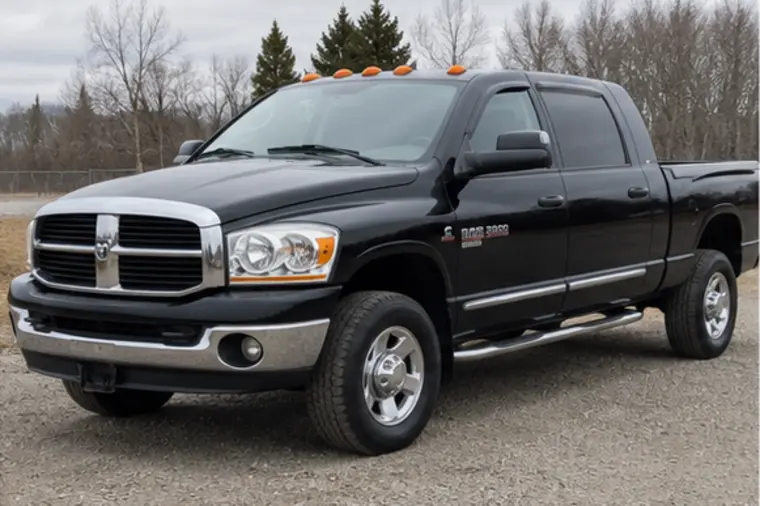
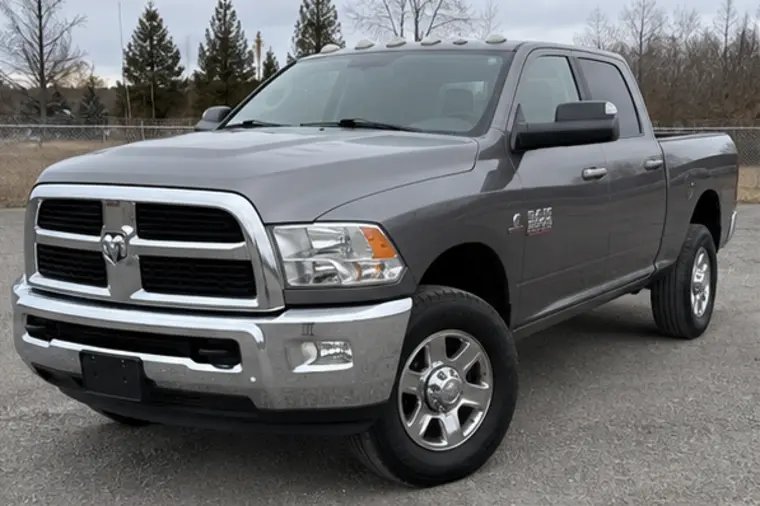
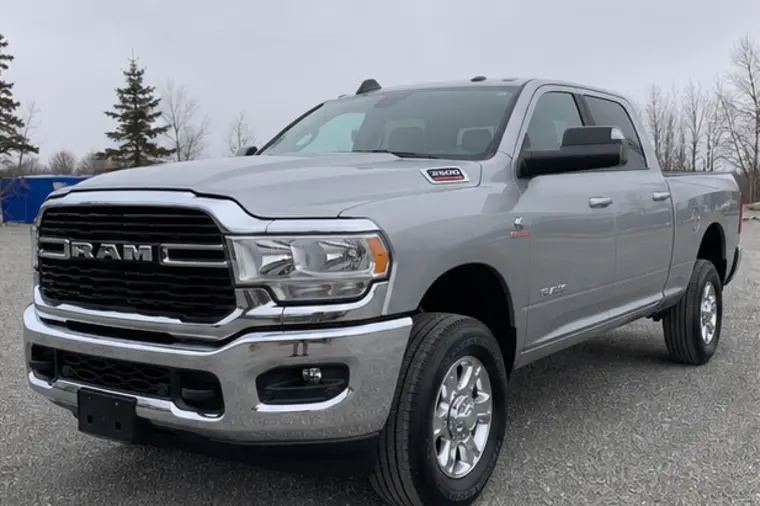
The 6.7L Cummins is a defining RAM HD engine, but model year, output version and transmission pairing materially change the truck around it.
Two exact pickup snapshots show why year, output and transmission belong together
Cummins’ 2021 pickup material does not describe one universal 6.7L rating. It lists the RAM 3500 with Aisin automatic at 420 hp and 1,075 lb-ft, while RAM 2500 and 3500 pickups with the 68RFE are listed at 370 hp and 850 lb-ft. The same source identifies a 16.2:1 compression ratio for the high-output version and 19.0:1 for the standard-output version. Those are application distinctions, not a ranking of durability.
For 2025, Cummins lists RAM 2500 and 3500 pickups at 430 hp and 1,075 lb-ft with the new eight-speed transmission. Its launch announcement separately lists the chassis-cab engine at 360 hp and 800 lb-ft. A chassis cab and a pickup therefore cannot be assigned the same output merely because both use the 6.7L name.
The table is a comparison of two documented snapshots, not a complete annual specification history. It does not backdate 2025 output to earlier trucks, place the 2021 Aisin rating in a RAM 2500, or establish the calibration of a candidate without its year and application.
| Documented application | Output | Boundary to preserve |
|---|---|---|
| 2021 RAM 2500/3500 pickup, 68RFE | 370 hp / 850 lb-ft | Standard-output pickup branch |
| 2021 RAM 3500 pickup, Aisin automatic | 420 hp / 1,075 lb-ft | High-output rating is not listed for the 2500 |
| 2025 RAM 2500/3500 pickup | 430 hp / 1,075 lb-ft | New eight-speed pickup system |
| 2025 RAM chassis cab | 360 hp / 800 lb-ft | Separate commercial application |
The 2025 change reaches beyond the peak-output number
Cummins describes the 2025 system as using a new high-pressure fuel-delivery system, a new fuel pump, top-feed dry-service injectors, glow plugs for cold starting and revised air handling. It also identifies top-side access for the oil filter and dual fuel filters. Those details create practical parts, procedure and service-access boundaries between revisions.
Manufacturer statements about smoother operation, serviceability or capability are not independent reliability measurements. The new component layout does not prove a lower repair rate, and a familiar displacement does not prove that earlier parts or procedures carry forward. Use the correct model-year parts catalogue, service information and calibration identification for the truck being evaluated.
For a used 2025-or-newer candidate, ask the inspecting shop to record the installed fuel-system and filtration components it can identify, the software or campaign information it actually checked, and any limits on that identification. For an older truck, retain its own configuration rather than judging it against the current system solely by peak torque.
Build the service file around duty cycle and the exact application
Cummins’ 2021 pickup page says the oil-change warning is duty-cycle based and gives maximum limits of 15,000 miles or 24,000 kilometres, 12 months or 500 hours, whichever occurs first. It also says severe conditions can shorten the interval and describes checking the level on level ground 30 minutes after shutting down a fully warmed engine. These are 2021 pickup-source boundaries, not a blanket schedule for every 6.7L truck.
Distance alone can hide concentrated idling or stationary work. Record kilometres, engine hours, calendar time and the operating assignment when they are available. Match invoices to the applicable owner information and keep oil quantity, oil specification and service interval as separate fields; one does not establish the others.
A seller’s statement that maintenance was completed ‘on time’ is not enough to compare two different duty cycles. Ask for dated work orders, product and filter identification, mileage or hours and any related diagnosis. Missing records create uncertainty, not proof of neglect, and complete records do not guarantee future reliability.
For 2025 and 2026 trucks, retrieve the matching RAM owner information before transferring a 2021 interval or procedure. The official 2026 pickup handbook independently confirms a 12-U.S.-quart / 11.4-litre with-filter capacity, but its capacity row alone does not reproduce the full 2021 level-check procedure.
Use a campaign record as an application-and-remedy check, not a family score
FCA’s Y78/21V880 filing covers defined 2019–2020 diesel populations and gives separate pickup and chassis-cab production boundaries. Its remedy describes replacing the high-pressure fuel pump, updating powertrain-control software, and inspecting or replacing additional fuel-system components as necessary. A completion entry should therefore be matched to the candidate and the work actually recorded.
The filing does not establish that every 6.7L truck failed, that every fuel-system component was replaced on every repaired vehicle, or that another model year shares the same action. A potentially affected population is not a measured failure rate for the engine family. Current symptoms still require current diagnosis even when the campaign record is complete.
Before purchase, preserve four distinct conclusions: the truck’s exact application, whether the campaign applies, what remedy is documented, and what the present inspection found. Keeping them separate prevents a recall lookup from being treated as a substitute for mechanical condition or a prediction of future cost.
A reproducible used-candidate decision file
Start with the VIN-decoded year and truck application, then record pickup or chassis cab, 2500 or 3500, transmission, output branch and emissions configuration. Add the payload and certification labels from the actual truck. This identification step prevents a correct specification from being assigned to the wrong variant.
Next, attach the model-year owner information, maintenance and repair history, applicable campaign results and a current inspection. Ask the shop to identify which conclusions came from records, which came from observation or testing and which remain unresolved. Do not replace an unresolved software, fuel-system or emissions question with an online reputation claim.
Finally, compare the candidate with the intended load, route, climate, service access and downtime plan. The result may favour a lower-output older truck with strong evidence, a newer system with a suitable support plan, or no purchase at all. This guide supplies a method; it does not assign a best year, rank reliability or promise a service life. Those remain separate editorial intents and vehicle-specific decisions.
| File section | Minimum useful record | Do not infer |
|---|---|---|
| Identity | Year, application, transmission and output branch | Specification from engine name alone |
| Service | Dates, distance or hours, products and work performed | Future repair-free operation |
| Campaigns | Applicability and documented remedy | Family-wide failure rate |
| Condition and fit | Current inspection plus the actual work or towing brief | Universal best configuration |
The 2025 powertrain change separates two buying eras
Cummins’ January 2025 announcement identifies a revised engine and an eight-speed transmission for the new HD powertrain. Its stated output distinguishes pickups from chassis cabs: 430 hp and 1,075 lb-ft for pickups, versus 360 hp and 800 lb-ft for chassis cabs.
These figures must not be applied to an older 6.7L truck. Identify the model year, application and transmission before comparing a used RAM with a newer one. An advertisement that lists only displacement omits information that materially changes the service and operating references you need.
| 2025 application in Cummins’ announcement | Horsepower | Torque |
|---|---|---|
| Heavy-duty pickup | 430 hp | 1,075 lb-ft |
| Chassis cab | 360 hp | 800 lb-ft |
Treat transmission identification as part of engine selection
On an older used-truck shortlist, request the original configuration evidence and inspect the unit actually installed. A replacement transmission, altered calibration or undocumented conversion should be discussed with the inspecting shop rather than resolved by the model badge alone.
Compare the service invoices with the correct manual. If the seller describes a transmission as “rebuilt,” ask who performed the work, what was replaced, what warranty remains and whether the original complaint returned. That is a more useful starting point than assigning the same repair allowance to every Cummins-powered RAM.
Fuel-system history and recall completion are different records
For the specified 2019–2020 RAM diesel populations, the U.S. Y78 recall filing provides a documented fuel-pump campaign to investigate. Check Canadian applicability and current completion by VIN; do not assume every truck in an advertisement’s year range has the same status.
Keep any campaign completion record alongside independent repair invoices. A campaign entry may answer whether a required action was recorded, while a shop invoice may explain a separate breakdown or replacement. Neither should be converted into an unsupported failure percentage or a guaranteed remaining engine life.
Where this engine is used
Applications include RAM 2500 and 3500 pickups, with chassis-cab versions and output ratings requiring separate context.
Evolution over time
Emissions generation, transmission options and output changes mean buyers should research the exact year and configuration.
Output ratings, calibrations, turbocharging, emissions systems and supporting hardware can differ. Compare a specific model year and configuration rather than treating the engine name as one unchanging specification.
Output and transmission context
Horsepower and torque ratings can change by year, calibration and application. Transmission pairings also evolve and may differ between standard-output, high-output, pickup and chassis-cab configurations. Verify the exact powertrain instead of applying one current rating to every used truck.
Work and towing context
The engine is only one part of a tow vehicle. Cab, bed, axle ratio, transmission, cooling package, payload label, SRW or DRW configuration and hitch setup determine how the complete truck fits a workload.
Maintenance and emissions context
Modern diesel ownership includes the DPF, DEF and EGR systems as well as the engine itself. Usage pattern, maintenance, warning history and previous modifications are relevant when evaluating a used truck.
Build the service plan from the exact model-year owner documentation and the truck's records. Cold weather, extended idling, short trips, dust and frequent towing may change inspection priorities.
Questions for a used-truck inspection
Ask what work the truck performed, whether service intervals are documented and whether the powertrain or emissions system has been modified.
- Ask for dated maintenance and repair records rather than relying on a verbal summary.
- Evaluate a true cold start, warning lights, leaks, transmission behaviour and underbody condition.
- Confirm whether the truck has towed, carried commercial loads or been modified, and inspect accordingly.
- Verify emissions equipment, tires, suspension and the exact payload label on the truck itself.
Fuel-pump campaign evidence and application boundaries
FCA's U.S. 21V-880 / Y78 report covers certain 2019–2020 RAM diesel pickups and chassis cabs and describes a high-pressure fuel-pump concern. It is a reason to verify the exact VIN and repair history, not a statement that the entire 6.7L family shares one failure rate. Canadian applicability and completion require Canadian and manufacturer verification.
Request campaign-completion documentation and the details of any separate fuel-system repair. A completed recall does not certify present engine condition, and a replacement-pump invoice does not explain every prior warning. Have an inspecting shop identify the installed configuration and interpret remaining symptoms.
For earlier and later 6.7L trucks, keep transmission, output version, emissions equipment and pickup versus chassis-cab context distinct. Compare the working routine with the correct maintenance and operating guidance. The useful buying file connects identity, service evidence, diagnostic findings and a realistic budget for unresolved work.
Keep output, transmission and application in separate fields
A Cummins 6.7L badge does not identify whether a truck is a 2500, 3500 pickup or completed chassis cab. It also does not establish a particular transmission or high-output configuration. Request factory evidence and compare it with the installed components.
For a used work truck, connect repeated fuel or emissions complaints with the actual repair history. Campaign evidence addresses its specified population; ordinary inspection still needs to assess the rest of the truck. A lower asking price should be weighed against repair access and time before the first job.
| Evidence area | Decision it supports |
|---|---|
| Powertrain identity | Matching service and towing documents |
| Fuel campaign record where applicable | VIN-specific remedy and completion research |
| Stationary or towing use | Hours, maintenance and auxiliary-system inspection |
Evidence note: manufacturer documents establish the specific facts and applications cited. Buying workflows and cost scenarios are DieselTrucks.ca editorial guidance. These pages do not publish measured failure rates or confirm the condition, recall status or capacity of a particular truck.
FIND TRUCKS USING THIS ENGINE
Connect the engine to a model year and exact truck.
Engine-family research is one part of the configuration. Use the explorer to connect model, year, transmission, cab, bed and rear-wheel context.
General educational content for Canadian diesel-pickup research. Verify the exact truck, model year, certification labels, owner manual and manufacturer documentation, and obtain qualified mechanical or towing advice where appropriate.
Sources & Further Verification
Use the exact model year, VIN, truck labels and current manufacturer documentation when moving from general research to a purchase or towing decision.
- FCA: U.S. recall 21V-880 / Y78 population and defect report
- Cummins: RAM engine-history milestones
- Cummins January 2025 announcement — revised engine, eight-speed and separate pickup/chassis-cab outputs
- Cummins — 2021 6.7L pickup ratings and maintenance
- Cummins — 2025 pickup engine specifications
- RAM — 2026 2500/3500 owner handbook