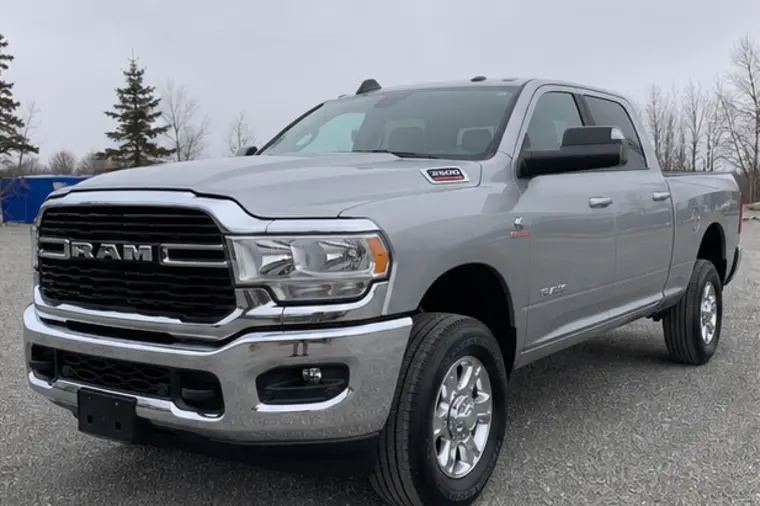
The 2019 RAM 2500 chart publishes maximum trailer ratings from 10,380 to 19,780 lb, but neither endpoint is a universal answer. The 19,780-lb maximum belongs to a 4x2 Regular Cab Tradesman with an 8-foot box, 6.7L Cummins, 68RFE six-speed, 3.73 axle and 27,000-lb GCWR. The 10,380-lb endpoint belongs to a 4x4 Crew Cab with Power Wagon equipment, RamBox, 6.4L HEMI, 8HP75-LCV eight-speed, 4.10 axle, 8,565-lb GVWR and 18,000-lb GCWR. This guide preserves RAM's generic and Canada-only rows, all published source dashes and the chart's estimated-load assumptions. It does not turn a catalogue row into a rating for an unseen Canadian VIN or loaded combination.
Direct answer: 10,380 to 19,780 lb across the published chart
RAM's 2019 chart is a selector, not a single-number specification. The body, drive, box, engine, transmission, axle ratio, GVWR, base weight and GCWR all remain attached to a maximum-trailer cell. The highest and lowest results therefore answer two different configuration questions.
The chart marks the 19,780-lb Cummins Regular Cab result as maximum capability. A buyer still has to match the physical truck, labels, equipment and loaded axle weights. Power Wagon equipment changes the lower branch materially and is not interchangeable with a standard Crew Cab row.
| Endpoint | Exact 2019 configuration | GVWR / GCWR | Maximum trailer |
|---|---|---|---|
| Chart maximum | 4x2 Regular Cab, 8-foot box, 6.7L Cummins, 68RFE, 3.73 | 10,000 or Canada-only 9,900 / 27,000 lb | 19,780 lb |
| Chart minimum | 4x4 Crew Cab, Power Wagon equipment, RamBox, 6.4L HEMI, 8HP75-LCV, 4.10 | 8,565 / 18,000 lb | 10,380 lb |
| Power Wagon standard box | 4x4 Crew Cab, Power Wagon equipment, 6-foot-4 box, 6.4L HEMI, 4.10 | 8,565 / 18,000 lb | 10,620 lb |
How to use the tables without losing a selector
Choose the market row first. RAM separately labels a set of 9,900-lb-GVWR rows as Canada only; the generic companion rows usually use 10,000 lb. Then match drive, cab, box or RamBox, engine and axle ratio. A dash means the chart does not publish that powertrain in that body row.
The compact tables below reproduce maximum trailer ratings. RAM's primary chart also publishes estimated payload, base-weight distribution, front and rear GAWR and GCWR. Use the original row whenever those additional controls are needed; do not select a towing number by engine badge alone.
4x2 Regular Cab rows
The Regular Cab with the factory 8-foot box owns the 19,780-lb chart maximum. Both generic and Canada-only rows publish the same three trailer ratings, even though their GVWR and payload columns differ. Box-delete rows contain gas entries only and are not completed-body ratings.
| Market / GVWR | Configuration | 6.4L / 3.73 | 6.4L / 4.10 | 6.7L / 3.73 |
|---|---|---|---|---|
| Generic / 10,000 | 8-foot box | 15,080 | 17,580 | 19,780 |
| Generic / 10,000 | Box delete | 14,900 | 17,400 | — |
| Canada only / 9,900 | 8-foot box | 15,080 | 17,580 | 19,780 |
| Canada only / 9,900 | Box delete | 14,900 | 17,400 | — |
4x2 Crew Cab rows
Crew Cab results change with the short box, RamBox, long box and box-delete frame. The Canada-only short-box diesel cell is 19,370 lb rather than the generic row's 19,350 lb. That small printed difference is retained; it is not rounded into a shared value.
No diesel result is published for a box-delete row. A missing diesel cell is not permission to subtract a guessed body weight from a complete pickup rating.
| Market / GVWR | Configuration | 6.4L / 3.73 | 6.4L / 4.10 | 6.7L / 3.73 |
|---|---|---|---|---|
| Generic / 10,000 | 6-foot-4 box | 14,680 | 17,180 | 19,350 |
| Generic / 10,000 | RamBox | 14,560 | 17,060 | 18,700 |
| Generic / 10,000 | Short-frame box delete | 14,500 | 17,000 | — |
| Generic / 10,000 | 8-foot box | 14,580 | 17,080 | 19,200 |
| Generic / 10,000 | Long-frame box delete | 14,420 | 16,920 | — |
| Canada only / 9,900 | 6-foot-4 box | 14,680 | 17,180 | 19,370 |
| Canada only / 9,900 | RamBox | 14,560 | 17,060 | 18,700 |
| Canada only / 9,900 | Short-frame box delete | 14,500 | 17,000 | — |
| Canada only / 9,900 | 8-foot box | 14,580 | 17,080 | 19,200 |
| Canada only / 9,900 | Long-frame box delete | 14,420 | 16,920 | — |
4x4 Mega Cab rows preserve large Canada-only diesel differences
Mega Cab is 4x4 in the reviewed chart. RAM publishes 16,520 lb for the generic standard-box diesel row and 15,520 lb for its Canada-only companion. The RamBox diesel pair is 15,070 and 14,070 lb. Those 1,000-lb differences are visually clear in the source and remain distinct.
The gas rows do not follow the same pattern: the standard-box 4.10 cell changes by only 10 lb, while other gas cells match. This is why neither the powertrain nor the Canadian label can be treated as a fixed adjustment.
| Market / GVWR | Configuration | 6.4L / 3.73 | 6.4L / 4.10 | 6.7L / 3.73 |
|---|---|---|---|---|
| Generic / 10,000 | 6-foot-4 box | 14,000 | 16,500 | 16,520 |
| Generic / 10,000 | RamBox | 13,850 | 16,350 | 15,070 |
| Canada only / 9,900 | 6-foot-4 box | 14,000 | 16,490 | 15,520 |
| Canada only / 9,900 | RamBox | 13,850 | 16,350 | 14,070 |
4x4 Regular Cab rows
The complete-pickup diesel rating is 19,350 lb in both generic and Canada-only Regular Cab rows. The gas pickup cells differ by 10 lb between market rows. Box-delete rows again publish only the two gas axle choices.
| Market / GVWR | Configuration | 6.4L / 3.73 | 6.4L / 4.10 | 6.7L / 3.73 |
|---|---|---|---|---|
| Generic / 10,000 | 8-foot box | 14,710 | 17,210 | 19,350 |
| Generic / 10,000 | Box delete | 14,550 | 17,050 | — |
| Canada only / 9,900 | 8-foot box | 14,700 | 17,200 | 19,350 |
| Canada only / 9,900 | Box delete | 14,550 | 17,050 | — |
4x4 Crew Cab short-box, RamBox and Power Wagon rows
For a standard short-box Crew Cab, the generic diesel cell is 19,040 lb and the Canada-only cell is 19,010 lb. RamBox changes those to 18,870 and 17,720 lb. Keep the body row and market row together rather than applying a generic RamBox deduction.
Power Wagon equipment is a separate gas-only branch at 8,565-lb GVWR and 18,000-lb GCWR. The source publishes only the 4.10 axle there: 10,620 lb with the standard box and 10,380 lb with RamBox.
| Market / GVWR | Configuration | 6.4L / 3.73 | 6.4L / 4.10 | 6.7L / 3.73 |
|---|---|---|---|---|
| Generic / 10,000 | 6-foot-4 box | 14,410 | 16,910 | 19,040 |
| Generic / 10,000 | RamBox | 14,260 | 16,760 | 18,870 |
| Generic / 10,000 | Short-frame box delete | 14,190 | 16,690 | — |
| Power Wagon / 8,565 | 6-foot-4 box | — | 10,620 | — |
| Power Wagon / 8,565 | RamBox | — | 10,380 | — |
| Canada only / 9,900 | 6-foot-4 box | 14,410 | 16,910 | 19,010 |
| Canada only / 9,900 | RamBox | 14,260 | 16,760 | 17,720 |
| Canada only / 9,900 | Short-frame box delete | 14,190 | 16,690 | — |
4x4 Crew Cab long-box rows
The long-box diesel cells use 25,525-lb GCWR rather than the 27,000-lb value found in several shorter-body diesel rows. Their maximum trailer ratings are 17,390 lb for the generic pickup and 17,380 lb for the Canada-only pickup.
The paired box-delete rows remain gas-only. The Canada-only gas results are 10 to 20 lb below the generic cells, again showing why a market label cannot be represented by one blanket deduction.
| Market / GVWR | Configuration | 6.4L / 3.73 | 6.4L / 4.10 | 6.7L / 3.73 |
|---|---|---|---|---|
| Generic / 10,000 | 8-foot box | 14,220 | 16,720 | 17,390 |
| Generic / 10,000 | Long-frame box delete | 14,030 | 16,530 | — |
| Canada only / 9,900 | 8-foot box | 14,220 | 16,720 | 17,380 |
| Canada only / 9,900 | Long-frame box delete | 14,020 | 16,510 | — |
The Canada-only rows are independent source records
Most Canada-only rows use 9,900-lb GVWR while the generic companion uses 10,000 lb. Payload changes because the source defines payload as GVWR minus base weight. Maximum trailer rating sometimes matches, sometimes changes slightly and sometimes changes by 1,000 lb or more.
Do not choose the generic row merely because it produces a larger number. Match the original-market documentation, certification label, equipment and build record for the actual truck. This article does not infer whether an unseen VIN uses one branch or the other.
Engine, transmission and axle choices stay attached
The 6.4L HEMI rows use the 8HP75-LCV eight-speed and publish both 3.73 and 4.10 axle choices for most standard bodies. The 6.7L Cummins rows use the 68RFE six-speed and a 3.73 axle in this chart. A transmission swap, axle change or ambiguous listing needs separate proof.
For the gas rows, moving from 3.73 to 4.10 usually accompanies a GCWR change from 21,500 to 24,000 lb and a 2,500-lb increase in the displayed trailer rating. That is an observed pattern within these cells, not permission to recalculate an unlisted body.
GCWR is part of the answer, not background metadata
RAM publishes GCWR beside every maximum-trailer value. The highest Cummins result uses 27,000 lb. Mega Cab diesel rows use 25,265 lb, and the long-box 4x4 Crew Cab diesel rows use 25,525 lb. Power Wagon equipment uses 18,000 lb.
A trailer rating does not authorize the combination to exceed GCWR. It also does not override truck GVWR, front or rear GAWR, tire limits or hitch limits. Weigh the loaded combination and compare each independent control.
Payload and trailer rating are mutually exclusive estimates
RAM states that payload and maximum trailer weight are estimated, rounded to the nearest 10 lb and mutually exclusive. Its payload formula is GVWR minus base weight. The chart therefore does not promise that the full displayed payload and full displayed trailer rating can be used together.
People, cargo, accessories, hitch hardware and trailer tongue or pin weight all consume truck capacity. Use the tire-and-loading and certification labels, then verify the loaded axle weights. A strong tow rating can still leave insufficient payload or rear-axle margin for a particular trailer.
RAM's SAE J2807 assumptions define the catalogue result
The chart specifies 300 lb of passenger weight and 100 lb of options weight. It uses 10 percent tongue weight for a conventional hitch and 15 percent for fifth-wheel or gooseneck. Trailering-equipment allowances are 75 lb conventional, 70 lb gooseneck and 250 lb fifth-wheel.
These inputs explain the published calculation basis; they are not a loading recipe for every owner. If actual passengers, options, equipment or hitch weight differ, the remaining margins differ. Trailer brakes, receiver or bed-hitch ratings and operating requirements still need their own checks.
Box-delete rows require completed-body evidence
RAM includes explicitly named box-delete configurations and states a body-completion assumption of 80 lb per foot from the end of the cab to the end of the frame. Those rows are useful starting evidence for the listed incomplete configuration, not final ratings for an unknown service body or flat deck.
Retain the final-stage certification, completed empty weight, axle distribution and upfitter documentation. This page does not transfer a box-delete result to a factory pickup or claim that every completed body stays within the chart's assumed completion weight.
Power Wagon equipment is not a standard Crew Cab row
The two Power Wagon-equipment rows have 8,565-lb GVWR, 18,000-lb GCWR, 4.10 axle and gas power only. Their 10,620- and 10,380-lb ratings are materially below the standard 4x4 Crew Cab gas 4.10 cells.
Do not add a diesel result or substitute a standard Crew Cab rating. Confirm the build equipment and the actual truck's labels before selecting this branch.
A vehicle-specific towing check has three layers
First, identify the exact catalogue row. Second, verify the individual truck's labels, original equipment, hitch and any modifications. Third, compare loaded scale weights with GVWR, both GAWRs, GCWR, tire limits and hitch ratings.
Keep the trailer's loaded weight and tongue or pin weight separate from advertised dry weight. Water, batteries, propane, cargo and dealer-installed equipment can change the loaded result. A chart match is necessary evidence, but it is not the final loaded calculation.
A reproducible 2019 RAM 2500 worksheet
Record every selector before copying a number. If a field is unknown, leave the result unresolved rather than choosing the largest compatible-looking row.
| Step | Evidence to retain | Failure prevented |
|---|---|---|
| 1 | 2019 model year and original market | Wrong year or generic/Canada-only row |
| 2 | 4x2/4x4, Regular/Crew/Mega Cab | Wrong body family |
| 3 | Standard box, RamBox or box delete | Wrong base-weight branch |
| 4 | 6.4L/8HP75 or 6.7L/68RFE and axle | Wrong powertrain row |
| 5 | GVWR, GAWR, GCWR, tires and hitch | Headline-only conclusion |
| 6 | Loaded truck, axle and trailer scale weights | Catalogue estimate used as measured proof |
Keep 2019 separate from later RAM HD charts
This guide is limited to RAM's 2019 chart. A later RAM 2500 can change transmission, output, weights, body availability, GVWR, GCWR and individual trailer cells even when the badge and cab description look familiar.
Do not import a 2020 or current-year maximum into a 2019 listing. The general RAM 2500 towing page retains the broad model intent; exact-year siblings need their own source matrices.
Source method and evidence limits
All seven pages of RAM's manufacturer-hosted chart were rendered and visually checked against layout-preserving extraction on 14 September 2026. The 34 body/market rows in the tables retain every displayed maximum-trailer result and dash. RAM's Body Builder record confirms the document identity.
The chart does not certify a Canadian VIN, installed hitch, current payload, tongue or pin weight, axle margin, completed upfit, trailer brakes, legal operation, reliability, failure rate, inventory, sellers, dealer counts, prices, financing or offers.
Frequently asked questions
Can every 2019 RAM 2500 tow 19,780 lb? No. That figure belongs to the exact Cummins Regular Cab 4x2 long-box row. Is the Canada-only matrix just 100 lb lower? No. Its GVWR is commonly 100 lb lower, but trailer-rating differences vary by configuration and include 1,000-lb Mega Cab diesel differences.
Does a 4.10 axle always identify the largest result? No. The chart's highest result is a 3.73-axle Cummins row. Can payload and maximum trailer rating be added together? No. RAM explicitly calls them mutually exclusive estimated values.
What this guide establishes—and what it does not
It establishes the complete maximum-trailer selector printed in RAM's seven-page 2019 RAM 2500 chart: 34 body/market rows, two engines, their paired transmissions, two axle ratios where published, three GVWR families and configuration-specific GCWR branches.
It does not establish that a particular used truck is unmodified, correctly represented, equipped with an adequate hitch, within loaded axle or tire limits, mechanically sound or available for sale. Complete those checks with vehicle-specific documents and measurements.
Evidence note: manufacturer documents establish the specific facts and applications cited. Buying workflows and cost scenarios are DieselTrucks.ca editorial guidance. These pages do not publish measured failure rates or confirm the condition, recall status or capacity of a particular truck.
General educational content for Canadian diesel-pickup research. Verify the exact truck, model year, certification labels, owner manual and manufacturer documentation, and obtain qualified mechanical or towing advice where appropriate.
Sources & Further Verification
Use the exact model year, VIN, truck labels and current manufacturer documentation when moving from general research to a purchase or towing decision.