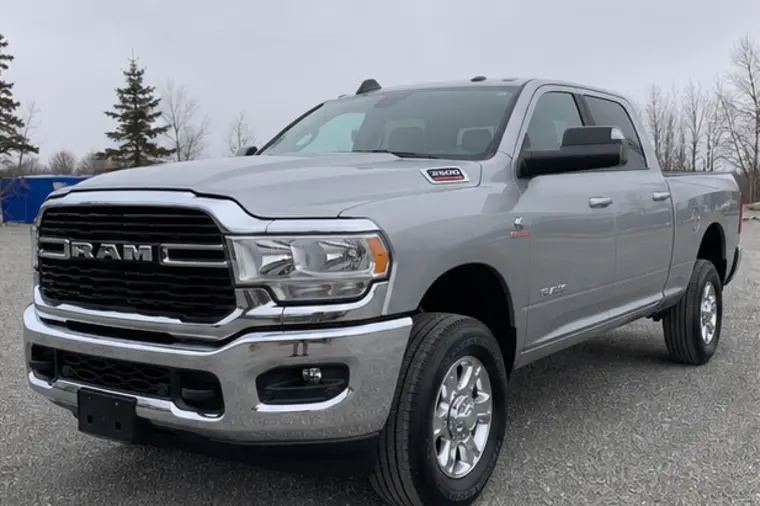
RAM's 2023 2500 charts publish 45 configuration rows and maximum-trailer ratings from 10,490 to 19,980 lb. Those endpoints belong to different trucks. The 19,980-lb result appears in several 4x2 Cummins rows and the 4x4 Crew Cab short-box Cummins row, each with its own base weight and GCWR. The 10,490-lb minimum is one of two Power Wagon rows, with the 6.4L HEMI, 4.10 axle, 8,565-lb GVWR and 17,800-lb GCWR. This guide preserves all 18 4x2 rows and 27 4x4 rows, including the new Rebel branch, a revised Power Wagon table and an unresolved source arithmetic conflict. It does not turn a catalogue row into a rating for an unseen VIN.
Direct answer: 10,490 to 19,980 lb across the published rows
There is no single 2023 RAM 2500 towing capacity. RAM attaches each maximum-trailer value to drive, cab, box, engine, transmission, axle selection, GVWR, payload, base weight, GAWR and GCWR. The same badge can therefore lead to materially different results.
The range on this page covers only the completed-pickup configurations actually printed in the 4x2 and 4x4 charts. The notes mention a generic box-off completion-weight assumption, but neither reviewed 2023 2500 matrix publishes a box-off rating row. No box-off or diesel-upfit value is manufactured here.
| Endpoint | Exact 2023 branch | GVWR / GCWR | Maximum trailer |
|---|---|---|---|
| Published maximum | Selected 4x2 Cummins rows and 4x4 Crew Cab short-box Cummins, 3.73 | 9,900 or 10,000 / 27,320–27,980 lb | 19,980 lb |
| Published minimum | Power Wagon Crew Cab, HEMI/4.10 | 8,565 / 17,800 lb | 10,490 lb |
| Other Power Wagon row | Power Wagon Crew Cab, source selector XE5 | 8,565 / 18,000 lb | 10,530 lb |
| Rebel diesel row | Rebel Crew Cab, Cummins/68RFE/3.73 | 9,680 / 23,100 lb | 14,920 lb |
Use one complete source row as the selector
Begin with the 2023 model year and original build evidence. Then identify 4x2 or 4x4, Regular, Crew or Mega Cab, box length, special model, engine, transmission, axle selector and the truck's displayed GVWR. Do not select by Cummins or HEMI badge alone.
RAM also prints payload, total/front/rear base weight, front/rear GAWR and GCWR. Those fields help distinguish similar-looking rows and remain independent loaded limits. If a selector cannot be verified, retain the uncertainty instead of choosing the largest nearby number.
4x2 Regular Cab matrix
The Regular Cab long-box group contains six rows. HEMI ratings use the 8HP75-LCV eight-speed with either 3.73 or 4.10; the Cummins uses the 68RFE six-speed and 3.73. The paired 10,000- and 9,900-lb GVWR branches print the same trailer values in this body group.
The 4.10 HEMI raises GCWR from 22,000 to 24,200 lb and the trailer result from 15,530 to 17,730 lb. The Cummins row uses 27,320-lb GCWR and reaches 19,980 lb, but payload and rear-axle margin still require separate checks.
| 4x2 Regular Cab / 8-foot row | 10,000-lb GVWR | 9,900-lb GVWR | GCWR |
|---|---|---|---|
| 6.4L HEMI / 3.73 | 15,530 | 15,530 | 22,000 |
| 6.4L HEMI / 4.10 | 17,730 | 17,730 | 24,200 |
| 6.7L Cummins / 3.73 | 19,980 | 19,980 | 27,320 |
4x2 Crew Cab standard short-box matrix
The 6-foot-4 standard-box chart publishes six more rows. Gas values differ by 10 lb between the two GVWR branches, while both Cummins rows print 19,980 lb at 27,700-lb GCWR.
A 100-lb GVWR change does not produce a uniform 100-lb trailer change. RAM's trailer values reflect the complete source calculation, including different base weights, so each displayed result remains attached to its row.
| 4x2 Crew Cab / 6-foot-4 row | 10,000-lb GVWR | 9,900-lb GVWR | GCWR |
|---|---|---|---|
| 6.4L HEMI / 3.73 | 15,180 | 15,170 | 22,000 |
| 6.4L HEMI / 4.10 | 17,380 | 17,370 | 24,200 |
| 6.7L Cummins / 3.73 | 19,980 | 19,980 | 27,700 |
4x2 Crew Cab long-box matrix
The 8-foot Crew Cab group again contains six rows. Its 10,000-lb GVWR HEMI values are 15,050 and 17,250 lb; the 9,900-lb branches are 10 lb lower. The Cummins pair differs by 10 lb at the same 27,840-lb GCWR.
The 19,980-lb Cummins row is therefore not a family-wide promise. Its paired 9,900-lb branch prints 19,970 lb, and either value still depends on the chart's base-vehicle assumptions and the truck's actual labels and load.
| 4x2 Crew Cab / 8-foot row | 10,000-lb GVWR | 9,900-lb GVWR | GCWR |
|---|---|---|---|
| 6.4L HEMI / 3.73 | 15,050 | 15,040 | 22,000 |
| 6.4L HEMI / 4.10 | 17,250 | 17,240 | 24,200 |
| 6.7L Cummins / 3.73 | 19,980 | 19,970 | 27,840 |
4x4 Regular Cab matrix
The 4x4 Regular Cab long-box group spans 15,200 to 19,970 lb. Its paired gas rows differ by 10 lb, while both Cummins rows print 19,970 lb at 27,650-lb GCWR.
Four-wheel drive is part of the row identity, not an adjustment that can be applied to a 4x2 result. Base weight and axle loads differ, so the correct 4x4 source row must be selected directly.
| 4x4 Regular Cab / 8-foot row | 10,000-lb GVWR | 9,900-lb GVWR | GCWR |
|---|---|---|---|
| 6.4L HEMI / 3.73 | 15,210 | 15,200 | 22,000 |
| 6.4L HEMI / 4.10 | 17,410 | 17,400 | 24,200 |
| 6.7L Cummins / 3.73 | 19,970 | 19,970 | 27,650 |
4x4 Mega Cab matrix
Mega Cab gas values match across the paired GVWR rows at 14,460 and 16,660 lb. The Cummins rows do not: the 10,000-lb GVWR branch is 15,570 lb, while the 9,900-lb branch is 14,510 lb, a 1,060-lb difference.
Both diesel rows use the same named engine, transmission, axle and 24,240-lb GCWR. Their different base-weight and GVWR evidence is therefore essential; copying one Mega Cab headline onto the other row would erase a material distinction.
| 4x4 Mega Cab / 6-foot-4 row | 10,000-lb GVWR | 9,900-lb GVWR | GCWR |
|---|---|---|---|
| 6.4L HEMI / 3.73 | 14,460 | 14,460 | 22,000 |
| 6.4L HEMI / 4.10 | 16,660 | 16,660 | 24,200 |
| 6.7L Cummins / 3.73 | 15,570 | 14,510 | 24,240 |
Power Wagon has two revised source rows
RAM's later 4x4 PDF revision publishes two Power Wagon rows. The HEMI/4.10 row uses 17,800-lb GCWR and prints 10,490 lb. The second row prints selector XE5, 18,000-lb GCWR and 10,530 lb. XE5 is preserved exactly because the table places it in the axle-selector column; no package or axle meaning is invented.
The second row also prints 1,730-lb payload beside 8,565-lb GVWR and 6,995-lb total base weight. That subtraction equals 1,570 lb, not 1,730 lb. The conflict remains explicit and unresolved; this page does not silently repair RAM's source.
| Power Wagon selector | GVWR | Printed payload / base weight | GCWR / maximum trailer |
|---|---|---|---|
| 4.10 | 8,565 | 1,730 / 6,837 | 17,800 / 10,490 |
| XE5 | 8,565 | 1,730 / 6,995 | 18,000 / 10,530 |
The Rebel diesel row is distinct
The 2023 4x4 chart adds a Rebel Crew Cab row with the 6.7L Cummins, 68RFE six-speed, 3.73 axle, 9,680-lb GVWR, 7,702-lb base weight, 23,100-lb GCWR and 14,920-lb maximum trailer value.
An earlier RAM-hosted PDF encodes the Rebel transmission as 8HP75-LCV even though the later-created revision prints 68RFE. The later revision is used for the table, while both official file identities and their creation dates are retained in the evidence record.
4x4 Crew Cab long-box matrix
The 8-foot Crew Cab group prints gas values 10 lb higher in the 9,900-lb GVWR branch than in the 10,000-lb branch. Its diesel rows are farther apart: 18,150 lb versus 17,040 lb, a 1,110-lb difference at the same 26,400-lb GCWR.
That direction and magnitude show why a flat GVWR deduction is unsafe. Preserve the exact source cell rather than calculating the second branch from the first.
| 4x4 Crew Cab / 8-foot row | 10,000-lb GVWR | 9,900-lb GVWR | GCWR |
|---|---|---|---|
| 6.4L HEMI / 3.73 | 14,690 | 14,700 | 22,000 |
| 6.4L HEMI / 4.10 | 16,890 | 16,900 | 24,200 |
| 6.7L Cummins / 3.73 | 18,150 | 17,040 | 26,400 |
4x4 Crew Cab short-box matrix
The standard 6-foot-4 Crew Cab group reaches the 4x4 maximum. Its 10,000-lb GVWR Cummins row prints 19,980 lb at 27,980-lb GCWR; the paired 9,900-lb row prints 19,170 lb, an 810-lb difference.
Gas values are 14,870/17,070 lb and 14,860/17,060 lb. As elsewhere, 3.73 and 4.10 are gas choices, while the diesel uses 3.73.
| 4x4 Crew Cab / 6-foot-4 row | 10,000-lb GVWR | 9,900-lb GVWR | GCWR |
|---|---|---|---|
| 6.4L HEMI / 3.73 | 14,870 | 14,860 | 22,000 |
| 6.4L HEMI / 4.10 | 17,070 | 17,060 | 24,200 |
| 6.7L Cummins / 3.73 | 19,980 | 19,170 | 27,980 |
The 45-row count preserves every printed branch
The four-page 4x2 publication contains three body groups with six rows each: 18 ratings. The revised six-page 4x4 publication contains four six-row standard groups, two Power Wagon rows and one Rebel row: 27 ratings. Together they produce 45, with no interpolation and no duplicate alias.
This count is an evidence check, not a claim that every possible retail trim or option was published. A missing RamBox, box-off, gas Rebel or diesel Power Wagon row remains missing unless exact 2023 factory evidence supplies it.
| Source family | Body groups | Printed ratings |
|---|---|---|
| 4x2 | Regular Cab long; Crew Cab short; Crew Cab long | 18 |
| 4x4 standard | Regular Cab long; Mega Cab; Crew Cab long; Crew Cab short | 24 |
| 4x4 special models | Power Wagon and Rebel | 3 |
| Total | Eight body/model groups | 45 |
Payload and maximum trailer weight are mutually exclusive estimates
RAM calls payload and maximum trailer weight estimated values, rounded to the nearest 10 lb, and says they are mutually exclusive. Payload equals GVWR minus base weight under the chart method. Full published payload and full published trailer weight are not simultaneous allowances.
Occupants, cargo, options, accessories, hitch hardware and tongue or pin load consume capacity. A truck can be below the maximum-trailer value yet exceed payload, GVWR, rear GAWR or tire limits.
GCWR is both a selector and a loaded limit
The charts use 17,800, 18,000, 22,000, 23,100, 24,200, 24,240, 26,400, 27,320, 27,650, 27,700, 27,840 and 27,980-lb GCWR values. These distinguish rows and cap the combined loaded truck and trailer.
A maximum-trailer cell never authorizes exceeding GCWR, GVWR, either GAWR, tire capacity, receiver, fifth-wheel, gooseneck or trailer-component ratings. Compare each limit independently.
RAM's SAE J2807 assumptions define the catalogue result
The notes specify 300 lb of passenger weight, 100 lb of options, 75 lb for conventional-hitch equipment, 70 lb for gooseneck equipment and 250 lb for fifth-wheel equipment. They use 10 percent tongue weight for conventional towing and 15 percent for fifth-wheel or gooseneck.
Those are calculation assumptions, not measurements of the candidate truck or trailer. Different occupants, installed options, hitch hardware and actual tongue or pin load change the remaining margin.
A vehicle-specific check has three layers
First choose the exact 2023 catalogue row. Second verify the truck's certification and tire/loading labels, original powertrain, axle, tires, hitch and modifications. Third weigh the working combination and compare total and axle weights with every applicable limit.
Use loaded trailer weight, not advertised dry weight. Water, propane, batteries, cargo and installed equipment change the combination. The chart row starts the analysis; it does not finish it.
A reproducible 2023 RAM 2500 worksheet
Record every selector and evidence item before copying a trailer value. If a field remains unknown, do not substitute a nearby trim or the family maximum.
| Field | Record | Decision protected |
|---|---|---|
| Identity | VIN, 2023 model year and pickup status | Keeps the correct source family |
| Body | Drive, cab, box and special model | Chooses one group |
| Powertrain | Engine, transmission and axle selector | Chooses one rating row |
| Labels | GVWR, front/rear GAWR and tires | Controls the individual truck |
| Combination | GCWR, hitch and loaded trailer | Controls the coupled vehicle |
| Scale | Truck, axle and trailer weights | Tests actual margin |
Keep 2023 independent from 2022 and later years
The 2023 charts are not a cosmetic copy of 2022. They add Rebel, revise Power Wagon, remove the earlier completed-pickup RamBox groups from the reviewed matrices and change many base weights and trailer results. Even a repeated 19,980- or 20,000-lb headline cannot replace year-specific rows.
Later RAM 2500 powertrains and ratings change again. The general RAM 2500 towing guide owns broad configuration intent; this URL remains canonical only for the distinct 2023 query.
Source method, revision handling and provenance limit
The six-page 4x4 PDF was retrieved from RAM's Body Builder service. Two RAM-hosted files carry the same printed 29 August 2022 date: the original PDF was created that day, while a second was created 12 April 2023. The later file revises the Power Wagon table and prints the Rebel transmission as 68RFE, so it supplies the data above; the earlier official file remains recorded for auditability.
RAM's current service did not expose a matching 4x2 record during this review. The four-page manufacturer-authored 4x2 document was therefore retrieved from an independent archival host. All 16 source pages across the three files were hashed, rendered and visually checked against layout-preserving extraction on 14 September 2026. The archival location is a provenance limit, not a reason to relabel it as live RAM hosting.
Frequently asked questions
Can every 2023 RAM 2500 tow 19,980 lb? No. That value belongs to selected Cummins configurations. Does a 4.10 axle identify the overall maximum? No; the maximum rows use the Cummins 3.73 axle. Is XE5 being named as a package? No; it is preserved only as the unresolved source selector printed in that column.
Can the Power Wagon payload typo be corrected by subtraction? Not without authoritative revision evidence. Can a box-off rating be calculated from the note? No. Can payload and maximum trailer weight be added? No; RAM calls them mutually exclusive estimates.
What this guide establishes—and what it does not
It establishes the 45 published 2023 RAM 2500 maximum-trailer rows across 4x2, 4x4, cab, box, special model, engine, transmission, axle selector, GVWR and GCWR, while preserving revision and source conflicts.
It does not certify an unseen Canadian VIN, original market, box-off body, completed upfit, installed hitch, actual loaded weight, axle or tire margin, trailer brakes, legal operation, reliability, failure rate, inventory, sellers, dealer counts, prices, financing or offers.
Evidence note: manufacturer documents establish the specific facts and applications cited. Buying workflows and cost scenarios are DieselTrucks.ca editorial guidance. These pages do not publish measured failure rates or confirm the condition, recall status or capacity of a particular truck.
General educational content for Canadian diesel-pickup research. Verify the exact truck, model year, certification labels, owner manual and manufacturer documentation, and obtain qualified mechanical or towing advice where appropriate.
Sources & Further Verification
Use the exact model year, VIN, truck labels and current manufacturer documentation when moving from general research to a purchase or towing decision.