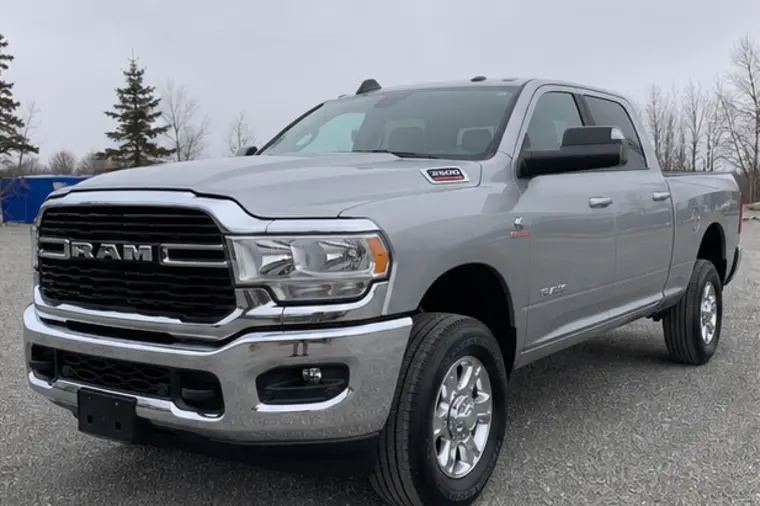
For a RAM 2500 diesel buyer who wants the pre-2025 six-speed combination, use a documented 2024 truck as a shopping benchmark. Consider 2025 when the newer Cummins and eight-speed system is the equipment you want. These are conditional selection points, not statistically proven best years; condition and load suitability can change the choice.
Our best-year recommendation is an equipment decision
Start with 2024 if you specifically want the documented Cummins/68RFE six-speed RAM 2500 combination. RAM's manufacturer chart identifies that pairing; its high-output/Aisin rows belong to the 3500. Do not buy a 2500 on the assumption that every diesel in the same brochure has the 3500's powertrain or capability.
For 2025, Cummins describes a revised engine system and new eight-speed for the HD pickups. That creates a meaningful alternative, not proof that the older truck is obsolete or the new one will last longer. Identify which combination you actually prefer, then compare candidates supported by equivalent condition and ownership evidence.
We do not have matched Canadian failure-frequency data establishing one RAM 2500 diesel year as the universal winner. The shortlist here is editorial guidance based on identifiable equipment and buying needs. A better-documented earlier truck can be preferable to a neglected benchmark-year candidate, and a newer configuration can be worth choosing for a function you actually need.
Shortlist by the reason for buying
This is not a ranking from safest to riskiest. It prevents the search from treating different powertrains and assignments as though one calendar year could answer them all. Decide what would make you change your preference before becoming attached to a particular advertisement.
Keep cab, drivetrain and intended load reasonably consistent when comparing candidates. Otherwise, an apparent year advantage may really reflect a different configuration, equipment level or repair commitment. A clear comparison identifies what each truck offers and which unanswered questions matter to the buyer.
| Buyer preference | Starting comparison | What must be verified |
|---|---|---|
| Prefer the pre-2025 diesel/six-speed arrangement | A 2024 RAM 2500 with complete history | Actual engine/transmission, inspection result and required load |
| Want the revised diesel/eight-speed system | A correctly identified 2025 pickup | Installed equipment, support and current condition; no assumed lifespan advantage |
| Considering an earlier used Cummins | Compare the individual record and inspection with the benchmark | Applicable campaigns, prior repairs, modifications and duty cycle |
| Need more carried-load margin for a trailer | Compare an appropriately configured RAM 3500 | Actual labels and configuration rather than another 2500 year |
Do you need a different year, or a different truck?
Before narrowing dates, write down the actual occupants, tools, hitch equipment and trailer load. Obtain the candidate's vehicle labels and applicable towing information. Do not use the largest number in the RAM brochure without matching the actual engine, cab and configuration.
For a fifth-wheel owner, the trailer load carried by the truck needs attention alongside total trailer mass. A candidate can appear attractive from its engine specification while leaving a material carried-load question unanswered. Address that question before treating a more popular or newer year as the solution.
If the RAM 2500 does not fit the assignment, compare the appropriate 3500 configuration. Changing the model can be a more relevant decision than moving to a later 2500 year. An added suspension accessory does not supply missing rating or installation evidence.
What the 2025 change does and does not tell you
Cummins' launch material identifies a new pickup engine system, with changes including fuel delivery and cold-start technology alongside the eight-speed pairing. Use those statements to identify the equipment boundary. Do not convert a manufacturer's product introduction into a long-term reliability study.
A buyer considering the newer truck should ask which service requirements and parts apply to that system. A familiar Cummins badge does not mean every earlier maintenance assumption, diagnostic procedure or component carries over unchanged. Establish support for the actual configuration rather than relying on a shop's general experience with older engines.
Equally, do not assign an automatic first-year failure penalty. The right purchasing question is whether the candidate's equipment, current condition and support fit the buyer. A claim that a new design fixes every previous concern needs issue-specific evidence, not merely a later date on the registration.
Earlier years need campaign screening, not a blanket rejection
The selected FCA filings identify Y78 fuel-pump concerns on a defined 2019–2020 population, ZA3 transmission concerns on specified 2020–2023 68RFE trucks, and 13A heater-relay concerns on a defined 2021–2023 population. Check each separately; the populations and required actions are not interchangeable.
Ask RAM to establish current Canadian VIN applicability and completion. For an affected unrepaired 13A vehicle, follow the manufacturer's outdoor-parking and separation instructions. A general statement that the truck has had its recalls is less useful than a dated record matching the actual vehicle and action.
Assess current symptoms independently of campaign paperwork. A completed recall does not explain every starting, shifting or warning-light complaint. An earlier truck with a documented resolution may remain eligible; an unresolved safety-related concern should stop an ordinary ready-to-work buying decision regardless of the preferred year.
Service history should fit the way the truck was used
Ask about towing, low-speed work, idling and seasonal storage, and retain hours where recorded. Use that information to direct the inspection rather than assuming every commercial truck was mistreated or every personal truck had easy use. Missing records are uncertainty to investigate, not proof of a particular failure.
The HD section of RAM's 2018 diesel supplement explains that excessive idling can interfere with aftertreatment regeneration. It is distinct from the same document's RAM 1500 material. The buying lesson is to match service and operating evidence to the actual engine and application, not to import EcoDiesel guidance into a Cummins assessment.
For an older candidate, ask an appropriate diesel specialist which records and measurements will be useful. A short video, a warm start or an informal engine demonstration should not be treated as a remaining-life test. A written report should explain its scope and any intermittent concern that could not be confirmed.
Read repair invoices for the story they support
Find the original complaint, diagnosed cause, work performed and follow-up result. Several new parts can reflect a careful completed repair or a succession of unresolved attempts. The number of invoices alone does not distinguish those situations; their content and sequence do.
For major fuel-system or transmission work, ask the inspecting shop whether the documented scope answers the cause of the fault. Do not prescribe an arbitrary list of replacements from an online account of a different truck. The appropriate repair depends on the actual diagnosis and equipment.
Identify modifications and the present calibration where relevant. A seller's upgrade label is not a standardized durability certification. Ask what changed, who performed the work and what verification remains. A replaced engine does not reset the history of the rest of the vehicle.
Inspect the parts of the truck the next job will use
Name trailer electrical connections, brake controls, hitch hardware and fitted accessories in the inspection brief. Ask which functions the shop can assess and which need a separate specialist or the actual trailer. Do not assume that a general powertrain inspection covers every system needed for the assignment.
Include the underside, steering, suspension, brakes, tires and evidence of body or equipment changes. An engine-focused search can overlook a candidate whose required non-engine work makes it a poor purchase. Keep the findings separate so cosmetic wear is not confused with a material structural or operating concern.
For an operational complaint, preserve the circumstances and avoid deliberately reproducing a dangerous event. A qualified professional should decide what can be checked safely. A lower asking price does not resolve an unexplained safety symptom or make the truck ready for committed work.
Decide on commitment, timing and a realistic backup
Ask for itemized local estimates separating diagnosis, confirmed repairs and maintenance catch-up. Keep unresolved exposure visible instead of turning a generic repair average into a precise allowance. Compare the total known commitment with another candidate supported by equivalent evidence.
For commercial work, establish whether a substitute can actually handle the load and hitch arrangement. For recreational towing, compare the inspection and repair timetable with departure plans. A truck can be the wrong purchase for the required date even when the eventual work appears manageable.
Choose the benchmark year only while it remains the best-supported candidate for your needs. Change the year or model when another truck fits better. Decline when material uncertainty cannot be reduced within the budget, support and time available.
RAM 2500 best-year questions
Is 2024 proven to be the most reliable year? No. It is a defined comparison point for buyers who want the documented pre-2025 diesel/six-speed equipment.
Does a 2024 RAM 2500 have the same high-output/Aisin pairing as a 3500? The manufacturer chart separates those applications. Verify the actual truck rather than transferring the 3500 row.
Should I automatically avoid 2025? No. A changed system deserves the correct evidence and support assessment, not an invented first-year penalty.
Can an earlier repaired truck be a good choice? Yes, when its repair evidence, current condition and configuration support your assignment. That does not establish a universal reliability verdict for its year.
Evidence note: manufacturer documents establish the specific facts and applications cited. Buying workflows and cost scenarios are DieselTrucks.ca editorial guidance. These pages do not publish measured failure rates or confirm the condition, recall status or capacity of a particular truck.
General educational content for Canadian diesel-pickup research. Verify the exact truck, model year, certification labels, owner manual and manufacturer documentation, and obtain qualified mechanical or towing advice where appropriate.
Sources & Further Verification
Use the exact model year, VIN, truck labels and current manufacturer documentation when moving from general research to a purchase or towing decision.
- RAM 2024 Heavy Duty towing and powertrain chart — original manufacturer configuration matrix
- Cummins January 2025 announcement — revised engine, eight-speed and separate pickup/chassis-cab outputs
- FCA Y78 / U.S. 21V-880 filing — specified 2019–2020 diesel population
- FCA ZA3 / U.S. 22V-835 — specified 68RFE transmission and model years
- FCA 13A / U.S. 23V-060 — defined 2021–2023 intake heater relay population
- RAM 2018 diesel supplement — separate 1500 and HD applications
- Cummins–RAM engine history