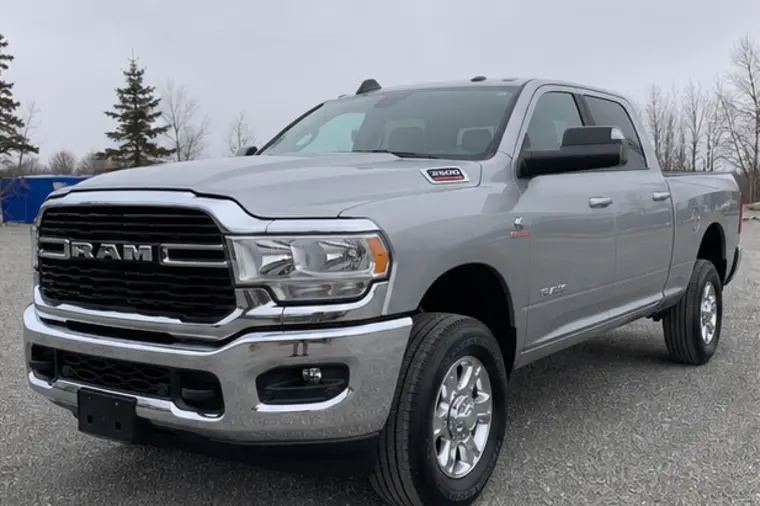
RAM's 2025 Heavy Duty chart contains 37 populated RAM 2500 trailer ratings: 25 gas and 12 diesel values, spanning 10,530 to 20,000 lb. The low endpoint belongs to Power Wagon; the high endpoint belongs to the High-Output Cummins 4x2 Crew Cab with an 8-foot box and a grouped 10,000/10,190-lb GVWR selector. This is a changed powertrain and configuration matrix, not the 2024 chart with a new date. The tables below retain every populated 2500 trailer value, the source's paired 4x2/4x4 order and grouped GVWR alternatives. These are manufacturer reference ratings, not permission to tow that weight with an unidentified truck.
Exact answer: which 2025 RAM 2500 reaches each maximum?
A 2500 badge and engine name do not select a rating. Match the completed pickup's model year, cab, box, drive system, axle, GVWR and GCWR before reading a trailer cell. All populated 2500 rows in this source are single-rear-wheel, or SRW. The adjacent RAM 3500 columns include different vehicles and are excluded.
The overall range describes the lowest and highest populated catalogue values. It is not a continuously available adjustment or a promise that a loaded truck retains the advertised maximum.
| Reference | Configuration | GVWR / GCWR (lb) | Trailer (lb) |
|---|---|---|---|
| Minimum | Power Wagon; 4x4 Crew Cab 6-foot-4 box; HEMI/4.10 | 8,565 / 18,000 | 10,530 |
| Gas maximum | 4x2 Regular Cab 8-foot box; HEMI/4.10 | 9,900 or 10,000 / 24,250 | 17,750 |
| Diesel maximum | 4x2 Crew Cab 8-foot box; High-Output Cummins/3.42 | 10,000/10,190 grouped / 28,010 | 20,000 |
| Diesel Mega Cab maximum | 4x4 Mega Cab 6-foot-4 box; High-Output Cummins/3.42 | 10,190 / 24,290 | 15,680 |
Read the slash correctly: drive pair versus grouped GVWR
In the trailer columns, RAM prints 4x2 first and 4x4 second. Thus 15,550/15,230 means two separate drivetrain ratings, while NA/19,900 publishes only the 4x4 value. NA is not zero and is not permission to borrow the other drivetrain's number.
A slash in the GVWR column serves a different purpose. For example, the diesel 10,000/10,190 selector is one source line covering those listed GVWR alternatives. It does not mean 4x2/4x4. We retain the combined selector and count its printed trailer value once. Blank vehicle columns remain blank; they are not additional available configurations.
The 2025 engine and transmission change matters
The source's gas engine remains the 6.4L HEMI V8 with the 8HP75-LCV eight-speed automatic. The diesel section is now the 6.7L Cummins High-Output Turbo Diesel. RAM's descriptive panel calls its transmission TorqueFlite HD eight-speed; the rating table labels it ZF Powerline eight-speed automatic. Both names are preserved as labels from the same document.
Do not use the earlier 68RFE/3.73 diesel selector for this page. The 2025 diesel trailer rows use a 3.42 axle. More engine output alone does not establish a higher tow rating for every body, drivetrain or GVWR branch.
| 2025 source family | Output | Transmission | 2500 towing axles |
|---|---|---|---|
| 6.4L HEMI V8 | 405 hp; 429 lb-ft | 8HP75-LCV eight-speed | 3.73 or 4.10 |
| 6.7L Cummins High-Output | 430 hp; 1,075 lb-ft | TorqueFlite HD / ZF Powerline eight-speed | 3.42 |
Gas 3.73 matrix: all twelve drivetrain ratings
These rows apply to the standard gas cab/box columns, not Power Wagon. Each pair is 4x2/4x4 in pounds. Both GVWR branches have a 22,050-lb GCWR. The 10,000-lb-GVWR Crew Cab long-box 4x4 value is 14,720 lb, below the 9,900-lb row's 14,730 lb; that small reversal is retained, not corrected into an assumed trend.
| GVWR (lb) | GCWR (lb) | Regular Cab 8-foot: 4x2/4x4 | Crew Cab 6-foot-4: 4x2/4x4 | Crew Cab 8-foot: 4x2/4x4 |
|---|---|---|---|---|
| 9,900 | 22,050 | 15,550/15,230 | 15,210/14,920 | 15,070/14,730 |
| 10,000 | 22,050 | 15,550/15,240 | 15,220/14,930 | 15,080/14,720 |
Gas 4.10 matrix: all twelve drivetrain ratings
The standard gas 4.10 rows use a 24,250-lb GCWR. In each matched cab, drive and GVWR position, the listed trailer value is 2,200 lb above the 3.73 cell. That is a comparison of factory chart rows, not a statement that changing an axle on an existing truck changes its certification or rating.
The two 17,750-lb gas maxima are both Regular Cab 4x2 entries. A Crew Cab or 4x4 cannot inherit that number merely because it has the same engine and axle.
| GVWR (lb) | GCWR (lb) | Regular Cab 8-foot: 4x2/4x4 | Crew Cab 6-foot-4: 4x2/4x4 | Crew Cab 8-foot: 4x2/4x4 |
|---|---|---|---|---|
| 9,900 | 24,250 | 17,750/17,430 | 17,410/17,120 | 17,270/16,930 |
| 10,000 | 24,250 | 17,750/17,440 | 17,420/17,130 | 17,280/16,920 |
Power Wagon is a separate 10,530-lb branch
RAM identifies a single Power Wagon towing cell: the gas 4x4 Crew Cab short box at 8,565-lb GVWR, 18,000-lb GCWR and 4.10 axle. Its trailer pair is NA/10,530. Do not select a standard Crew Cab 4.10 rating for this special model.
This sheet does not publish a separately labelled 2025 Rebel towing row or a populated gas Mega Cab trailer cell. Neither is backfilled from 2024. This describes the reviewed chart's coverage, not a claim about every vehicle that may exist or every option combination.
| Model | Cab / box | Axle | GVWR / GCWR (lb) | Trailer 4x2/4x4 (lb) |
|---|---|---|---|---|
| Power Wagon | Crew Cab / 6-foot-4 | 4.10 | 8,565 / 18,000 | NA/10,530 |
Diesel Regular Cab: the source publishes only 4x4
The High-Output Cummins Regular Cab long-box line combines three GVWR alternatives. Its NA/19,900 pair leaves the 4x2 position unavailable in this chart. A reader who assumes that Regular Cab automatically means the lightest or highest-rated diesel would select the wrong maximum.
| GVWR selector (lb) | GCWR (lb) | Axle | Regular Cab 8-foot trailer 4x2/4x4 (lb) |
|---|---|---|---|
| 9,900/10,000/10,190 | 27,820 | 3.42 | NA/19,900 |
Diesel Crew Cab short box: four printed trailer values
The 4x2 short-box rating is 19,960 lb under one grouped GVWR selector and 27,870-lb GCWR. The three 4x4 values instead use 28,110-lb GCWR and individual GVWR rows. Do not attach the 4x2 row's GCWR to the 4x4 values or split the grouped line into extra counted ratings.
The 4x4 entries rise from 18,820 to 19,770 to 19,890 lb. Those differences show why a diesel badge and short box are insufficient: the source's 9,900-, 10,000- and 10,190-lb GVWR selectors materially change the answer.
| GVWR selector (lb) | GCWR (lb) | Axle | Crew Cab 6-foot-4 trailer 4x2/4x4 (lb) |
|---|---|---|---|
| 9,900 | 28,110 | 3.42 | NA/18,820 |
| 9,900/10,000/10,190 | 27,870 | 3.42 | 19,960/NA |
| 10,000 | 28,110 | 3.42 | NA/19,770 |
| 10,190 | 28,110 | 3.42 | NA/19,890 |
Diesel Crew Cab long box: where 20,000 lb belongs
The 20,000-lb cell is on the 4x2 side of the 10,000/10,190-lb grouped selector at 28,010-lb GCWR. The separate 9,900-lb-GVWR 4x2 line is 19,980 lb. Long-box 4x4 entries have a lower 26,580-lb GCWR and publish 17,080 or 18,230 lb.
The 4x4 long-box rating cannot be filled from the 20,000-lb 4x2 cell. The empty side of each pair helps prevent precisely that mistake. The chart also requires a bed-mounted hitch for a trailer above 18,000 lb.
| GVWR selector (lb) | GCWR (lb) | Axle | Crew Cab 8-foot trailer 4x2/4x4 (lb) |
|---|---|---|---|
| 9,900 | 26,580 | 3.42 | NA/17,080 |
| 10,000/10,190 | 26,580 | 3.42 | NA/18,230 |
| 9,900 | 28,010 | 3.42 | 19,980/NA |
| 10,000/10,190 | 28,010 | 3.42 | 20,000/NA |
Diesel Mega Cab: three independent 4x4 rows
All three populated Mega Cab diesel values use a 6-foot-4 box, 3.42 axle and 24,290-lb GCWR. The 9,900-lb branch is 14,630 lb, the 10,000-lb branch is 15,380 lb and the 10,190-lb branch is 15,680 lb. They remain separate even though the body and GCWR match.
The 1,050-lb difference between the lowest and highest Mega Cab cells is arithmetic across source rows, not capacity that can be unlocked by choosing a different number. The actual truck's certification and applicable factory configuration decide which row can be used.
| GVWR (lb) | GCWR (lb) | Axle | Mega Cab 6-foot-4 trailer 4x2/4x4 (lb) |
|---|---|---|---|
| 9,900 | 24,290 | 3.42 | NA/14,630 |
| 10,000 | 24,290 | 3.42 | NA/15,380 |
| 10,190 | 24,290 | 3.42 | NA/15,680 |
Coverage: 37 values, not 37 unique weights or VINs
The count is 24 standard gas drivetrain entries plus one Power Wagon entry, then one Regular Cab, four short-box Crew Cab, four long-box Crew Cab and three Mega Cab diesel entries. That totals 25 gas and 12 diesel ratings. Repeated numeric values are counted when they occupy distinct source positions; grouped GVWR alternatives do not multiply a printed trailer value.
Rows with values only under RAM 3500 are excluded. The diesel 36,610-lb endpoint elsewhere on the sheet is not a RAM 2500 rating. Blank positions are not converted to NA, zero, estimated capacities or new model offerings.
Hitch method: the 20,000-lb maximum is not receiver towing
RAM's footnote requires a fifth-wheel or gooseneck hitch for trailers over 18,000 lb. It also limits Class V receiver tongue weight to 1,800 lb and recommends conventional tongue weight of 10 percent of loaded trailer weight. The sheet gives a shared maximum-trailer matrix, not separate complete fifth-wheel and gooseneck matrices.
Do not describe a 20,000-lb row as conventional towing, and do not assume an installed hitch can carry the maximum merely because the truck row can. Verify the hitch, mounts, coupler, trailer and loaded pin or tongue weight against their own ratings and the truck's axle, tire and payload limits.
Payload and GCWR remain separate constraints
The same sheet has a separate payload table; its figures are not additional trailer capacity. RAM explicitly says trailer and payload ratings are mutually exclusive. People, bed cargo, accessories and the hitch load can use the truck's available carrying allowance before the advertised trailer limit is reached.
GVWR limits the loaded truck, GAWR limits each axle, and GCWR limits the combination. None substitutes for another. A scale-based check must avoid counting transferred tongue or pin weight twice when adding truck and trailer measurements. A catalogue maximum is not the actual curb weight, remaining payload or measured combination weight.
What RAM assumed in the chart calculation
The source identifies SAE J2807 calculations and says weights are in pounds rounded to the nearest 10 lb. Its stated allowances are 300 lb for passengers and 100 lb for options. Trailering equipment allowances differ: 75 lb for conventional, 70 lb for gooseneck and 250 lb for fifth-wheel.
These assumptions explain why a heavily equipped family or work truck may not reproduce a maximum-rating configuration. They are not instructions to subtract every listed allowance from an already measured loaded truck. Use consistent measurements and the exact applicable manufacturer method, rather than mixing catalogue assumptions with actual weights.
Canadian evidence boundary and source date
The numeric evidence here is RAM's U.S. 2025 Heavy Duty chart, reviewed on 14 September 2026. Its one-page PDF has a 4 February 2025 creation timestamp and SHA-256 beginning 2b431926d147fd79. The page layout was visually checked because text extraction alone can merge the RAM 2500 and 3500 columns.
The requested Canadian 2025 capability URL redirected to a page headed 2026 during review. That newer page was rejected as 2025 numeric evidence. RAM Canada's current before-you-buy guide is linked only for general terminology and upfit context. No Canadian VIN status, original market, regional package mapping or exact Canadian rating is inferred from either source.
A practical checklist for a used 2025 truck
Record the VIN and model year, photograph the certification and loading labels, and obtain the factory engine, transmission and axle information. Confirm cab, box and drive system against the vehicle, then locate the matching GVWR and GCWR branch. A seller's copied maximum is not that evidence.
Inspect the installed hitch and mounting system, tires and trailer ratings. Account for occupants, fuel, cargo, tools, accessories and any completed upfit in the actual loaded condition. If an identifier or rating remains unresolved, obtain manufacturer documentation for that truck before using a catalogue cell as a planning limit.
FAQ: can every 2025 Cummins 2500 tow 20,000 lb?
No. The populated diesel cells range from 14,630 to 20,000 lb. The maximum is a particular 4x2 Crew Cab long-box row, while the reviewed 4x4 long-box rows are 17,080 and 18,230 lb. Mega Cab tops out at 15,680 lb in this source. Match all selectors, not just the engine.
FAQ: does 10,190-lb GVWR guarantee a higher tow rating?
No. Some source lines group 10,190 with other GVWR alternatives and publish one trailer value. Other bodies have separate entries with different results. GVWR is a loaded-truck limit, not trailer capacity, and a different certification value must not be selected to improve a calculation.
Related years, tools and honest limits
Use the 2024 and 2023 guides for those exact years. The linked general specification pages include newer-year data and must not supply missing 2025 cells. A planning tool can organize known ratings and measured loads; it cannot certify an unseen combination or replace an unresolved factory record.
This towing reference does not establish reliability, failure rates, legal operating allowances, inventory, sellers, dealer counts, prices, financing or offers. The marketplace remains the commercial destination; no available truck or transaction is implied by an editorial rating.
Evidence note: manufacturer documents establish the specific facts and applications cited. Buying workflows and cost scenarios are DieselTrucks.ca editorial guidance. These pages do not publish measured failure rates or confirm the condition, recall status or capacity of a particular truck.
General educational content for Canadian diesel-pickup research. Verify the exact truck, model year, certification labels, owner manual and manufacturer documentation, and obtain qualified mechanical or towing advice where appropriate.
Sources & Further Verification
Use the exact model year, VIN, truck labels and current manufacturer documentation when moving from general research to a purchase or towing decision.