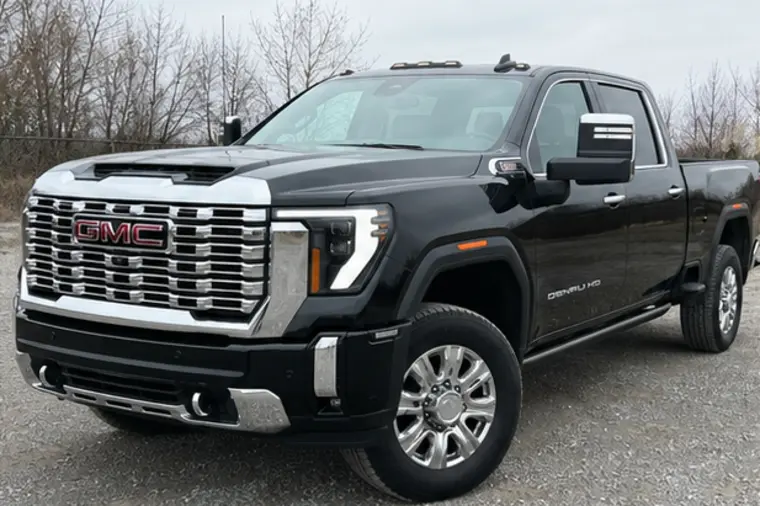
The Sierra 2500HD serves three-quarter-ton work, trailer and recreational needs with trims ranging from basic work trucks to premium tow vehicles.
MODEL-YEAR INTELLIGENCE
Research GMC Sierra 2500HD by Model-Year Era
6.6L Duramax
Use the selected model year and canonical engine relationship as research context. Confirm the exact transmission, cab, bed, drivetrain, rear-wheel configuration, labels and manufacturer documentation on the truck.
Choose the engine and year range that matches your truck. These ranges organize research; confirm the exact equipment from its labels and records.
Research this model in detail
Choose the Sierra 2500HD around a repeatable working load
A Sierra 2500HD diesel is worth shortlisting when its particular configuration can carry the crew, equipment and trailer connection load while remaining useful between towing jobs. Start with that requirement before choosing Pro, SLE, SLT, AT4 or Denali equipment. A premium cabin may suit long travel days, but it does not prove additional carrying allowance. Conversely, a basic truck with the right documented specification may do the same towing job without the features you do not need.
Create two descriptions of your use: the ordinary working day and the heaviest planned journey. Include passengers, tool storage, hitch hardware, bed cargo and loaded trailer weight in both. A truck that passes only the ordinary day needs a different plan for the heavier job. Do not count on travelling with less fuel, leaving essential equipment behind or making an occasional overloaded trip. Where measured loads are not yet available, keep the estimates visible and leave the purchase decision conditional.
Use dated powertrain anchors rather than one Duramax specification
The Sierra 2500HD name covers several Duramax revisions. Identify the installed engine and transmission before using an older invoice, selecting a manual or comparing a seller's claimed output. Our generation guide supplies the broader chronology; the anchors below demonstrate why the same displacement is not a complete specification. GMC's reviewed 2020 trailering guide records a 445-hp, 910-lb-ft diesel with a ten-speed automatic. Its 2024 specification book records 470 hp and 975 lb-ft. GM also explicitly distinguishes its later L5P from 2023-and-older L5P engines.
Those factory references are not measurements of a used vehicle. An engine replacement, controller tune or transmission replacement needs its own documentation. Ask for part identification and calibration information where work has changed the original configuration. Treat a mismatch between the build record, installed components and seller's description as an inspection question, not as a harmless naming difference. A later rating cannot be used to advertise an earlier truck simply because both have L5P engines.
| Dated GMC reference | Diesel output | Buying implication |
|---|---|---|
| 2020 Sierra HD trailering guide | 445 hp; 910 lb-ft; ten-speed automatic | Use that year's engine, transmission and load documentation |
| 2024 Sierra HD features/specifications | 470 hp; 975 lb-ft; ten-speed automatic | Later output is not a retrofit claim for earlier trucks |
| Older or modified candidate | Identify independently | Obtain the exact application manual and inspect installed hardware |
Read the Sierra chart before applying a towing maximum
GMC's 2026 U.S. chart publishes conventional towing separately from a combined fifth-wheel/gooseneck field. Its 22,390-lb in-bed maximum belongs to a Duramax Regular Cab long-bed 2WD with the 30,000-lb GCWR Max Trailering Package branch. It is not the conventional rating of that truck: the corresponding conventional cell is 14,500 lb. Selected Crew Cab Max Trailering configurations instead reach 20,000 lb conventional. These examples show why cab, drive system, package and hitch must stay attached to the number.
The chart also carries separate AT4, AT4X, AEV, Denali and Denali Ultimate qualifications. A blank cell is not permission to borrow the next trim's rating. Use the dedicated exact-year towing guide for the complete matrix, then confirm the Canadian candidate's labels and documentation. Do not split GMC's combined in-bed field into invented independent hitch ratings or carry the 2024 maximum into a 2026 advertisement.
Make payload and trailer fit separate pass-or-fail checks
Payload remaining for a trailer is not the catalogue's maximum payload. Start with the actual truck label and account for the occupants and equipment that were not included in that allowance. A toolbox, bed slide, auxiliary equipment and hitch can consume room you expected to use for pin weight. If you have a loaded scale weight instead, compare it directly with the relevant ratings and avoid subtracting installed equipment a second time.
Check truck gross weight, front and rear axle loads, combined weight and every hitch-system limit. Passing one does not cancel another. Then check physical fit: cab-to-trailer clearance through turns, bed-rail clearance, level trailer attitude and clearance over uneven ground. Use the hitch manufacturer's application instructions and a qualified installer. A 3500HD may be the better candidate when the 2500HD cannot meet the load, but compare an actual 3500HD configuration rather than treating its badge as approval.
Investigate reliability by year and completed work
There is no evidence-based single lifespan or failure-rate figure established here for every Sierra 2500HD. Separate a documented defect mechanism from the probability that a particular truck will experience it. GM's U.S. 24V797 filing, for example, includes certain 2020–2022 Sierra 2500/3500 diesel vehicles and describes transmission control-valve wear. That is a targeted record-checking question, not a verdict on every Duramax or on gasoline trucks.
Ask a GM service department to check the candidate VIN for current campaigns, superseding actions and completed repairs. A receipt for an earlier software operation is not proof that every later obligation is closed. Use the year-specific reliability page for the detailed campaign boundaries; use the problems guide to prepare diagnostic questions. Canadian involvement and completion need Canadian VIN verification. Recall totals and anecdotes cannot establish which model year is the most reliable.
Budget for the complete truck, not an assumed diesel saving
Build the ownership comparison from your annual kilometres, loaded share and locally quoted service costs. Record fuel consumption over comparable journeys instead of assigning the model a universal mpg figure. Separate fuel, insurance, scheduled service, tires and brakes from an inspection-based repair reserve. Do not convert the manufacturer's engine-output claim into a fuel-saving promise. A lower purchase price may simply move spending into the first year.
For modern diesel candidates, retain the correct owner manual and Duramax supplement together. Review the oil and fuel-filter history, cooling-system work, emissions-system repairs and the actual duty cycle with the inspecting shop. Short trips, extended idle time and demanding work deserve discussion rather than an automatic rejection or an invented service interval. For higher trims, request quotes for any failed cameras, power steps, seats or tailgate functions before deciding what the equipment is worth to you.
Finish with a two-stage used-Sierra inspection
Before travelling, request the VIN, label photographs, service invoices and photographs of the frame, hitch installation and engine compartment. Ask whether the seller can leave the truck cold for inspection. At the appointment, have a qualified shop assess starting, charging, leaks, cooling, transmission operation, fault history, steering, suspension, brakes and corrosion. Distinguish cosmetic condition from structural condition and ask for a written estimate of work that cannot wait.
Test the equipment that influenced your shortlist, including mirrors, trailer connections and fitted camera views, under appropriate safe conditions. Finish with three written outcomes: whether the configuration fits the load, what maintenance or repair is due, and what remains unverified. Compare those outcomes with an equivalent Silverado and suitable 3500HD. Keep year-selection research separate from the inspection: a favoured year cannot rescue a poor individual truck, and an unresolved document is not evidence of a clean history.
Start with the Sierra HD powertrain reference
GMC Canada lists the 2026 Sierra HD’s available 6.6L Duramax at 470 hp and 975 lb-ft with a ten-speed automatic. These current figures belong to that documented application; an older 2500HD needs its own version-specific specification.
Use the engine and transmission guides to identify the used-buying era, then inspect the entire truck. A Sierra 1500 diesel comparison needs a different branch because its 3.0L powertrain and half-ton role are distinct from this HD.
Choose equipment for the way the truck will work
Keep desirable cabin and towing features in the shortlist, but establish capacity first. Cameras and convenience systems can help with operation; they do not replace the truck’s rating, the trailer’s loaded weight or an inspection of the installation.
| Equipment choice | Purchase question |
|---|---|
| Cab and bed | Does the layout fit crew, cargo and trailer clearance? |
| Hitch installation | Is it identified, compatible and documented? |
| Trailering technology | Which features are installed and functional? |
| Tires and suspension | Are the current parts appropriate to the verified configuration? |
Compare the Sierra with the equivalent Silverado
Hold model year, diesel version, rear-wheel arrangement and working load constant before comparing price and equipment. An attractive trim difference is easier to assess when the underlying configurations already meet the same job.
Ask for matching inspection scopes and service evidence on both candidates. Compare immediate work, upcoming maintenance and practical service access, then decide whether the remaining equipment and comfort differences justify their cost for your use.
Model evolution & used-buying eras
The 6.6L Duramax generation and transmission depend on model year; verify exact equipment and service history.
Cab, bed and work configurations
Cab, bed, axle and drivetrain choices materially affect capacity and manoeuvrability.
Towing and payload
There is no single towing or payload number for every truck wearing this model badge. Ratings vary with model year, cab, bed, drivetrain, axle ratio, wheel configuration and factory equipment.
- Read the door-jamb payload label on the exact truck.
- Use the owner manual and manufacturer towing guide for the model year.
- Account for passengers, cargo, hitch equipment and trailer pin or tongue weight.
Used-buying checks
A diesel pickup should be assessed as a complete working vehicle, not only as an engine choice.
- Ask for dated maintenance and repair records rather than relying on a verbal summary.
- Evaluate a true cold start, warning lights, leaks, transmission behaviour and underbody condition.
- Confirm whether the truck has towed, carried commercial loads or been modified, and inspect accordingly.
- Verify emissions equipment, tires, suspension and the exact payload label on the truck itself.
Separate Sierra equipment value from capability
Cross-shopping a Sierra 2500HD often involves trim and comfort differences as well as age. List the equipment that actually helps the job, then verify that it works. Compare the engine code, transmission and load limits independently from the trim name.
| Sierra 2500HD decision | Inspection question |
|---|---|
| Daily and work use | Does the cab fit the crew with secure storage? |
| Frequent towing | Are hitch, trailer connection and braking controls functional? |
| Higher trim | Which fitted systems add repair exposure if they fail? |
Compare against a similar Silverado and a suitable 3500HD
A same-era Chevrolet can be a useful price comparison, but match cab, bed, drivetrain and condition before attributing a difference to the badge. If the job requires more remaining load allowance, compare the 3500HD separately. Keep the chosen truck's label photographs and load sheet with the inspection report so capability and condition are evaluated together.
Evidence note: manufacturer documents establish the specific facts and applications cited. Buying workflows and cost scenarios are DieselTrucks.ca editorial guidance. These pages do not publish measured failure rates or confirm the condition, recall status or capacity of a particular truck.
General educational content for Canadian diesel-pickup research. Verify the exact truck, model year, certification labels, owner manual and manufacturer documentation, and obtain qualified mechanical or towing advice where appropriate.
Sources & Further Verification
Use the exact model year, VIN, truck labels and current manufacturer documentation when moving from general research to a purchase or towing decision.
- GMC Canada 2026 Sierra HD Pro/SLE/SLT — diesel powertrain
- GMC 2020 trailering guide — dated powertrain anchor
- GMC 2024 Sierra HD features, specifications and options
- GMC 2026 Sierra 2500HD trailering charts — U.S. application
- GM L5P engine — later revision and application boundary
- GM/NHTSA 24V797 original filing — selected diesel vehicles
- Chevrolet Canada manuals and guides