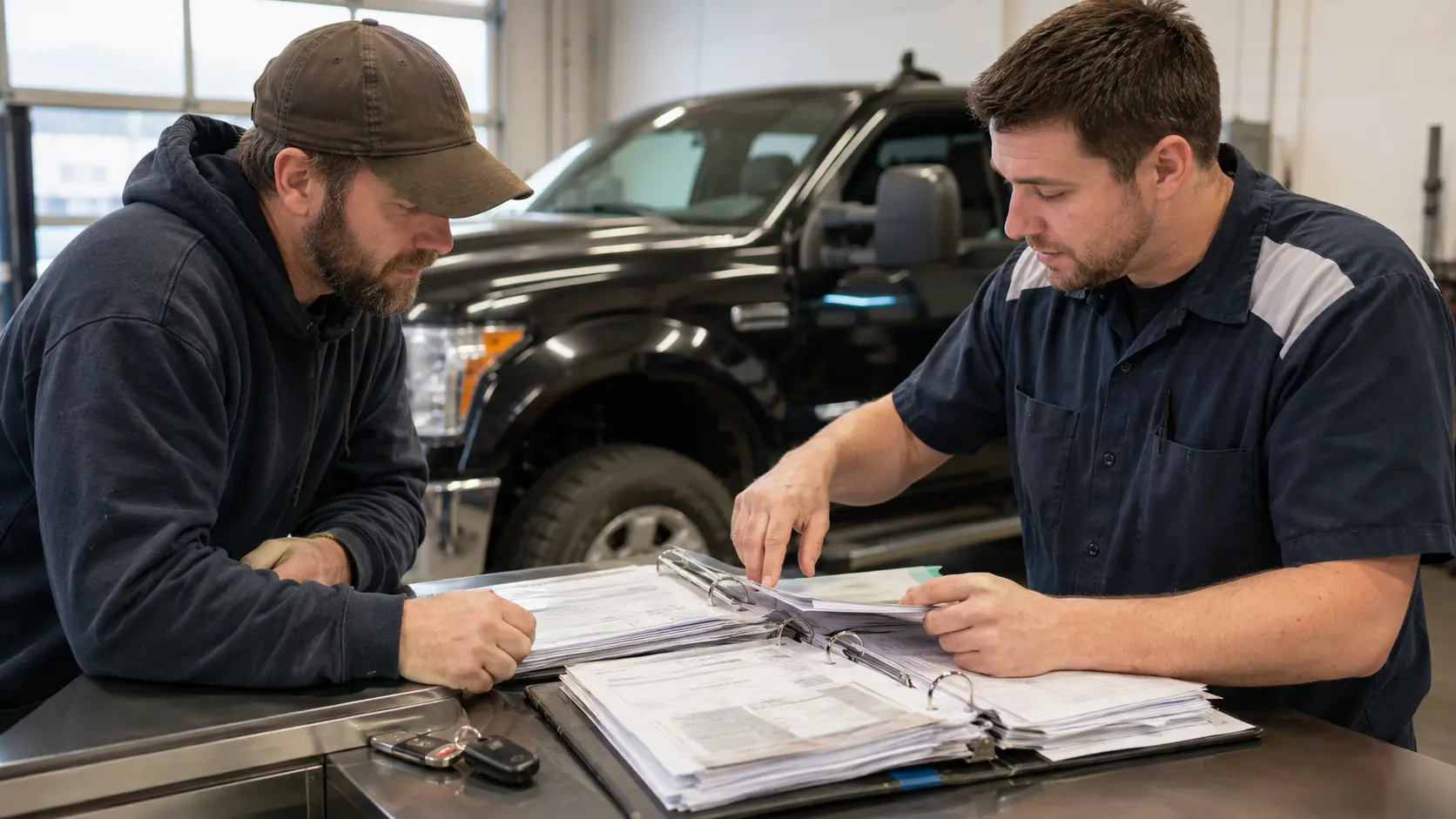
A 2020 GMC Sierra 2500HD buying assessment should start with the truck's repair history, not a general reputation for the Duramax name. This model year paired the 6.6L diesel with an Allison-branded ten-speed, while the new 6.6L gas engine used a different six-speed. Later safety records include a diesel transmission campaign and a 2026 follow-up for some incorrectly repaired vehicles. Replacement hoods and accessory spare-tire combinations create separate checks. The evidence below supports a configuration-specific inspection; it does not establish a failure rate, a best-year ranking or Canadian VIN clearance.
The 2020 powertrain change matters to the diagnosis
GMC's 2020 Trailering Guide describes the next-generation Sierra HD with the 6.6L Duramax diesel and Allison ten-speed automatic. It lists 445 hp and 910 lb-ft for the diesel. The gas alternative is a 6.6L V8 paired with the 6L90 six-speed. A seller's reference to a transmission repair therefore needs the engine and installed unit identified before its significance can be assessed.
The manufacturer literature is a specification baseline, not evidence that either combination lasts longer. Record the VIN, build label, mileage, modifications and repair invoices, and arrange a diesel-capable inspection if considering the Duramax. A quiet drive without a trailer cannot establish the condition of a transmission that has mainly worked under load.
24V797 and 26V083 are two stages of the transmission history
GM's October 2024 Part 573 filing for N242454440 / 24V797000 includes diesel-powered 2020–2022 Sierra 2500/3500 trucks. It explicitly excludes gas vehicles from that campaign because they use a different transmission. GM describes control-valve wear causing pressure loss, harsh shifts and possible momentary rear-wheel lockup. This is a safety concern, not just an unwanted shift feel.
The filing describes software that monitors valve performance. When it detects the condition, it limits the transmission to fifth gear and displays a service-engine light and reduced-propulsion message. That protective response is not proof that the worn hardware has been repaired; nor should a key cycle be treated as a lasting fix. The current NHTSA summary also describes special transmission coverage for conditions detected by the remedy, but Canadian eligibility and terms require dealer confirmation.
The exact 2020 Sierra 2500 query now also includes N252516560 / 26V083000, reported on 12 February 2026. It covers certain vehicles that may have been repaired incorrectly under 24V797 and calls for inspection and a transmission-software update. Its current record says owner letters were mailed on 6 March 2026. An old invoice marked recall complete is therefore not the final check: obtain a current VIN result and the applicable operation history.
Ask the inspecting technician to reconcile software completion with any valve-body or transmission replacement, unresolved shift complaints and stored diagnostic information. Do not deliberately provoke harsh shifts or wheel lockup on a test drive. If warning messages or abnormal shifting appear, stop the assessment and obtain professional direction before towing.
Hood replacement is not automatically the end of the hood issue
Two 2020 hood records explain why the provenance of replacement parts matters. Both concern hood-latch striker wires that may fracture, but the later action is not merely a duplicate entry. Collision-repair paperwork can be relevant even where the first campaign was never assigned to the original vehicle.
| U.S. campaign / GM number | Scope distinction | Record to obtain |
|---|---|---|
| 20V142000 / N192284960 | Certain original 2020 HD hood assemblies with improperly heat-treated striker wires. | VIN applicability and hood-assembly replacement invoice. |
| 20V324000 / N202306490 | Affected replacement hoods, including some installed under 20V142 and others supplied during service such as collision repair. | Replacement-hood origin and completion of the later applicable action. |
Spare tires, tailgate switches and restraint actions stay separate
The 21V578000 / N212329780 spare-tire action is specifically for certain 2020–2021 Sierra 2500 trucks with a 17-inch spare, RPO ZHQ or ZXT, combined with accessory 20-inch road tires, RPO REM, or 18-inch road tires, RPO Q2V. The mismatched combination can interfere with independent rear-wheel ABS control. The remedy includes an appropriate spare and a new information label. Do not substitute a visual check of the four road tires for checking the stored spare and option codes.
24V060000 / N232426400 concerns power-unlatching tailgates: water intrusion can short the release switch and unlatch the tailgate while parked. The record calls for exterior touchpad-switch replacement and advises checking that the tailgate is latched before driving. This does not establish that every MultiPro complaint has the same cause.
The other reviewed records concern carpet ignition from pretensioner gases, 19V814000; roof-rail airbag inflator components, 20V446000; and front-row centre seat-belt bracket attachments, 20V792000. Match the installed seating, floor covering and VIN to the applicable remedies. These U.S. records identify inspection questions, not nine confirmed faults on every truck.
Use the actual 2500HD and hitch row when assessing prior work
The 2020 GMC guide separates its standard capability table from a table for trucks rated at 10,000 lb GVWR or less. The following selected Duramax examples are in pounds. A conventional rating cannot be silently used as a fifth-wheel rating, and a visually similar low-GVWR truck does not inherit the standard table's maximum.
| 2020 Duramax configuration / table | GCWR | Conventional | Fifth-wheel | Gooseneck |
|---|---|---|---|---|
| Regular Cab 2WD long bed / standard | 26,000 | 14,500 | 18,510 | 18,510 |
| Double Cab 4WD standard bed / standard | 26,000 | 14,500 | 17,890 | 17,890 |
| Crew Cab 4WD standard bed / standard | 27,500 | 18,500 | 18,500 | 18,500 |
| Double Cab 4WD standard bed / 10,000-lb GVWR | 24,500 | 14,500 | 12,610 | 12,610 |
| Crew Cab 4WD standard bed, 18- or 20-inch wheels / 10,000-lb GVWR | 26,000 | 17,850 | 11,530 | 11,530 |
| Crew Cab 4WD long bed, 18- or 20-inch wheels / 10,000-lb GVWR | 26,000 | 16,560 | 10,240 | 10,240 |
A tow rating cannot reconstruct the truck's wear history
The 18,510-lb figure belongs to the Regular Cab 2WD long-bed fifth-wheel/gooseneck row, not a universal bumper-pull rating. The low-GVWR examples also show why more conventional capacity does not necessarily mean more fifth-wheel capacity. Use the full linked 2020 towing guide for the broader matrix, then check the individual vehicle labels, axle limits, hitch equipment and actual loaded weights.
Ask what trailer was used, its loaded mass and pin or tongue load, and what the truck carried at the same time. Receipts and scale records can support that account; a brochure number cannot prove that the combination stayed within its limits. Do not infer overload, transmission damage or remaining life from missing paperwork alone.
Trailer-brake messages require a vehicle-and-trailer assessment
The 2020 owner manual distinguishes CHECK TRAILER WIRING from SERVICE TRAILER BRAKE SYSTEM. Its diagnostic sequence separates a vehicle-side electrical fault from one that reappears only when the trailer harness is connected. A service-system message persisting across ignition cycles requires service. Acknowledging a display message is not a repair.
The manual warns that either message while driving can mean reduced or absent integrated trailer-brake operation. Pull over safely when traffic permits and follow its instructions; continuing faults require vehicle or trailer service. For a purchase inspection, have a qualified technician evaluate the connector, truck and intended trailer together rather than assuming every warning requires a truck control module. These are selected pages of the combined Sierra manual, not a complete Duramax maintenance or emissions-system audit.
A defensible buying verdict
This year's strongest documented buying questions are whether the diesel transmission actions are correctly closed, whether a replacement hood has its own relevant history, and whether the spare-tire and trailer systems match the equipment. A current Canadian dealer VIN check, documented applicable repairs and an independent inspection support a decision more usefully than a model-wide reliability score.
Budget discussions should follow actual inspection findings and written repair estimates. This review does not assign prices, predict failure frequency, certify an emissions system or promise a mileage lifespan. Nine entries in one U.S. query are not an exhaustive mechanical assessment or Canadian recall status. The linked catalogue remains an editorial reference, not a claim that an inspected truck is available for sale.
Evidence note: manufacturer documents establish the specific facts and applications cited. Buying workflows and cost scenarios are DieselTrucks.ca editorial guidance. These pages do not publish measured failure rates or confirm the condition, recall status or capacity of a particular truck.
General educational content for Canadian diesel-pickup research. Verify the exact truck, model year, certification labels, owner manual and manufacturer documentation, and obtain qualified mechanical or towing advice where appropriate.
Sources & Further Verification
Use the exact model year, VIN, truck labels and current manufacturer documentation when moving from general research to a purchase or towing decision.