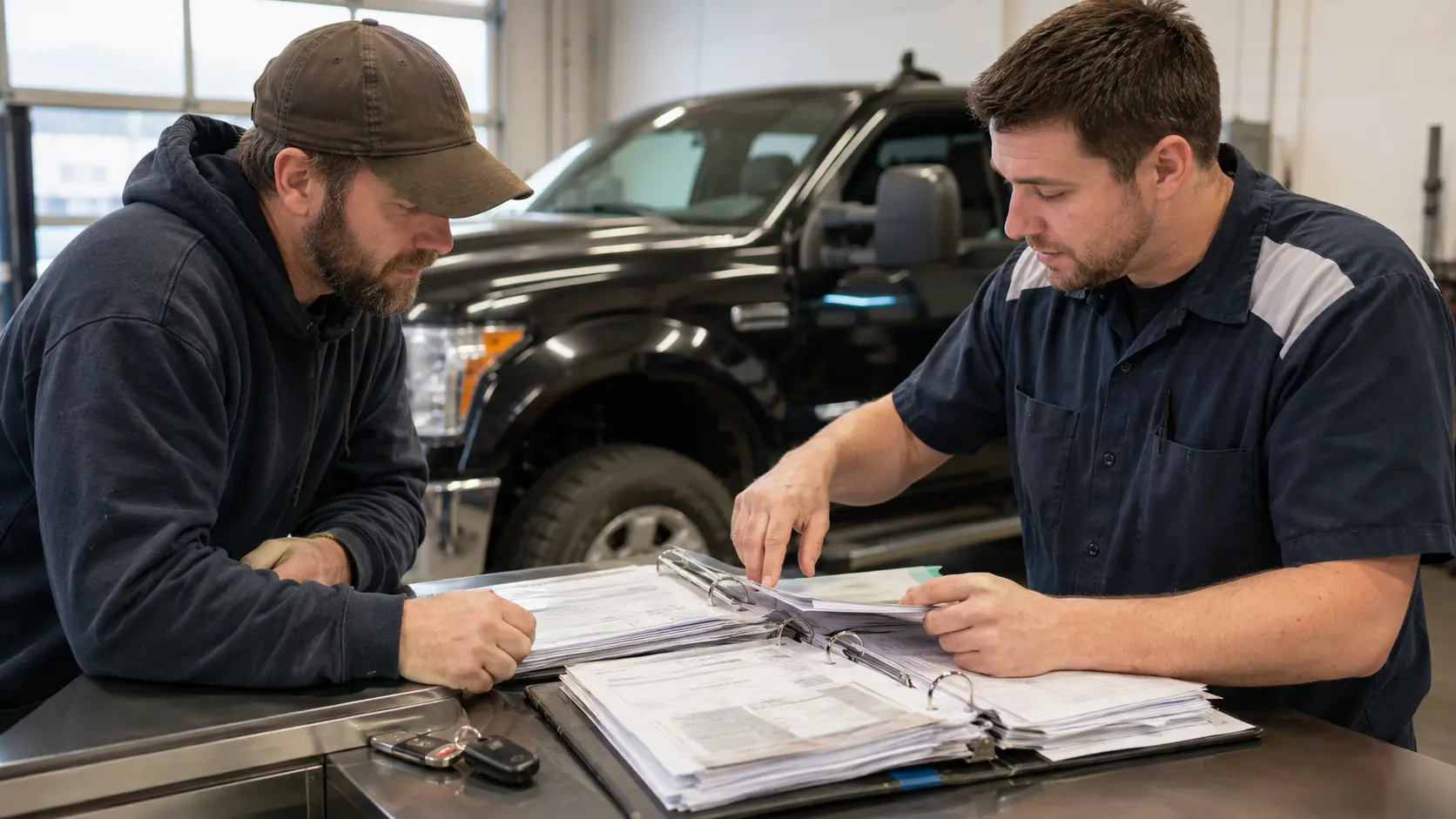
A 2025 GMC Sierra 2500HD should be assessed as a specific engine, transmission, transfer-case and towing configuration—not simply as a newer version of an older truck. This review uses GMC's exact 2025 model information, its fleet guide, the 2025 HD owner manual and individually scoped GM service evidence. The findings support an inspection plan, not a reliability score or a prediction of how many kilometres a particular truck will last.
Start with the actual 2025 powertrain and equipment
GMC's 2025 page specifies the available 6.6L Duramax at 470 hp and 975 lb-ft, paired with an Allison ten-speed automatic. Its gas 6.6L engine is also paired with an Allison ten-speed. These are separate engine branches, not a reason to apply diesel service information to a gasoline truck.
The 2025 AT4X description includes a factory 1.5-inch suspension lift, Multimatic DSSV dampers, a rear electronic-locking differential and 35-inch tires. That equipment changes what an inspector needs to identify; it does not establish a failure rate or make a base-truck towing number valid for the off-road configuration.
The reviewed output figures match the 2024 diesel specification. That limited continuity should not be expanded into a claim that every component, calibration or campaign is unchanged. Ask for the build information, installed tire sizes and modification history before comparing an advertisement with manufacturer literature.
The current tire-label campaign has a narrow equipment scope
The U.S. NHTSA query for the 2025 GMC Sierra 2500 returned one record on 15 September 2026: 26V530000, GM number N262561970. It concerns certain 2024–2025 2500 trucks with the enhanced towing option and a 20-inch accessory tire/wheel package—not every Sierra HD or every factory 20-inch wheel.
The record describes an incorrect rear-pressure label that can leave tires underinflated without the expected TPMS warning. The recorded remedy includes inspection and, as necessary, ECM software, a label overlay, correct inflation and a TPMS relearn. No replacement pressure is supplied here.
Owner letters are expected on 28 September 2026, a future date at this review. A scheduled mailing is not proof of completed repairs. The query is U.S. evidence, not Canadian VIN confirmation. Obtain the current VIN-specific campaign record and reconcile the accessory package, installed tires, label and completed operation.
One query result does not mean that this truck has only one possible issue. Conversely, the older model year's steering, tailgate or injector-programming actions must not be copied onto a 2025 truck without their own applicability evidence.
A bellhousing leak needs source confirmation, not a guessed overhaul
GM bulletin 21-NA-238, revised in May 2025, covers listed 2020–2025 Sierra/Silverado HD applications with L5P or L8T engines and MGM, MGU or MKM transmissions. It describes transmission fluid emerging near the bellhousing inspection cover and identifies a rolled or damaged front-cover seal as a possible cause.
If that origin is verified, the bulletin specifies replacement of the automatic-transmission case front-cover seal and torque-converter fluid seal. It does not instruct an owner to assume every wet bellhousing needs a complete transmission or torque converter.
For a purchase inspection, ask the technician to identify the fluid and leak origin, document any prior repair, and assess the truck after an appropriate operating check. A freshly cleaned housing, a vague 'seal done' invoice or the absence of a driveway puddle is not equivalent to a diagnosis. This bulletin supplies a diagnostic branch, not incidence data or a promise of current warranty coverage.
Fleet-table columns do not describe one fully configured truck
The 2025 GM Envolve Fleet Guide separates the 2500HD and 3500HD tables. Its 2500HD footnotes use diesel configurations for GVWR and towing, but gasoline configurations for payload. The final column combines gooseneck and fifth-wheel wording, while selected entries carry an additional gooseneck-only package footnote.
Consequently, copying a whole summary row can create a combination that the source never certifies. A payload maximum beside a diesel towing maximum does not prove that the diesel truck can carry that payload. Nor does a gooseneck-qualified value establish an identical fifth-wheel rating.
The table below records how to read those footnotes, rather than promoting selected headline maxima as usable towing ratings. The complete 2025 configuration matrix was not established in this review; no 2024 rating is substituted.
| Fleet-guide field | Stated branch or qualification | Buying implication |
|---|---|---|
| Maximum GVWR | 6.6L Duramax; 18- or 20-inch wheels | Check the actual truck's certification label. |
| Maximum payload | 6.6L gas; specified wheel equipment | Do not assign this maximum to the diesel branch. |
| Maximum trailering | 6.6L Duramax; some entries require Max Trailering | Match package, cab, bed and actual load. |
| Selected in-bed entries | Max Trailering plus a gooseneck hitch | Do not relabel them as unrestricted fifth-wheel ratings. |
Keep the load investigation separate from the reliability verdict
A useful towing-history discussion starts with the loads actually carried and pulled. Ask what trailer was used, whether hitch and axle weights were measured, and whether suspension, tires or hitch hardware were changed. These are questions for the candidate's records and inspection; this guide does not claim that an unknown truck was overloaded.
The next step is to obtain the exact-year rating information for the confirmed configuration and reconcile it with the truck's labels and intended loaded trailer. Trailer weight, cargo capacity and rear-axle or tire limits are not interchangeable allowances. An attractive family-wide maximum should not end that investigation.
If the seller cannot identify the configuration behind a quoted capacity, leave that claim unresolved until it is documented. Do not turn a brochure comparison into permission to tow. Equally, a correctly matched rating does not establish that the engine, transmission, brakes or emissions equipment are in good condition.
Confirm the transfer case before interpreting a 4WD demonstration
The 2025 HD manual distinguishes transfer-case arrangements. In the reviewed two-speed AUTO system, AUTO engages the front axle and distributes power as conditions require; it is not simply another label for two-wheel-drive high. A part-time arrangement has different controls, so identify the installed system first.
The manual describes flashing indicators during a requested shift and a steady indication when completed. Low-range selection has speed and transmission-Neutral conditions; entering low range also turns traction control and StabiliTrak/ESC off. Those expected states are not, by themselves, proof of a fault.
Have the system demonstrated under the exact manual's appropriate conditions. A request light is not proof that the shift completed. The manual cautions against selecting a transmission gear before the relevant shift indicator stops flashing because transfer-case damage can result. This inspection summary is not a substitute for the full operating procedure.
Do not accept repeated failed shifts or persistent warnings as normal merely because some lights change during normal operation. Record the symptoms and seek diagnosis. Also keep transfer-case Neutral distinct from transmission Neutral; do not improvise a towing or rollaway-prone demonstration.
Build a purchase file that answers the unresolved questions
Request an itemized service history, the present VIN campaign report, the original configuration information and records for modifications. For a visible leak, seek a diagnosis and repair description tied to the actual finding. For the accessory-tire action, seek evidence that the installed package and current label were checked together.
During an independent inspection, record cold-start behaviour, warning messages, fluid leakage and the results of an appropriate road test. Do not let a cleared dashboard, a recent software update or a seller's statement that the truck is 'all sorted' replace those observations. Any unresolved safety-related symptom needs assessment before further use.
Decide in advance what evidence would change the purchase decision: an unresolved campaign, an unexplained leak, a failed transfer-case function check, or missing configuration support for the intended trailer. That makes the assessment specific to the truck and your use without inventing repair prices or ranking every 2025 example.
Verdict and the limits of this review
A supportable 2025 Sierra 2500HD purchase is one whose equipment, campaign status, inspection findings and intended workload agree. The reviewed documents identify practical checks; they do not establish that 2025 is the best year, quantify a failure probability or certify remaining service life.
The fleet PDF was recovered through a Canadian dealer's download, but that does not identify it as a Canadian edition. The main HD owner manual also refers diesel readers to separate engine literature; the Duramax supplement was not comprehensively audited here. No diesel maintenance interval or individual Canadian VIN status is inferred.
This is a selected year-specific review, not an exhaustive technical-bulletin or maintenance catalogue. The unresolved exact towing matrix remains separate work. The commercial link leads to editorial catalogue profiles, not a claimed live offer, verified seller or available truck.
Evidence note: manufacturer documents establish the specific facts and applications cited. Buying workflows and cost scenarios are DieselTrucks.ca editorial guidance. These pages do not publish measured failure rates or confirm the condition, recall status or capacity of a particular truck.
General educational content for Canadian diesel-pickup research. Verify the exact truck, model year, certification labels, owner manual and manufacturer documentation, and obtain qualified mechanical or towing advice where appropriate.
Sources & Further Verification
Use the exact model year, VIN, truck labels and current manufacturer documentation when moving from general research to a purchase or towing decision.