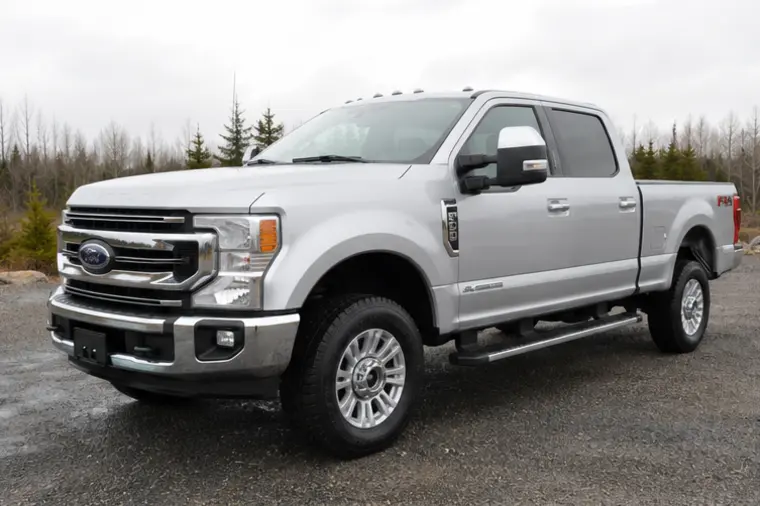
The F-350 moves into one-ton pickup territory with broad work, fifth-wheel, gooseneck and recreational-towing applications.
MODEL-YEAR INTELLIGENCE
Research Ford F-350 by Model-Year Era
6.7L Power Stroke
Use the selected model year and canonical engine relationship as research context. Confirm the exact transmission, cab, bed, drivetrain, rear-wheel configuration, labels and manufacturer documentation on the truck.
Choose the engine and year range that matches your truck. These ranges organize research; confirm the exact equipment from its labels and records.
Research this model in detail
Four F-350 DRW configurations show why the exact row matters
These selected examples are from Ford’s U.S. 2026 pickup guide. Every row describes an F-350 DRW Crew Cab 4x4 with a 176.0-inch wheelbase and eight-foot box. The table varies engine output and axle ratio while preserving the separate conventional, fifth-wheel and gooseneck values. It is not a chart for an F-450, an SRW pickup or a completed chassis cab.
The high-output 4.10 row is especially instructive: its fifth-wheel cell is 34,900 lb while its gooseneck cell is 35,900 lb. The standard-output 4.10 row lists 35,000 lb for fifth-wheel. More advertised engine output therefore does not increase every hitch rating in a simple sequence. Use the published row rather than smoothing away an inconvenient difference.
These are rated examples, not clearance for a particular trailer. Verify the Canadian candidate’s documentation, installed hitch, available payload and axle limits. Account for the complete load, not only the advertised trailer weight. Ford’s occupant and equipment assumptions also matter; an option-heavy truck with additional passengers needs its own loading assessment.
| 2026 F-350 DRW CC 4x4 8-foot box | GCWR | Conventional | Fifth-wheel | Gooseneck |
|---|---|---|---|---|
| Standard 6.7L / 3.55 | 40,000 lb | 27,000 lb | 31,200 lb | 31,400 lb |
| Standard 6.7L / 4.10 | 43,900 lb | 27,000 lb | 35,000 lb | 35,300 lb |
| High-output 6.7L / 3.55 | 40,500 lb | 27,000 lb | 31,700 lb | 31,800 lb |
| High-output 6.7L / 4.10 | 45,600 lb | 28,000 lb | 34,900 lb | 35,900 lb |
SRW and DRW need separate evidence, not a fixed upgrade allowance
Ford publishes the SRW towing rows on separate pages, including tire-dependent branches. Do not take a DRW value and subtract a guessed amount to estimate an SRW rating. Nor should a seller’s claimed suspension or wheel conversion be treated as the factory configuration represented by the chart.
Start with the actual carried load and the places the truck must operate. If an SRW candidate clears every requirement, daily access, parking and tire servicing may support that choice. If it does not, evaluate an appropriate DRW configuration using the same worksheet. A wider truck is useful only when the complete vehicle suits the assignment.
On a used dually, include all rear tires, wheel condition, valve access and the servicing arrangement in the inspection and budget. Ask about previous wheel or tire changes and whether the installed equipment matches the truck’s documented requirements. A photograph of two rear wheels on each side does not establish the rating or condition of the assembly.
Use engine generations to select the inspection brief
The model-year explorer below separates older Power Stroke eras from later 6.7L applications. Follow the engine link for the truck being considered, then verify the actual transmission and output version. Replacement assemblies and modified calibrations require additional documentation; the model year alone cannot identify everything currently installed.
For a dated current anchor, Ford’s 2026 guide lists the standard 6.7L at 475 hp and 1,050 lb-ft and the high-output version at 500 hp and 1,200 lb-ft, alongside the ten-speed automatic. Those ratings explain the current engine branches in the table, not the output of an older F-350. The chart’s hitch distinctions remain relevant even after engine identity is confirmed.
Keep major repairs connected to the condition that prompted them. A rebuilt transmission, a replacement engine and routine service describe different interventions. Ask what components were reused and how the repair was evaluated afterward. This is particularly important when a used truck is advertised for demanding work on the strength of recent parts spending.
A defined fuel-system action is not an F-350 reliability verdict
Ford’s 24V957/24S78 filing revised on 23 January 2026 includes certain 2020–2022 6.7L Super Duty vehicles built from 19 February 2019 through 23 August 2021. It identifies a high-pressure-pump concern associated with aged biodiesel deposits and describes PCM/TCM software changes in the remedy. The listed population is not every F-350 or every model year using a 6.7L.
For an applicable candidate, obtain the current manufacturer VIN result and the recorded action. Do not equate a software campaign with an invoice for replacing a failed pump. Where an actual fuel-system failure occurred, ask for the diagnosis and the scope of component replacement independently of campaign completion.
Continue to evaluate current starting, running and load-related symptoms with a qualified shop. A completed action does not establish overall reliability, a Canadian VIN result or a guaranteed remaining lifespan. Keep the separate problems, reliability, best-year and years-to-avoid guides as distinct research paths rather than collapsing those questions into the parent overview.
Price the complete one-ton ownership assignment
Compare purchase cost with the immediate work identified by inspection, scheduled service, tires and any necessary hitch installation. Use written local quotes for the actual truck. DRW tire requirements, body equipment and the ability of a shop to handle the configuration can affect the practical ownership plan without supporting a universal annual repair figure.
Keep fuel-economy assumptions tied to loaded distance, unloaded travel and idling. A seller’s best unloaded trip is not a forecast for towing a tall trailer or running equipment during a workday. If comparable records are unavailable, leave the estimate as a clearly identified scenario rather than inventing a precise MPG or life-cycle saving.
For work that earns income, assess what happens when the truck is unavailable. A substitute must meet the same load, hitch and body requirements; the existence of an ordinary rental pickup does not resolve that problem. For recreational owners, consider service access along the planned route and the effect of a repair on a fixed travel schedule.
Buying checks should close the gaps, not merely collect paperwork
Before an inspection, assemble the VIN, label photographs, configuration evidence, service chronology, campaign records and installation details for the body or hitch. Mark inconsistencies so the inspecting shop knows what to investigate. A folder of invoices is useful only if the records can be connected to this vehicle and its current equipment.
At the truck, verify cold and warm operation, stored faults, leaks, chassis condition, brakes, steering, tires and the towing installation through an appropriately qualified inspection. A good engine report does not clear a damaged hitch mount or unsuitable tire. A desirable DRW configuration is not a reason to accept unresolved mechanical or structural concerns.
Complete the loading worksheet before putting the vehicle into the intended service, and update it after adding permanent equipment or changing trailers. If the assignment involves a service body or chassis cab, obtain the applicable completed-vehicle documentation. The parent guide provides a research framework; it does not certify an individual truck or claim marketplace availability.
SRW towing evidence before a DRW decision
A 2024 U.S. Ford guide reference for an F-350 SRW with standard 6.7L diesel, 3.31 axle, Regular Cab 4x4, 141.6-inch wheelbase and eight-foot box lists 31,000 lb GCWR and 20,000 lb maximum loaded conventional trailer weight.
This reference illustrates the need for a specific row. It is not an allowance for every SRW F-350, nor does it establish sufficient payload for a fifth-wheel. Apply the guide’s equipment and occupant assumptions and verify the exact Canadian truck’s labels, tires, hitch and axle limits.
| 2024 F-350 SRW reference | Guide value |
|---|---|
| Engine / axle | Standard 6.7L diesel / 3.31 |
| Cab / drive / wheelbase / box | Regular Cab / 4x4 / 141.6 in / 8 ft |
| GCWR / conventional trailer limit | 31,000 lb / 20,000 lb |
Keep pickup and completed-work-body evidence separate
A pickup’s factory bed and a subsequently fitted service body create different purchase questions. Ask who installed the body, what documentation accompanied it and whether loaded axle weights are available. A body that fits on the chassis is not proof that the completed working truck has adequate remaining capacity.
For a camper or fifth-wheel, record both loaded weight and physical clearance. For a tool body, list permanently installed equipment before counting removable cargo. These uses can consume the same carrying allowance in different ways, making a generic “one-ton” description a poor substitute for a completed load plan.
Choose the F-350 around the full working week
An SRW candidate may suit access and daily use if it satisfies the entire job. A DRW candidate may deserve evaluation when rear-axle or carrying requirements drive the choice. In either case, include unloaded travel, parking, tire service and seasonal equipment in the comparison.
Finish the shortlist with a shop inspection and model-year powertrain research. A desirable configuration with unresolved condition concerns is a different purchase from a fully evaluated truck with a documented maintenance baseline.
Model evolution & used-buying eras
The applicable Power Stroke generation depends on model year. Modern 6.7L trucks should still be compared by year, output version, transmission and supporting equipment.
Cab, bed and work configurations
F-350 buyers face an important SRW-versus-DRW choice in addition to cab, bed, drivetrain and axle-ratio decisions.
Towing and payload
There is no single towing or payload number for every truck wearing this model badge. Ratings vary with model year, cab, bed, drivetrain, axle ratio, wheel configuration and factory equipment.
- Read the door-jamb payload label on the exact truck.
- Use the owner manual and manufacturer towing guide for the model year.
- Account for passengers, cargo, hitch equipment and trailer pin or tongue weight.
Used-buying checks
A diesel pickup should be assessed as a complete working vehicle, not only as an engine choice.
- Ask for dated maintenance and repair records rather than relying on a verbal summary.
- Evaluate a true cold start, warning lights, leaks, transmission behaviour and underbody condition.
- Confirm whether the truck has towed, carried commercial loads or been modified, and inspect accordingly.
- Verify emissions equipment, tires, suspension and the exact payload label on the truck itself.
Choose SRW or DRW before comparing trim
An F-350 shortlist can span trucks with markedly different width, tire arrangements and load capacity. Begin with the intended trailer's loaded pin weight and the cargo carried in the bed. Then measure the parking and access spaces used daily. A trim upgrade should follow those decisions rather than obscure them.
| Intended role | F-350 evidence to prioritize |
|---|---|
| Fifth-wheel travel | Hitch compatibility, bed clearance and separate axle weights |
| Work body | Completed body weight and mount documentation |
| Daily-use SRW | Actual allowance after occupants and accessories |
Examine the complete towing installation
Bed holes, rails and a fitted hitch show an installation exists, not that it matches the trailer you intend to use. Request the hitch model, installation record and truck-specific instructions. Compare an F-350 SRW and DRW on the same loaded job, and inspect all rear tires on the dually candidate. Keep pickup towing documentation separate from chassis-cab body guidance.
Evidence note: manufacturer documents establish the specific facts and applications cited. Buying workflows and cost scenarios are DieselTrucks.ca editorial guidance. These pages do not publish measured failure rates or confirm the condition, recall status or capacity of a particular truck.
General educational content for Canadian diesel-pickup research. Verify the exact truck, model year, certification labels, owner manual and manufacturer documentation, and obtain qualified mechanical or towing advice where appropriate.
Sources & Further Verification
Use the exact model year, VIN, truck labels and current manufacturer documentation when moving from general research to a purchase or towing decision.