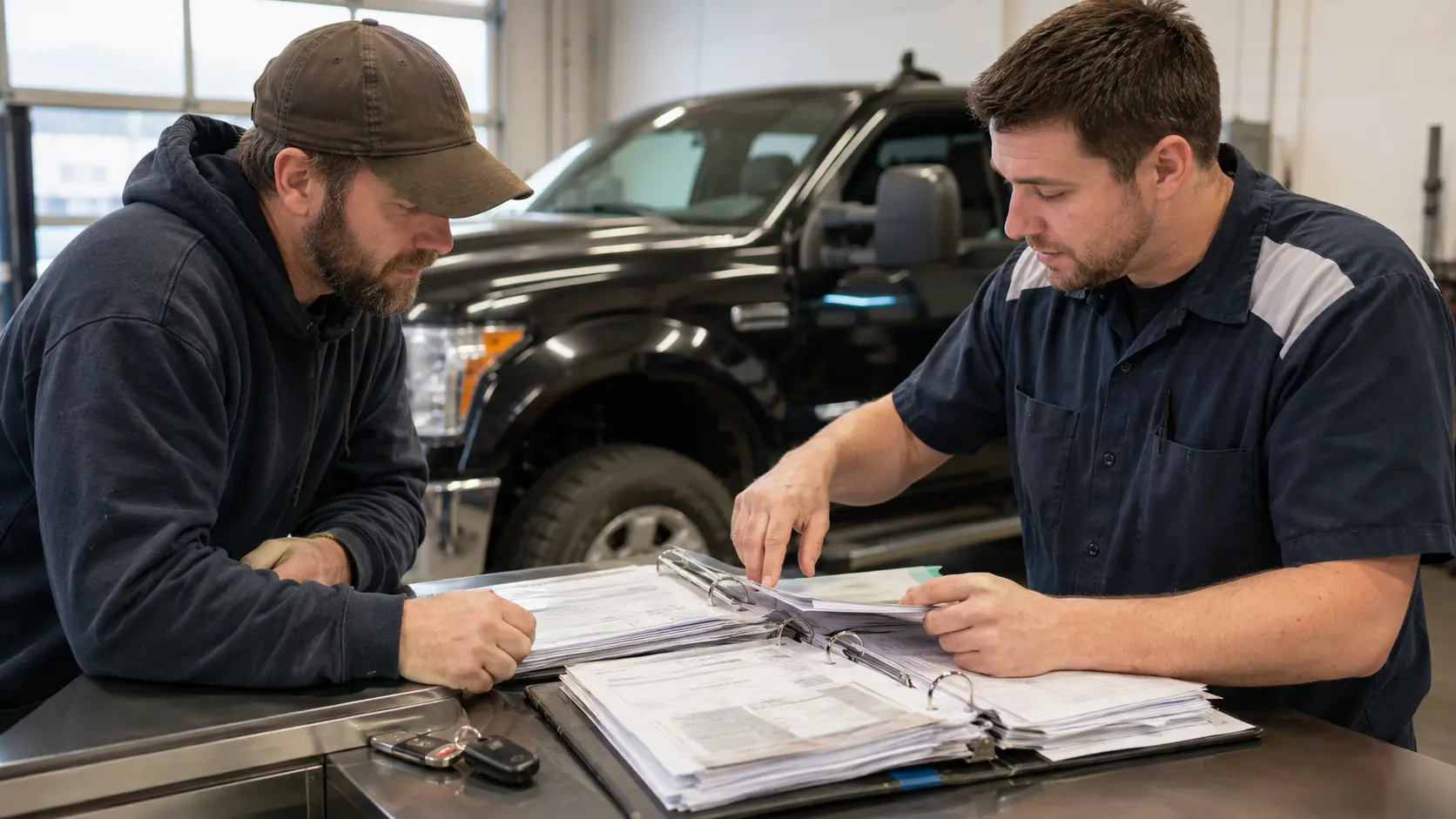
The 2023 Ford F-350 is a redesign, not simply a 2022 truck with a newer registration. Four engine choices, changed ratings and more electronic functions create a different inspection task. Selected SRW trucks have a rear axle-shaft campaign; other selected trucks have a front hub-extender campaign carrying a no-drive instruction. Reviewed on 15 September 2026, this guide combines Ford Canada's exact-year towing guide, the Canada/U.S. owner manual and current U.S. campaign records. It provides a purchase-screening framework, not a reliability ranking or Canadian VIN clearance.
What changed with the 2023 F-350
Ford Canada's 2023 guide introduces the 6.8-litre gas V8, standard on XL, at 405 hp and 445 lb-ft. The 7.3-litre gas V8 is listed at 430 hp and 485 lb-ft. The standard 6.7-litre Power Stroke and the new high-output 6.7-litre diesel are separate engine branches; the high-output engine is rated at 500 hp and 1,200 lb-ft.
A ten-speed automatic is standard across the listed models, and 4x4 becomes standard on XLT and higher trims. Those statements do not identify an unseen truck's engine or tow rating. Confirm its build information, especially when a seller uses 'Power Stroke' without distinguishing standard from high-output.
The guide also describes changed camera and trailer-assistance equipment. Presence of a feature is not evidence that its software or hardware is fault-free. Identify the actual cluster, camera and trailer-assistance options before checking the relevant campaigns.
SRW axle, front hub extender and steering are different safety gates
23S49 / NHTSA 23V595 concerns selected 2023 F-250 and F-350 trucks with single rear wheels and the specified 10.5-inch rear axle shaft. The left rear axle shaft may have received improper heat treatment. The remedy inspects its date code and replaces the shaft when necessary. Do not apply this SRW-specific defect narrative to every dually.
23S59 / 23V758 instead concerns front wheel hub-extender fasteners on selected 2022–2023 Super Duty vehicles. The current record advises affected owners not to drive until the repair is performed. Dealers inspect the retaining nuts and, if loose, replace the extender, retaining nuts and hub assembly. A generic wheel-service receipt is not proof that this campaign was completed.
23S22 / 23V344 addresses missing or improperly tightened steering-column upper-shaft coupler bolts. Dealers inspect and tighten the bolts or install missing bolts as needed. This differs from the earlier-model shaft condition described under 25S94; campaign numbers and production populations are not interchangeable.
Resolve any applicable no-drive restriction before arranging a road test. Have Ford establish VIN applicability and obtain completed repair records, then commission an independent inspection of the actual axle, steering, brakes, tires and suspension. Neither visual cleanliness nor the absence of a warning light proves mechanical acceptance.
| Record | Exact concern | Buying consequence |
|---|---|---|
| 23S49 / 23V595 | Specified SRW 10.5-inch left rear axle shaft | Verify date-code inspection and required replacement |
| 23S59 / 23V758 | Front wheel hub-extender fastening | Affected vehicle must not be driven until repaired |
| 23S22 / 23V344 | Steering-column upper-shaft coupler bolts | Verify bolt inspection, tightening or installation |
Read the 2023 towing matrix, not the previous year's maximum
Ford Canada's guide separates fifth-wheel and gooseneck values into individual columns. For the high-output diesel SRW Regular Cab 4x4, 141.6-inch wheelbase, eight-foot box, 3.55 axle and 35,200-lb GCWR, the 18-/20-inch all-terrain-tire position is 26,000 lb fifth-wheel and 27,400 lb gooseneck. Different tire positions in that same row have different values.
The high-output Tremor SRW Crew Cab 4x4 short-box branch, 159.8-inch wheelbase, 3.55 axle and 31,200-lb GCWR, lists 23,000 lb for both fifth-wheel and gooseneck. Its conventional entry is 18,200 lb. These numbers do not carry over from the F-250's superficially similar Tremor branch.
For a high-output DRW Regular Cab 4x2, 141.6-inch wheelbase, eight-foot box, 4.10 axle and 45,600-lb GCWR, the guide lists 35,000 lb fifth-wheel and 38,000 lb gooseneck. The comparable DRW Crew Cab 4x4, 176.0-inch wheelbase, is 34,700 lb fifth-wheel and 35,800 lb gooseneck. The headline 40,000-lb gooseneck position is a packaged F-450, not an F-350.
Canadian manufacturer literature establishes these configuration examples, not an individual truck's usable payload or certification. Match the complete build and hitch, then check labels, tire and axle ratings, passengers, cargo and measured pin load. Engine power and maximum trailer weight do not establish long-term reliability.
| Selected high-output diesel configuration | Fifth-wheel | Gooseneck |
|---|---|---|
| SRW Regular Cab 4x4, 3.55, 35,200-lb GCWR, specified all-terrain tires | 26,000 lb | 27,400 lb |
| SRW Tremor Crew Cab 4x4 short box, 3.55, 31,200-lb GCWR | 23,000 lb | 23,000 lb |
| DRW Regular Cab 4x2, 4.10, 45,600-lb GCWR | 35,000 lb | 38,000 lb |
| DRW Crew Cab 4x4, 4.10, 45,600-lb GCWR | 34,700 lb | 35,800 lb |
Camera and window repairs can require a later correction
23S46 / 23V573 concerns the default rearview image while using Pro Trailer Hitch Assist. Its remedy updates the ADAS module. 25S17 / 25V134 is specifically an incorrect-repair follow-up for vehicles previously repaired under 23V573. An original campaign invoice is therefore not necessarily the final answer.
23S37 / 23V507 concerns the front windows' anti-pinch behaviour following a low-power reset while a window is moving. 25S25 / 25V157 follows incorrect prior repairs under that campaign. Request the current status and corrective software record; do not demonstrate anti-pinch performance using a person's body.
24S66 / 24V806 is a different camera issue involving water entering the tailgate park-assist sensor interface module. Its current remedy includes the tailgate camera, harness, module and IPMA software. 25S49 / 25V315 instead describes an APIM software issue. The word 'camera' does not make these the same defect or repair.
Also identify whether the truck has the digital instrument cluster covered by 23C25 / 23V506, concerning improper soldering and a display that may not illuminate. The described repair replaces the module or cluster as necessary. Check actual functionality and repair records independently.
Diesel maintenance must match duty, not just kilometres
The exact 2023 Canada/U.S. owner manual gives a diesel oil-service ceiling of one year, 15,000 miles/24,000 km or 450 engine hours, while directing service according to the instrument-cluster indication. This is a ceiling, not permission to ignore an earlier oil-life message.
In the normal diesel schedule, the engine-mounted and frame-mounted fuel filters are replaced at 30,000 miles/48,000 km. Under the separate diesel special-operating-conditions schedule for a vehicle used primarily for towing, the filter entry is 15,000 miles/24,000 km, six months or 600 engine hours. The manual distinguishes primarily operating in those conditions from occasional use.
Review invoices for both filters and compare the service history with actual towing and engine hours. A truck with relatively low road distance can still have a materially different duty history. These selected entries do not replace the complete manual's maintenance and exception tables, and they are not transferred to the gas engines.
For a dually, the same maintenance section separately addresses wheel rotation: rotate the front wheels as specified, with rear-wheel rotation when unusual wear is noticed. Have the correct tire configuration and wear pattern professionally assessed rather than applying an SRW rotation pattern indiscriminately.
Fuel, trailer and restraint records still need equipment matching
25S75 / 25V455 is categorized as a gasoline low-pressure fuel-pump action. The current remedy replaces the pump on affected Super Duty vehicles, while other affected model families receive PCM updates. It is not a documented defect in the 2023 high-output diesel merely because the model name appears in the same search.
26C10 / 26V104 concerns integrated trailer-module communication loss, potentially affecting trailer lights or brakes. Its software update is separate from the Pro Trailer Hitch Assist camera action. Verify actual trailer lighting and braking after applicable repair work before towing.
Other returned records concern a clock-spring electrical connection to the driver airbag, SuperCab head-restraint instructions and wiper arms. This review read all 15 U.S. summaries and remedies, but the count is not a candidate-specific defect count or a complete service-bulletin inventory. Absence from this one model query is not VIN clearance.
Reliability verdict and purchase decision
The defensible verdict is conditional: establish the exact redesigned configuration, resolve applicable safety restrictions, verify original and follow-up repairs, and reconcile maintenance with the truck's work history. Do not choose or reject the whole year from a recall total or a headline towing claim.
An independent inspection and complete records can support further consideration. Unresolved hub safety, axle or steering concerns, contradictory repair invoices or insufficient load capacity justify pausing the purchase. Ford Canada and a Canadian dealer must determine local VIN eligibility and completion; the U.S. records do not do that automatically.
This guide preserves the distinct 2023 reliability intent and supplies no invented failure percentage, lifespan, ranking, active inventory, seller, dealer count, price or offer. General F-350, problems and towing pages remain separate resources.
Evidence note: manufacturer documents establish the specific facts and applications cited. Buying workflows and cost scenarios are DieselTrucks.ca editorial guidance. These pages do not publish measured failure rates or confirm the condition, recall status or capacity of a particular truck.
General educational content for Canadian diesel-pickup research. Verify the exact truck, model year, certification labels, owner manual and manufacturer documentation, and obtain qualified mechanical or towing advice where appropriate.
Sources & Further Verification
Use the exact model year, VIN, truck labels and current manufacturer documentation when moving from general research to a purchase or towing decision.