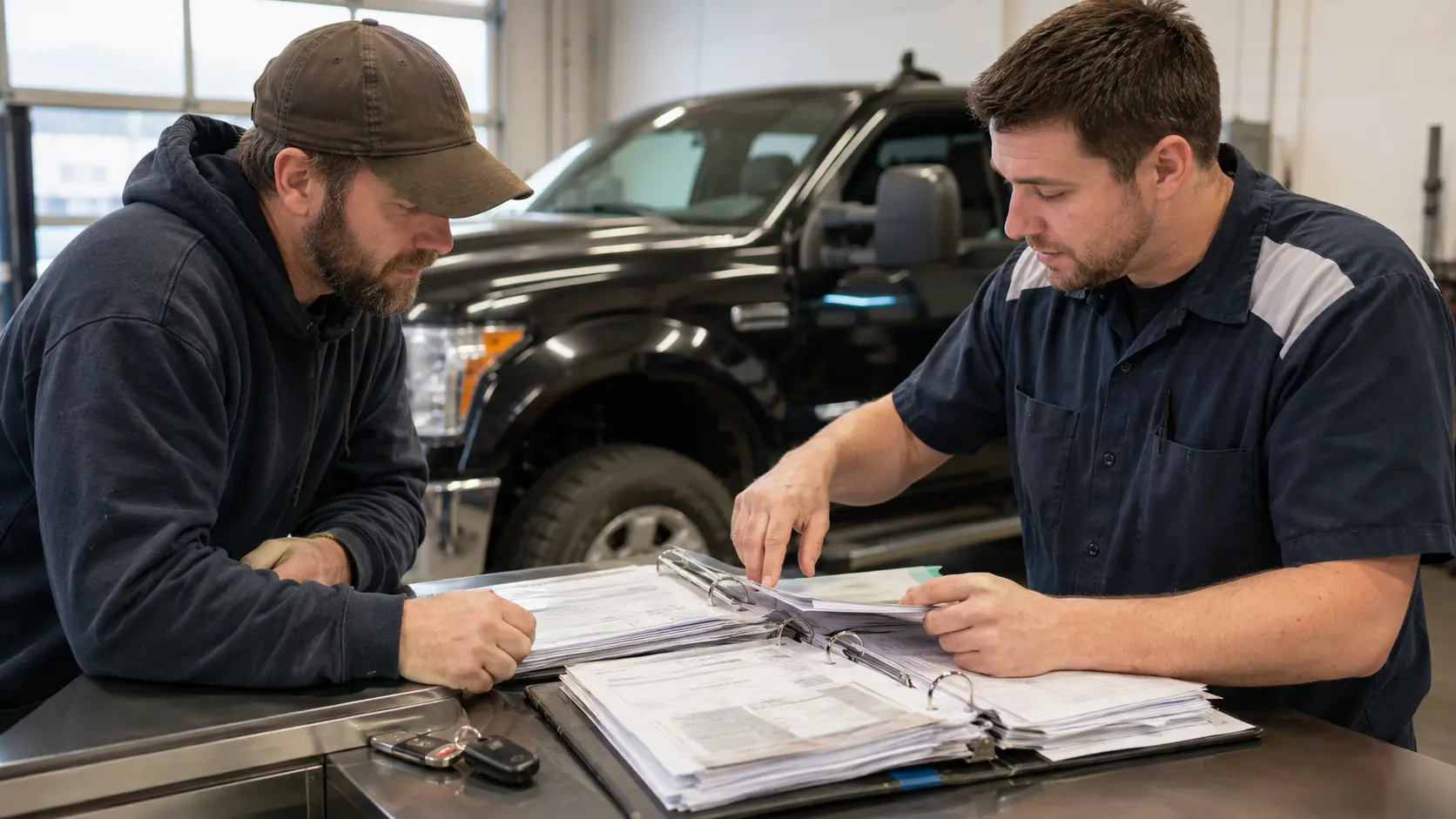
The 2017 Ford F-350 starts a redesigned Super Duty era, but a used example should be judged as a specific truck: single rear wheel or dually, gasoline or diesel, factory pickup or altered body, and documented work history. This guide was researched on 15 September 2026 using Ford's 2017 literature, a manufacturer steering bulletin and current U.S. campaign records. It separates original capability from present condition and keeps the F-350's limits distinct from the F-250 and F-450.
Verdict: first-year redesign is context, not a reliability score
Ford's 2017 towing guide describes a high-strength-steel frame and aluminum-alloy body for the new Super Duty generation. Those are engineering and identification facts, not evidence that a used truck is free of corrosion, collision damage or fatigue. Inspect the steel underbody, body attachments and any repaired or modified areas on the actual candidate.
The defensible buying verdict is conditional: consider a truck whose identity, maintenance, campaign status and independent inspection support its intended use. Do not declare 2017 a best or worst year from the redesign alone, a complaint count or a previous owner's mileage. No controlled failure-rate or remaining-life estimate was established by the reviewed sources.
Identify the 2017 powertrain and rear-wheel branch
The reviewed Ford pickup guide separates the 6.2L gasoline V8 from the second-generation 6.7L Power Stroke diesel. Its 2017 pickup diesel rating is 440 hp at 2,800 rpm and 925 lb-ft at 1,800 rpm. Do not copy the later 450-hp/935-lb-ft rating into this year or transfer a chassis-cab output merely because the engine displacement matches.
Ford's exact-year online transmission section describes operation through six forward gears, including SelectShift and tow/haul. This is not the later ten-speed powertrain. Match the fitted transmission and factory configuration from the candidate's documentation rather than inferring an internal transmission code from this operating page.
An F-350 SRW and an F-350 DRW are separate load configurations, not interchangeable names for the same towing allowance. Record cab, box, wheelbase, drive, axle, GVWR, GCWR, tires and hitch. A pickup-box-delete row also remains separate from a completed pickup and does not certify an aftermarket body.
SRW versus dually: hitch limits that materially affect a purchase
Ford's U.S. 2017 guide was recovered from the external RV Safety archive; its manufacturer authorship and dated revisions were visually checked. The selected examples below illustrate why both configuration and hitch method matter. They are not Canadian VIN ratings, payload certificates or allowances for every F-350.
The SRW table marks selected high ratings as gooseneck values with an 18,000-lb fifth-wheel hitch limit. The DRW table uses a separate 27,500-lb fifth-wheel hitch limit on its marked gooseneck cells. The guide's 32,500-lb gooseneck position is in the F-450 column, not the F-350 column.
| Exact 2017 pickup example | Source gooseneck position | Fifth-wheel boundary |
|---|---|---|
| F-350 SRW diesel; Regular Cab 4x2, 142-in wheelbase, 8-ft box, 3.31 or 3.55, 28,700-lb GCWR, 17-in tires | 21,500 lb | 18,000 lb hitch limit on marked cell |
| F-350 DRW diesel; Regular Cab 4x2, 142-in wheelbase, 8-ft box, 4.10, 40,000-lb GCWR; ordinary pickup row | 32,000 lb | 27,500 lb hitch limit on marked cell |
| F-350 DRW diesel; Crew Cab 4x4, 176-in wheelbase, 8-ft box, 4.10, 40,000-lb GCWR; ordinary pickup row | 31,300 lb | 27,500 lb hitch limit on marked cell |
Do not turn a capacity example into a payload guarantee
A heavier permitted trailer can impose more pin load on the truck, but the trailer-table number does not establish the payload remaining after occupants, hitch, tools and other cargo. Verify the candidate's payload, GVWR, rear GAWR, tires, wheels and hitch labels and use actual loaded measurements.
The 2017 overview's up-to-7,630-lb payload claim is footnoted to an F-350 DRW Regular Cab 4x2. It is not a diesel Crew Cab payload figure. A dually conversion, replacement body or suspension modification cannot be assumed to inherit the factory DRW rating.
Review prior hitch mounting, bed and frame changes, trailer use and axle service as part of the inspection. Those checks address the candidate's history; they do not imply that towing within the correct limits inevitably damages an F-350.
Steering bulletin 19-2274 has a defined 4WD symptom boundary
Ford TSB 19-2274, dated 10 September 2019, addresses some 2017–2019 F-250/F-350 4WD vehicles with sustained steering-wheel oscillation after rough pavement or an expansion joint above 72 km/h. The bulletin specifies that all applicability conditions must be met and supplies a technician procedure involving the steering-linkage damper.
This is not a safety recall, not a failure-rate study and not proof that every 2017 F-350 has that condition. Do not deliberately provoke a dangerous oscillation during a buying test. Document any reported symptom and ask a qualified technician to establish the cause and current applicable Ford guidance.
The bulletin also discusses aftermarket chassis, steering and suspension modifications. Separately, the U.S. model-year query returns an Icon accessory-stabilizer recall, 20E090, for part 65050. That aftermarket product record must not be counted as an original Ford component defect on an unmodified truck.
Tailgate, driveshaft and diesel fuel-shield campaigns are different
Ford's 6 December 2019 announcement for 19S48 describes water entering the electric tailgate-release wiring and potentially unlatching the tailgate. It explicitly excludes mechanical-release handles and identifies a Canadian affected population, but neither that population nor a build-date range verifies this candidate's VIN or completion.
Current U.S. records add component-specific checks. Obtain the actual applicable campaign result and repair evidence; an ordinary service entry is not necessarily a completed recall. The examples are selected, not an exhaustive campaign list.
| Action | Recorded applicability/concern | Evidence boundary |
|---|---|---|
| 19S48 / 19V864 | Selected 2017–2019 trucks with electric tailgate release; unintended opening | Harness isolation and switch action; mechanical handle excluded |
| 22S74 / 22V880 | Selected 2017–2018 4x4 trucks; driveshaft internal radial damper can move and cause fracture | Driveshaft replacement record; not a 2025–2026 friction-weld campaign |
| 16S39 / 16V778 | Selected 2017 diesel trucks built 21 March–28 August 2016; fuel-conditioning-module shield adhesion | Protective-shield replacement; not a universal high-pressure-pump diagnosis |
Camera checks need current records, not just a 2017 recall list
Ford 22S51 / 22V644 concerns certain vehicles equipped with the 360-degree camera system, where rear-camera coating degradation can produce a cloudy image. Its recorded remedy is rear-camera replacement. Ford 25S89 / 25V572 separately addresses distorted, inverted or blank reversing images, with inspection and replacement as necessary and phased 2026 notices in the reviewed record.
These are not automatically the same fitted-camera population or the same completed repair. Check equipment and current Ford Canada VIN results, then safely evaluate the actual display. A camera that works once does not confirm campaign completion; an old invoice does not prove every later action is closed.
The selected U.S. API returned 14 records, including the aftermarket accessory item. That count is not 14 defects on the truck and cannot establish whether this year is more reliable than another. Other returned seat, latch and block-heater records still require candidate-specific checking even though this article does not reproduce every summary.
Use the correct operating context and inspection sequence
The 2017 owner's transmission guidance explains that tow/haul changes shift behaviour and supplies engine braking in forward gears. It also warns against tow/haul on slippery surfaces. A shift that occurs during tow/haul should be interpreted in its operating context, but persistent harshness, delays, warnings or loss of drive still require diagnosis.
Before operation, resolve applicable safety restrictions and review campaign records. After clearance, arrange an independent inspection of cold and warm operation, diagnostic history, steering, brakes, tires, corrosion, leaks, cooling, hitch installation and modified wiring. Preserve service receipts, kilometres and engine hours and ask how the truck was worked.
The online manual can include later information; the manual supplied with the truck remains important. The operating section reviewed here is not a complete maintenance schedule, and no fluid-change interval is inferred from it. This guide confirms no inventory, seller, price, availability, financing or Canadian VIN status.
Evidence note: manufacturer documents establish the specific facts and applications cited. Buying workflows and cost scenarios are DieselTrucks.ca editorial guidance. These pages do not publish measured failure rates or confirm the condition, recall status or capacity of a particular truck.
General educational content for Canadian diesel-pickup research. Verify the exact truck, model year, certification labels, owner manual and manufacturer documentation, and obtain qualified mechanical or towing advice where appropriate.
Sources & Further Verification
Use the exact model year, VIN, truck labels and current manufacturer documentation when moving from general research to a purchase or towing decision.
- Ford — 2017 RV & Trailer Towing Guide, manufacturer document in RV Safety archive
- Ford — 2017 Super Duty owner manual: automatic transmission
- Ford — TSB 19-2274, 10 September 2019
- Ford — 19S48 announcement, 6 December 2019
- NHTSA — 2017 F-350 SD U.S. campaign records, reviewed 15 September 2026
- Ford Canada — recall information and VIN lookup
- Ford owner manuals