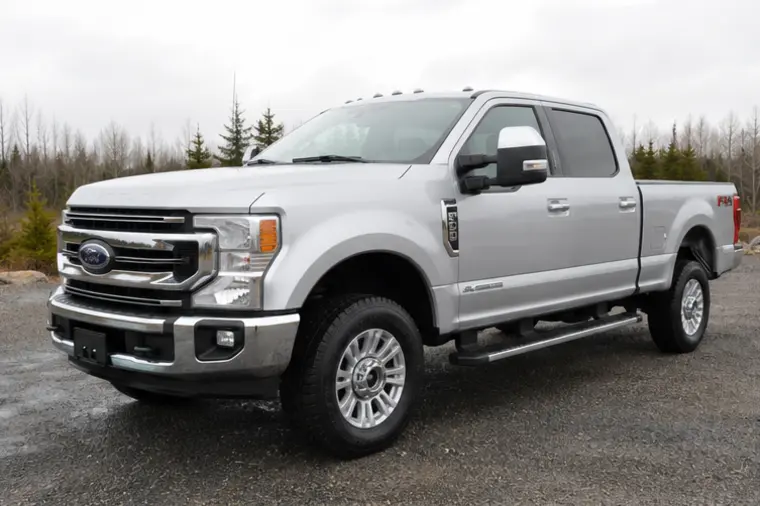
Ford F-350 problems need to be separated by model year, Power Stroke generation and truck configuration. Start with the documented conditions relevant to the candidate, then inspect the complete pickup. An F-350 carrying a fifth-wheel or permanent work equipment also needs a careful rear-tire, hitch and loaded-weight assessment; engine health alone does not make it ready for the job.
F-350 issue map: begin with the applicable years and equipment
The table identifies documented campaign or bulletin questions alongside separate condition checks. It is not a list of defects present on every F-350, nor a ranking of failure frequency. Match the truck's VIN, build date and equipment to current manufacturer information before assuming that a document applies.
| Issue to investigate | Published scope | Buying action |
|---|---|---|
| Sustained steering oscillation | TSB 19-2274: 2017–2019 F-250/F-350 4WD with a defined symptom | Review symptom and repair history; arrange current professional assessment |
| Unexpected electric tailgate release | 19S48: specified 2017–2019 Super Duty electric-release configurations | Identify release equipment and verify VIN campaign completion |
| High-pressure diesel fuel pump | 24S78 / U.S. 24V-957: defined 2020–2022 6.7L population | Check campaign status and any separate fuel-system repair history |
| Steering-column upper shaft | 25S94 / U.S. 25V626: specified 2020–2021 Super Duty population | Obtain current VIN instructions and remedy evidence |
| Rear tires, hitch mounting and carried load | Condition and configuration of the individual SRW or DRW pickup | Inspect the hardware and verify the loaded truck rather than relying on the badge |
Steering oscillation is a specific symptom, not a universal diagnosis
Ford TSB 19-2274 addresses sustained steering-wheel oscillation on specified 2017–2019 four-wheel-drive F-250/F-350 trucks after rough pavement or an expansion joint at higher speed. Its diagnostic discussion concerns steering-linkage damper lag or lash. The bulletin is not a recall or evidence that all F-350 steering complaints have the same cause.
Ask whether the candidate has experienced the described oscillation, whether it recurred after work and what the shop actually diagnosed. A receipt naming a replacement damper is useful, but it does not document the current condition of every steering joint, tire or suspension component. Have an inspecting technician assess the truck using current service information, especially if it has a lift, changed tires or other modifications.
Do not attempt to reproduce instability by deliberately hitting a rough road at speed during a buying visit. Unresolved steering behaviour is a reason to arrange appropriate professional evaluation before normal driving or towing. Keep the original symptom description with the repair invoice so the technician can distinguish a recurring condition from a new complaint.
The newer steering-shaft recall is a different check
Ford's 25S94 / U.S. 25V626 filing identifies an upper steering-column shaft separation concern in specified 2020–2021 F-250 through F-450 vehicles. Separation can cause loss of steering, and the filing does not identify a dashboard warning that reliably precedes it. A warning-free instrument panel therefore cannot establish that this campaign is resolved.
Use the current Ford VIN record and follow the instructions for the actual truck. An invoice for steering-oscillation work is not evidence that the shaft campaign has been completed: the components, years and conditions are different. A seller may have paperwork for one event while another campaign was issued later in the truck's life.
Ask the shop to identify the campaign number, completion date and recorded action. Retain that evidence with the sale and inspection documents rather than accepting an undated statement that the truck has “had all its recalls.” The next owner needs to know which actions were checked and when.
Tailgate release: check the equipment as well as the year
Ford's 19S48 announcement includes certain 2017–2019 Super Duty trucks with electric tailgate-release equipment, including Canadian vehicles. It describes water entering the switch circuit and unintended release. Trucks with a mechanical release handle are excluded from that announcement's affected equipment.
Inspect how this F-350's tailgate operates and ask about replacement handles, harness work or unexpected opening. Those observations help frame the enquiry, while Ford's current VIN information establishes the campaign question. A new-looking tailgate is not proof of either campaign completion or a hidden defect.
For a working pickup, evaluate the bed and tailgate as cargo-handling equipment. Check present latch operation and damage with the technician, and use appropriate cargo restraint independently of the tailgate. An intermittent latch should be resolved before the truck carries unsecured items that could be lost if it opens.
6.7L fuel-system history: separate the campaign from a failure repair
The 24S78 filing describes a high-pressure pump concern involving aged biodiesel deposits in a defined 2020–2022 Super Duty diesel population. Possible signs include longer cranking, noise, reduced power and a check-engine light. These observations require diagnosis; none alone proves the campaign condition is the cause.
A used buyer should ask both whether the campaign is outstanding and whether the truck has already needed fuel-system repairs. A recorded campaign update is different from a pump or injector replacement. Request an itemized invoice for any breakdown, including the diagnosis and the repair scope, and have a qualified diesel shop explain unresolved questions.
Do not assume a U.S. filing confirms Canadian coverage for the candidate VIN. Use the manufacturer to establish current applicability and completion. If the truck has a present loss-of-power or fuel-leak concern, resolve the condition before treating it as ready to tow merely because an earlier campaign entry exists.
Older Power Stroke engines require their own inspection questions
An F-350 with a 7.3L or 6.0L Power Stroke presents a different starting and lubrication investigation from a later 6.7L. Ford's period supplements describe oil's role in injector actuation on those older applications. Correct oil and fuel service records are therefore part of the evidence a technician will interpret, not simply a cosmetic indication that the owner kept receipts.
The 6.4L F-Super Duty supplement describes DPF operation and distinguishes soot regeneration from ash accumulation. A dashboard message on that application should not be interpreted using an unrelated newer engine's equipment or service assumptions. Identify the exact engine first, then use its documentation and diagnostic findings.
Avoid accepting an informal blow-by demonstration or a short video as a remaining-life test. A qualified shop can determine which measurements are appropriate to the engine and symptoms. Similarly, a major repair described as a permanent cure needs an invoice explaining the original problem, installed components and work performed. It does not reset the condition of the entire truck.
F-350 SRW and DRW: inspect the configuration you intend to load
For a DRW candidate, include the inner rear tires and their condition in the inspection rather than stopping at the visible outer pair. Ask the technician to assess tire suitability, wear patterns, wheels and signs of contact or damage. A six-tire pickup brings more components to maintain, but the presence of duals does not diagnose past use or establish present capacity.
For either rear-wheel arrangement, inspect hitch mounting and the surrounding structure. Obtain documentation for installed fifth-wheel or gooseneck hardware and any bed or suspension changes. Fresh paint, added air assistance or a large hitch does not prove that the truck has been operated within its limits or that its present configuration fits your trailer.
Use the payload label, axle and tire information, correct towing guide and loaded measurements to assess the next job. A handling complaint with a trailer may require investigation of loading and setup as well as the truck itself. Do not immediately attribute every symptom to a model-wide mechanical defect.
Turn the inspection findings into a repair and downtime plan
Ask for a written report dividing findings into concerns to resolve before use, diagnosed repair items and further investigation. Request itemized local estimates for the diagnosed work, including parts, labour and expected scheduling. Keep a symptom with an uncertain cause separate from an ordinary maintenance allowance.
For an F-350 used to earn income, identify what happens while it is unavailable. A replacement pickup may need the same hitch type, carried-load capacity and seating, so availability alone is not enough. Account for a realistic substitute arrangement or lost work without counting overlapping costs twice.
For a recreational tow vehicle, consider the timing of booked trips and the ability to complete repairs before departure. A low purchase price does not compensate for an unresolved safety issue or a truck that cannot perform the planned assignment. Compare the purchase plus known work with an alternative candidate supported by equivalent inspection evidence.
F-350 problems: common buyer questions
Does an F-350 have the same problems as an F-250? Some documents cover both, but applicability remains year- and equipment-specific. The F-350's particular SRW/DRW configuration, prior loads and component condition also need their own assessment.
Is a steering damper replacement proof that a truck is fixed? It documents that item of work. Ask what was diagnosed and whether symptoms returned; it does not certify the complete steering system or resolve an unrelated campaign.
Does a completed recall prove reliability? No. It addresses a specified action. Current inspection and maintenance evidence are still needed to assess the rest of the truck.
Which F-350 years should be avoided? This problems guide identifies documented concerns rather than turning selected campaigns into a universal blacklist. Year selection needs the engine era, equipment, condition and intended use considered together. The presence of a campaign does not provide a measured lifetime failure rate.
Evidence note: manufacturer documents establish the specific facts and applications cited. Buying workflows and cost scenarios are DieselTrucks.ca editorial guidance. These pages do not publish measured failure rates or confirm the condition, recall status or capacity of a particular truck.
General educational content for Canadian diesel-pickup research. Verify the exact truck, model year, certification labels, owner manual and manufacturer documentation, and obtain qualified mechanical or towing advice where appropriate.
Sources & Further Verification
Use the exact model year, VIN, truck labels and current manufacturer documentation when moving from general research to a purchase or towing decision.
- Ford TSB 19-2274 — 2017–2019 F-250/F-350 4WD steering oscillation
- Ford 25S94 / U.S. 25V626 filing — defined 2020–2021 steering shaft population
- Ford 19S48 announcement — specified 2017–2019 electric tailgate latches, including Canada
- Ford 24S78 / U.S. 24V-957 filing — defined 2020–2022 Super Duty population
- Ford 2003 7.3L supplement — engine lubrication and injection
- Ford 2007 6.0L diesel supplement — F-Super Duty fuel and lubrication sections
- Ford 2009 diesel supplement — F-Super Duty 6.4L and DPF sections
- Ford owner manuals