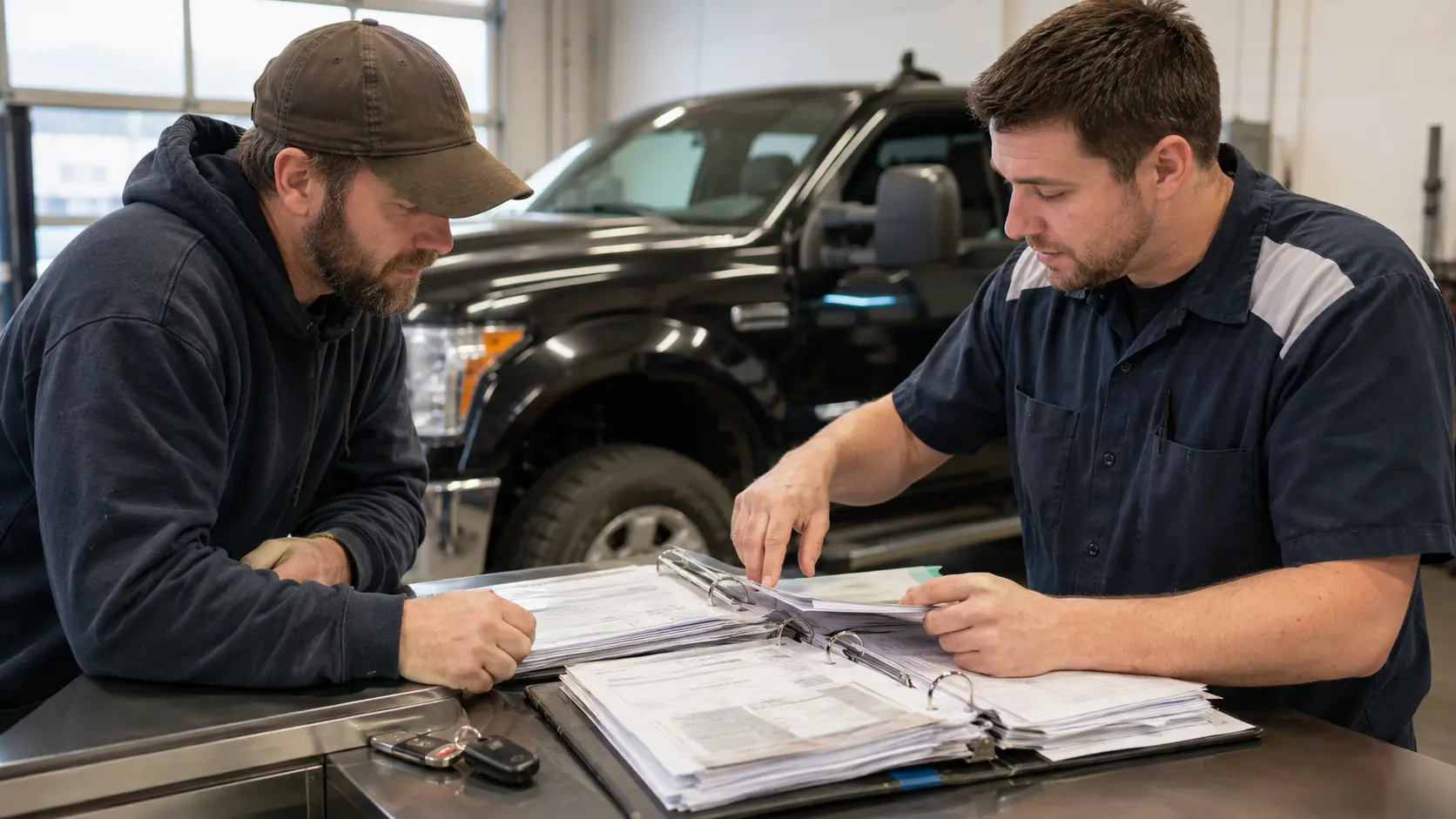
A 2018 Ford F-350 combines the redesigned Super Duty platform with a higher published diesel output than 2017, but that change does not establish a reliability ranking. The useful buying questions concern the fitted transmission, SRW or dually configuration, emissions-system duty cycle and completion of applicable equipment-specific campaigns. Reviewed on 15 September 2026, this guide uses exact 2018 Ford literature and independently checked service and safety records rather than transferring the preceding year's page.
What changed for 2018—and what is not an F-350 change
Ford's 2018 pickup guide rates the 6.7L diesel at 450 hp at 2,800 rpm and 935 lb-ft at 1,800 rpm, compared with the 2017 guide's 440 hp and 925 lb-ft. The 6.2L gasoline V8 remains a separate branch. More rated output is a specification difference, not evidence of lower repair frequency or a longer service life.
The same 2018 overview announces F-450 4x2 availability and a 34,000-lb family gooseneck headline. Neither should be presented as a new F-350 configuration or its maximum. The F-350 DRW matrix retains distinct 3.55 and 4.10 axle rows, separate from the F-450's 4.30 rows.
For a used purchase, identify the actual engine, transmission, wheel arrangement, body and factory ratings before judging a seller's claim. A model-year badge, diesel badge or set of dual rear wheels cannot establish every remaining specification.
Transmission identification: use the label, not a guessed six-speed code
Ford's exact 2018 Canadian-market online owner table places the transmission code on the Safety Compliance Certification Label. It maps P to six-speed 6R140, S to six-speed 6R100 and W to six-speed 6R140W. The table describes the wider manual's code set; it does not establish that every entry was fitted to every F-350 configuration.
Read the candidate's code and reconcile it with build and service records. Do not call every six-speed a 6R140 solely from a photograph, and do not describe the truck as the later ten-speed generation. If the transmission has been replaced, request the replacement identity and repair documentation.
An inspection should assess the actual complaint, operating temperature, diagnostic information and repair history. A shift-feel report is not by itself proof of an internal failure, but an unexplained delay, warning or loss of drive should not be dismissed because the truck has a familiar transmission name.
| 2018 owner-table code | Manufacturer description | How to use it |
|---|---|---|
| P | Six-speed automatic 6R140 | Read actual certification label |
| S | Six-speed automatic 6R100 | Do not assume universal F-350 fitment |
| W | Six-speed automatic 6R140W | Reconcile original and replacement records |
Exact SRW and DRW ratings keep hitch limits separate
The manufacturer-authored 2018 U.S. towing guide is available through the RV Safety archive. Fresh visual review confirms that the SRW Regular Cab 4x2, 142-inch-wheelbase, eight-foot-box diesel with 3.31 or 3.55 axle, 28,700-lb GCWR and 17-inch tires has a 21,500-lb gooseneck position. The marked cell limits fifth-wheel use to an 18,000-lb hitch rating.
For the F-350 DRW diesel Regular Cab 4x2, 142-inch wheelbase, eight-foot box, 4.10 axle and 40,000-lb GCWR, the guide lists 32,000 lb gooseneck, with a 27,500-lb fifth-wheel hitch limit. The comparable DRW Crew Cab 4x4, 176-inch-wheelbase row is 31,300 lb gooseneck, not 32,000 lb.
The 2018 chart does not reproduce the 2017 pickup-box-delete alternate rows. Do not insert those old cells into this selector or assign the F-450's 34,000-lb value to an F-350. These are configuration-specific U.S. guide references, not Canadian VIN certifications.
DPF duty cycle is a purchase-history question, not a deletion recommendation
Ford's exact 2018 DPF guidance distinguishes normal automatic regeneration from conditions where short trips, low-speed work or extensive stationary operation may prevent effective cleaning. Changes in exhaust sound can occur during regeneration; a noise alone does not diagnose filter failure.
Ask how the diesel was used, whether warning messages were addressed, and what diagnostic or cleaning work was documented. The manual warns that ignoring required action can allow excessive loading and damage. A candidate with recurring messages needs qualified diagnosis, not a promise that any highway drive will cure it.
Regeneration creates very hot exhaust. Ford warns against parking or idling over combustible vegetation and against working on hot exhaust components. Operator-commanded regeneration is equipment-dependent and subject to specific precautions; this guide does not provide a shortcut procedure or tell a buyer to force it during a viewing.
Evaluate the intact emissions system against the candidate's actual work and service history. The operating guidance does not establish a fleet failure rate, a universal regeneration interval or an expected filter replacement mileage for this truck.
Two driveshaft records and a steering bulletin address different conditions
Ford 22S09 / NHTSA 22V087 concerns specified gasoline-engine trucks with aluminum driveshafts, where loose underbody heat/noise insulators can contact and damage the shaft. Ford 22S74 / 22V880 separately concerns selected 2017–2018 4x4 trucks with an internal radial damper that can move and cause imbalance or fracture. Do not label the gasoline-insulator action as a universal diesel driveshaft defect.
Ford TSB 19-2274 addresses defined sustained steering oscillation on 2017–2019 F-250/F-350 4WD after rough pavement or an expansion joint above 72 km/h. It is a technician bulletin, not a recall or a prevalence study. Do not deliberately reproduce dangerous oscillation during a purchase test; have the reported condition professionally assessed.
The query also returns Icon's 20E090 stabilizer-kit action for part 65050. This is aftermarket equipment, not an original Ford defect on every truck. Record suspension and steering modifications and identify fitted parts before using any campaign or bulletin as a diagnosis.
| Evidence | Distinct component/condition | Buying evidence |
|---|---|---|
| 22S09 | Gasoline engine, aluminum shaft, loose underbody insulator | Applicable inspection/repair and insulator attachment |
| 22S74 | Selected 2017–2018 4x4 internal driveshaft damper | Applicable driveshaft replacement record |
| TSB 19-2274 | Defined 4WD sustained steering oscillation | Current technician diagnosis and bulletin applicability |
| Icon 20E090 | Accessory stabilizer kit 65050 | Actual aftermarket part identity |
Lighting, tires, tailgate and camera checks remain equipment-specific
Ford 19C10 / 19V808 covers selected 2018–2019 Super Duty daytime running lights that may not dim with the headlight switch on; the recorded action is BCM programming. Ford 21S10 / 21V155 concerns specified Continental tires and calls for tire inspection and replacement when required. Check the actual fitted tires, including replacements, rather than treating the model year as a tire identifier.
Ford 19S48 concerns selected electric tailgate-release systems, not mechanical handles. Ford 22S51 concerns camera-coating degradation on specified 360-degree-camera vehicles. The later 25S89 record separately concerns distorted, inverted or blank reversing images. Keep each applicable action and completion record distinct.
Ford's 2018 camera guidance explains that an ajar tailgate changes camera position and removes guidelines, and that a connected trailer may obstruct the view or alter guides. These operating limits cannot excuse a persistent blank or distorted image. Use mirrors and direct observation; do not operate camera settings while moving.
Reliability verdict and practical acceptance checklist
The reviewed evidence does not rank 2018 against 2017, SRW against DRW or gasoline against diesel for failure probability. Ten returned U.S. records include an accessory action and equipment-specific populations; they are not ten failures on the candidate. A lower count than another year's query is not proof of better reliability.
Before operation, obtain current Ford Canada VIN results and resolve any applicable safety restriction. Review maintenance and campaign invoices, kilometres, engine hours, modifications and prior towing or stationary work. After clearance, commission an independent inspection covering cold/warm operation, scan findings, leaks, cooling, steering, brakes, tires, corrosion, electronics and hitch installation.
For the intended trailer, use the exact-year chart plus actual payload, GVWR, GAWR, tires, hitch and measured loads. The overview's 7,630-lb payload maximum is footnoted to an F-350 DRW Regular Cab 4x2, not every diesel dually.
Buy only when the candidate's evidence supports the work. The online owner manual can contain later updates; the supplied manual and current vehicle-specific instructions remain important. This selected research is not a full service-bulletin or maintenance audit, and it invents no lifespan, inventory, seller, dealer count, price or offer.
Evidence note: manufacturer documents establish the specific facts and applications cited. Buying workflows and cost scenarios are DieselTrucks.ca editorial guidance. These pages do not publish measured failure rates or confirm the condition, recall status or capacity of a particular truck.
General educational content for Canadian diesel-pickup research. Verify the exact truck, model year, certification labels, owner manual and manufacturer documentation, and obtain qualified mechanical or towing advice where appropriate.
Sources & Further Verification
Use the exact model year, VIN, truck labels and current manufacturer documentation when moving from general research to a purchase or towing decision.
- Ford — 2018 RV & Trailer Towing Guide, manufacturer document in RV Safety archive
- Ford — 2018 Canadian-market owner manual: transmission codes
- Ford — 2018 Canadian-market owner manual: diesel particulate filter
- Ford — 2018 Canadian-market owner manual: reversing camera
- Ford — TSB 19-2274
- Ford — 19S48 announcement
- NHTSA — 2018 F-350 SD U.S. campaign records, reviewed 15 September 2026
- Ford Canada — recall information and VIN lookup
- Ford owner manuals