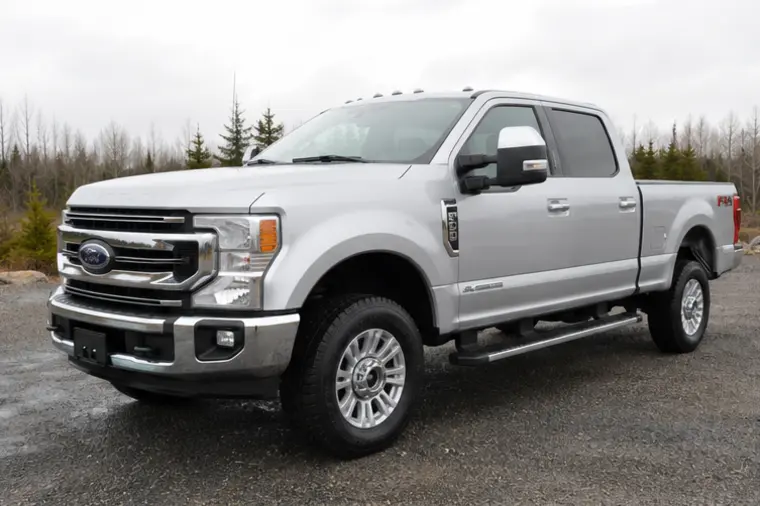
The best F-350 year depends first on whether you need an SRW or DRW pickup and what it must carry. For a buyer specifically seeking a six-speed diesel, use 2019 as an equipment benchmark. For a ten-speed diesel, compare 2020 and later candidates. Neither starting point is a measured reliability winner.
Our recommendation begins with the loaded truck
For an F-350 buyer, choosing the rear-wheel arrangement can matter more than choosing between adjacent years. Start with the occupants, carried equipment, hitch and loaded trailer you intend to use. Then identify candidates whose actual labels and applicable ratings support that assignment. Do not search for a favourite year first and try to make its available configuration fit afterwards.
Our conditional six-speed reference is the 2019 diesel F-350. Ford's period brochure documents that powertrain pairing. A buyer who specifically wants the updated diesel and ten-speed combination should instead begin with the 2020 equipment boundary described in Ford's guide. These are equipment preferences, not evidence that either year has fewer failures.
We cannot name a universal best F-350 diesel year from comparable Canadian ownership data. The recommendation here combines verified configuration changes with an editorial purchasing method. A well-supported candidate can beat another truck in the preferred year when its load suitability, repair history and present condition are stronger.
A useful shortlist for three different F-350 buyers
Do not compare a lightly equipped regular cab with a heavily optioned crew cab as though year alone explains their different usefulness. Likewise, an SRW and DRW advertisement may describe the same engine while offering materially different vehicles for your assignment. Keep the intended configuration consistent when comparing asking prices and known required work.
An older candidate remains eligible when a specialist can support its condition and the equipment fits. Our shortlist does not imply that 2019 or 2020 is the earliest acceptable year. It gives the search a clear starting reference without converting all other years into a blacklist.
| Buyer | Starting comparison | Evidence that should decide it |
|---|---|---|
| SRW pickup for mixed personal and towing use | A 2019 six-speed or a 2020-onward ten-speed diesel, according to preference | Actual loaded rear-axle and payload position, safe condition and maintenance record |
| DRW pickup dedicated to a heavy trailer | Equivalent dually candidates across those equipment boundaries | Correct hitch configuration, all six road tires, loaded combination evidence and repair support |
| Business considering a flat deck or service body | Identify factory pickup versus completed chassis cab first | Body-installation records, completed-vehicle information and the applicable ratings |
SRW or DRW: make this decision before the test drive
For an SRW candidate, obtain the actual labels and estimate the load with everyone and everything aboard. If those facts leave a material capacity question unresolved, do not rely on a seller's account of what the truck used to tow. Arrange the appropriate configuration and weight assessment before negotiating around a supposedly ideal year.
For a DRW candidate, include the inner rear tires and the installed hitch in the inspection brief. Ask the shop to inspect what is actually fitted, including wheel and tire condition and any relevant mounting changes. A photograph showing dual wheels does not establish the condition or suitability of the complete setup.
For either configuration, separate trailer mass from the load imposed on the truck. A fifth-wheel buyer should bring the actual trailer identification and loading information to the discussion. Do not use an empty-trailer advertisement to represent a fully equipped trip. The truck must be selected for the assignment, not merely for an attractive headline tow number.
How the equipment timeline changes the shortlist
The 2019 and 2020 documents provide a useful powertrain boundary, but they do not tell you how a particular used transmission has been maintained. Ask for cold and warm operational assessment and the explanation behind any previous transmission work. A satisfactory short drive does not resolve a documented intermittent concern by itself.
If a later candidate attracts you through greater advertised output or towing technology, identify the exact engine and installed features. Ford's 2024 pickup guide separates standard and high-output diesel configurations and hitch-specific towing tables. Use the matching information; do not transfer a favourable row from a different cab, axle or hitch application.
The buying implication is selective: newer equipment is valuable when you need it and the candidate supports its condition. If the older truck already fits the assignment, the newer one's appeal should be assessed against its actual additional commitment. No failure-rate assumption is needed to make that comparison.
Checks that can overturn a preferred-year choice
The selected Ford documents identify different screening windows: 19-2274 for specified 2017–2019 F-350 4WD steering oscillation, 19S48 for certain electric tailgates, 25S94 for a defined 2020–2021 steering-shaft population and 24S78 for a defined 2020–2022 diesel population. Their scopes should not be combined into one model-wide defect list.
Ask Ford to establish the current Canadian VIN position and retain any completion evidence. Then assess the actual truck. A completed campaign is not a substitute for investigating a current symptom, and a routine steering invoice does not establish completion of every steering-related campaign.
If the seller reports instability, loss of power or another unresolved material fault, suspend the ordinary test-drive and towing plan until an appropriate professional assessment is available. A preferred year is not a reason to accept an unresolved safety question. Avoid intentionally provoking a fault to decide whether the asking price is fair.
Older engines: select a supportable candidate
An older Power Stroke should receive an engine-specific inspection rather than a newer 6.7L checklist with the date changed. Request the relevant service record, repair history and modification information before the appointment. Ask the shop which questions the available documents answer and which need further diagnosis.
Ford's 6.0L supplement describes oil's role in injector actuation; its 6.4L F-Super Duty guidance separates soot regeneration from ash service. These are reasons to match the maintenance evidence to the engine. They do not establish that every older truck is defective or provide a guaranteed remaining lifespan.
A truck with documented major work may deserve consideration, but establish what the work covered. Replacing an engine does not replace the age and history of the chassis, hitch, transmission and accessories. For a buyer without specialist support or spare capacity, an unexplained project is a weak choice regardless of its reputation.
Review the work history alongside the kilometres
Ask what the F-350 carried and towed, whether it worked seasonally and whether operating hours were recorded. Treat those answers as context for inspection rather than proof of abuse. A commercially used truck with a coherent service file can be easier to assess than a privately owned one with no useful history.
Read repair invoices in sequence. Identify recurring complaints, changes in diagnosis and evidence of a satisfactory result. A large collection of receipts can represent careful ownership or repeated unresolved work; the number of pages alone does not decide which. Record the unresolved question so the inspecting shop knows what to investigate.
Look beyond the powertrain. Ask about removed equipment, added electrical systems, bed or body changes and structural repairs. The purpose is to understand the candidate you are buying now. A factory brochure describes original equipment, not every alteration made over years of service.
Decide on total commitment and availability
Obtain written estimates for known work, with diagnosis distinguished from confirmed repair scope. Separate immediate needs, scheduled maintenance catch-up and elective improvements. Keep uncertainty explicit where the shop cannot yet quote a complete repair. Do not create a precise repair allowance from an unconfirmed symptom.
A business should also identify an appropriate substitute truck. Matching a fifth-wheel hitch, rear-load requirement or fitted work equipment can be more difficult than locating any available pickup. Confirm the practical backup arrangement before promising that the new purchase will cover a specific job from its first day.
For a recreational owner, compare the repair timetable with the actual trip. A candidate that fits financially but cannot be assessed or prepared in time may be the wrong purchase for that season. Avoid allowing a booked departure to turn a qualified inspection result into an unconditional yes.
The inspection brief to send before viewing
Choose the truck when its identity, suitability and condition can be supported within your budget and timing. Change the year preference when another candidate answers those questions better. Walk away when the seller will not allow a material uncertainty to be investigated.
- State whether you need an SRW pickup, DRW pickup or a completed commercial-body vehicle, and identify the planned load.
- Send the VIN, equipment details, seller's symptom list and repair records to the inspecting shop in advance.
- Request appropriate powertrain diagnosis, physical condition checks and a safe operational assessment, with limitations recorded.
- Ask for the hitch, tires and fitted work systems needed for your assignment to be included explicitly.
- Retain a written distinction between required repairs, further investigation and maintenance.
F-350 best-year questions
Is the best F-250 year automatically the best F-350 year? No. Shared powertrain evidence does not resolve SRW/DRW configuration, load suitability or the condition of an individual F-350.
Should I buy a dually solely because it has more rear tires? No. Establish the actual vehicle's suitability and condition. The wheel arrangement is a configuration fact, not a health certificate.
Is 2020 a year to reject because the diesel transmission changed? A change is a reason to identify the correct equipment and evidence. It is not a measured failure penalty.
Can an inspected older F-350 beat a newer candidate? Yes, for a particular buyer and assignment. That conclusion does not prove its entire model year is more reliable.
Evidence note: manufacturer documents establish the specific facts and applications cited. Buying workflows and cost scenarios are DieselTrucks.ca editorial guidance. These pages do not publish measured failure rates or confirm the condition, recall status or capacity of a particular truck.
General educational content for Canadian diesel-pickup research. Verify the exact truck, model year, certification labels, owner manual and manufacturer documentation, and obtain qualified mechanical or towing advice where appropriate.
Sources & Further Verification
Use the exact model year, VIN, truck labels and current manufacturer documentation when moving from general research to a purchase or towing decision.
- Ford 2019 Super Duty brochure — original Ford publication, archived by Zigwheels
- Ford 2020 Super Duty Packaging Guide — original Ford publication, dealer-hosted copy
- Ford 2024 Super Duty pickup towing guide — original configuration tables and footnotes
- Ford TSB 19-2274 — 2017–2019 F-250/F-350 4WD steering oscillation
- Ford 19S48 announcement — specified 2017–2019 electric tailgate latches, including Canada
- Ford 25S94 / U.S. 25V626 filing — defined 2020–2021 steering shaft population
- Ford 24S78 / U.S. 24V-957 filing — defined 2020–2022 Super Duty population
- Ford 2007 6.0L diesel supplement — F-Super Duty fuel and lubrication sections
- Ford 2009 diesel supplement — F-Super Duty 6.4L and DPF sections
- Ford owner manuals