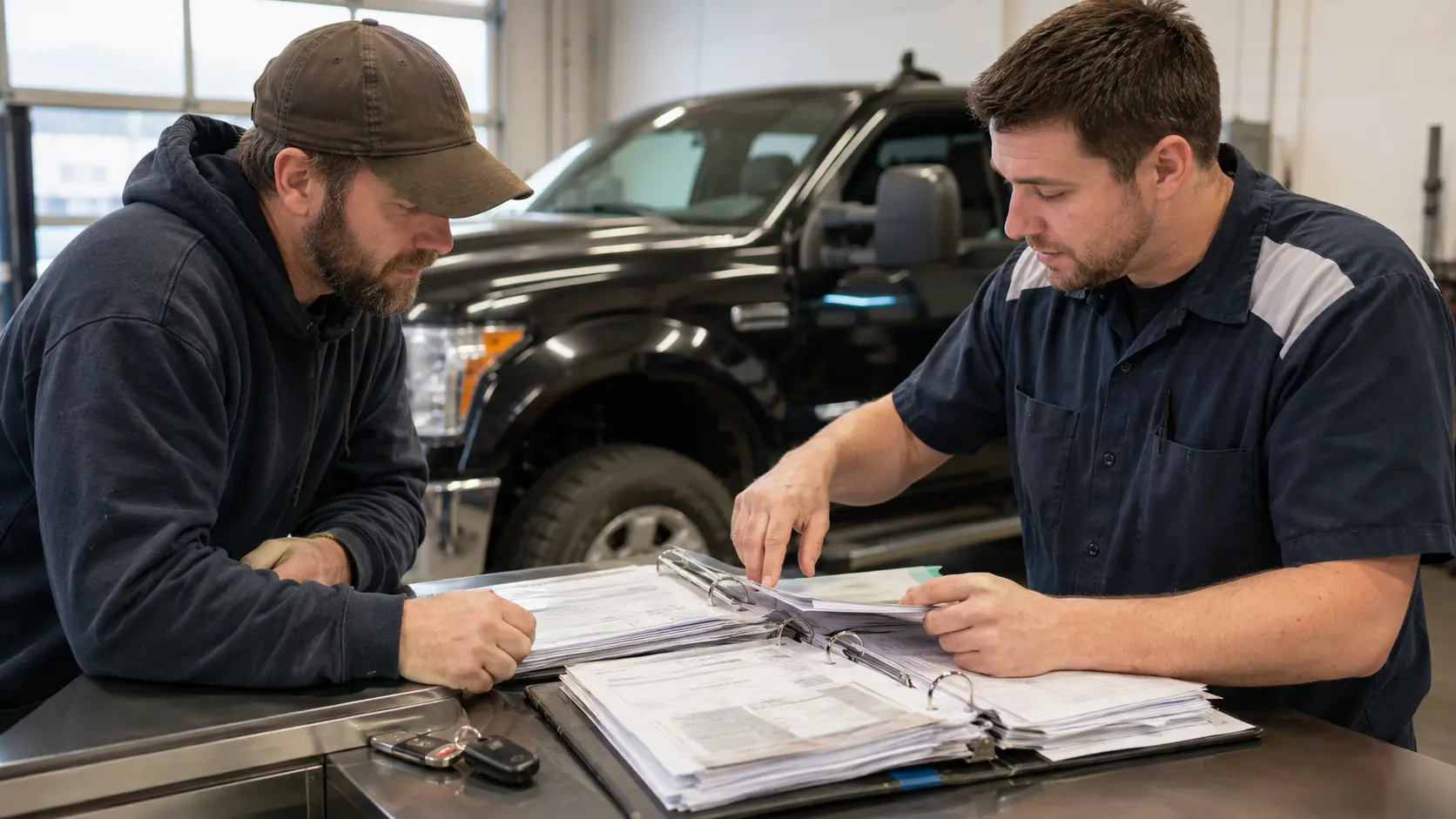
A 2026 Ford F-350 cannot yet earn a credible long-term reliability verdict from the evidence reviewed here. It can, however, be checked against specific early safety actions, exact Canadian towing configurations and Ford's current owner guidance. The important mechanical distinction is between a right rear axle shaft with a heat-treatment concern and a rear driveshaft with a friction-weld concern. They have different inspection identifiers and cannot share a generic 'axle recall done' receipt. This review is dated 15 September 2026 and does not determine Canadian VIN eligibility.
Two driveline actions require two different inspections
Ford 25SD8, U.S. filing 25V866000, concerns selected 2026 F-250 and F-350 trucks whose right rear axle shaft may have been improperly heat-treated. A break can cause loss of drive power or rollaway even when Park is selected. The remedy is inspection of the right rear axle shaft date code and replacement when necessary. It is not the earlier model year's left-shaft repair.
Ford 26S13, U.S. filing 26V119000, instead concerns a driveshaft friction weld that may fail, allowing the rear driveshaft to separate and drive power to be lost. Its remedy uses the driveshaft serial number. Although the database's component category mentions an axle shaft, the defect summary and remedy identify the driveshaft. A date-code check on one part cannot document the serial-number inspection of the other.
Ask Ford to establish which actions apply to the candidate and how it should be handled until any required repair is complete. Obtain distinct, VIN-matched work orders naming the inspected component and result. Do not assume that a successful short drive establishes weld integrity or heat treatment, and do not use Park alone as evidence that the affected axle condition is absent.
The four-record snapshot also separates IPC and trailer software
The fresh NHTSA 2026 F-350 SD query returned four records. The two mechanical actions above and the two software actions below are a bounded research snapshot, not the number of defects experienced by an average owner. The query supplies no Canadian repair clearance or model-year failure rate.
| Action | Exact concern | Useful verification |
|---|---|---|
| 25SD8 / 25V866000 | Right rear axle-shaft heat treatment; possible break, power loss or Park rollaway. | Right rear axle shaft date-code inspection; replacement if required. |
| 26S13 / 26V119000 | Rear driveshaft friction-weld failure and separation. | Driveshaft serial-number inspection; replacement if required. |
| 25S88 / 25V540000 | Instrument-panel cluster may fail at startup, obscuring speed or warning information. | Completed IPC software update through the applicable dealer or OTA route. |
| 26C10 / 26V104000 | Integrated trailer module may lose communication, affecting trailer brake/turn lights or braking. | Completed ITRM software update and appropriate trailer-system verification. |
What the snapshot does not establish
A functioning cluster during one ignition cycle does not prove the 25S88 software update, and an illuminated trailer lamp is not proof of the 26C10 remedy. Keep software completion evidence distinct from hardware inspections. A workshop visit may have completed one action but not another, so compare the actual work performed with the candidate's current campaign list.
Do not automatically carry the 2025 brake-pedal no-drive campaign or the F-250's separate camera-menu record into this F-350 page solely because the trucks are related. Their absence from this particular query is not a finding that the candidate is unaffected or globally recall-free. Ford Canada's VIN process and current dealer instructions remain necessary.
The available sources do not provide an owner-population denominator, exposure-adjusted failure rate or long-duration test of every engine and axle combination. Four records cannot support a claim that 2026 is more reliable than a year with six, nor can an absence of visible symptoms establish how the truck was previously used.
2026 chart structure restores short-box SuperCab positions
The Canadian guide retains four published engine pairs: 6.8L gasoline at 405 hp/445 lb-ft, 7.3L gasoline at 430 hp/485 lb-ft, standard 6.7L diesel at 475 hp/1,050 lb-ft and high-output 6.7L diesel at 500 hp/1,200 lb-ft. All use a ten-speed automatic. Output is equipment information, not a measured reliability ranking.
Unlike the eight-column 2025 SRW chart, the 2026 SRW matrix has ten cab/drive columns, including 148-in-wheelbase SuperCab short-box positions. That changes how a row must be read. A blank remains unsupported by that chart; it must not be replaced with a neighbouring cab's rating. The DRW table also contains F-450 columns that must remain separate from F-350 values.
| Selected 2026 F-350 pickup configuration | Fifth-wheel | Gooseneck |
|---|---|---|
| HO diesel SRW Regular Cab 4x4, 141.6-in wheelbase, 8-ft box, 3.55 axle, 35,200-lb GCWR, 18/20-in all-terrain tires | 27,400 lb | 27,600 lb |
| HO diesel SRW SuperCab 4x4, 148-in wheelbase, 6.75-ft box, 3.55 axle, 35,200-lb GCWR, 18/20-in all-terrain tires | 26,700 lb | 27,400 lb |
| HO diesel SRW SuperCab 4x4, 164.2-in wheelbase, 8-ft box, 3.55 axle, 35,200-lb GCWR, 18/20-in all-terrain tires | 26,300 lb | 27,300 lb |
| HO diesel SRW Tremor Crew Cab 4x4, 159.8-in wheelbase, 6.75-ft box, 3.55 axle, 31,200-lb GCWR | 22,900 lb | 23,000 lb |
| HO diesel DRW Regular Cab 4x2, 141.6-in wheelbase, 8-ft box, 4.10 axle, 45,600-lb GCWR | 35,000 lb | 38,000 lb |
| HO diesel DRW Crew Cab 4x4, 176-in wheelbase, 8-ft box, 4.10 axle, 45,600-lb GCWR | 34,900 lb | 35,900 lb |
Respect hitch limits and unresolved footnotes
The HO Tremor's conventional rating is 18,200 lb, not its 23,000-lb gooseneck number. Ford's 40,000-lb figure belongs to the specified F-450 branch, not an F-350. For a loaded candidate, GVWR, both axle ratings, tire capacities, hitch rating and GCWR all remain independent constraints. Confirm the labels and a loaded scale measurement before calculating remaining pin-weight capacity.
The 2026 DRW page shows slash-separated standard-diesel Regular Cab ratings without the same visible superscript linkage used in the 2025 edition. Its footnote 2 now explicitly names the F-350 gas Heavy Duty Payload Package. This guide therefore does not assign a package meaning to the unannotated diesel alternatives or copy the 2025 interpretation. Use Ford's candidate-specific configuration evidence to resolve that branch; the clearly identified HO examples above do not settle it.
For the same reason, a conventional-towing row is not a licence to invent an absent fifth-wheel or gooseneck pairing. Chart availability and physical vehicle availability are different questions. These are selected, individually verified examples, not a claim that every rating in the nine-page guide has been reproduced.
Dually maintenance depends on use, not just odometer age
Ford's exact 2026 Canadian-market owner page gives additional dual-rear-wheel axle guidance: rear-axle fluid at 400,000 km in normal commercial applications, but 96,000 km when operating at or near maximum gross vehicle weight, or under the specified special conditions. The longer number is not a universal promise of maintenance-free dually ownership. Confirm the axle, duty and complete schedule before applying an interval.
For oil service, the owner page says to act within two weeks or 800 km after the oil-change message. Its one-year/24,000-km diesel ceiling applies when the display resets prematurely or becomes inoperative; it is not a normal fixed interval for every work truck. The same guidance discusses oil dilution from short trips, prolonged idling and low-speed use, supporting a review of operating hours and duty rather than odometer readings alone.
This is a limited maintenance review, not a complete service schedule or a diagnosis of a particular fluid sample. Preserve invoices, specifications and evidence of actual work. An unexplained symptom or contaminated fluid requires professional assessment rather than an assumption that a low-mileage truck cannot have a maintenance problem.
An early verdict tied to evidence and intended work
A supportable buying decision starts with the two distinct driveline inspections, then verifies IPC and trailer-module software, physical condition and service history. After any applicable safety restrictions are resolved, have an independent technician assess the truck. A new model-year label is not evidence of correct assembly, completed updates or suitable loading.
For SRW buyers, the restored SuperCab chart columns make exact body identification especially important. For dually buyers, reconcile rear-axle maintenance duty with the trailer and cargo actually carried. Neither the 38,000-lb maximum nor the 1,200-lb-ft output establishes spare payload or a promised lifespan. This page offers no numerical reliability score, failure rate, inventory availability, seller count, price or offer.
Evidence note: manufacturer documents establish the specific facts and applications cited. Buying workflows and cost scenarios are DieselTrucks.ca editorial guidance. These pages do not publish measured failure rates or confirm the condition, recall status or capacity of a particular truck.
General educational content for Canadian diesel-pickup research. Verify the exact truck, model year, certification labels, owner manual and manufacturer documentation, and obtain qualified mechanical or towing advice where appropriate.
Sources & Further Verification
Use the exact model year, VIN, truck labels and current manufacturer documentation when moving from general research to a purchase or towing decision.