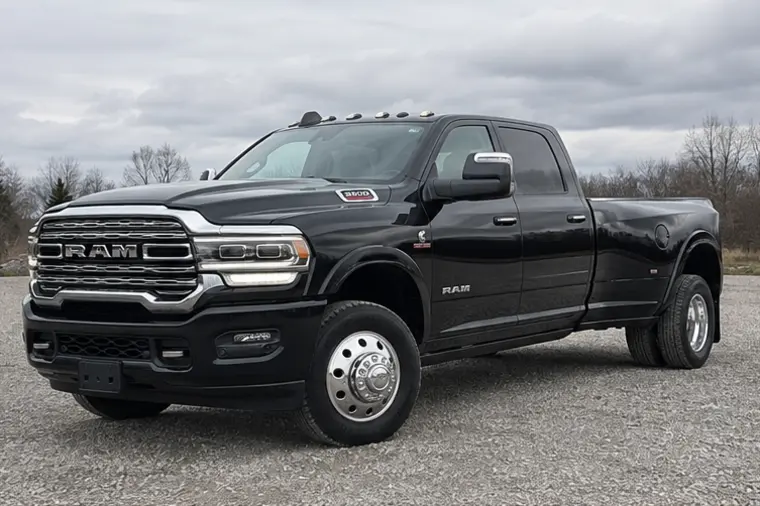
The RAM 3500 is a one-ton platform for heavier payload and trailer needs, offered in configurations ranging from SRW work trucks to DRW tow vehicles.
MODEL-YEAR INTELLIGENCE
Research RAM 3500 by Model-Year Era
6.7L Cummins
Use the selected model year and canonical engine relationship as research context. Confirm the exact transmission, cab, bed, drivetrain, rear-wheel configuration, labels and manufacturer documentation on the truck.
Choose the engine and year range that matches your truck. These ranges organize research; confirm the exact equipment from its labels and records.
Research this model in detail
Separate the engine history from the truck you are buying
Cummins dates its RAM pickup partnership to 1989 and the launch of the 6.7L engine to 2007. Those are useful engine-family milestones, not a claim that today’s RAM 3500 name, chassis or transmission existed unchanged throughout that history. For an older candidate, identify the actual truck and installed drivetrain before treating a generation label as a parts or service specification.
The 2025 powertrain change is a more recent, dated decision point. Cummins’ 7 January 2025 announcement separates the pickup’s 430 hp and 1,075 lb-ft from the chassis-cab’s 360 hp and 800 lb-ft, alongside the new eight-speed pairing. It also describes revised fuel delivery and improved access to service filters. These engineering changes identify the application; they do not establish a measured reliability advantage over older trucks.
That distinction helps when comparing a used six-speed truck with a later eight-speed pickup. Ask which output version and transmission are actually installed, then obtain the matching records. A generic advertisement saying “high-output Cummins” is not enough to identify every component, an exact tow rating or the condition of a rebuilt unit.
A used-truck chart shows why axle and GVWR belong in the comparison
The following are selected rows from Stellantis’ original 2022 RAM 3500 4x2 chart, preserved by RV Safety. All refer to the Regular Cab ST with an eight-foot box, high-output 6.7L diesel, Aisin six-speed and DRW. They are not Crew Cab, 4x4, current-model or Canadian-VIN ratings. The values are in pounds.
The chart calls payload and trailer values estimates and says the two maxima are mutually exclusive. Its hitch footnotes require a gooseneck above 30,000 lb. Accordingly, none of these maximum-trailer entries should be presented as a conventional receiver rating. The table demonstrates the effect of documented configuration choices; it does not authorize changing a used truck’s certification label.
| Axle / GVWR | Base-chart payload | GCWR | Maximum trailer |
|---|---|---|---|
| 3.73 / 14,000 lb | 6,560 lb | 41,600 lb | 33,690 lb |
| 4.10 / 14,000 lb | 6,560 lb | 45,000 lb | 37,090 lb |
| 3.73 / 13,500 lb | 6,060 lb | 41,600 lb | 33,690 lb |
| 4.10 / 13,500 lb | 6,060 lb | 45,000 lb | 35,250 lb |
A hitch limit is not the truck’s maximum trailer weight
The 2026 RAM 2500/3500 Owner Handbook lists separate factory-hitch limits for 3500 models: 23,000 lb trailer / 2,300 lb tongue for Class V, 30,000 / 4,500 lb for fifth-wheel, and 37,100 / 5,565 lb for gooseneck. Its next page directs the reader to drivetrain-specific towing ratings. This is the shorter Owner Handbook, not a claim to have reproduced the full owner manual.
Keep those hardware limits separate from RAM Canada’s 36,610-lb model maximum and from the capacity of the truck in front of you. A 37,100-lb gooseneck hardware entry cannot raise a lower vehicle rating. Nor does a factory prep package prove that a compatible hitch is installed, correctly mounted or sufficient for the planned vertical load.
Check the actual installation with a qualified hitch professional, including the coupler, mounting components and clearance requirements. If a used truck has multiple sets of bed holes or an undocumented adapter, identify what remains usable before assigning value to it. The presence of towing equipment is not equivalent to verified towing readiness.
Keep two important recall examples tied to their actual populations
FCA’s 21V880/Y78 filing covers certain 2019–2020 Cummins-equipped RAM 3500 pickups with a suspect high-pressure fuel pump. The pickup production window in that report is 18 October 2018 through 13 November 2020; chassis-cab applications have their own entries. The remedy describes pump replacement, software updating and inspection of additional fuel-system components as needed. This is not evidence that every 6.7L truck has the same pump or needs the same repair.
The separate 23V060/13A filing concerns certain 2021–2023 trucks with a suspect intake-heater-grid relay. It documents fire risk with ignition on or off and instructs affected owners not to park inside buildings or near other vehicles until the final repair is completed. For a candidate in scope, obtain current VIN-specific instructions and completion evidence rather than accepting a generic “all recalls done” statement.
These U.S. filings explain specific concerns; they do not establish Canadian VIN eligibility, current completion status or a failure rate. A completed campaign also does not replace inspection of unrelated systems. The model’s year-specific reliability guides retain their separate campaign records and should be consulted for the candidate year.
Budget for your rear-wheel arrangement and working week
An SRW and a DRW truck should be compared after the normal load has been established. For a dually, obtain a tire-service quote that covers all six road-wheel positions and the relevant inspection or replacement work. Ask what is included in balancing, access and disposal rather than assuming that a four-tire quote can simply be reused. Include the spare and wheel condition in the inspection file.
Price routine service separately from known repairs and from a contingency for unresolved findings. For a working truck, also ask how a breakdown would affect the trailer: can the substitute vehicle use the same hitch, carry the same vertical load and meet the same route needs? A replacement pickup that is available but unsuitable is not a complete downtime plan.
Consider parking and site access before dismissing an otherwise suitable SRW or choosing DRW solely for its brochure capacity. Conversely, daily convenience is not a reason to keep an overloaded configuration. The aim is a truck that passes the load checks and can be maintained and used consistently, not the most impressive specification without a workable operating plan.
Choose a year for documented fit, then inspect the individual truck
There is no defensible universal best year in the evidence used for this parent guide. A later drivetrain offers a different specification and service context; an older truck may have a clearer repair history or a configuration better matched to the job. Neither observation proves a lower lifetime failure rate. Keep year-selection research, current condition and price as separate questions.
Before paying a deposit, assemble the build record, readable capacity labels, transmission identity, maintenance chronology, recall-status check and hitch information. Ask the inspecting technician to distinguish confirmed faults, further diagnostic work and routine maintenance. Compare the written findings with your intended load and date for entering service.
Use the independent best-year and years-to-avoid guides for the selection discussion, not as substitutes for inspecting a particular RAM 3500. If the candidate is a chassis cab or completed commercial body, move to the correct application documents rather than borrowing this pickup’s chart or engine output. Marketplace pages remain a separate, verification-gated commercial path; this research does not establish stock, price or availability.
A current diesel reference, with the right application
RAM Canada lists the 2026 3500 pickup’s high-output 6.7L diesel at 430 hp and 1,075 lb-ft with an eight-speed automatic. Its advertised maximum diesel towing figure is 36,610 lb / 16,606 kg, subject to the required configuration and loading conditions.
A family maximum is a starting point for research, not the usable capacity of a loaded truck. Keep the exact trailer type and hitch limit in view; a fifth-wheel and gooseneck need their own applicable rating.
| Evidence for your 3500 | What it resolves |
|---|---|
| Pickup versus chassis-cab identity | Correct application and powertrain documentation |
| SRW versus DRW | Rear-wheel arrangement and relevant capacity tables |
| Cab, bed, drive and axle | The applicable manufacturer configuration row |
| Labels and loaded axle weights | Whether people, equipment and hitch load fit |
Compare transmission eras deliberately
An older RAM 3500 may have a different output/transmission combination from the current eight-speed truck. Ask for the original build record and confirm the installed unit, especially when the seller describes a replacement or rebuild. Use that identity to interpret the service history.
Treat an engine repair, a transmission repair and a completed recall as separate records. Together they can improve the purchase file, but none proves that every system has been inspected. Resolve current concerns with a shop that can evaluate the complete truck under an agreed inspection brief.
Include the costs of a loaded working configuration
A dually used with substantial pin load needs a different operating budget from an unloaded personal-use pickup. Count the actual tire arrangement, hitch equipment, cargo and required service. Ask whether the inspection and any repairs can be scheduled around the work the truck is expected to perform.
For a commercial body, compare the completed installation rather than borrowing pickup figures. If the job is primarily an upfit task, follow the chassis-cab research branch before committing to a particular pickup configuration.
Model evolution & used-buying eras
Cummins generation, output version and transmission pairing vary by year and configuration, so model-year documentation matters.
Cab, bed and work configurations
RAM 3500 research should compare SRW and DRW, cab and bed length, axle ratio, hitch use and the actual payload label.
Towing and payload
There is no single towing or payload number for every truck wearing this model badge. Ratings vary with model year, cab, bed, drivetrain, axle ratio, wheel configuration and factory equipment.
- Read the door-jamb payload label on the exact truck.
- Use the owner manual and manufacturer towing guide for the model year.
- Account for passengers, cargo, hitch equipment and trailer pin or tongue weight.
Used-buying checks
A diesel pickup should be assessed as a complete working vehicle, not only as an engine choice.
- Ask for dated maintenance and repair records rather than relying on a verbal summary.
- Evaluate a true cold start, warning lights, leaks, transmission behaviour and underbody condition.
- Confirm whether the truck has towed, carried commercial loads or been modified, and inspect accordingly.
- Verify emissions equipment, tires, suspension and the exact payload label on the truck itself.
Choose a working configuration before an output badge
A RAM 3500 can enter the shortlist as an SRW pickup, a dually or a chassis-cab application. Identify which one is being sold and how it will be loaded. Engine output, transmission and body configuration are separate fields in the purchase worksheet.
| Role | What to compare |
|---|---|
| Fifth-wheel pickup | Bed length, hitch arrangement, pin load and rear axle weight |
| Dually work truck | Tire condition across all positions and daily access width |
| Completed body | Installer documents, body condition and loaded axle distribution |
Evaluate the installed powertrain as a pair
Ask for transmission identification and dated maintenance alongside engine records. A seller's high-output claim does not identify every mechanical component or establish its current condition. For a candidate with previous transmission work, obtain the invoice scope and verify the road-test findings after repair. Compare SRW and DRW on the recurring load rather than an assumption that one is always preferable.
Evidence note: manufacturer documents establish the specific facts and applications cited. Buying workflows and cost scenarios are DieselTrucks.ca editorial guidance. These pages do not publish measured failure rates or confirm the condition, recall status or capacity of a particular truck.
General educational content for Canadian diesel-pickup research. Verify the exact truck, model year, certification labels, owner manual and manufacturer documentation, and obtain qualified mechanical or towing advice where appropriate.
Sources & Further Verification
Use the exact model year, VIN, truck labels and current manufacturer documentation when moving from general research to a purchase or towing decision.