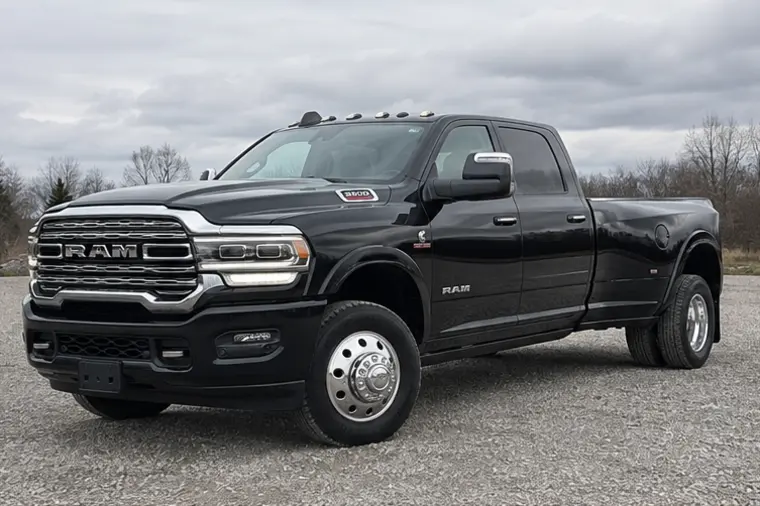
For a RAM 3500 buyer specifically seeking the pre-2025 high-output Cummins/Aisin combination, use a documented 2024 pickup as an equipment benchmark. Compare standard-output and newer candidates when they better fit the assignment. Rear-wheel arrangement, present condition and actual load evidence matter more than a universal best-year label.
The recommendation is conditional on the powertrain you want
RAM's 2024 chart separates the 3500's standard-output/68RFE and high-output/Aisin combinations. Our 2024 high-output benchmark applies to a buyer who wants that particular pairing, not to every truck carrying the 3500 badge. Verify the installed engine and transmission before using the recommendation.
For a buyer considering the 2025 pickup, Cummins identifies a revised system with an eight-speed. Treat it as another equipment choice. Neither a first-year penalty nor a guaranteed durability improvement follows from the product introduction. Compare the actual candidate and the support available for it.
We do not have comparable Canadian failure-frequency evidence proving one RAM 3500 year is best. The recommendation combines a verified equipment boundary with an editorial buying method. An earlier candidate with stronger condition and records can win the comparison, while a preferred-year truck with unresolved faults can leave the shortlist.
Decide SRW, DRW and vehicle type before selecting a year
Identify the actual assignment: occupants, carried tools, installed body or accessories, hitch and loaded trailer. Then decide which candidate configurations can support it. Do not select a favourite year first and use the available truck's reputation to work around a missing capacity or installation fact.
For a factory pickup, retain the vehicle labels and matching towing information. For a chassis cab completed with a work body, obtain the appropriate completion and installation records. A flat-deck advertisement may require a different assessment from a factory pickup, even when the engine description sounds familiar.
SRW and DRW candidates should not be treated as equivalent merely because their engines match. Keep the rear-wheel arrangement and intended work visible in the comparison. A larger advertised maximum on a different configuration does not rate the truck being purchased.
A shortlist for three buying priorities
The shortlist is not a hierarchy of failure rates. It makes the buying preference explicit so it can be challenged by better evidence. A truck outside the initial range should remain eligible when it fits the job and has a stronger record than a benchmark-year alternative.
Compare similar cabs, drivetrains and rear-wheel arrangements where practical. Otherwise, a price or capacity difference may be attributed to the year when configuration is doing most of the work. Keep each candidate's known required repairs beside its asking price rather than comparing advertisements alone.
| Priority | Starting point | What could change the decision |
|---|---|---|
| Want the documented pre-2025 high-output/Aisin pairing | Compare a 2024 RAM 3500 pickup with equivalent earlier candidates | Actual transmission, service history, inspection and load suitability |
| Standard-output equipment already fits the assignment | Compare appropriately configured candidates on condition and known commitment | Unresolved faults, unsuitable rear load or unexplained modifications |
| Want the newer pickup powertrain system | Investigate a correctly identified 2025 candidate | Support, current condition and useful equipment rather than assumed lifespan |
| Need a completed commercial-body vehicle | Start from actual chassis and body identity | Missing completion, installation or current configuration evidence |
High output should serve the assignment
Do not choose the high-output label solely because it sounds like the strongest reliability choice. Identify what benefit matters to your actual work and whether the truck's complete configuration supports it. A more powerful engine does not resolve every payload, hitch, tire or seating requirement.
Likewise, do not dismiss a standard-output candidate simply because another version exists. If the actual vehicle fits the assignment and its condition and support are strong, it deserves a fair comparison. The relevant distinction is suitability and evidence, not a belief that one badge guarantees better ownership.
Ask the inspector to identify the current powertrain when major components or calibrations have changed. A seller's description of an upgrade should be supported by installed-part and workmanship information. The purpose is to assess the truck as it stands, not the specification it may have had when new.
Earlier-year screening remains necessary
Selected FCA filings identify separate Y78 fuel-pump, 13A heater-relay and ZA3 transmission populations. For RAM 3500, the cited ZA3 scope is specified 2020–2022 68RFE pickups; do not transfer it to Aisin equipment. Other applicable concerns must still be checked on their own terms.
Have RAM establish the current Canadian VIN position and retain the result. For an affected unrepaired 13A vehicle, follow the manufacturer's outdoor-parking and separation instructions. A year label cannot establish applicability or completion, and an unrelated repair invoice does not answer the campaign question.
Review current symptoms separately. A completed campaign can resolve a specified action without certifying every fuel-system or transmission component. An earlier repaired truck may remain a viable candidate, but an unresolved material condition should change the buying decision regardless of how attractive the year or trim appears.
Dually condition needs a deliberate inspection brief
For a DRW pickup, ask the technician to assess the inner rear tires and relevant wheels as well as the visible outer pair. Record abnormal wear, damage or contact and let the shop determine the necessary follow-up. A photograph of a clean dually does not establish the condition of the whole arrangement.
Inspect the actual hitch installation and surrounding structure. Obtain the equipment documentation and ask what the inspection can verify. Where a body or hitch has been changed, identify the present setup and its history rather than evaluating it as though it still matched every factory assumption.
For an SRW candidate, give equal attention to the actual loaded-use question. If the intended trailer and carried equipment do not fit, compare an appropriate DRW or another suitable vehicle. Do not use a favourite model year to justify an unresolved configuration mismatch.
Service history should explain the work behind the odometer
Ask about towing, idle-heavy assignments, seasonal storage and recorded hours. A commercial history is context for inspection, not proof of abuse. A vehicle with a clear maintenance file may be easier to assess than one with an appealing low-distance description and little supporting evidence.
RAM's 2018 HD diesel supplement separates the Cummins applications from the RAM 1500 section and addresses idling-related regeneration concerns. Use the appropriate year and application for the actual candidate. Do not transplant an EcoDiesel schedule or another generation's requirements because the document title mentions both models.
Read invoices in sequence, identifying recurring symptoms and the result of major work. A replacement engine or transmission can be appropriate, but it does not reset the history of the chassis, hitch, wiring and other systems. The entire truck still needs a condition assessment.
Turn the viewing into a useful comparison
Send the inspecting shop the VIN, configuration, seller's symptom list and repair history in advance. Explain the trailer and work equipment you will use. Ask for the appropriate diagnostic and physical assessment, a safe operational check, and a written statement of limitations.
Name the working systems that matter. Trailer electrical connections, fitted brake controls and accessories may need checks beyond a general engine inspection. Ask which were tested and which require the actual trailer or a specialist. An untested feature should not become an assumed pass in the buying file.
Preserve evidence of material symptoms without intentionally provoking a dangerous event. An unstable or poorly running truck should be assessed appropriately before ordinary towing use. A discount does not supply the missing diagnosis or make an uncertain vehicle ready for the next job.
Budget for the commitment you can actually support
Obtain itemized local estimates for diagnosed work and a separate scope for unresolved investigation. Distinguish immediate repairs, maintenance catch-up and optional changes. Do not turn a generic repair average into an exact allowance for a fault whose cause remains unknown.
For commercial use, identify a substitute with the right rear-load position, hitch and equipment. Any pickup available to rent is not necessarily a useful backup for a dually work assignment. Confirm the practical arrangement and likely scheduling before promising that the purchase will cover committed work immediately.
For recreational towing, compare the inspection and repair timeline with departure plans. Choose the truck when identity, suitability and condition are supportable within the budget and timing. Change the preferred year when another candidate answers those questions better.
RAM 3500 best-year questions
Is 2024 proven to be the most reliable RAM 3500? No. It is a conditional equipment benchmark for a buyer seeking the documented pre-2025 high-output/Aisin combination.
Does every diesel 3500 have Aisin equipment? No. Identify the actual pairing rather than inferring it from the badge or an advertisement for another truck.
Does choosing DRW settle the load question? No. Use the actual labels, configuration, hitch and planned load.
Can a standard-output or earlier truck be the better purchase? Yes, when its suitability, condition and support are stronger for the assignment. That remains an individual buying judgment rather than a population-wide reliability conclusion.
Evidence note: manufacturer documents establish the specific facts and applications cited. Buying workflows and cost scenarios are DieselTrucks.ca editorial guidance. These pages do not publish measured failure rates or confirm the condition, recall status or capacity of a particular truck.
General educational content for Canadian diesel-pickup research. Verify the exact truck, model year, certification labels, owner manual and manufacturer documentation, and obtain qualified mechanical or towing advice where appropriate.
Sources & Further Verification
Use the exact model year, VIN, truck labels and current manufacturer documentation when moving from general research to a purchase or towing decision.
- RAM 2024 Heavy Duty towing and powertrain chart — original manufacturer configuration matrix
- Cummins January 2025 announcement — revised engine, eight-speed and separate pickup/chassis-cab outputs
- FCA Y78 / U.S. 21V-880 filing — specified 2019–2020 diesel population
- FCA 13A / U.S. 23V-060 — defined 2021–2023 intake heater relay population
- FCA ZA3 / U.S. 22V-835 — specified 68RFE transmission and model years
- RAM 2018 diesel supplement — separate 1500 and HD applications
- Cummins–RAM engine history