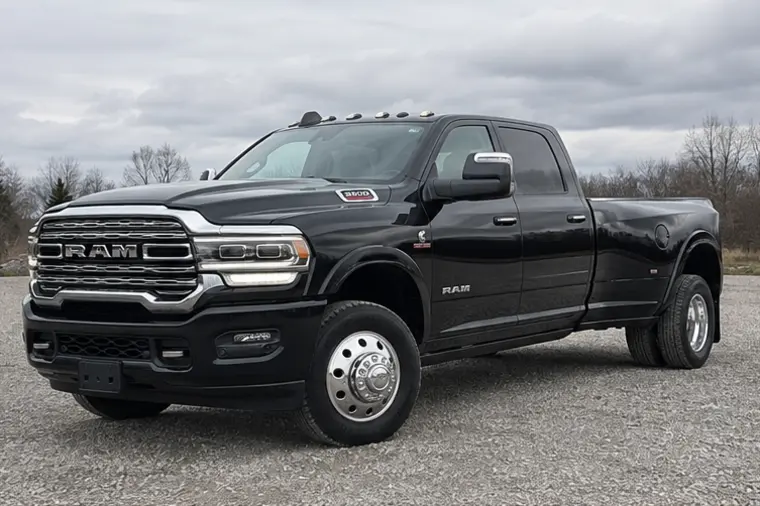
RAM 3500 reliability must be assessed by the actual powertrain and vehicle configuration. Standard-output and high-output pickups, SRW and DRW trucks, and completed chassis cabs do not become interchangeable because they share a Cummins badge. Build the decision around verified identity, condition, history and the next assignment.
The reliability verdict should describe this vehicle
Favour a RAM 3500 whose maintenance and repair history can be explained, whose condition has been independently assessed and whose configuration supports the planned work. That recommendation is an editorial purchasing judgment. The reviewed evidence does not establish a universal lifespan, predictable annual repair cost or Canadian year-by-year failure ranking.
A working one-ton pickup must do more than start and accelerate. Hitch equipment, trailer connections, tires, steering and fitted accessories can determine whether it is available for the assignment. Include those systems in the inspection brief rather than treating every non-engine issue as a secondary matter after purchase.
Suitability remains separate from mechanical condition. An excellent service record does not create capacity, and an appropriate rating does not certify the truck's present health. Require support for both before treating the candidate as ready for the job.
Identify output and transmission together
RAM's 2024 matrix separates standard-output/68RFE and high-output/Aisin pickups. Cummins identifies a newer eight-speed pickup system for 2025. Match service and symptom evidence to the actual combination instead of combining all RAM diesel transmission reports into one conclusion.
Ask whether the engine, transmission or calibration has changed. For a replacement, identify the installed component, original diagnosis and verification. A major replacement can reduce uncertainty when properly documented; a part name alone cannot explain why the work was needed or whether the complaint returned.
Do not treat a familiar transmission name as a complete reliability assessment. The actual unit's condition, maintenance and operating history still matter. Equally, exclusion from a particular campaign does not demonstrate that a different transmission is free of every possible fault.
An evidence hierarchy for the purchase file
Use the evidence to separate known work from unresolved exposure. Do not manufacture a numerical reliability score from counts of recalls, complaints and bulletins. Those documents serve different purposes and do not supply comparable kilometres, hours, maintenance or application across the population.
Severity is not frequency. A potentially serious condition can justify a specific check without a defensible estimate of how often it occurs. A routine service item and an unresolved safety symptom should not be treated as equivalent because each appears once in the file.
| Evidence | Useful conclusion | Limit to retain |
|---|---|---|
| Vehicle and powertrain identity | Establishes which application is being assessed | Later modifications still need documentation |
| Service record with dates and use | Shows maintenance actually recorded | Missing entries are uncertainty, not automatic proof of neglect |
| Diagnosed repair and verification | Explains a specific complaint and result | Does not certify the entire vehicle |
| Campaign determination | Establishes the applicable action when current and VIN-specific | A general filing cannot determine Canadian status alone |
| Independent condition assessment | Describes findings within scope | Untested systems and intermittent concerns remain limitations |
Selected campaign scopes do not cover every configuration
The cited ZA3 filing identifies specified 2020–2022 RAM 3500 pickups with 68RFE, not Aisin. Y78 and 13A involve separate equipment and populations. Check the actual vehicle rather than allowing one transmission's exclusion to become an assumption that every campaign is irrelevant.
For an affected unrepaired 13A vehicle, follow the manufacturer's outdoor-parking and separation instructions. Ask RAM for the current Canadian VIN determination and relevant completion evidence. A broad U.S. description cannot supply that individual status.
Read campaign entries separately from breakdown repairs. An action on a specified component does not establish that the entire engine or transmission was rebuilt. Present starting, shifting, warning or drivability symptoms still require appropriate diagnosis, even when earlier campaign paperwork is complete.
SRW and DRW condition should match the next load
For a DRW pickup, require assessment of the inner rear tires and relevant wheels as well as the outer pair. Ask the technician to explain abnormal wear, damage or contact rather than assuming those observations are normal for a large truck. A known tire replacement need and an unresolved cause of repeated wear are different budget items.
For an SRW candidate, establish the actual rear-load and payload position for the planned work. Do not assume that a strong engine or transmission reputation resolves the capacity question. If the assignment does not fit, compare another configuration before spending money trying to make the preferred truck feel more suitable.
For either arrangement, document changes to tires, suspension and hitch equipment. The presence of a modification does not prove it caused a fault, but an inspection based on an assumed factory configuration can miss questions raised by the actual installation.
Completed chassis cabs need a wider assessment
Identify factory pickup versus completed chassis cab at the start. A flat deck, service body or other installation needs relevant records describing the current vehicle. Do not use a pickup towing row to supply missing information about a completed commercial truck.
Ask who installed the body and equipment, what has changed since, and which labels and documents apply now. Include the work systems needed for the assignment in the inspection scope. A general powertrain assessment may not establish the condition or suitability of a specialized installation.
Keep shared mechanical evidence and completed-vehicle questions distinct. Some campaigns can include more than one vehicle type, but that does not make the body, ratings or operating requirements interchangeable. The reliability decision should reflect the actual truck being purchased.
Maintenance history should reflect the duty cycle
Use the appropriate diesel manual for the candidate's year and application. RAM's 2018 supplement separates HD Cummins material from RAM 1500 guidance. Do not transfer instructions between those sections because they are bound in the same publication.
Ask about towing, long idling periods, short movements, storage and recorded operating hours. Use the answers to direct inspection rather than treating all commercial use as abuse. Avoid an invented hours-to-kilometres conversion or a blanket assumption that low distance means little relevant service was needed.
Establish a maintenance baseline from the records and current findings. Keep completed tasks, recommended catch-up work and future requirements separate. Retain the date, kilometres and relevant specifications so a later owner can understand what was actually done instead of relying on a reminder reset.
Repair quality requires cause and follow-up
Read the repair file in sequence, noting whether a symptom recurred and how the diagnosis evolved. Several invoices can document a careful repair or repeated unresolved attempts. The volume of paperwork alone does not determine which; the complaint, cause, work and verification do.
For major engine, fuel-system or transmission work, ask an appropriate specialist whether the recorded scope answers the original concern. Do not prescribe the same replacement package for every truck because a similar fault appeared online. The correct scope depends on the actual findings and equipment.
If a warranty is part of the sale, obtain current written terms and establish whether it transfers. Coverage can affect financial exposure, but it does not promise immediate availability while diagnosis or authorization occurs. Include that practical process in the ownership decision.
A useful inspection includes the working combination
Provide the shop with the actual trailer and load information, the installed hitch and the functions required for the assignment. Ask what can be checked during the appointment and what needs another specialist or the trailer itself. Record untested items rather than treating them as automatic passes.
For symptoms that occur only while towing, preserve the conditions without deliberately recreating a dangerous event. Loading and setup information may be relevant alongside the truck's mechanical history. A qualified professional should determine the safe assessment path.
Ask for a written separation of immediate concerns, diagnosed repairs, maintenance catch-up and further investigation. The report should make the purchase decision easier by showing what is known and what remains open, rather than reducing every finding to an unexplained good-or-bad score.
Commercial availability and repair commitment
A backup vehicle must match the assignment. A dually pickup with a particular hitch or a completed work-body truck may not be replaced effectively by any available rental pickup. Confirm the required equipment and local support before relying on that backup in the budget.
Obtain current local estimates for diagnosed work and a separate plan for unresolved symptoms. Keep repair cost and operating interruption distinct, avoiding double-counting the same loss where a substitute already covers the work. An owner-selected contingency should remain a planning assumption, not a claimed failure forecast.
Choose the candidate when its known commitment and remaining uncertainty fit the business or personal use. A lower asking price does not resolve an unsupported diagnosis, and a higher price does not establish a better history. Compare the evidence, configuration and realistic support of the actual alternatives.
RAM 3500 reliability questions
Is high output automatically more reliable? The output label cannot establish a failure rate. Identify the pairing and assess the actual condition and history.
Does ZA3 apply to every RAM 3500 diesel transmission? The cited filing specifies 68RFE equipment and its defined population. Do not transfer it to Aisin.
Does a dually configuration guarantee enough capacity? No. Use the actual vehicle's labels, equipment and intended load.
Which years are best or worst? The evidence supports equipment boundaries and selected concerns, not a universal ranking. Use the separate year-selection and rejection guides for conditional buying decisions.
Evidence note: manufacturer documents establish the specific facts and applications cited. Buying workflows and cost scenarios are DieselTrucks.ca editorial guidance. These pages do not publish measured failure rates or confirm the condition, recall status or capacity of a particular truck.
General educational content for Canadian diesel-pickup research. Verify the exact truck, model year, certification labels, owner manual and manufacturer documentation, and obtain qualified mechanical or towing advice where appropriate.
Sources & Further Verification
Use the exact model year, VIN, truck labels and current manufacturer documentation when moving from general research to a purchase or towing decision.
- RAM 2024 Heavy Duty towing and powertrain chart — original manufacturer configuration matrix
- Cummins January 2025 announcement — revised engine, eight-speed and separate pickup/chassis-cab outputs
- FCA ZA3 / U.S. 22V-835 — specified 68RFE transmission and model years
- FCA Y78 / U.S. 21V-880 filing — specified 2019–2020 diesel population
- FCA 13A / U.S. 23V-060 — defined 2021–2023 intake heater relay population
- RAM 2018 diesel supplement — separate 1500 and HD applications
- Cummins–RAM engine history