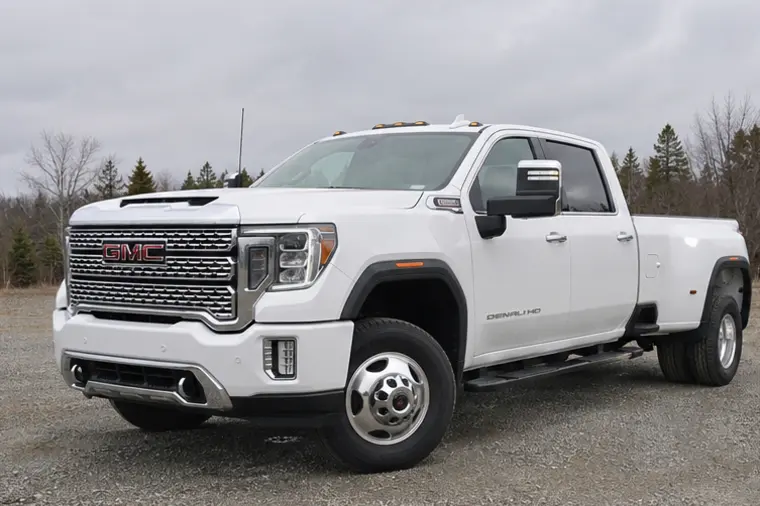
The Sierra 3500HD is a one-ton pickup intended for buyers whose payload or trailer requirements exceed typical three-quarter-ton configurations.
MODEL-YEAR INTELLIGENCE
Research GMC Sierra 3500HD by Model-Year Era
6.6L Duramax
Use the selected model year and canonical engine relationship as research context. Confirm the exact transmission, cab, bed, drivetrain, rear-wheel configuration, labels and manufacturer documentation on the truck.
Choose the engine and year range that matches your truck. These ranges organize research; confirm the exact equipment from its labels and records.
Research this model in detail
Choose the Sierra 3500HD around the job, not the Denali badge
The Sierra 3500HD belongs on a shortlist when a verified one-ton configuration addresses the loaded job better than the available 2500HD candidates. Decide whether that job is a conventional trailer, an in-bed trailer, a camper or carried work equipment. Those uses put different demands on the pickup, and the most luxurious version is not necessarily the one with the most useful capacity.
Choose the cab and bed around passengers, hitch clearance and equipment before selecting trim. Then compare SRW and DRW candidates with the same loaded assumptions. An SRW truck that passes every limit may suit tighter daily access; a DRW package may be necessary for the heavier combination. Neither layout makes an unverified trailer or an overloaded rear axle acceptable.
GMC's own 2026 chart keeps trim and wheel-layout limits visible
The examples below come from GMC's U.S. 2026 Sierra 3500HD chart, not an assumed copy of Chevrolet's ratings. They describe Duramax Crew Cab, long-bed, 4x4 pickups. The in-bed column is GMC's combined fifth-wheel/gooseneck category, with its trim qualifications preserved. Actual equipment, labels and loaded weights still govern candidate suitability.
| 2026 Duramax Crew Cab long-bed 4x4 | GCWR | Published in-bed trailer cell |
|---|---|---|
| SRW base chart row | 30,000 lb | 21,460 lb |
| SRW AT4 qualification | 30,000 lb | 21,200 lb |
| SRW Denali qualification | 30,000 lb | 21,100 lb |
| SRW Denali Ultimate qualification | 30,000 lb | 21,000 lb |
| DRW base chart row | 40,000 lb | 31,000 lb |
| DRW Denali qualification | 40,000 lb | 30,800 lb |
| DRW Denali Ultimate qualification | 40,000 lb | 30,700 lb |
Separate the headline maximum from the candidate in front of you
GMC's separate Regular Cab, long-bed, 2WD DRW Max Trailering row uses 43,900 lb GCWR and distinguishes a 32,000-lb fifth-wheel ceiling from a 36,000-lb gooseneck ceiling. The non-Max 43,500-lb row has a 35,500-lb gooseneck ceiling. These are not the Crew Cab Denali values above, and no figure is Canadian VIN clearance.
Treat a trailer-weight ceiling as one constraint in a complete loading calculation. Obtain the truck's occupant/cargo information, GVWR and axle ratings; establish the loaded trailer's actual connection weight; then include people, hitch hardware, tools and other carried items. A brochure cannot tell you how much reserve remains after a previous owner's equipment.
Keep a separate worksheet for each listing. Photograph the labels and identify the factory trailering package, rear-wheel layout and permanent accessories. If the seller cites a maximum from another cab or model year, request the matching documentation rather than adjusting the number yourself. Use the annual specification guide for the full matrix; this parent page presents selected decision examples.
Powertrain identity and trim equipment are separate research tasks
GMC's current 2026 reference identifies the available 6.6L Duramax at 470 hp and 975 lb-ft with an Allison-branded ten-speed automatic. Use that as a dated current reference, not as the output of every Sierra 3500HD. Used examples require their own engine, transmission and model-year evidence, including any replacement or modification records.
Follow the Duramax generation guide to distinguish older applications before comparing service requirements. A seller's broad 'Duramax and Allison' description does not identify the calibration, transmission generation or emissions equipment. Where a truck has been repowered or electronically modified, obtain installation details and have a qualified inspector reconcile the actual hardware with the documentation.
Trim selection then becomes an equipment decision: inspect the features that matter to your work, including mirrors, cameras, trailer controls and bed access. Verify that the advertised system is present and working rather than assuming that a trim badge proves every option. Compare the loaded usefulness of the complete truck, not a count of screens or convenience features.
A GMC-specific inspection point: MultiPro and installed towing equipment
The 2026 GMC manual warns against opening the MultiPro inner tailgate while the primary tailgate is open with a hitch ball or trailer attached. It also describes an inner-gate enable/disable feature on equipped trucks. This is a practical compatibility check when a used pickup has a receiver accessory or other equipment behind it—not evidence that every MultiPro tailgate is defective.
Before operating the tailgate, read the correct manual, check the surrounding area and confirm the installed equipment will not interfere. Have the seller demonstrate supported functions under safe conditions, and inspect for damage or altered components. Do not deliberately test for contact. The same approach applies to cameras, trailer connectors and aftermarket bed storage: establish how the installation interacts with factory features.
For a camper or replacement body, go beyond the appearance of the bed. Obtain the relevant installation and loading documentation, inspect mounts and electrical work, and compare the completed vehicle's loaded axle results. A pickup chart is not a substitute for the documentation of an altered or completed vehicle.
Used reliability, maintenance budget and year selection
Start a used-Sierra review with a service chronology and an independent inspection. A clean exterior, recent oil change or high trim level cannot establish fuel-system, cooling, transmission or emissions-system condition. Request a cold-start assessment, retained scan findings and a road test appropriate to the vehicle, then have unresolved symptoms explained before assigning a value to the truck.
Treat major repairs as evidence to investigate. An invoice should identify the vehicle, the initiating complaint, parts and work performed, and any follow-up. A replaced component is not a guarantee that unrelated systems are healthy. For safety campaigns, ask the manufacturer to check the VIN and confirm the remedy record. The dedicated year-specific reliability guides preserve campaign boundaries; this parent does not convert campaign counts into failure probabilities.
Budget for the whole one-ton pickup. A dually inspection includes all tire and wheel positions, while a heavily equipped work truck may also need body, hitch or auxiliary electrical work. Obtain written local estimates for identified needs and use the correct maintenance schedule for the engine, transmission and duty. No universal repair cost, fuel-economy figure or lifespan follows from the model name.
Which Sierra 3500HD year is best? First select the capability and equipment you need, then compare documented condition within suitable years. The separate best-year and years-to-avoid pages address those narrower questions without turning this parent into a blacklist. If a 2500HD meets the same loaded job, compare it too; if not, the 3500HD's additional configuration choices deserve their own inspection.
This guide establishes research paths, not inventory or an offer. The commercial destination remains separate, and no seller, price or available truck is implied.
Match the 3500HD to carried load and trailer type
The 3500HD shortlist should begin with SRW/DRW configuration and the loaded job, followed by engine year and transmission. GMC’s current HD material lists the 6.6L diesel and ten-speed combination; that does not supply a universal capacity or specification for every older Sierra 3500HD.
Write those conditions down before visiting trucks. A seller can then provide the relevant labels and records, and the inspecting shop can evaluate the setup you actually intend to use.
| Working role | What needs to be established |
|---|---|
| Heavy recreational trailer | Loaded pin weight, hitch compatibility and clearance |
| Equipment hauling | Correct trailer-type rating and combined loaded weights |
| Service or utility body | Completed body mass, equipment and axle distribution |
| Mixed daily use | Capacity plus width, parking and access requirements |
Compare the complete dually ownership cost
Include the actual tire arrangement, service access, permanent equipment and known repairs in the budget. For work use, add a practical plan for scheduled maintenance and the consequence of unplanned downtime. Avoid assuming that the engine’s reputation answers those operational questions.
A higher-specification trim may provide features you value, but compare its price only after the working configuration and condition have been established. Keep optional convenience spending separate from money needed to correct a current fault.
Check documentation before inheriting an upfit
If a pickup has a replacement body, added auxiliary equipment or altered towing hardware, obtain the installation records. Ask the shop to identify the present configuration and any unresolved changes. The original model badge does not describe every subsequent installation.
When the intended job is primarily a commercial body application, compare the appropriate chassis-cab research as well. A factory pickup and a purpose-completed work truck should be evaluated using the documents for their respective applications.
Model evolution & used-buying eras
Compare the applicable 6.6L Duramax generation, transmission and factory trailering equipment for the exact model year.
Cab, bed and work configurations
SRW and DRW, cab and bed length, axle ratio and trim create very different trucks under the same Sierra 3500HD name.
Towing and payload
There is no single towing or payload number for every truck wearing this model badge. Ratings vary with model year, cab, bed, drivetrain, axle ratio, wheel configuration and factory equipment.
- Read the door-jamb payload label on the exact truck.
- Use the owner manual and manufacturer towing guide for the model year.
- Account for passengers, cargo, hitch equipment and trailer pin or tongue weight.
Used-buying checks
A diesel pickup should be assessed as a complete working vehicle, not only as an engine choice.
- Ask for dated maintenance and repair records rather than relying on a verbal summary.
- Evaluate a true cold start, warning lights, leaks, transmission behaviour and underbody condition.
- Confirm whether the truck has towed, carried commercial loads or been modified, and inspect accordingly.
- Verify emissions equipment, tires, suspension and the exact payload label on the truck itself.
Start with the loaded combination and daily access
For a Sierra 3500HD, settle whether SRW or DRW configurations fit the recurring load and the places the truck must enter. Measure storage, shop-door and parking access. Include the entire crew and permanent equipment when calculating room for pin or tongue load.
| Sierra 3500HD use | Evidence that resolves the choice |
|---|---|
| Fifth-wheel travel | Hitch geometry, loaded pin weight and axle results |
| Dually commercial use | All tire positions, wheel condition and replacement support |
| Utility body | Body mass, compartment loading and mount condition |
Value a documented truck over an attractive specification alone
A later engine family or desirable trim does not establish that cooling, fuel, transmission and emissions systems are healthy. Request a chronological service file and a report on current faults. For a truck with a completed body, add body service and electrical records. Price the work needed to reach the first planned job before comparing two advertised prices.
Evidence note: manufacturer documents establish the specific facts and applications cited. Buying workflows and cost scenarios are DieselTrucks.ca editorial guidance. These pages do not publish measured failure rates or confirm the condition, recall status or capacity of a particular truck.
General educational content for Canadian diesel-pickup research. Verify the exact truck, model year, certification labels, owner manual and manufacturer documentation, and obtain qualified mechanical or towing advice where appropriate.
Sources & Further Verification
Use the exact model year, VIN, truck labels and current manufacturer documentation when moving from general research to a purchase or towing decision.