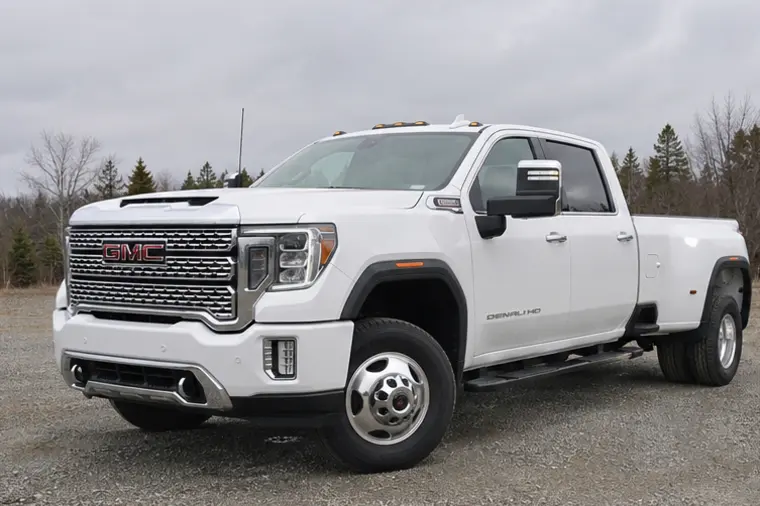
Avoid a GMC Sierra 3500HD diesel when a material safety, repair, identity or load-suitability question remains unresolved beyond what your assignment can support. Defined L5P service concerns and the specified 2020–2022 diesel transmission campaign deserve screening, but they do not justify a universal year blacklist. The actual truck, rear-wheel arrangement, completed body and repair evidence should decide the purchase.
Which candidates require extra questions?
Specified 2020–2022 diesel Sierra HD applications appear in Transport Canada 2024637. Verify the individual VIN and the relevant repair evidence. Defined 2017–2020 L5P applications also appear in GM's fuel-pressure connector and coolant diagnostic records, with a separate cold-start document covering defined 2017–2019 L5P vehicles. Each source answers a different question.
Do not combine those windows into a claim that every truck from the earliest year to the latest is defective. A service bulletin is not a frequency ranking, and the absence of a year from these selected records is not a complete health assessment. Newer vehicles and different equipment require their own investigation. The comparison must remain tied to actual application and condition.
Use the evidence to decide whether to pause, decline or continue evaluating a candidate. A supported repair can change the decision when it addresses the original concern. A cosmetic improvement or a new description cannot resolve a load mismatch or an unexplained safety symptom. The goal is a suitable working vehicle, not a favourable label attached to its model year.
Distinguish a year change from a reliability guarantee
The 2020 manufacturer guide documents an HD diesel ten-speed pairing and separate SRW, DRW and chassis-cab configurations. GM's later L5P description identifies a revision relative to 2023-and-older engines. These are useful equipment boundaries, but neither establishes a universal failure-rate improvement or proves that a candidate's earlier problems were fixed.
Obtain the actual build information and identify modifications. A completed body, altered rear-wheel arrangement or aftermarket calibration can change what must be inspected. Do not evaluate an altered vehicle solely from the original brochure or treat an unrelated half-ton transmission report as evidence against its HD powertrain.
| Application or change | Evidence to check | What it does not prove |
|---|---|---|
| Defined earlier L5P service scope | Symptoms, diagnosis and repair outcome | Every same-year engine has the condition |
| 2020 HD ten-speed reference | Actual transmission and current operation | Guaranteed remaining transmission life |
| Specified 2020–2022 campaign | Current VIN status and performed work | Every vehicle requires identical additional repair |
| Later L5P revision | Correct model-year equipment and inspection | Automatic immunity from earlier or new concerns |
| Completed or modified vehicle | Final documentation and specialist assessment | Original chassis figures equal usable completed capacity |
Decline a configuration that cannot meet the real load
Before judging the year, calculate the actual assignment with people, cargo, body equipment, hitch hardware and trailer load. Obtain the candidate's labels and the appropriate manufacturer or completed-vehicle documentation. Use measured weights where practical. A desirable engine cannot make an unsuitable combination acceptable, and a dually badge is not a replacement for checking the actual limits.
For a completed service or utility vehicle, establish what was installed and how the final configuration is documented. An unfinished chassis figure does not necessarily describe the usable truck after the body and equipment are fitted. If the evidence needed to establish suitability cannot be obtained, pause the purchase rather than assuming that a commercial appearance means the installation is appropriate.
For a heavy recreational trailer, verify the intended hitch type and the actual carrying requirement. Do not transfer a range-wide maximum from another cab, drivetrain or rear-wheel arrangement. If the combination cannot be supported, decline that candidate or reassess the intended equipment with qualified help. Moving to another year alone does not resolve the underlying mismatch.
Treat dually and body condition as purchase gates
Have the complete wheel and tire arrangement inspected, including areas that are not obvious during a casual walk-around. Ask about condition, suitability, wear and any modifications. A clean outside tire and attractive wheel do not establish the condition of everything behind them. The inspection should identify what was assessed and any access limitation.
Review brakes, visible corrosion, frame and bed condition, hitch attachments, wiring and body installations. For specialist equipment, determine whether the general inspector can assess it or whether another qualified person is needed. A body that looks operational may still have unanswered maintenance, installation or load questions that affect the purchase.
Decline a truck when a material structural, equipment or capability concern cannot be resolved within your needs. If a problem is repairable, obtain a supported scope and appropriate recheck before treating it as closed. Do not let enthusiasm for a preferred model year reduce the evidence standard applied to the working vehicle.
Transmission symptoms should interrupt the transaction
Obtain the campaign completion evidence and any separate transmission repair history. Ask whether abnormal shifts or warnings occurred before or after the work. A software action is not the same as replacing a transmission, and either entry may still require an explanation of the original complaint and outcome.
Do not use aggressive driving to provoke a suspected serious fault. Have a qualified professional decide how the vehicle can be evaluated appropriately. If a material safety concern is present, stop the assessment and arrange diagnosis before further use. A seller's reassuring explanation should not replace the evidence needed to determine whether the truck can safely enter service.
Repeated visits for the same unexplained complaint deserve a focused review. Determine what the shop found, what changed after each repair and what remains unresolved. The number of invoices cannot establish either dependability or unrepairability. The useful question is whether the current evidence supports the next assignment and the owner's ability to manage any remaining uncertainty.
Do not accept a code-only engine diagnosis
Pressure-related faults, coolant loss and rough cold running can require different diagnostic paths. The selected GM bulletins identify specific possibilities within stated applications. They do not authorize diagnosing a failed pump, a particular leak path or the cold-start bulletin's cause solely from a seller's symptom description.
Request the findings supporting a proposed repair and obtain a written scope. A pressure fault labelled an easy connector fix should still be verified on the actual vehicle. A coolant complaint should be traced rather than dismissed because the visible leak appears small. A cold-start issue should be assessed under relevant conditions rather than hidden by evaluating only a warmed engine.
If the diagnosis remains open, preserve that uncertainty in the purchase decision. A lower price may make investigation affordable without making the outcome predictable. For a truck needed immediately, the inability to complete diagnosis and follow-up in time can justify declining the candidate even if the eventual repair might prove manageable.
Use a clear pause-and-reconsider standard
Specify what would change your mind before commissioning more work. Another general inspection may not resolve a specialist body question; another invoice may not explain the same recurring symptom. Ask for the evidence that directly answers the material uncertainty. This helps you avoid repeating checks that produce little new information.
Reconsideration does not oblige you to buy. The time spent investigating a candidate can still have been worthwhile if it prevents an unsuitable purchase. Compare the revised truck with alternatives using the same evidence standard, including identified work, remaining limits and practical support for the intended job.
| Finding | Initial decision | Evidence needed to reconsider |
|---|---|---|
| Missing campaign or repair documentation | Pause the affected question | Current VIN result and relevant work records |
| Recurrent material symptom | Pause use or purchase as appropriate | Supported diagnosis, repair and focused recheck |
| Unverified completed-body capability | Pause the transaction | Final documentation and actual load assessment |
| Unsuitable tire, wheel or hitch arrangement | Decline as presently configured | Appropriate correction and qualified assessment |
| Unmanageable repair timing for the assignment | Choose another candidate or change the plan | A credible completion and substitute-vehicle arrangement |
Keep repair support realistic
Obtain estimates for diagnosed work and ask about parts and appointment availability. Separate immediate repairs, scheduled servicing, wear items and optional improvements. This guide does not assign a universal repair price or predict a remaining distance before failure. The actual scope and the owner's support options should determine the budget discussion.
Confirm whether a substitute can perform the same trailer or body-dependent task. Driver transportation alone may not preserve work capability. For fixed travel dates, leave room for inspection, repair and follow-up. If the plan relies on immediate uninterrupted use while a material complaint remains unexplained, changing the candidate can be more sensible than relying on a model-year reputation.
Sierra 3500HD years-to-avoid questions
Should every truck in a recall year be rejected? No. Check the actual VIN, completed work and current condition.
Does buying a dually remove capacity concerns? No. Verify the configuration, installed equipment and real loaded requirements.
Can an unresolved fault be acceptable? That depends on a supported scope and the owner's requirements; an unexplained safety concern should not be dismissed.
What is the clearest walk-away signal? A material unresolved issue that cannot be corrected or adequately assessed within the capability, budget and timing needed for the job.
Evidence note: manufacturer documents establish the specific facts and applications cited. Buying workflows and cost scenarios are DieselTrucks.ca editorial guidance. These pages do not publish measured failure rates or confirm the condition, recall status or capacity of a particular truck.
General educational content for Canadian diesel-pickup research. Verify the exact truck, model year, certification labels, owner manual and manufacturer documentation, and obtain qualified mechanical or towing advice where appropriate.
Sources & Further Verification
Use the exact model year, VIN, truck labels and current manufacturer documentation when moving from general research to a purchase or towing decision.
- Transport Canada 2024637 — diesel transmission recall
- GM 20-NA-197, September 2020 — fuel-pressure connector diagnosis
- GM 18-NA-098, June 2019 — Duramax coolant leak diagnosis
- GM 19-NA-108, June 2019 — defined L5P cold-start concern
- GMC 2020 trailering guide — original manufacturer powertrain and configuration tables
- GM L5P technical description — later specification versus 2023-and-older engines
- Chevrolet Canada manuals and guides