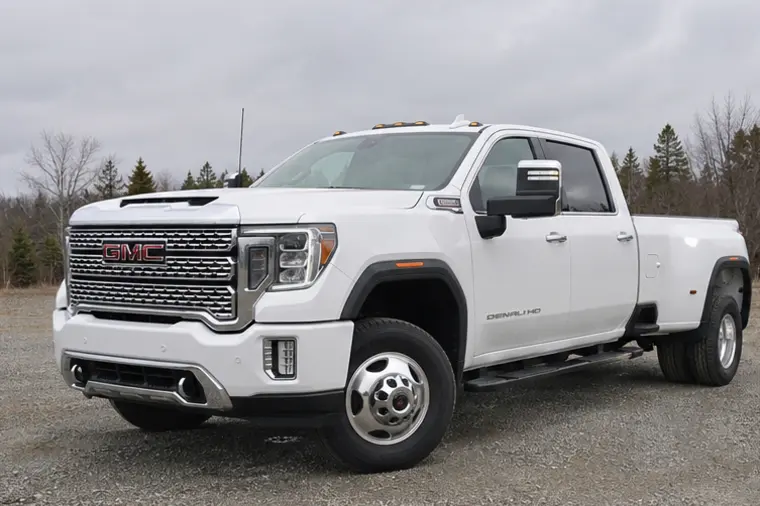
Use a 2020 GMC Sierra 3500HD diesel as a documented reference for the L5P/Allison ten-speed combination, then compare earlier or later candidates around the job they must perform. The best purchase depends first on rear-wheel arrangement, body, hitch and actual loading. A preferred model year cannot compensate for the wrong configuration, and no universal reliability-winning year is established by the sources reviewed here.
Choose the configuration before the calendar year
A heavy fifth-wheel owner, a local contractor with bed equipment and an operator buying a completed service vehicle may all search for a Sierra 3500HD diesel. They are not necessarily looking for the same truck. Start with the actual loaded assignment, the intended hitch connection and the body arrangement. Then identify which candidates can satisfy those requirements.
The 2020 GMC guide separates SRW and DRW configurations and documents the HD diesel's Allison ten-speed pairing. Its highest advertised figures depend on particular configurations and hitch types. Use the guide to establish a comparison framework, then verify the candidate's own labels and equipment. A 3500HD badge does not make every capacity in the brochure available on every truck.
For a completed commercial vehicle, retain the final body and installation evidence as well as the original chassis information. Do not assume an unfinished chassis specification describes the usable capacity after a service body and equipment have been fitted. The best year is secondary when the body configuration or load distribution is the deciding factor.
What makes 2020 a useful reference?
The manufacturer's 2020 publication explicitly pairs the HD 6.6L diesel with the 10L1000 ten-speed. That makes it a clear equipment comparison point for a buyer seeking that combination. It does not make 2020 a statistically proven reliability winner, establish the condition of a used transmission or imply that all trucks from that year have equivalent capability.
Compare a later revised L5P if its equipment better meets your preferences. GM's technical description distinguishes the later engine from 2023-and-older versions. Verify the exact model-year application and build rather than transferring a current power figure to every L5P candidate. A design revision is a reason to compare equipment, not proof that every previous concern has disappeared.
An earlier candidate can remain viable when its actual configuration, records and condition provide the stronger ownership proposition. Obtain the relevant year documents and identify the transmission rather than guessing from the badge. A coherent inspection and repair history can matter more to the purchase than a small difference in model year between otherwise suitable trucks.
Shortlist by the role the truck must fill
For SRW versus DRW, evaluate the actual load and the practical consequences of the arrangement. A dually may be the configuration your assignment requires, but it should not be selected solely as a reassuring label. Inspect its tires, wheels and body clearance and consider where it must operate. Confirm the relevant equipment rather than assuming a rear-wheel conversion retains the original vehicle's documented capability.
If an SRW candidate meets the real requirements, compare it on its own evidence. If it does not, a desirable year or premium trim cannot close the gap. This is why an honest best-year answer begins with the job and configuration rather than a ranked list of dates.
| Intended role | Configuration question | What should decide between years |
|---|---|---|
| Heavy recreational trailer | Which hitch and loaded truck limits apply? | Suitable configuration, current condition and support before departure |
| Bed cargo plus trailer | How much load remains after people and equipment? | Actual labels, measured weights and installed equipment |
| Completed service or utility vehicle | What does the completed body contribute to weight and operation? | Final documentation, installation assessment and maintenance history |
| Mixed work and daily use | Can the vehicle access parking, shops and the work site? | Practical fit as well as towing requirements |
| Seasonal towing | What happened during storage and recommissioning? | Documented condition rather than low annual distance alone |
Inspect the campaign and repair history
Transport Canada 2024637 includes defined 2020–2022 diesel Sierra HD applications. Check the candidate's VIN and obtain records supporting any claimed completion. Review continuing transmission symptoms separately from the campaign visit. A software action and a repair for a mechanical complaint are different events and should not be described interchangeably.
For defined 2017–2020 L5P candidates with relevant faults, GM's 20-NA-197 identifies a fuel-pressure sensor connector diagnostic possibility. Use it to ask whether the cause was properly established. A fault code alone does not identify every component needing repair. The practical purchase evidence is a clear diagnosis, performed work and outcome for the individual vehicle.
Do not count repair invoices as either automatic reassurance or automatic disqualification. A documented repair that resolved a concern can be useful history. Repeated invoices for the same unexplained complaint leave a different level of uncertainty. Ask what remains unresolved and whether that uncertainty is compatible with the truck's planned assignment.
Evaluate work hours and maintenance correctly
The 2025 6.6L supplement contains specific maintenance guidance for PTO and extended idle use. That is a reason to request hour information and the applicable maintenance records on a relevant 2025 candidate. Do not use a low odometer reading alone to characterize a working vehicle, and do not apply a later schedule indiscriminately to an earlier truck.
Ask how the vehicle was used, who maintained it and what documentation supports completed work. Separate engine servicing from body or equipment maintenance. A service vehicle can have important records outside the ordinary oil-change file. Identify what was installed, how it was operated and which specialist should assess it if the general inspector cannot do so.
For seasonal or recreational use, obtain the storage and recommissioning history as well as the annual distance. The aim is not to convert an anecdote into a failure prediction. It is to identify relevant inspection questions and build a maintenance plan from the correct documents once the candidate is selected.
Carry out a purchase inspection around the actual trailer
Provide the inspector with the vehicle's history and intended use before the appointment. Arrange a cold start, diagnostic review and appropriate road evaluation. Ask for a focused assessment of any repeated complaint rather than expecting a generic checklist to resolve it. A short drive should not be used to provoke a suspected serious fault.
Inspect the hitch, attachment points, bed, frame, tires, brakes, visible corrosion and electrical installations. For a dually, ensure the inspection covers the complete rear-wheel arrangement, including areas that are less obvious during a walk-around. For a completed body, identify inaccessible or specialist systems and obtain the relevant additional assessment before assuming the whole vehicle is ready for work.
Check the intended trailer connection and loading evidence. Include occupants, tools, bed equipment and hitch hardware. If exact loaded weights are not yet available, record the assumptions and the evidence needed to close them. An attractive towing headline should not conceal an unresolved carrying-capacity question.
Compare two suitable candidates fairly
Use the same evidence standard for both trucks. A fully inspected earlier candidate and a newer vehicle with only a seller's assurance are not equally documented. Obtain the missing information before attributing the difference to model year. Decide in advance which findings would require repair, a focused recheck or rejection.
Separate required work from optional improvements. A cosmetic preference should not obscure an unresolved mechanical or load question, and a repair reserve should follow identified needs rather than an unsupported universal average. Preserve the final evidence with the vehicle so that the maintenance plan begins from a known baseline.
| Comparison item | Candidate evidence to retain | Why it matters |
|---|---|---|
| Equipment | VIN, labels, body and hitch documentation | Establishes what is actually being purchased |
| Condition | Independent findings and relevant diagnostics | Separates observable condition from advertising |
| Repair needs | Written scope and estimates for identified work | Makes budget and timing reviewable |
| Service access | Appointment and parts information | Helps assess entry into the intended assignment |
| Substitute capability | Actual trailer and cargo requirements | Determines whether an interruption can be managed |
Sierra 3500HD best-year questions
Is 2020 the best year for everyone? No. It is the documented ten-speed reference used here, with suitability and condition deciding the actual purchase.
Is a dually automatically preferable? Only if its real configuration and practical tradeoffs fit your assignment.
Can a completed service body use the pickup's advertised capacity? Assess the actual completed vehicle and its loading evidence; do not assume the figures transfer.
What should settle a close comparison? Prefer the suitable candidate with stronger relevant evidence, a manageable repair scope and support that matches the work you expect it to do.
Evidence note: manufacturer documents establish the specific facts and applications cited. Buying workflows and cost scenarios are DieselTrucks.ca editorial guidance. These pages do not publish measured failure rates or confirm the condition, recall status or capacity of a particular truck.
General educational content for Canadian diesel-pickup research. Verify the exact truck, model year, certification labels, owner manual and manufacturer documentation, and obtain qualified mechanical or towing advice where appropriate.
Sources & Further Verification
Use the exact model year, VIN, truck labels and current manufacturer documentation when moving from general research to a purchase or towing decision.
- GMC 2020 trailering guide — original manufacturer powertrain and configuration tables
- GM L5P technical description — later specification versus 2023-and-older engines
- Transport Canada 2024637 — diesel transmission recall
- GM 20-NA-197, September 2020 — fuel-pressure connector diagnosis
- GM 2025 6.6L Duramax diesel supplement — original manufacturer operating and maintenance instructions
- Chevrolet Canada manuals and guides