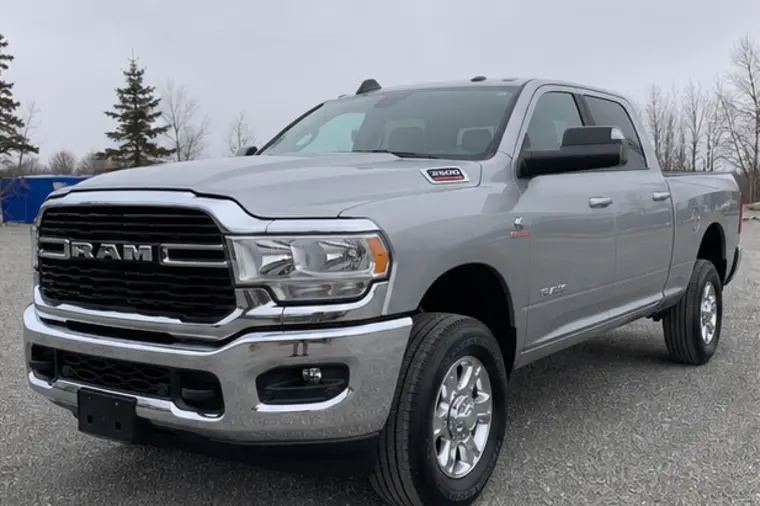
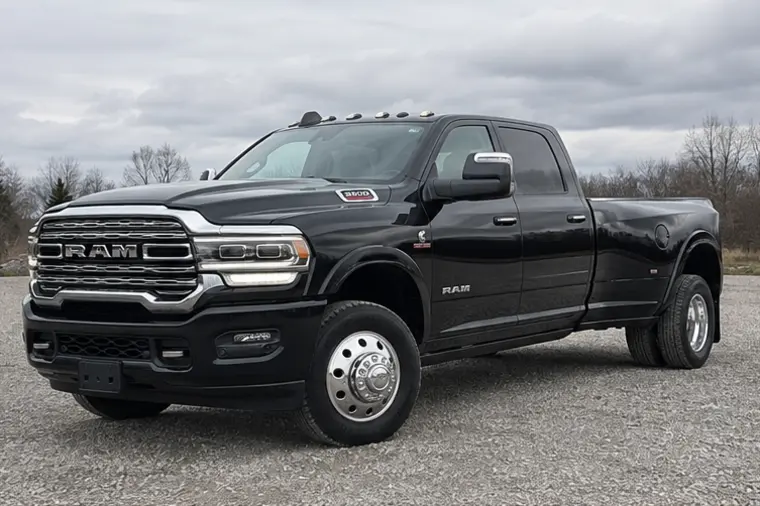
Choose between a three-quarter-ton and one-ton diesel pickup by the load the truck must carry, not by the literal meaning of the class nickname. A 250/2500 can be the right fit when its actual ratings cover the work. A 350/3500 becomes a stronger candidate when people, equipment and trailer pin weight demand more carried-load capacity or a DRW configuration.
What the class names actually tell you
Three-quarter-ton commonly groups Ford F-250, RAM 2500, Chevrolet Silverado 2500HD and GMC Sierra 2500HD pickups. One-ton groups their F-350 and 3500/3500HD counterparts. These names are useful shopping categories, but they are not the payload figure to enter into a towing plan.
Modern truck ratings depend on the exact vehicle. Diesel powertrain weight, cab, bed, drivetrain, trim and installed equipment all belong in the comparison. A highly equipped diesel pickup must be checked against its own payload label rather than the largest payload advertised for its model family.
| Decision | Three-quarter-ton pickup | One-ton pickup |
|---|---|---|
| Typical model shortlist | F-250, RAM 2500, Silverado/Sierra 2500HD | F-350, RAM 3500, Silverado/Sierra 3500HD |
| When to start here | Mixed use with verified carried-load margin | Greater carried-load needs or a DRW requirement |
| Rear-wheel configuration question | Verify the individual SRW configuration | Compare SRW and available DRW configurations explicitly |
| Engine comparison | May share a diesel family with its one-ton counterpart | Shared engine does not make ratings identical |
| Purchase decision | Appropriate if every limit and the operating brief are satisfied | Appropriate if its verified capability solves an actual load need |
Payload is often the deciding difference
Payload includes the people and cargo carried by the truck, added equipment not already accounted for in its label, hitch hardware and transferred trailer weight. Fifth-wheel pin weight can therefore move the decision toward a one-ton even when a three-quarter-ton's advertised trailer rating initially looks sufficient.
Work through the subtraction with the candidate's label. If payload demand exceeds it, the truck has failed one of the checks regardless of its engine torque. If there is only a narrow margin, examine how passengers, trip supplies or future equipment could change the load. Choose a margin deliberately rather than treating an exact arithmetic match as the ideal operating target.
A one-ton is not automatically adequate. It still needs the same assessment, including axle, tire and hitch limits. A DRW configuration is a reason to examine a potentially suitable alternative, not a substitute for reading labels and weighing the operating combination.
Same engine, different towing-guide row
Ford's 2024 guide provides a useful controlled illustration. A standard-output 6.7L F-250 SRW regular-cab 4x4, 8-foot bed and 3.31 axle is listed at 16,200 lb conventional towing in the cited row. The comparably described F-350 SRW row lists 20,000 lb. Both figures are tied to their configurations and guide conditions.
This does not establish that every F-350 tows 3,800 lb more than every F-250. It shows why engine displacement alone cannot determine the result. Other cabs, packages, axle combinations and hitch types have their own rows and footnotes. Use the correct market and model-year documentation for the actual truck.
Do not choose a hitch rating from one section and a payload maximum from another to assemble an imaginary best-case vehicle. Record one complete configuration, then verify its current equipment and loaded limits.
Suspension and rear wheels need a separate comparison
RAM Canada's 2026 overview distinguishes the 2500's link-coil rear suspension from the 3500's two-stage longitudinal leaf springs. That is a real model distinction worth understanding, but the specification alone does not prove how every trim will feel on your roads or how much a particular diesel truck can carry.
Test the candidate in a condition representative of your daily use, and assess the loaded assignment using the appropriate ratings. Aftermarket suspension assistance can alter ride or attitude without establishing a new certified payload. Keep modifications separate from the manufacturer's original capacity information.
For a one-ton, compare SRW and DRW intentionally. DRW adds width and another pair of road tires to the ownership plan. If an SRW truck provides adequate verified capacity, the narrower configuration may fit your access needs better. If it does not, moving to a suitable DRW truck is more meaningful than focusing on a higher engine-output option.
When a three-quarter-ton makes sense
A three-quarter-ton deserves the purchase when its actual load checks pass and it fits the full job. A conventional trailer, a modest crew and limited bed cargo can create a different requirement from a fifth-wheel plus passengers and permanent tools. Do the calculations for your use rather than adopting someone else's class rule.
Once capability is established, compare purchase quotes, insurance, tire replacement, parking and service history. A clean, appropriately configured used 250/2500 may be a better proposition than a poorly documented 350/3500 whose extra capacity you will not use. Conversely, no amount of attractive pricing makes insufficient payload acceptable.
When a one-ton is the more useful purchase
A one-ton belongs near the top of the shortlist when your load plan requires its verified capacity, when a suitable DRW configuration is needed, or when a known future assignment would make the smaller-class candidate unsuitable. Define that future requirement concretely: trailer, crew and cargo, rather than a vague possibility of “towing more someday.”
For commercial use, include the permanent load before estimating remaining capacity. Tool storage, hitch equipment and other accessories are part of the truck's everyday operating condition. Starting from an empty-truck assumption can conceal the very reason a one-ton is needed.
Keep pickup and chassis-cab research separate. A 350/3500 pickup comparison does not establish the completed-vehicle ratings or vocational suitability of an upfitted chassis cab.
Used-buying questions for both classes
Ask about previous trailers, bed loads, hitch installations and modifications. Inspect tires, steering, underbody, brakes and hitch mounting alongside the powertrain. A one-ton badge does not prove a truck was never overloaded, and a three-quarter-ton badge does not prove it led an easier life.
Can airbags turn a three-quarter-ton into a one-ton? Do not use them to replace the original ratings or the full load assessment. Does a one-ton cost more to run? Compare actual quotes and configuration-specific costs, especially SRW versus DRW tires and equipment. There is no universal cost premium established by the class name alone.
Evidence note: manufacturer documents establish the specific facts and applications cited. Buying workflows and cost scenarios are DieselTrucks.ca editorial guidance. These pages do not publish measured failure rates or confirm the condition, recall status or capacity of a particular truck.
General educational content for Canadian diesel-pickup research. Verify the exact truck, model year, certification labels, owner manual and manufacturer documentation, and obtain qualified mechanical or towing advice where appropriate.
Sources & Further Verification
Use the exact model year, VIN, truck labels and current manufacturer documentation when moving from general research to a purchase or towing decision.