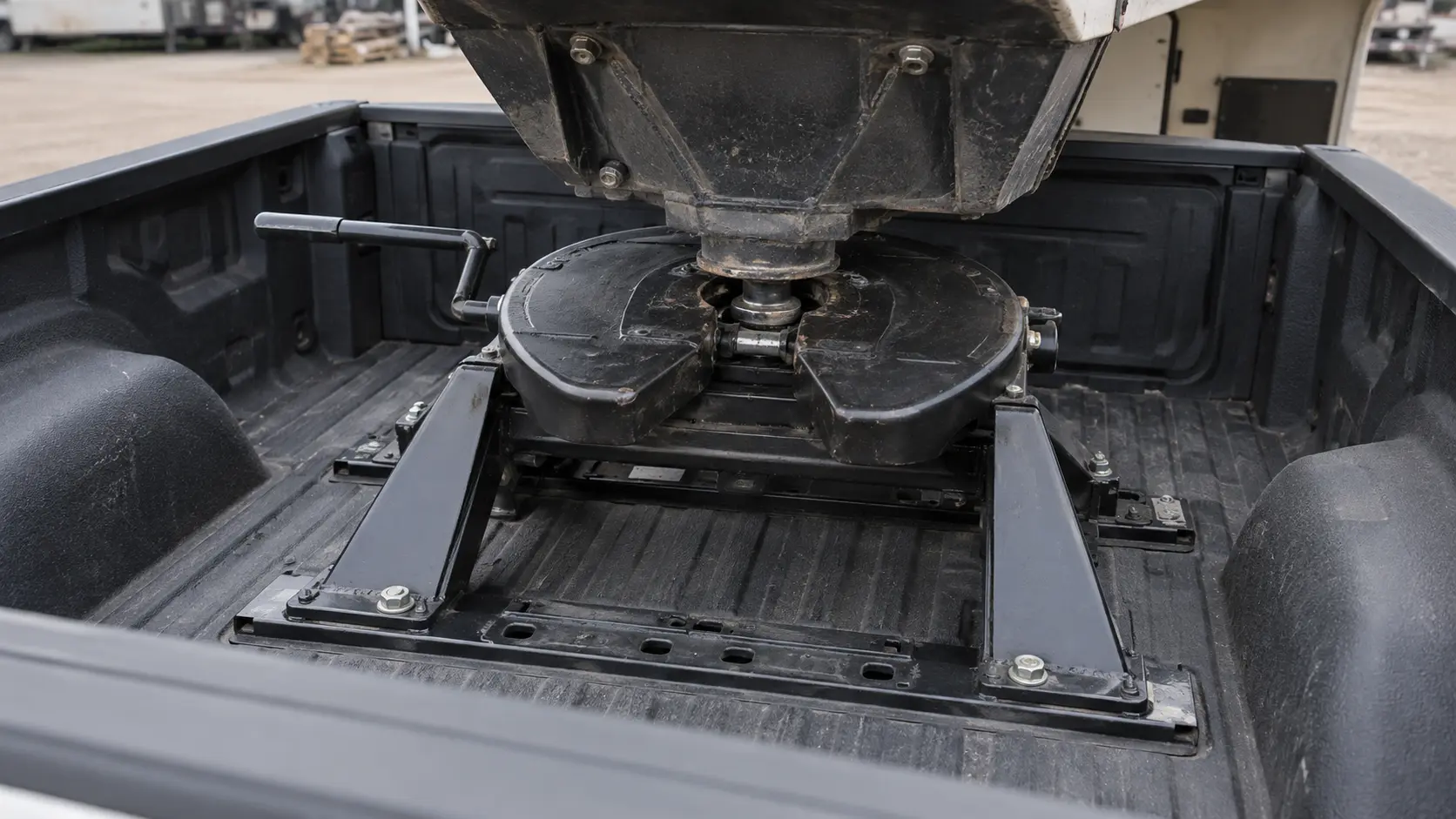
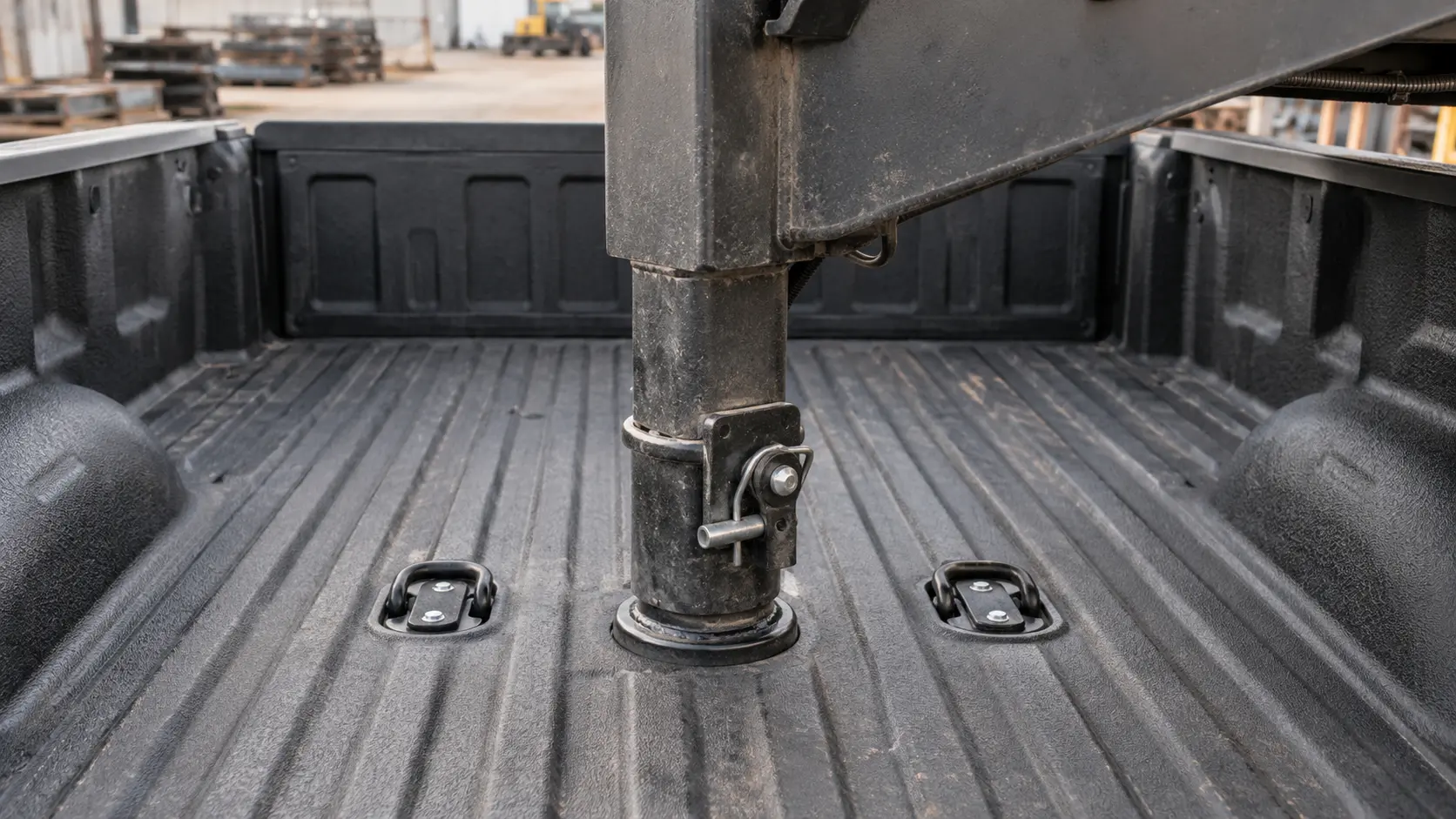
Fifth-wheel and gooseneck trailers both couple in the pickup-bed area, but they use different hardware and can have different manufacturer ratings even on the same truck row. A fifth-wheel uses a plate-and-kingpin hitch attached to designated bed mounting points; a gooseneck uses a compatible ball and coupler at a separate centre mounting point where the truck provides it. Choose the system supported by the exact truck, hitch and trailer—not by a universal claim that one tows more. Sources were checked on 9 September 2026.
Quick fifth-wheel versus gooseneck answer
Use a fifth-wheel when the trailer was engineered around a kingpin and compatible fifth-wheel plate, the truck has an approved mounting system, and the complete loaded combination passes. Use a gooseneck when the trailer was engineered for a ball-and-coupler connection and the truck, ball, safety-chain arrangement and trailer documentation support that system. Common recreational or commercial use does not replace the manufacturer decision.
Neither coupling automatically creates payload, rear-axle reserve or towing capacity. Include hitch hardware and actual loaded vertical trailer weight in the truck's carried-load calculation, then check GVWR, front and rear GAWR, tires, wheels, hitch, GCWR, trailer maximum and trailer ratings. The lowest applicable limit controls.
The attachment systems are not interchangeable
Ford's reviewed 2024 Super Duty manual describes a fifth-wheel hitch attached to four mounting pads in an equipped pickup bed. It describes the gooseneck ball as using a separate centre mounting pad. A factory preparation package enables the vehicle to accept certain compatible hardware; it is not the removable hitch itself and does not identify every hitch rating.
Follow the exact truck, mounting-system, hitch and trailer instructions. Do not substitute an adapter, ball, plate, rail or mounting hardware merely because it physically fits. Confirm model numbers, fasteners, installation record, locking method, required lubrication or inspection and the applicable rating labels before loading.
Fifth-wheel and gooseneck decision table
This table structures the research; it does not approve a combination. Some trucks share factory attachment provisions for both systems, but the removable components, coupling inspection, safety equipment and trailer interface remain distinct.
| Decision point | Fifth-wheel questions | Gooseneck questions | Evidence that decides |
|---|---|---|---|
| Trailer interface | Is the kingpin, pin box and plate geometry approved? | Is the ball size, coupler, height and latch approved? | Trailer and hitch model instructions |
| Truck attachment | Are the required rails or four-pad system present and compatible? | Is the centre ball socket and required chain-anchor system present? | Truck prep/build record and installed-hitch labels |
| Vertical load | What is the actual loaded pin weight? | What is the actual loaded vertical load? | Loaded trailer data and appropriate scale process |
| Clearance | Will trailer nose, pin box and hitch clear cab, bed rails and tailgate? | Will neck, coupler and trailer body clear cab, bed and tailgate? | Measured geometry through intended articulation |
| Rating row | Which fifth-wheel column applies? | Which gooseneck column applies? | Exact model-year configuration matrix and footnotes |
| Daily bed use | How much plate/rail hardware remains after uncoupling? | Does the installed ball stow or remove as designed? | Exact installed product, not category assumptions |
The same truck row can publish different hitch limits
GMC's 2026 Sierra 3500 HD matrix provides a clear configuration-specific example. The identified Duramax Regular Cab, long-bed, 2WD DRW truck with 43,900-lb GCWR and the Max Trailering Package is rated at 36,000 lb for gooseneck use but 32,000 lb for fifth-wheel use. The four-thousand-pound difference belongs to that exact row and source; it is not a universal gooseneck advantage.
Chevrolet Canada's 2026 guide uses separate fifth-wheel and gooseneck cells as well, while its highest detailed 3500HD row and family headline contain a documented discrepancy preserved in the dedicated Silverado guide. Always keep model, cab, bed, drive, SRW/DRW, engine, GVWR, GCWR, package and coupling type attached to a number.
Payload and vertical load are truck-side limits for both systems
Ford's manual includes trailer tongue or kingpin weight in payload, and its loading procedure requires the loaded vehicle to remain within GVWR and both axle ratings. The hitch assembly itself is also carried by the truck. Add people, tools, accessories, auxiliary equipment, bed cargo and the complete installed hitch before adding actual trailer vertical load.
An advertised trailer maximum can coexist with insufficient payload or rear GAWR for a real family, toolbox and loaded pin. Use the door-jamb payload statement, certification label and measured travel-condition axle weights. Do not add front and rear GAWR to raise GVWR, add tire ratings to invent an axle rating, or use an empty-trailer pin estimate as the final load.
Bed length and turning clearance require physical verification
Ford warns that shorter pickup boxes provide less clearance between the cab and fifth-wheel or gooseneck trailer than longer boxes. Its reviewed manual tells buyers to verify clearance for turns up to 90 degrees because contact can occur during tight, low-speed parking manoeuvres. This is a compatibility check, not an instruction to force a 90-degree turn in normal operation.
Measure the actual trailer nose or neck, pin box or coupler, hitch position, cab, bed rails, tailgate and any toolbox or auxiliary tank. Terrain changes relative angles, and a combination that clears on level pavement may behave differently at a crest, dip or uneven site. Use manufacturer-approved solutions where additional clearance is needed; do not assume an adapter preserves ratings or warranty.
Safety chains, breakaway equipment and connection checks differ
The Ford manual directs users to install trailer safety chains as the trailer-hitch manufacturer recommends, cross them under the coupler, allow turning slack, prevent dragging and attach them to the frame or hitch retainers rather than the bumper. Its equipped bed system provides designated safety-chain bracket holes for the gooseneck context. Apply the exact trailer, hitch and jurisdiction instructions.
For either system, perform the prescribed visual and physical coupling check, connect the electrical plug, breakaway cable and required chains, verify brake-controller operation, raise and secure landing gear or jack equipment, close and latch the tailgate, and complete a low-speed function check in a safe area. Do not improvise a pull test or stand between moving equipment.
Factory prep, aftermarket installation and adapters
A factory prep package can simplify attachment and preserve known mounting locations, but it does not prove the installed removable hitch matches the truck or trailer. Record the truck's original build, mounting system, hitch manufacturer/model, rating label, installation date and instructions. Inspect bed, frame and fasteners for undocumented changes, distortion or corrosion.
An adapter changes the load path or geometry between the trailer and hitch. Approval must come from the responsible truck, hitch and trailer documentation for the exact products; popularity or a seller's assurance is not enough. If compatibility or rating is unclear, obtain written manufacturer guidance or a qualified installer assessment before purchase or use.
Conventional towing is a third, separate system
A conventional trailer connects to a receiver behind the rear axle and uses a tongue, ball mount or weight-distributing equipment where specified. It does not use the in-bed fifth-wheel or gooseneck row. Ford's guide publishes separate selectors, and RAM's 2024 chart requires fifth-wheel or gooseneck equipment above its stated 18,000-lb conventional threshold.
Do not compare an in-bed maximum with a receiver trailer as if only the coupler name changed. Receiver rating, tongue load, weight-distribution requirements, ball and mount, trailer coupler, safety chains, brakes and conventional table conditions all need their own verification.
Match the exact towing row before choosing the hitch
Build a configuration identity before reading a maximum: market and model year, pickup or chassis cab, model, engine/output, transmission, cab, bed or wheelbase, 2WD/4WD, SRW/DRW, axle ratio, GVWR and GCWR package, tires/wheels and hitch type. Read column headings, dashes, notes and footnotes together.
RAM's reviewed chart states that maximum payload and trailer ratings are mutually exclusive and uses standardized hitch-equipment assumptions that differ between gooseneck and fifth-wheel. Real installed equipment and passengers can weigh more. Treat chart assumptions as part of the published method, then replace planning inputs with actual travel-condition weights for the candidate.
Used-truck and used-trailer inspection
On the truck, inspect the bed, puck/rail or ball system, frame attachment, hitch labels, fasteners, wiring, brake controller, rear suspension, axle, tires, wheels and evidence of overload or collision repair. Match installed hardware with invoices and manufacturer instructions. A covered hole pattern or fresh bed liner can justify closer inspection but does not prove misuse by itself.
On the trailer, verify VIN and rating labels, kingpin/pin box or gooseneck coupler identity, latch condition, breakaway system, safety equipment, brakes, landing gear or jack, frame and service history. Confirm any coupler or adapter change in writing. A qualified truck/trailer or hitch shop should resolve wear, installation and compatibility concerns before towing.
Canadian configuration and operating limits
The Ford and RAM documents used for representative configuration and installation details state their applicable market and model-year contexts; the Chevrolet Canada 2026 guide provides Canadian-market matrix examples. None identifies an unseen Canadian VIN, an aftermarket installation or a province's legal operating allowance.
For Canadian use, obtain the exact applicable market literature, truck build and labels, hitch/trailer instructions, measured weights and installed-component ratings. Separately verify registration, licence, inspection, brakes, safety-chain, breakaway, dimension and operating-weight rules with the responsible province or territory. Administrative permission does not raise manufacturer ratings.
Fifth-wheel versus gooseneck questions
Which tows more? There is no universal answer. The exact manufacturer row can rate them equally or differently; the cited GMC row is one specific gooseneck-higher example.
Which is better for an RV? Trailer design and manufacturer approval decide the interface. Many large recreational trailers use fifth-wheel kingpins, but category convention does not authorize a conversion.
Which is better for equipment or agricultural work? Many such trailers use gooseneck couplers, but the exact trailer, truck and hitch still govern.
Does either use less payload? Use actual hitch mass and loaded vertical load. Do not assume one category always leaves more payload.
Can a short-bed truck use either? Only when the truck, hitch and trailer geometry and instructions support adequate clearance. Verify the actual combination.
Can I use an adapter? Only with explicit support for the exact truck, hitch and trailer products and resulting load path.
Does a factory prep package include the hitch? Not necessarily. Ford's reviewed manual distinguishes the prep provisions from compatible removable hardware.
Fifth-wheel context
Fifth-wheel hitches are common for large recreational trailers and use a plate-and-kingpin arrangement mounted in the bed.
Gooseneck context
Gooseneck trailers commonly use a ball in the bed and are frequent in agricultural, equipment and commercial applications.
Truck-fit questions
For either hitch, verify loaded pin weight, payload, axle and tire capacity, bed clearance, cab-to-trailer clearance and the truck and hitch manufacturers' instructions.
Check installation and clearance before comparing convenience
Confirm the coupler, hitch, mounting system and truck are compatible as installed. A factory preparation package does not by itself identify the rating of a removable hitch. Retain the hitch model, instructions and installation record.
Check cab-to-trailer and bed-rail clearance through the movements expected in use. A short bed or an adapter requires the relevant truck, hitch and trailer manufacturers' guidance; do not assume a different coupling arrangement preserves every rating or warranty condition.
Keep the load calculation independent of the coupling
For either layout, include the hitch hardware and loaded vertical trailer load in the truck's carrying calculation. Then check actual axle loads and the hitch, tire and combination limits separately.
Choose between the systems around the trailer you actually use, an approved installation and access to the bed when disconnected. Neither layout provides a universal increase in the truck's capacity.
Compare attachment and clearance before preference
A fifth-wheel trailer uses a kingpin and a compatible fifth-wheel hitch; a gooseneck uses a ball-and-coupler connection. Similar placement over the rear of the truck does not make the two systems interchangeable. Check the truck attachment, hitch rating, trailer approval and available articulation as one system.
| Decision | Fifth-wheel questions | Gooseneck questions |
|---|---|---|
| Coupling | Jaw engagement and hitch height | Ball/coupler match and locking method |
| Clearance | Cab, bed rails and trailer nose | Cab, bed and coupler adjustment |
| Conversion | Is an adapter approved for this trailer and hitch? | Is the proposed connection supported by both makers? |
Account for equipment mass and load transfer
Include the installed hitch in truck cargo before calculating available pin or tongue load. Do not select an adapter solely to avoid buying a hitch; obtain the relevant manufacturer instructions and assess the resulting geometry. The trailer's connection type does not override the truck's axle, gross or combined limits.
Evidence note: manufacturer documents establish the specific facts and applications cited. Buying workflows and cost scenarios are DieselTrucks.ca editorial guidance. These pages do not publish measured failure rates or confirm the condition, recall status or capacity of a particular truck.
Verify Before You Tow
Use the exact truck's labels and current manufacturer documentation. Do not transfer a model-family maximum to an unknown configuration.
General educational content for Canadian diesel-pickup research. Verify the exact truck, model year, certification labels, owner manual and manufacturer documentation, and obtain qualified mechanical or towing advice where appropriate.
Sources & Further Verification
Use the exact model year, VIN, truck labels and current manufacturer documentation when moving from general research to a purchase or towing decision.
- Ford towing guides and archive
- Ford 2024 Super Duty owner manual — vehicle-specific certification-label and payload instructions
- Ford 2024 Super Duty pickup towing guide — original configuration tables and footnotes
- GMC 2026 Sierra 3500 HD trailering charts — original conventional and fifth-wheel/gooseneck configuration matrices
- Chevrolet Canada 2026 Trailering Guide — original Canadian conventional and in-bed configuration tables
- GM manuals and guides — model-year owner-literature lookup
- RAM 2024 Heavy Duty towing and powertrain chart — original manufacturer configuration matrix
- RAM towing terms