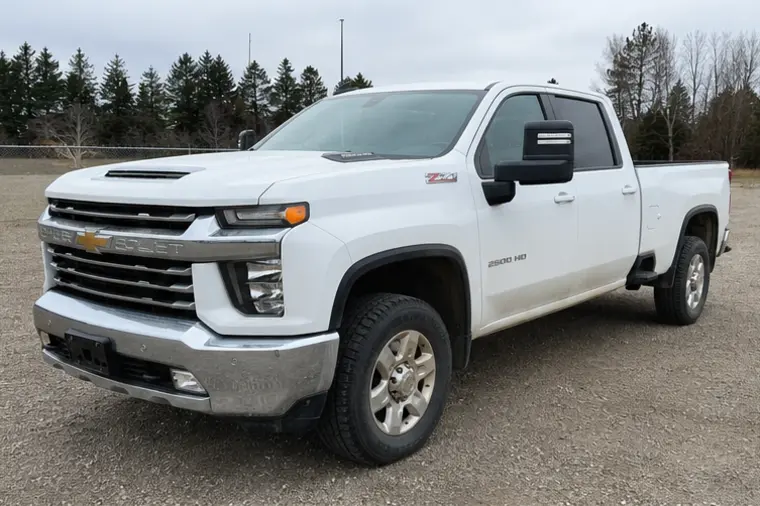
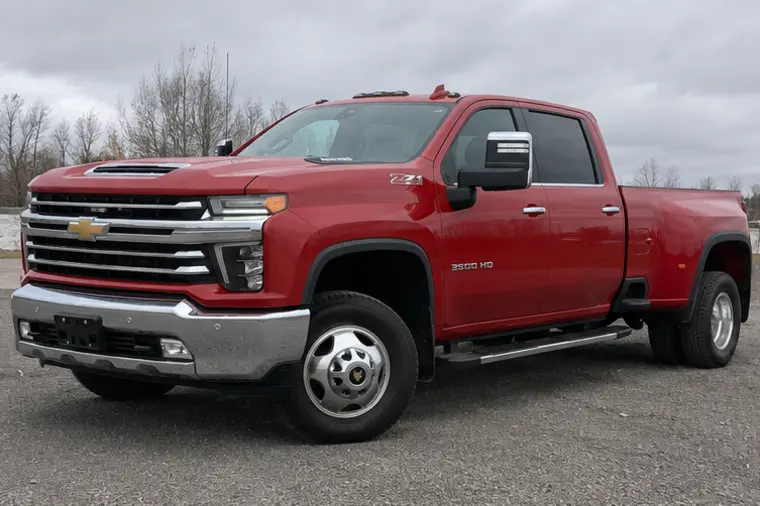
The 2500HD and 3500HD share many visible traits, but certification labels and available configurations can create important payload differences.
| Decision factor | Silverado 2500HD | Silverado 3500HD |
|---|---|---|
| Typical role | Three-quarter-ton HD towing and work | One-ton payload and heavier trailer use |
| Rear wheels | SRW pickup focus | SRW and DRW configurations |
| Daily use | May be sufficient without one-ton tradeoffs | Best justified by verified payload or trailer need |
| Choose when… | Exact labels cover the loaded job | More payload reserve or DRW capability is required |
2026 conventional towing can overlap at 20,000 lb
Chevrolet's 2026 U.S. charts prevent a common comparison error: the 3500HD badge does not automatically produce a larger conventional-trailer number. The 2500HD Duramax with the Max Trailering Package is listed at 20,000 lb in eligible cab and bed columns. The 3500HD chart also lists 20,000 lb conventional ratings for eligible Duramax SRW and DRW configurations. These are chart positions, not universal ratings.
That overlap means a conventional-trailer buyer must compare the exact cab, bed, drive system, wheel equipment, GCWR and package before paying for a class change. A 3500HD may still provide a better truck-side load result, but the reason must come from its labels and configuration—not from assuming every number rises with the badge.
In-bed towing is where the 3500HD range separates most clearly
Chevrolet gives fifth-wheel and gooseneck towing separate treatment. In the 2026 3500HD chart, an eligible Duramax DRW long-bed crew-cab 2WD position is shown at 32,000 lb with a fifth-wheel hitch and 35,500 lb with a gooseneck hitch. The Max Trailering Package branch retains the 32,000-lb fifth-wheel position and raises the gooseneck position to 36,000 lb. The hitch distinction is part of the claim.
Do not transfer those figures to an SRW 3500HD, a 2500HD or a different cab and drive combination. The 2500HD source is a separate multi-row matrix with its own GVWR, GCWR, wheel-size and package branches. If a loaded fifth-wheel's pin weight makes the 2500HD unsuitable, compare an exact 3500HD SRW before assuming a dually is required; then move to DRW only when the load evidence supports it.
Payload is a simultaneous-load calculation
Use the candidate truck's payload label before comparing trailer headlines. Occupants, tools, bed cargo, auxiliary fuel, caps, hitch hardware and the trailer's loaded tongue or pin weight all consume truck-side allowance together. Check rear-axle, tire, GVWR, hitch and GCWR limits as independent ceilings. Passing only the trailer column is not enough.
A 3500HD can be the correct step when the 2500HD's remaining allowance is too small, especially for sustained bed load or an in-bed trailer. It is not a substitute for calculation. Trim, four-wheel drive, cab, bed, options and added equipment change the completed truck. Record label photographs from both candidates and run the same load sheet rather than comparing brochure maxima assembled from different configurations.
2500HD, 3500HD SRW and 3500HD DRW are three practical choices
Treat the comparison as a three-way shortlist. A 2500HD may cover conventional towing and moderate carried loads without buying unused class. A 3500HD SRW can provide a different rating set while preserving a single-rear-wheel body. A 3500HD DRW introduces the broadest heavy-load configurations but also a wider rear body, two additional road tires and inner-rear tire access.
Measure parking, gates, loading areas and trailer clearance. Price six equivalent tires rather than comparing only purchase prices. For a daily driver, road-test each candidate unloaded and on the roads it will actually use. Capacity is the non-negotiable gate; once every candidate passes, width, ride, bed access, service cost and condition can decide the purchase.
Shared engines do not make ownership identical
Current Silverado HD pickups share relevant 6.6L gasoline and 6.6L Duramax choices, but engine output alone does not decide class. Axle, wheel, tire, spring, frame, hitch and package identity still control the completed truck's ratings. Verify the option and engine codes rather than describing every diesel candidate with the current 470-hp and 975-lb-ft Duramax specification.
Reliability research should follow model year, engine generation, transmission, emissions equipment, campaigns and candidate condition. This comparison does not rank the 2500HD or 3500HD by failure rate. For same-year trucks with the same powertrain, many service items overlap; chassis wear, tires, brakes, hitch installation and previous duty cycle can still create very different ready-for-work costs.
Used trucks must be normalized by generation and configuration
Do not apply the 2026 charts to a used truck from another model year. Record the VIN, model year, cab, bed, 2WD or 4x4, SRW or DRW, engine, transmission, axle information, GVWR and factory trailering equipment. Then use the matching Chevrolet guide and owner manual. A newer 2500HD and an older 3500HD may differ in far more than their class badge.
Inspect modifications separately. Suspension aids can change stance but do not increase the certified ratings printed for the truck. Non-factory wheels or tires may introduce a lower limit. Ask for receipts and installation details for the hitch, auxiliary tanks, flatbeds or other permanent equipment, and include their actual weight in the payload calculation before comparing remaining allowance.
Which Silverado HD fits which buyer?
Start with the least complex configuration that passes the recurring load case with useful reserve. Escalate the truck class or rear-wheel configuration only when an applicable limit, body requirement or duty cycle supports the move. This table screens the choice; the label set and exact Chevrolet row remain authoritative for the candidate.
| Buyer or job | Start with | Move the comparison when… |
|---|---|---|
| Conventional trailer within eligible 20,000-lb configurations | 2500HD and 3500HD using matched cab/bed rows | Truck-side load or another rating eliminates the 2500HD |
| Fifth-wheel RV | 2500HD and 3500HD SRW load sheets | Loaded pin weight or the exact matrix requires more truck |
| Heavy gooseneck or sustained bed load | 3500HD SRW and DRW | The calculated load supports the wider DRW configuration |
| Frequent unloaded driving in constrained spaces | The smallest configuration that passes | Never trade away a required certified allowance for convenience |
Questions buyers ask before choosing
Does a 3500HD always tow more than a 2500HD? No. Chevrolet's 2026 conventional charts include overlapping 20,000-lb positions. The 3500HD family separates more clearly in certain carried-load and in-bed-towing configurations.
Is a 3500HD dually required for every fifth-wheel? No. Calculate the loaded pin weight and compare the exact 2500HD, 3500HD SRW and 3500HD DRW labels and rows. Trailer marketing labels are not a substitute for measured weight.
Do the U.S. charts confirm a Canadian truck's VIN status or legal rating? No. They provide configuration evidence. Verify the Canadian candidate's labels, owner literature and applicable manufacturer information; this guide makes no Canadian VIN conclusion.
Compare the Chevrolet configurations that solve your load requirement
The Silverado 2500HD and 3500HD share relevant HD powertrain choices, but the exact cab, bed, rear-wheel configuration and equipment determine the buying comparison. Chevrolet's current Canadian material describes the later 6.6L Duramax at 470 hp and 975 lb-ft with a ten-speed pairing. That output does not establish either truck's individual payload or trailer rating.
Start with the 2500HD if its actual limits cover the work. Compare 3500HD SRW and DRW configurations when bed cargo or loaded pin weight requires a broader carried-load shortlist. A DRW truck's wider body and six road tires are practical ownership considerations to evaluate alongside its verified capacity.
Keep a family maximum out of an individual-truck calculation
A large Silverado HD towing headline may belong to a particular 3500HD configuration. It should not be used to describe an unrelated 2500HD crew-cab truck. Keep the guide row, model year, hitch type and footnotes with the capacity figure you use.
Calculate payload demand before deciding that either model is sufficient. Occupants, cargo, added accessories, hitch hardware and loaded trailer transfer all matter. Then verify axle, tire, hitch, GVWR and GCWR limits as well as the trailer rating. A shared Duramax engine cannot resolve a deficit in those checks.
Chevrolet's 2024 introduction also describes an available Max Towing package with specific 3500-series rear spring and shock content on the 2500. That equipment detail is a reason to verify the factory package, not to treat an aftermarket suspension change or every 2500HD as a 3500HD equivalent.
How to choose
Choose using the loaded trailer, payload reserve and daily-use needs. A 3500HD is valuable when its additional capacity is actually required.
- Define the real trailer and loaded pin or tongue weight.
- Estimate passengers, tools and cargo carried in the truck.
- Compare exact payload labels and manufacturer documentation.
- Inspect used condition, maintenance history and modifications.
Use one load sheet for both Silverado candidates
Start with carried equipment and people, then add the trailer's loaded connection weight. Compare the remaining allowances and every applicable axle and gross limit. The 3500HD becomes relevant when the job calls for a different load configuration or DRW option.
A price difference may reflect trim, age or repairs rather than capability. Ask for the engine code and transmission in each truck, especially across the 2020-era change. Choose after pricing initial work and verifying the recurring loaded job, not simply by comparing the largest brochure figures.
| Cross-shopping reason | What to hold constant |
|---|---|
| More truck load capacity | Same passengers, tools, hitch and trailer |
| Better used value | Similar year, engine code and documented condition |
| More towing equipment | Verify the actual installed hardware on both |
Evidence note: manufacturer documents establish the specific facts and applications cited. Buying workflows and cost scenarios are DieselTrucks.ca editorial guidance. These pages do not publish measured failure rates or confirm the condition, recall status or capacity of a particular truck.
General educational content for Canadian diesel-pickup research. Verify the exact truck, model year, certification labels, owner manual and manufacturer documentation, and obtain qualified mechanical or towing advice where appropriate.
Sources & Further Verification
Use the exact model year, VIN, truck labels and current manufacturer documentation when moving from general research to a purchase or towing decision.
- Chevrolet Canada 2026 Silverado HD — powertrains and configuration choices
- Chevrolet Canada 2024 Silverado HD introduction — powertrain and chassis specifications
- Chevrolet 2026 Silverado 2500HD trailering chart
- Chevrolet 2026 Silverado 3500HD trailering chart
- Chevrolet Canada 2026 trailering guide
- Chevrolet Canada manuals and guides