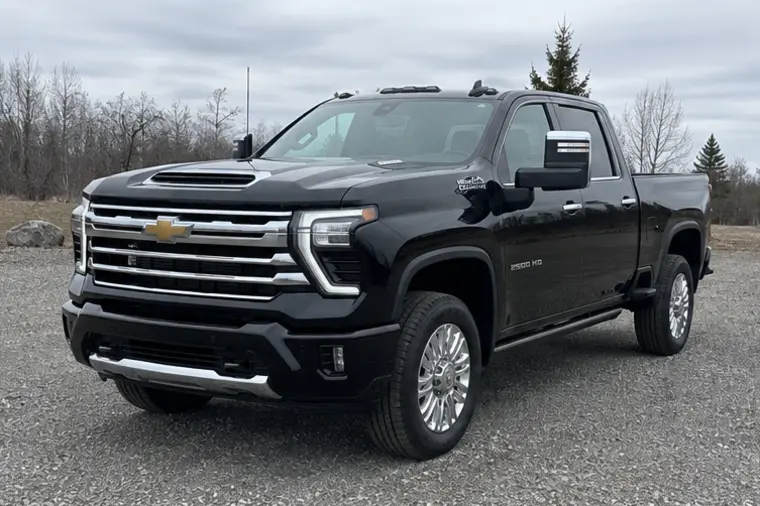
The Silverado 2500HD is a three-quarter-ton work and towing platform positioned between half-ton convenience and one-ton capacity.
MODEL-YEAR INTELLIGENCE
Research Chevrolet Silverado 2500HD by Model-Year Era
6.6L Duramax
Use the selected model year and canonical engine relationship as research context. Confirm the exact transmission, cab, bed, drivetrain, rear-wheel configuration, labels and manufacturer documentation on the truck.
Choose the engine and year range that matches your truck. These ranges organize research; confirm the exact equipment from its labels and records.
Research this model in detail
A Silverado 2500HD shortlist starts with the job
Choose a Silverado 2500HD diesel because a documented configuration fits your work, not because every truck wearing the badge can tow the advertised maximum. For an equipment trailer, describe the machine, attachments, chains and trailer together. For a travel trailer, include the loaded camping supplies and the people travelling in the truck. For a work pickup, start with the tools and permanent equipment that stay aboard even when there is no trailer.
These descriptions lead to different priorities. A frequent conventional-towing buyer needs enough loaded tongue allowance and a suitable receiver. A fifth-wheel buyer also needs pin-weight room and physical clearance. Someone who mainly carries tools may find payload more restrictive than trailer weight. Write down your normal and maximum intended loads before comparing engines and trims; that makes the same purchase test available for every candidate instead of changing assumptions to suit an attractive truck.
Identify the engine era and the actual transmission
The 6.6L Duramax badge is an engine-family starting point, not an all-years specification. Record model year, build identity, installed engine and transmission before comparing power, maintenance records or towing tables. The current GM L5P technical description explicitly compares its revised engine with 2023-and-older L5P versions. Therefore even a correctly identified L5P does not establish that a used truck has the later output or calibration.
Chevrolet Canada's 2026 HD page specifies 470 hp and 975 lb-ft for its diesel, and 401 hp and 464 lb-ft for its gasoline V8; both are paired with ten-speed automatics in that current reference. Neither set of figures belongs on an older listing without its own evidence. Inspect any engine or transmission replacement against invoices and installed identifiers. A replacement component does not by itself prove a factory-equivalent conversion, renewed chassis condition or a higher certified capacity.
| 2026 Chevrolet Canada powertrain reference | Output | What it does not establish |
|---|---|---|
| 6.6L Duramax diesel; ten-speed automatic | 470 hp; 975 lb-ft | The payload or hitch limit of a particular 2500HD |
| 6.6L gasoline V8; ten-speed automatic | 401 hp; 464 lb-ft | A diesel-versus-gas operating-cost winner |
| Earlier or modified Silverado | Verify its own application | Eligibility for current-year ratings or equipment |
Chevrolet's towing rows must stay attached to their configurations
The official 2026 U.S. Silverado 2500HD conventional chart separates engine, wheel and package branches. The Duramax 17-inch-wheel row lists 14,500 lb across its cab/bed/drive positions. The Max Trailering Package diesel branch with 18- or 20-inch wheels lists 20,000 lb for its four Crew Cab positions, while the Regular Cab positions in that same branch remain 14,500 lb. A Regular Cab is not automatically the conventional-towing winner just because it may weigh less.
Chevrolet publishes the in-bed matrix separately with additional GVWR and configuration detail. Do not fill its blanks or turn a combined fifth-wheel/gooseneck field into two independently verified ratings. The exact-year child guide contains that detailed lookup. This parent uses selected U.S. examples to explain the decision, not to certify a Canadian VIN or substitute a GMC chart. The 3500HD's headline and chassis-cab material belong to different applications.
Resolve cab, bed, trim and loaded-weight trade-offs together
Choose cab space for the crew who actually travels and bed length for the cargo and hitch arrangement you actually use. Measure parking, workshop and access constraints rather than assuming a long-bed truck will fit the same routine as a short-bed candidate. With an in-bed trailer, ask the installer to verify turning and bed-rail clearances for the precise truck, trailer and hitch. A compatibility check should not be replaced by a photograph of another owner's setup.
Trim features deserve their own functional inspection. Chevrolet Canada's current ZR2 description includes a factory lift, different dampers and off-road tires; High Country emphasizes different cabin and camera equipment. Neither description certifies maximum carrying capacity. Check the actual labels, then account for passengers, toolboxes, hitch and added accessories. Use loaded axle measurements to check rear GAWR as well as total GVWR, combined weight and hitch limits. Suspension aids do not supply a new manufacturer weight rating.
Use reliability evidence to choose inspection questions
A used Silverado should be assessed through its exact-year record and current condition. The original U.S. 24V797 filing includes certain 2020–2022 Silverado 2500/3500 diesel vehicles, excludes gasoline vehicles from that action, and describes transmission control-valve wear. Ask whether the particular VIN was involved and what work is currently required. An old repair invoice cannot establish completion of every later campaign or prove that unrelated symptoms have been corrected.
Keep three questions separate: what documented issue can apply, how the individual truck behaves, and what its records prove. A technical bulletin is not a failure-frequency study; a trouble-free test drive is not a guarantee. Canadian recall applicability must be checked through the appropriate VIN process. The problems, reliability, best-year and years-to-avoid pages remain separate research destinations. This model overview does not produce an unsupported ranking, guaranteed lifespan or universal avoid-year list.
Compare diesel ownership with a documented service budget
Separate purchase cost from the cost of making the truck ready for work. Obtain written estimates for inspection findings, then list upcoming scheduled service, tires, brakes, insurance and your expected fuel use. Add downtime exposure if the vehicle earns revenue: a replacement transport plan and local service access may matter more than a small theoretical saving per kilometre. Do not use a universal Silverado diesel mpg number when load, speed, route and driving pattern differ.
Have the shop reconcile dated records with the exact owner manual and diesel supplement. An oil-life display or filter reset is not a service invoice. Check what work was performed, what fluid or part was used and whether the record belongs to this VIN. For a modern emissions-equipped truck, discuss its previous and proposed duty cycles and any modifications. A seller's claim that a modification solves every maintenance concern is not a substitute for diagnosis, compliant equipment and documented calibration.
Close the purchase decision with an evidence file
Before inspection, obtain VIN and label photographs, the seller's service file, hitch identification and details of permanent accessories. Ask for a genuine cold start and agree on an independent inspection. Have the technician assess charging, cooling, leaks, transmission operation, fault history, corrosion, steering, suspension and braking. If warning messages appear, preserve their wording and diagnosis rather than accepting a cleared display as proof of repair.
At handover, retain the inspection report, load worksheet, applicable manuals and unresolved questions alongside the transaction documents. Compare a Sierra or 3500HD using the same load and inspection scope. Choose the truck whose verified configuration and condition fit the job at a supportable ownership cost. If key evidence remains unavailable, defer that candidate rather than converting an unknown into a clean bill of health. Marketplace pages are a separate commercial destination; this research does not establish that any described truck is currently offered for sale.
Current powertrain figures do not establish the truck’s payload
Chevrolet Canada lists the 2026 Silverado HD diesel powertrain at 470 hp and 975 lb-ft with a ten-speed automatic. The 2500HD’s carrying and towing capability still depends on the configuration and equipment around that engine.
Start by recording the year, cab, bed, drivetrain, axle information and vehicle labels. The same engine can appear in trucks with different carrying allowances. A 3500HD towing headline therefore does not belong on a 2500HD worksheet.
Compare a 2500HD with a 3500HD for the same loaded job
If both candidates satisfy every relevant limit, compare condition and ownership costs. If the 2500HD does not, establish which 3500HD configuration does before choosing between them. This is more useful than assigning one model class a universal towing advantage.
| Job feature | Question that changes the shortlist |
|---|---|
| Conventional trailer | Is loaded tongue weight included with passengers and tools? |
| Fifth-wheel trailer | Does loaded pin weight fit the truck and rear axle? |
| Daily bed cargo | How much allowance remains after permanent equipment? |
| Unloaded travel | Does the chosen configuration fit daily access and parking? |
Use the engine code alongside the model year
A used 2500HD spans more than one Duramax generation and transmission era. Record the installed engine code and unit before interpreting service invoices or output figures. The later 470-hp specification should not be applied across the entire used HD market.
Ask the inspecting shop to separate immediate faults from scheduled work and optional improvements. A clear baseline lets you compare two used 2500HDs on what they will require after purchase rather than on the seller’s description of previous spending.
Model evolution & used-buying eras
The 6.6L Duramax name spans multiple generations, and the applicable engine, transmission and emissions equipment depend on model year.
Cab, bed and work configurations
Crew, double and regular cabs, bed length and drivetrain all affect payload and trailer fit.
Towing and payload
There is no single towing or payload number for every truck wearing this model badge. Ratings vary with model year, cab, bed, drivetrain, axle ratio, wheel configuration and factory equipment.
- Read the door-jamb payload label on the exact truck.
- Use the owner manual and manufacturer towing guide for the model year.
- Account for passengers, cargo, hitch equipment and trailer pin or tongue weight.
Used-buying checks
A diesel pickup should be assessed as a complete working vehicle, not only as an engine choice.
- Ask for dated maintenance and repair records rather than relying on a verbal summary.
- Evaluate a true cold start, warning lights, leaks, transmission behaviour and underbody condition.
- Confirm whether the truck has towed, carried commercial loads or been modified, and inspect accordingly.
- Verify emissions equipment, tires, suspension and the exact payload label on the truck itself.
Compare the 2500HD by job and model year
An early Duramax truck and a later 2500HD can differ in engine code, transmission, emissions equipment and useful towing features. Start with the year selector and engine identification, then build the inspection scope. An Allison badge does not identify the transmission generation by itself.
| Silverado 2500HD buyer | Practical priority |
|---|---|
| Older work-truck purchase | Structural condition and immediate repairs |
| Frequent conventional towing | Receiver, wiring and loaded tongue allowance |
| Newer feature-focused purchase | Verify fitted cameras and towing equipment in use |
Know when the 3500HD belongs on the shortlist
If tools, passengers and trailer connection load approach the 2500HD's limits, compare a specific 3500HD. Use the actual label values and a consistent cargo list. The comparison is more useful than buying an overloaded configuration and attempting to compensate with suspension changes. Keep the 4500/5500/6500 medium-duty body-builder material separate from HD pickup specifications.
Evidence note: manufacturer documents establish the specific facts and applications cited. Buying workflows and cost scenarios are DieselTrucks.ca editorial guidance. These pages do not publish measured failure rates or confirm the condition, recall status or capacity of a particular truck.
General educational content for Canadian diesel-pickup research. Verify the exact truck, model year, certification labels, owner manual and manufacturer documentation, and obtain qualified mechanical or towing advice where appropriate.
Sources & Further Verification
Use the exact model year, VIN, truck labels and current manufacturer documentation when moving from general research to a purchase or towing decision.