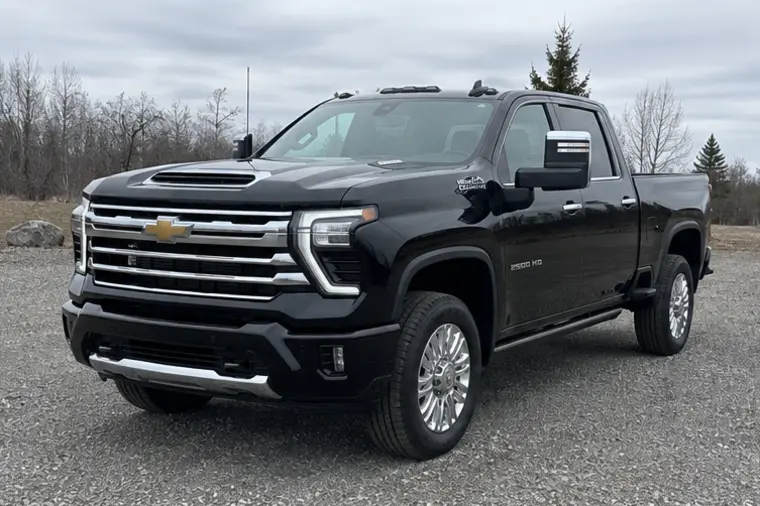
Avoid a Chevrolet Silverado 2500HD diesel when a material safety, repair, identity or load question cannot be resolved within your requirements. Defined earlier L5P diagnostic concerns and the specified 2020–2022 diesel transmission campaign deserve screening, but they do not establish a universal bad-year list. A later revision is not a substitute for inspecting the individual truck or verifying its actual configuration.
Screen the year without diagnosing from it
The selected GM records identify different concerns in different applications. The pressure-connector and coolant documents cover defined 2017–2020 Duramax/L5P contexts; the cold-start record has a defined 2017–2019 L5P scope. Transport Canada 2024637 addresses a separate concern in specified 2020–2022 diesel Silverado HD vehicles. Do not combine these windows into one claim that every truck across all those years should be rejected.
A year match tells you what to investigate. It does not establish that the actual candidate has the condition, whether work was completed or what remains unresolved. Equally, a year outside these selected records is not proof that no relevant problem or campaign exists. Current VIN checks and condition assessment remain necessary for the individual purchase.
Use the evidence to make a practical decision: continue evaluating, pause for a material answer, decline an unsuitable candidate or reconsider after supported correction. The available sources do not supply a comparable Canadian failure-frequency dataset from which to create an honest universal worst-year ranking.
Do not misread the 2024 change
Chevrolet's 2024 announcement documents a revised diesel and available equipment changes. The switch from a six-speed to a ten-speed transmission applies to the gasoline engine; it should not be presented as the diesel's first ten-speed year. A buyer needs the actual engine and transmission application before using the change as a reason to accept or reject a candidate.
A later L5P revision is not evidence that every earlier concern was eliminated. Nor does an earlier service bulletin prove a later vehicle has the same condition. Match the exact year, engine, build and symptoms to the appropriate information. An equipment preference and a reliability verdict are different decisions.
| Candidate or claim | Screening task | Unsupported inference |
|---|---|---|
| Earlier L5P with pressure faults | Obtain an application-specific diagnosis | Every code proves a pump failure |
| Earlier L5P with coolant loss | Locate the actual cause and review the result | Visible fluid identifies the required repair |
| Defined cold-start concern | Assess the relevant symptoms and prerequisites | Every rough start has the bulletin's cause |
| Specified 2020–2022 campaign vehicle | Verify VIN status and separate current symptoms | Campaign completion certifies the whole transmission |
| 2024 or later candidate | Verify actual equipment and present condition | A revision guarantees problem-free use |
When to pause a transmission-related purchase
Request the current VIN campaign result and the work record supporting any completion claim. Ask whether abnormal shifts, warnings or other material behaviour occurred before or after the visit. A campaign software action and a mechanical repair are different events and should not be described interchangeably.
If a continuing symptom remains unexplained, have a qualified professional determine an appropriate evaluation. Do not use aggressive driving to try to provoke a potentially serious fault. If a safety concern is suspected, stop the road assessment and obtain diagnosis before further use. A brief normal demonstration cannot explain every intermittent complaint.
Read the service sequence: what the owner reported, what the shop found, what was done and what happened afterwards. Repeated invoices can still leave a concern unresolved. A replacement part can be relevant evidence without guaranteeing future life. The purchase decision should follow the actual findings and the support available for any remaining issue.
Pressure and coolant warnings are not ready-made estimates
The listed diagnostic documents show why a symptom alone is insufficient to price a repair. A pressure fault may need investigation of the indicated connector in the applicable circumstances, but that does not establish the same cause on every truck. A coolant complaint needs the leak or loss traced; visible location alone can mislead the assessment.
Ask for the findings behind a proposed repair and a written scope. If the seller says the truck only needs a minor part, establish why that conclusion is supported. If a major repair is proposed, ask the same question. Neither the cheapest nor the most expensive assumption should replace the diagnosis.
Where work has already been done, determine whether the original complaint returned. An unrelated service, a cleaned engine bay or a cleared warning does not necessarily resolve the concern. A useful recheck addresses the original issue under appropriate conditions. Keep the evidence and any limitations together before deciding that a paused candidate can return to the shortlist.
Avoid an emissions shortcut with an unknown outcome
Establish the actual emissions equipment, calibration and history of warnings or reduced-power events. A seller's explanation should be supported by appropriate assessment. Do not accept the premise that every complaint is cured by regeneration, a reset or removal of a component. The actual cause and corrective scope need to be understood for the intended use.
If the vehicle has been modified, request documentation and a qualified review of what is installed. The original brochure may no longer fully describe the truck. A low purchase price does not make an unknown repair scope predictable, and a clean dashboard during one viewing does not certify that the underlying concern has been addressed.
Preserve the inspection limits honestly. Recent clearing or incomplete history may leave a need for further normal operation and a focused recheck without proving deliberate concealment. Decide whether the remaining uncertainty can be resolved before the truck is committed to work or travel. If not, changing the candidate may be the more practical decision.
Reject the wrong load configuration even when it runs well
Chevrolet's 2024 2500HD chart separates cab, hitch, wheel, tire, package and trim conditions. Check the actual candidate's labels and applicable documentation rather than relying on an engine badge or range-wide maximum. A different configuration's rating cannot establish what this vehicle can carry and tow.
Include occupants, bed cargo, installed equipment, hitch hardware and the trailer's load on the truck. Use measured weights where practical and identify assumptions still needing verification. For work, consider the busiest ordinary day; for recreation, include the people and equipment that accompany the trailer. An empty demonstration may miss the requirement that matters most.
If the assignment requires a 3500HD or another configuration, make that comparison directly. A newer 2500HD year, a premium trim or more engine output does not automatically resolve the mismatch. The appropriate model still needs its own inspection and practical review, but the original capability question should not be hidden behind a favourable reliability reputation.
Decide what evidence would change the outcome
Ask for information that directly addresses the concern. Another general history report may not resolve a diagnostic question; another inspection may not establish a missing configuration fact. Specifying the evidence needed helps prevent repeated checks that add little to the decision.
Declining a candidate after an inspection is not wasted effort. The inspection may have answered the most important question by identifying a truck that does not fit. If substantive correction later changes the evidence, reconsider it against alternatives using the same standard. Time already invested should not create an obligation to complete the purchase.
| Material concern | Initial response | Evidence that could support reconsideration |
|---|---|---|
| Unclear vehicle identity | Pause before relying on the records | Matching build data and actual equipment |
| Continuing transmission symptom | Obtain appropriate diagnosis before use | Supported cause, corrective work and focused recheck |
| Unexplained pressure or coolant complaint | Do not assume the repair scope | Diagnostic findings and relevant repair evidence |
| Uncertain load capability | Pause the transaction | Actual labels and a complete loaded assessment |
| Repair timing incompatible with the job | Choose another candidate or change the plan | Credible completion timing and a capable substitute |
Keep the repair and ownership plan concrete
Obtain estimates for diagnosed work and ask about parts and appointments. Separate immediate repairs, scheduled maintenance, wear items and optional improvements. Do not use a universal internet repair allowance or a promised remaining lifespan as a substitute for the actual scope and condition.
Confirm whether a temporary vehicle could handle the real trailer and cargo. Driver transportation alone may not preserve work capability. For a fixed departure or assignment, leave time for inspection, repair and follow-up. An unresolved material symptom may be manageable in one ownership situation and incompatible with another; that does not require a blanket verdict against the year.
Silverado 2500HD years-to-avoid questions
Should all 2020–2022 diesel HD trucks be rejected? No. Check the actual VIN, campaign work, repair history and present condition.
Does 2024 guarantee a better candidate? No. Equipment revisions do not replace inspection or prove lower failure frequency.
Is a pressure-related code enough to price a repair? No. Obtain a supported diagnosis for the actual application.
What is a clear walk-away signal? A material unresolved safety, identity, repair or capability issue that cannot be brought within your requirements through supported assessment or corrective work.
Evidence note: manufacturer documents establish the specific facts and applications cited. Buying workflows and cost scenarios are DieselTrucks.ca editorial guidance. These pages do not publish measured failure rates or confirm the condition, recall status or capacity of a particular truck.
General educational content for Canadian diesel-pickup research. Verify the exact truck, model year, certification labels, owner manual and manufacturer documentation, and obtain qualified mechanical or towing advice where appropriate.
Sources & Further Verification
Use the exact model year, VIN, truck labels and current manufacturer documentation when moving from general research to a purchase or towing decision.
- GM 20-NA-197, September 2020 — fuel-pressure connector diagnosis
- GM 18-NA-098, June 2019 — Duramax coolant leak diagnosis
- GM 19-NA-108, June 2019 — defined L5P cold-start concern
- Transport Canada 2024637 — diesel transmission recall
- Chevrolet 2024 Silverado HD announcement — original manufacturer equipment changes, updated June 2023
- Chevrolet 2024 Silverado 2500HD chart — original manufacturer hitch, cab, wheel and package conditions
- Chevrolet Canada manuals and guides