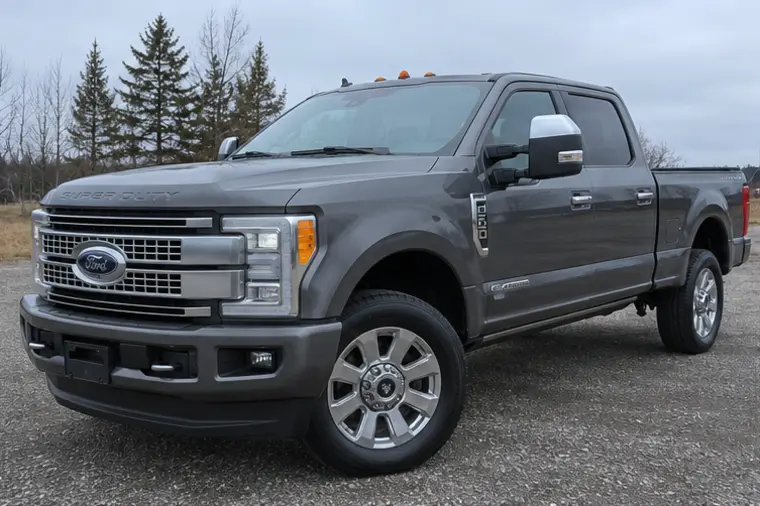
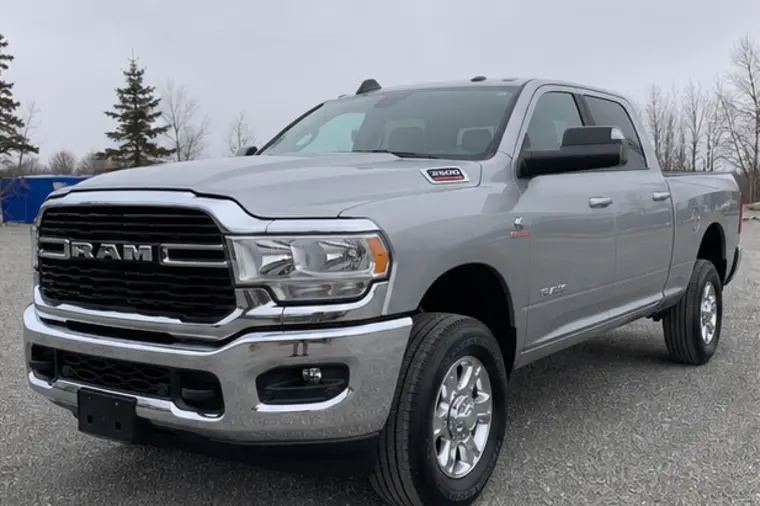
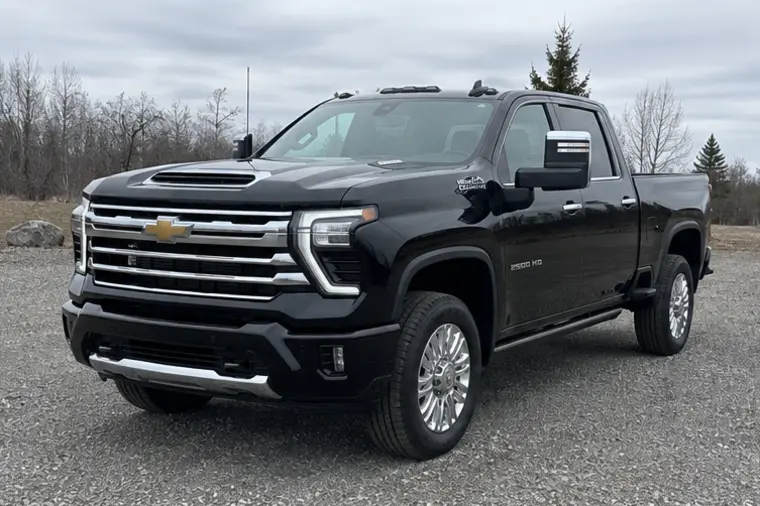
A three-quarter-ton diesel truck is a 250/2500-class pickup, not a literal 1,500-lb payload promise and not one universal towing specification. The 2026 F-250, RAM 2500, Sierra 2500HD and Silverado 2500HD manufacturer tables all change with cab, bed, drive, engine, axle, GVWR or GCWR branch, package and hitch method. Their largest published trailer values come from different table structures and cannot be ranked as though they describe the same truck. Use this class to build an exact-configuration shortlist, then compare the candidate's payload label, GVWR, front and rear GAWR, tires, wheels, installed hitch, trailer rating, GCWR and loaded weights. When the required tongue or pin load leaves too little carried-load margin, compare a suitable 350/3500 configuration rather than treating suspension changes as new capacity.
Direct answer: what is a three-quarter-ton diesel truck?
Three-quarter-ton is current market shorthand for heavy-duty pickups such as the Ford F-250, RAM 2500, Chevrolet Silverado 2500HD and GMC Sierra 2500HD. It describes a model class, not a vehicle-specific payload allowance, legal weight class or guaranteed trailer rating. Modern configurations can differ widely inside one badge.
This guide covers complete pickups. It does not transfer pickup values to chassis cabs, incomplete vehicles, service bodies or other upfits. A diesel engine can support sustained loaded work, but its added vehicle weight and selected trim or options can reduce the carried-load allowance available on an individual truck.
| Shorthand | Families in this guide | What the shorthand cannot establish |
|---|---|---|
| Three-quarter-ton / 250 / 2500 | F-250, RAM 2500, Silverado 2500HD, Sierra 2500HD | Payload, towing, axle, licence or registration result |
| Diesel HD | An engine choice in an exact pickup | That diesel has the greatest payload in every configuration |
| SRW | Single-rear-wheel pickup layout | That every rear axle, tire or wheel has the same rating |
| Tow package | Named equipment tied to source conditions | That the installed hitch or every package requirement is present |
| Maximum | One source cell under listed conditions | A rating for every truck sharing the badge |
The 2026 source maxima answer different questions
Ford Canada's table separates conventional, fifth-wheel and gooseneck ratings. RAM's Canadian and U.S. matrices publish one configuration-specific maximum trailer column, with hitch-equipment notes that do not create three separate rating columns. GMC's U.S. chart separates conventional from a combined fifth-wheel/gooseneck field. Chevrolet's Canadian matrix also combines the two in-bed methods and is cross-checked by a separate U.S. selector.
The comparison below preserves those structures. It is a map into the source documents, not a declaration that the largest number is the best truck. Exact payload, hitch load, rear-axle margin, installed equipment, market and working load can reverse a shortlist that considers only the headline.
| 2026 family and source scope | Verified high branch | Boundary that must travel with it |
|---|---|---|
| Ford F-250 — Canadian guide | 22,000 lb conventional; 22,300 lb fifth-wheel; 23,000 lb gooseneck | Three exact-configuration maxima; package 68U/68D/535, Tremor, GVWR and source blanks remain cell-specific |
| RAM 2500 — U.S. matrix | 20,000 lb maximum trailer value | One trailer column; 43 populated values, receiver and in-bed equipment notes do not invent hitch-specific rows |
| RAM 2500 — Canadian matrix | 20,000 lb maximum trailer value | 42 populated values; several rows and hitch notes differ from the U.S. source |
| GMC Sierra 2500HD — U.S. chart | 20,000 lb conventional; 22,390 lb combined fifth-wheel/gooseneck | Duramax Regular Cab long-bed 2WD, 30,000-lb GCWR and Max Trailering Package in-bed branch |
| Chevrolet Silverado 2500HD — Canadian matrix | 22,050 lb highest reproduced detailed row | Combined fifth-wheel/gooseneck field; the separate 22,070-lb Crew Cab headline lacks a supporting detailed row |
Payload is often the reason to compare a one-ton
Trailer rating controls the trailer side of the pairing, but tongue or pin weight is carried by the truck. Add people, cab and bed cargo, permanent accessories, hitch hardware and loaded vertical trailer load. Compare that demand with the candidate's actual payload or occupant-and-cargo label; then check GVWR and each axle independently.
A fifth-wheel can be below a 250/2500 trailer maximum while its loaded pin weight, hitch and ordinary cargo exceed the truck's carrying or rear-axle limit. When the correct trailer balance does not leave defensible margin, compare the corresponding F-350, RAM 3500, Sierra 3500HD or Silverado 3500HD configuration. Air springs, helper springs or other suspension changes do not rewrite certification, tire, axle or hitch ratings.
Build the carried-load worksheet before choosing trim
Use a single stated travelling scenario for every candidate. A premium trim, four-wheel drive, diesel engine, larger wheels, bed equipment or permanent accessories can change the truck's own weight. Do not borrow the payload maximum from a lighter cab or gas configuration and apply it to the truck being considered.
Simple label subtraction is an early screen, not final approval. Vertical hitch load does not distribute evenly between axles, and conventional receiver location can unload some front-axle weight while increasing the rear-axle effect. Suitable scale readings, component markings and the manufacturer's hitch instructions complete the assessment.
| Worksheet line | Evidence | Do not substitute |
|---|---|---|
| People and cab cargo | Real trip load | Driver-only brochure assumption |
| Bed cargo and accessories | Weighed or itemized installed load | Empty-bed payload claim |
| Hitch hardware | Installed equipment documentation or measured load | Factory prep package alone |
| Loaded tongue or pin weight | Trailer instructions, load plan and suitable measurement | Dry hitch weight |
| Payload allowance | Vehicle-specific loading label | Model-family maximum |
| Axle and component margin | Truck/tire/wheel labels and scale readings | Positive payload arithmetic alone |
Keep conventional and in-bed hitch methods distinct
A conventional trailer uses a receiver behind the rear axle. A fifth-wheel uses a kingpin and plate in the bed; a gooseneck uses an in-bed ball and coupler. Ford publishes three separate F-250 result sets and demonstrates that the hitch method changes the maximum. GMC and Chevrolet combine fifth-wheel and gooseneck in their 2500HD matrix fields, so those combined cells must not be split into invented values.
RAM's 2026 sources use one trailer value per configuration plus equipment notes. The U.S. note changes the receiver tongue limit to 2,000 lb and references bed-mounted hitch equipment over 20,000 lb; Canadian fifth-wheel and gooseneck equipment notes use different thresholds. These notes do not increase an exact matrix value or certify the hitch installed on a candidate.
Read every configuration selector and footnote
Match model year and market before cab, bed, two- or four-wheel drive, engine output, transmission, axle ratio, wheels, GVWR or GCWR branch, towing package and hitch method. A table may place conditions in a header, footnote or continuation band rather than beside every number. Record the entire source identity with the candidate.
Never fill a blank from a nearby truck or another year. Ford's 2026 selector restores two SuperCab short-box columns absent from its Canadian 2025 table. RAM publishes several 2026 U.S./Canadian differences, including diesel rows of 18,820 versus 18,700 lb and 19,770 versus 19,650 lb. The Canadian 19,880-lb starred position differs from the U.S. 19,890-lb position. Those are separate published records, not rounding opportunities.
| Selector | Why it matters | Verification path |
|---|---|---|
| Year and market | Column structure, equipment and values change | Exact-year Canadian or clearly labelled U.S. document |
| Cab, bed and drive | Changes truck weight, wheelbase and available source cells | Build record, physical truck and table header |
| Engine, transmission and axle | Selects output and GCWR branch | Build record and exact source row |
| GVWR/GCWR and wheels | Can identify optional or reduced-rating branches | Labels, source headers and footnotes |
| Package and hitch method | Can be mandatory for the published value | Factory/build record, installed hitch and source note |
| Source dash or absence | Means that source does not publish a value there | Leave unresolved; do not backfill |
Every applicable rating must pass together
The loaded pickup must remain within GVWR and both GAWR values. Installed tires, wheels, receiver or in-bed hitch and trailer components retain independent limits. The complete loaded combination must remain within GCWR, and the loaded trailer must remain within the exact configuration's published trailer rating. The lowest applicable limit governs.
Ratings are limits; scale readings are observations for one load. Keep them in separate columns and count transferred hitch load only once in a combination total. Recalculate and, where appropriate, reweigh after meaningful changes to passengers, cargo, trailer contents, hitch equipment or permanent accessories.
| Gate | Question | Primary evidence |
|---|---|---|
| Payload / occupant-cargo allowance | Can this individual truck carry all people, equipment and hitch load? | Vehicle-specific label and consistent load accounting |
| GVWR | Does the complete loaded truck remain under its limit? | Certification label and truck scale total |
| Front/rear GAWR | Does each axle remain under its own limit? | Certification label and axle-group readings |
| Tires, wheels and hitch | Do installed components pass? | Component markings, instructions and axle readings |
| Trailer rating | Does the exact configuration and hitch row permit the loaded trailer? | Exact-year table and footnotes |
| GCWR | Does the loaded truck-and-trailer combination pass? | Manufacturer guide and combination scale total |
Use cases that fit the 250/2500 decision
A conventional equipment or enclosed trailer may fit a three-quarter-ton pickup when its loaded tongue weight, receiver requirements, bed cargo and occupants all pass. A moderate fifth-wheel may fit an exact configuration, but pin weight and rear-axle load often decide the answer before the combined in-bed maximum. A plow, service equipment, auxiliary tank or dense bed cargo also belongs in the carried-load plan even when no trailer is attached.
For mixed daily and towing use, compare parking, height, ride, tire and service needs alongside loaded capability. A 250/2500 may be the practical fit when it retains adequate verified margin. If the workload repeatedly consumes nearly all payload or rear-axle capacity, the corresponding one-ton may offer a better engineering starting point even when both badges publish a sufficient trailer number.
| Use case | Early deciding inputs | Reason to compare 350/3500 |
|---|---|---|
| Conventional work trailer | Loaded tongue, receiver mode, people and bed cargo | Correct balance or ordinary cargo leaves little carried-load margin |
| Fifth-wheel | Loaded pin, hitch mass, rear axle and bed clearance | Pin load or rear axle becomes binding |
| Gooseneck equipment trailer | Loaded machine/trailer, in-bed load and equipment placement | Working load varies or requires more reserve |
| Plow or service equipment | Front/rear axle effects and installed equipment weight | Upfit plus cargo approaches axle/GVWR limits |
| Daily use with occasional towing | Real trailer plus parking, ride and service priorities | Future trailer or cargo plan exceeds documented margin |
A repeatable 250/2500 shortlist workflow
Write the heaviest intended loaded day before shopping: trailer and hitch type, loaded trailer weight, loaded tongue or pin weight, occupants, cargo and permanent equipment. For each truck, record year, market, cab, bed, drive, engine, transmission, axle, wheels, GVWR/GCWR branch and packages. Attach the exact source row and footnotes.
At inspection, reconcile the VIN, build information, certification/loading labels and physical configuration. Verify the installed hitch and components, inspect brakes, suspension, tires and wheels, and review service and modification records. Use the actual label and measured weights rather than a listing headline. Keep unresolved inputs visible instead of entering zero or borrowing another configuration.
Canadian-use and source boundaries
The F-250 source is a Ford Canada exact-year guide; the RAM comparison preserves both official Canadian and U.S. matrices; Chevrolet supplies a Canadian detailed matrix and a labelled U.S. cross-check. The detailed Sierra chart is U.S.-market evidence with a Canadian exact-vehicle handoff. No U.S. table certifies an unseen Canadian VIN or decides provincial licensing, registration, inspection or operating requirements.
The Canadian truck's physical labels, installed equipment and manufacturer documentation control its identity. Confirm brakes, breakaway equipment, lighting, securement, tires, hitch installation and applicable route or use requirements. An imported, altered or upfitted truck may require additional manufacturer, upfitter or qualified professional evidence.
Research and marketplace next steps
Use the towing-capacity tool to keep payload, hitch-load and rating inputs organized, then retain the underlying manufacturer row, label readings and scale results. Continue into the model guides for the complete exact-year evidence. This class page does not replace them or turn four different source formats into a universal winner.
No guide statement invents reliability rankings, failure rates, candidate condition, inventory, sellers, dealer counts, prices, financing or offers. The separate `/trucks` marketplace remains the commercial authority and may have no eligible listings. Any listed truck still requires identity, condition, ownership and load verification.
Evidence note: manufacturer documents establish the specific facts and applications cited. Buying workflows and cost scenarios are DieselTrucks.ca editorial guidance. These pages do not publish measured failure rates or confirm the condition, recall status or capacity of a particular truck.
General educational content for Canadian diesel-pickup research. Verify the exact truck, model year, certification labels, owner manual and manufacturer documentation, and obtain qualified mechanical or towing advice where appropriate.
Sources & Further Verification
Use the exact model year, VIN, truck labels and current manufacturer documentation when moving from general research to a purchase or towing decision.
- Ford towing guides and archive
- Ford Canada — 2026 Super Duty pickup towing guide
- Ford Canada — towing resources and VIN handoff
- RAM — 2026 Heavy Duty payload and towing matrix (U.S.)
- RAM Canada — 2026 Heavy Duty payload and towing matrix
- GMC — 2026 Sierra 2500HD trailering charts
- GMC Canada — manuals and guides
- Chevrolet Canada — 2026 Trailering Guide
- Chevrolet — 2026 Silverado 2500HD selector