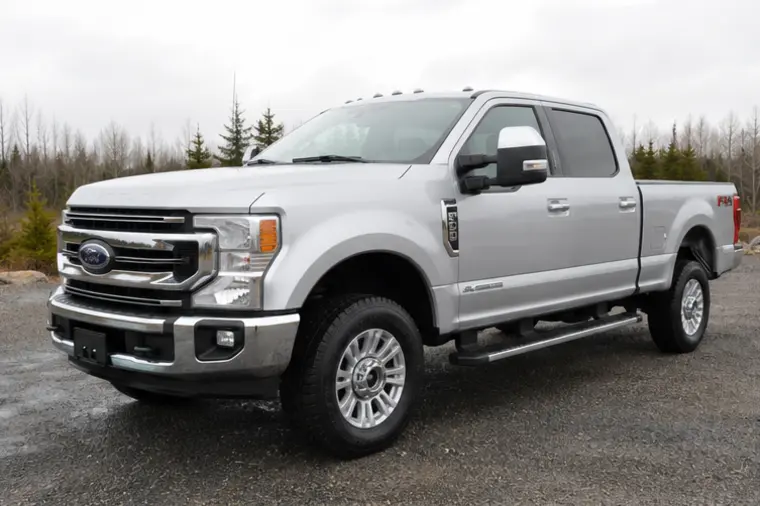
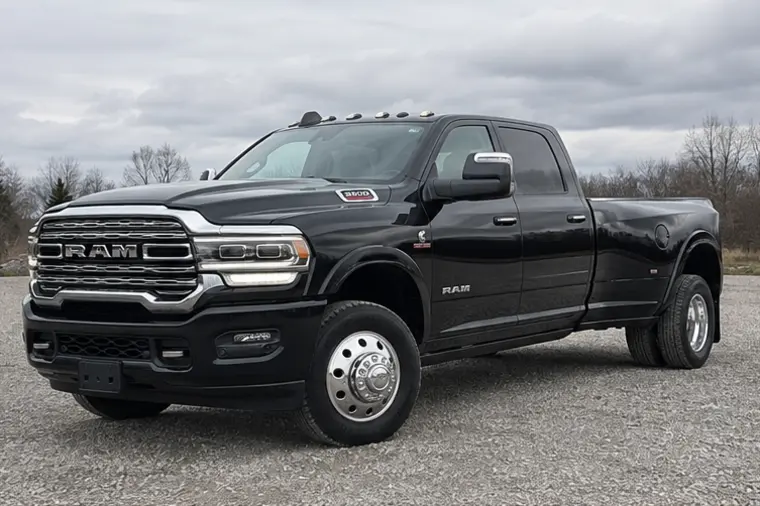
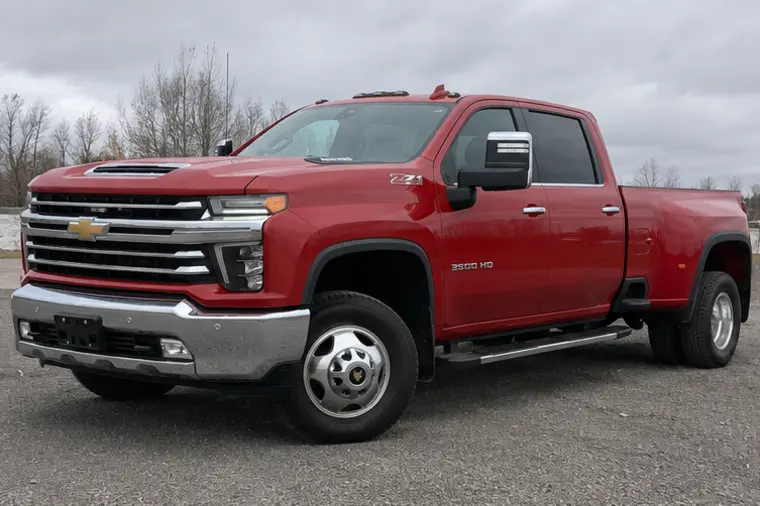
A one-ton diesel truck is a 350/3500-class pickup, not a promise that every truck carries exactly one ton or shares one towing limit. The useful comparison starts with the exact model year, cab, bed, drivetrain, engine, rear-wheel layout, axle and towing package. For 2026, the F-350, RAM 3500, Sierra 3500HD and Silverado 3500HD source tables all contain materially different branches. Their largest published trailer figures belong to particular dual-rear-wheel configurations and, where the manufacturer separates hitch types, a particular conventional, fifth-wheel or gooseneck method. A real purchase still has to pass the truck's payload label, GVWR, front and rear GAWR, tires, wheels, installed hitch, trailer rating, GCWR and loaded scale checks.
Direct answer: what is a one-ton diesel truck?
In current pickup language, one-ton usually means the Ford F-350, RAM 3500, Chevrolet Silverado 3500HD or GMC Sierra 3500HD class. It is a market label carried forward from older payload categories, not a literal 2,000-lb payload specification and not a substitute for a certification label. Two trucks with the same badge can have very different carried-load allowances and trailer ratings.
This guide covers complete pickups in single-rear-wheel and dual-rear-wheel form. It does not transfer pickup ratings to an F-450, RAM 4500/5500, Silverado or Sierra chassis cab, incomplete vehicle, or upfitted work body. Those vehicles use different source documents and completed-vehicle information.
| Class shorthand | Pickup families in this guide | What the shorthand does not prove |
|---|---|---|
| One-ton / 350 / 3500 | F-350, RAM 3500, Silverado 3500HD, Sierra 3500HD | Payload, tow rating, legal weight or licence class |
| SRW | One tire at each rear corner | That every SRW has the same payload or stability margin |
| DRW / dually | Two tires at each rear corner | That every dually carries or tows the model-family maximum |
| Diesel | Engine choice within an exact configuration | That the diesel branch always has more payload than gas |
| HD badge | Manufacturer model family | A VIN-specific rating or completed-body certification |
The 2026 headline figures belong to different source branches
The table below is a source map, not a ranking. Ford's U.S. guide separates conventional, fifth-wheel and gooseneck ratings. RAM's U.S. and Canadian one-page matrices publish configuration-specific maximum trailer values but do not provide the same three-column hitch comparison. GMC's U.S. selector separates the hitch methods for its highest branch. Chevrolet's Canadian matrix combines fifth-wheel and gooseneck positions, while its exact-year U.S. selector separates them.
Because the table structures differ, a large number in one column cannot be treated as an equivalent result in another. The maximum only applies after the precise cab, bed, drive, rear-wheel, engine, axle, GVWR, GCWR, package and hitch conditions are matched. A dash or absent market row remains unavailable; it is not permission to borrow an adjacent value.
| 2026 family and source scope | Verified high branch | Necessary interpretation |
|---|---|---|
| Ford F-350 — U.S. exact-year guide | 28,000 lb conventional; 35,000 lb fifth-wheel; 38,000 lb gooseneck | Three different hitch maxima; 40,000 lb and package 535 belong to adjacent F-450 data and are excluded |
| RAM 3500 — U.S. matrix | 36,610 lb maximum trailer value | HO Cummins DRW Regular Cab 4x4, eight-speed, 3.42, 14,000-lb GVWR and 45,000-lb GCWR source cell |
| GMC Sierra 3500HD — U.S. selector | 20,000 lb conventional; 32,000 lb fifth-wheel; 36,000 lb gooseneck | Duramax Regular Cab long-bed 2WD DRW, 43,900-lb GCWR and Max Trailering Package |
| Chevrolet Silverado 3500HD — Canadian matrix | 35,500 lb highest populated detailed in-bed cell | Canadian table combines fifth-wheel/gooseneck; its overview advertises 36,000 lb for the family |
| Chevrolet Silverado 3500HD — U.S. selector | 32,000 lb fifth-wheel; 36,000 lb gooseneck | 43,900-lb-GCWR Max Trailering branch; not a Canadian VIN-level rating |
SRW or DRW is a workload decision, not a status upgrade
An SRW one-ton retains the narrower rear body and four road tires of a conventional pickup layout. It can be easier to park, use in narrow lanes and live with when the truck spends substantial time disconnected. A DRW adds rear tire contact and is commonly represented in the highest payload and in-bed towing branches, but it is wider, has two additional tires to inspect and replace, and still has finite axle, tire, wheel and payload limits.
Compare the two using the same people, cargo, hitch hardware and loaded trailer. If an SRW candidate only passes when water, tools or normal passengers are omitted, the shortlist is not robust. If a DRW is considered, measure garage doors, parking spaces, jobsite access and trailer clearance rather than assuming its extra width is inconsequential.
Payload can choose the truck before trailer rating does
Payload is the truck's carried load allowance for its vehicle-specific condition. People, cab and bed cargo, added equipment, hitch hardware and the trailer's vertical tongue or in-bed load all consume it. A diesel engine and a high trim can add truck weight, so the configuration with the strongest powertrain headline may not have the greatest payload allowance.
Start with the actual payload or occupant-and-cargo label, then verify GVWR and each axle separately. Rear GAWR, rear tires or wheels can become binding with a fifth-wheel, gooseneck, slide-in camper, auxiliary tank or tools even when simple payload subtraction remains positive. Suspension aids can change ride behaviour but do not rewrite the manufacturer's labels or component ratings.
| Carried-load item | Evidence to use | Common shortcut to reject |
|---|---|---|
| Occupants and cab cargo | Real travelling load | Driver-only brochure assumption |
| Bed cargo and permanent accessories | Weighed or itemized installed load | Leaving tools, tank or tonneau out |
| Hitch hardware | Installed hitch documentation or measured load | Assuming a factory prep package weighs nothing |
| Tongue or pin load | Loaded trailer plan and suitable measurement | Dry hitch weight |
| Payload allowance | Vehicle-specific label | Model-family maximum |
| Axle and tire capacity | Truck and component labels plus scale readings | Payload subtraction alone |
Conventional, fifth-wheel and gooseneck ratings stay separate
A conventional trailer loads a receiver behind the rear axle. A fifth-wheel uses a kingpin and plate in the bed, while a gooseneck uses an in-bed ball and coupler. The load paths, hitch hardware and manufacturer table positions differ. Ford, GMC and Chevrolet demonstrate why a single model-wide towing number is insufficient: the highest gooseneck value can exceed the fifth-wheel value on the same high-capacity branch, and both can differ sharply from conventional capacity.
The coupling choice does not erase payload. Loaded tongue or pin weight remains part of the truck's carried load, and the installed hitch can be lower-rated than the truck's headline. Confirm receiver mode, weight-distribution instructions, bed and cab clearance, hitch position, trailer instructions and every applicable component label.
Read the configuration row from left to right
Begin with model year and market, then match pickup body, cab, bed, two- or four-wheel drive, SRW or DRW, engine, transmission, axle ratio, GVWR or GCWR branch, towing package and hitch method. Some manufacturers group attributes in headers or footnotes, so the nearest large number is not necessarily connected to the candidate truck.
Preserve source blanks and market differences. The 2026 Canadian RAM table omits a U.S. 23,550-lb short-box diesel row. RAM also prints 32,890 lb in the U.S. and 33,890 lb in Canada for a comparable Mega Cab DRW position. Those figures are neither averaged nor silently normalized. They remain separate evidence for separate published documents.
| Row key | Why it changes the answer | Where to verify |
|---|---|---|
| Model year and market | Tables and equipment can change; U.S. and Canadian rows may differ | Exact-year manufacturer document |
| Cab and bed | Changes wheelbase, truck weight, clearance and available columns | Build record and towing table |
| 2WD or 4WD | Changes truck weight and may have separate values | Exact source cell |
| SRW or DRW | Changes rear axle/tire layout and table branch | Physical truck and source header |
| Engine, transmission and axle | Selects powertrain and GCWR branch | Build record, labels and guide |
| Package and hitch | Can be mandatory for the published value | Window/build record, installed-hitch label and footnotes |
The lowest applicable limit governs
A towing row is one gate in a system. The loaded truck must remain within GVWR and front and rear GAWR. Tires, wheels, receiver or in-bed hitch and trailer components have their own ratings. The loaded truck and loaded trailer together must remain within GCWR, and the trailer must remain within the exact configuration's trailer rating. Passing six limits does not override a seventh failure.
Keep ratings and measured weights in separate columns. A label or guide states a limit; a scale ticket records one loading event. When occupants, cargo, fuel, hitch equipment or trailer contents change materially, the measured result changes even though the ratings do not.
| Gate | What it limits | Evidence for the decision |
|---|---|---|
| Payload / occupant-cargo allowance | Vehicle-specific carried load | Truck label and consistent load accounting |
| GVWR | Complete loaded truck | Certification label and truck scale total |
| Front and rear GAWR | Load on each axle | Certification label and axle-group readings |
| Tires and wheels | Component load at stated conditions | Installed component markings and axle readings |
| Hitch | Receiver or in-bed coupling system | Installed-hitch label and instructions |
| Trailer rating | Configuration-specific trailer maximum | Exact-year source row and footnotes |
| GCWR | Loaded truck plus loaded trailer | Guide plus combination scale total |
Use cases: match the class to the loaded day
For a large fifth-wheel, loaded pin weight, hitch hardware and rear-axle load commonly narrow the field before the published trailer maximum does. For a gooseneck equipment trailer, record the actual machine, attachments, chains, fuel and trailer weight rather than selecting around an empty trailer. For a slide-in camper, use the camper's wet and optioned load, centre-of-gravity instructions and the truck's camper documentation in addition to ordinary payload checks.
A contractor should include occupants, tools, bed storage, auxiliary fuel and any trailer load in one operating scenario. A farm or recreational buyer should test both the heaviest planned combination and the truck's frequent unloaded use. One truck does not need to win every model-family maximum; it needs verified margin for the actual job without creating an impractical daily vehicle.
| Use case | Early deciding inputs | Evidence still required |
|---|---|---|
| Large fifth-wheel | Loaded pin weight, hitch mass, rear-axle load, bed clearance | Payload label, axle/tire readings, fifth-wheel row and hitch label |
| Gooseneck equipment trailer | Loaded trailer and in-bed load, equipment placement | Gooseneck row, GCWR, axles, hitch and scale tickets |
| Conventional work trailer | Loaded tongue weight, receiver mode, bed cargo | Conventional row, receiver instructions, payload and axle checks |
| Slide-in camper | Wet optioned camper load and centre of gravity | Camper documentation, payload/axles/tires and tie-down guidance |
| Daily use plus occasional towing | Parking, width, ride, service access and real trailer | Same full limit check; no exemption for infrequent use |
A repeatable one-ton pickup shortlist
Write the workload first: trailer type, intended loaded weight, loaded tongue or pin weight, people, cargo, installed equipment, terrain and duty cycle. Then shortlist exact configurations rather than badges. Record the complete source row and every footnote beside each candidate so a later trim or drivetrain change cannot inherit the wrong value.
At the truck, photograph the VIN and certification/load labels with permission, verify the build and installed equipment, and compare them with the source document. Inspect hitch installation, tires, wheels, suspension, brakes and service history. Complete the calculation with consistent loaded weights, then use appropriate scale readings before relying on the combination.
Canadian-use and source boundaries
The 2026 RAM and Silverado research includes official Canadian matrices. The F-350 and Sierra detailed comparisons rely on exact-year U.S. manufacturer tables with explicit Canadian limits. A U.S. table can describe that source's configuration; it does not certify an unseen Canadian VIN, prove installed equipment or determine provincial licensing, inspection, registration or operating requirements.
Use the Canadian truck's physical labels, manuals, build information and applicable manufacturer support as controlling evidence. Confirm brakes, breakaway equipment, securement, lighting, tires, hitch installation and route-specific rules. Seek qualified help where an upfit, imported truck, altered suspension or conflicting document leaves the configuration uncertain.
Research and marketplace next steps
Use the towing-capacity tool to organize payload, hitch-load and rating inputs, but retain the primary documents and label readings behind every value. Continue into the model-specific pages for the full 2026 matrices; this class guide intentionally does not repeat every source cell or collapse them into a synthetic ranking.
No page statement invents reliability rankings, failure rates, condition, inventory, sellers, dealer counts, prices, financing or offers. The separate truck marketplace remains the commercial authority and may contain no eligible listings. A listing, when present, still requires configuration, condition, ownership and load verification.
Evidence note: manufacturer documents establish the specific facts and applications cited. Buying workflows and cost scenarios are DieselTrucks.ca editorial guidance. These pages do not publish measured failure rates or confirm the condition, recall status or capacity of a particular truck.
General educational content for Canadian diesel-pickup research. Verify the exact truck, model year, certification labels, owner manual and manufacturer documentation, and obtain qualified mechanical or towing advice where appropriate.
Sources & Further Verification
Use the exact model year, VIN, truck labels and current manufacturer documentation when moving from general research to a purchase or towing decision.
- Ford — 2024 Super Duty pickup configuration and load tables
- Ford — 2026 RV & Trailer Towing Guide, version 2
- Ford Canada — towing resources and exact-vehicle handoff
- RAM — 2026 Heavy Duty payload and towing matrix (U.S.)
- RAM Canada — 2026 Heavy Duty payload and towing matrix
- GMC — 2026 Sierra 3500HD trailering charts
- Chevrolet Canada — 2026 Trailering Guide
- Chevrolet — 2026 Silverado 3500HD hitch-specific selector