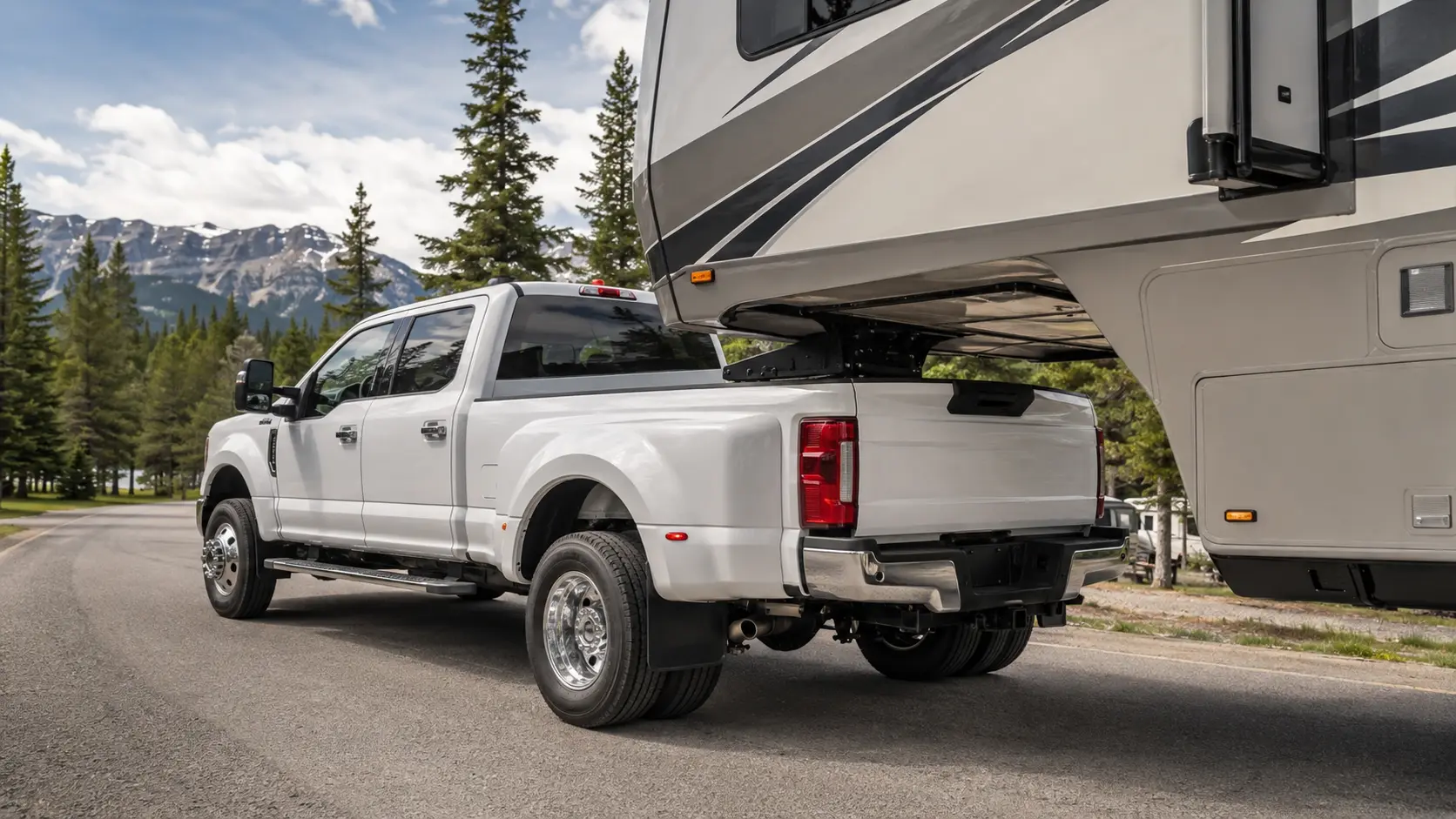
Choosing a tow vehicle requires more than comparing advertised maximums. Payload, hitch weight, axle ratings, configuration and real loaded trailer weight all matter.
Choose a truck class from the loaded job
Write down the heaviest realistic trip before comparing trucks: passengers, tools, trailer contents, water, fuel carried as cargo and the installed hitch. A boat taken out for an afternoon is a different purchasing problem from a horse trailer carrying animals and tack, or an equipment trailer whose machine and attachments change between jobs. Keep separate worksheets when one truck will serve several trailers. Passing the easiest trip does not settle the hardest one.
Use the following class table as a shortlist, not a capacity chart. A suitably configured smaller truck may satisfy one job while a poorly matched larger truck fails another. Compare exact candidate labels and manufacturer rows before deciding that moving up a badge has solved the problem.
| Candidate class | Reason to investigate | Question that can rule it out |
|---|---|---|
| Light-duty diesel pickup | Daily driving with a trailer that fits its verified limits | Do occupants, equipment and hitch load leave sufficient payload? |
| Single-rear-wheel HD pickup | A heavier towing job with conventional pickup dimensions | Does the loaded rear axle remain within its rating? |
| Dual-rear-wheel HD pickup | A job needing a different rear-axle and payload configuration | Do the exact ratings and parking/access requirements both work? |
| Completed chassis cab | A work body or vocational installation | What do the final-stage documents and completed vehicle weights establish? |
Use one rating row and keep every condition attached
Ford's 2026 pickup guide separates conventional towing from paired fifth-wheel and gooseneck columns. Its notes require both rear GAWR and GVWR compliance after hitch load, passengers and cargo are added. RAM Canada's 2026 matrix likewise keeps engine, transmission, axle, cab, box and drivetrain branches attached to its values. Chevrolet Canada's guide supplies separate pickup and chassis-cab information. These are different document structures; copy the complete applicable row rather than treating similarly placed numbers as equivalent.
For a used purchase, replace each current guide with the candidate’s exact model-year evidence. Record the document edition, row, footnotes and required package alongside the advertisement. If the seller claims a towing package, ask for build evidence identifying it. A receiver, wiring connector or dashboard tow button alone does not establish every factory requirement.
Work through payload and axle limits before trailer capacity
As an illustrative calculation only, suppose a candidate has 2,800 lb of labelled occupant-and-cargo capacity. If occupants total 600 lb, carried equipment totals 350 lb and an added hitch weighs 200 lb, the arithmetic leaves 1,650 lb for trailer-imposed load before any other uncounted additions. A measured 1,800-lb pin load would exceed that allowance even if the advertised trailer-weight rating looked generous. None of these invented example values rates a real truck.
The payload worksheet is only one check. Obtain loaded truck and axle weights and compare them with GVWR, each applicable GAWR and tire limits. Compare the complete combination with GCWR and the loaded trailer with its applicable trailer rating. Avoid counting tongue or pin weight twice in a combined-weight calculation: it transfers load onto the truck while remaining part of the trailer’s total mass. Ask the scale operator or a qualified towing professional to help establish a consistent weighing sequence.
Match the hitch and trailer before planning the route
A fifth-wheel plate and a gooseneck ball are different connection systems. Confirm the trailer coupling, truck installation, hitch rating and manufacturer-approved compatibility instead of assuming that an adapter makes all ratings interchangeable. Include bed clearance and turning clearance in the inspection. For a conventional trailer, identify the receiver, ball mount, ball and any required weight-distribution equipment as a complete combination.
Then discuss the actual route: sustained grades, frequent stops, narrow campgrounds, unpaved access and winter conditions can change the equipment and driving preparation needed. Verify the fitted brake controller and trailer brakes, tire condition and pressures, cooling-system condition and the manufacturer’s operating instructions. A higher engine output does not answer those questions. Do not stage a loaded road test until the combination has been verified for the proposed use.
Compare used tow vehicles on the same basis
Put each candidate into the same worksheet with the same occupants, equipment and loaded trailer. Keep original configuration evidence separate from later modifications. Photograph the truck labels, record tire sizes and obtain invoices for suspension, hitch, transmission and cooling work. Ask the inspecting shop what the modifications change and what remains unverified; do not treat a modification receipt as a revised manufacturer capacity label.
Budget separately for purchase, baseline maintenance, identified repairs and downtime. A recreational owner may value local service access and comfortable unloaded use; a working owner may need a backup vehicle when repairs interrupt a job. Request actual local quotes rather than choosing a truck from a generic annual-cost estimate. Use the towing calculator to organize inputs, then resolve missing evidence before purchase.
Build the shortlist from four separate questions
A towing shortlist becomes useful when it names the trailer type, loaded weight, hitch load and cargo carried by the truck. Start there, then select the class and configuration that can be checked against those inputs. Do not begin with the largest number in a brand advertisement.
A conventional trailer, fifth-wheel and gooseneck may have separate ratings even for the same truck. Keep those columns separate while comparing candidates. A payload calculation and loaded axle weights remain necessary after the correct towing row has been found.
| Question | Evidence to obtain |
|---|---|
| What does the trailer weigh ready to travel? | Loaded weight including normal equipment and supplies |
| What does it place on the truck? | Loaded tongue or pin weight |
| What else travels in the truck? | Occupants, cargo, hitch and permanent equipment |
| Which rating applies? | Model-year configuration row and truck/hitch/tire labels |
Make the test drive answer the shortlist’s questions
Ask the seller and inspecting shop to agree on a safe inspection scope. Evaluate normal driving, braking, steering, transmission behaviour and the installed towing equipment. Do not conduct a loaded test simply to discover whether a truck can tolerate an unverified combination.
For a truck that will haul professionally, include the maintenance and downtime plan in the buying comparison. For recreation, include passengers, supplies and the actual access at destinations. A useful towing guide should lead to a truck that fits both the load and the way it will be used between towing trips.
Where this category fits
Start with the trailer and loaded use case, then work backward to a truck with verified capacity and reasonable reserve.
Decisions that change the answer
The right class depends on the actual trailer, payload, passengers, cargo, frequency of use and how the truck must work when it is not towing.
- Identify conventional, fifth-wheel or gooseneck hitch type.
- Estimate loaded tongue or pin weight.
- Subtract passengers, cargo and hitch equipment from payload.
- Verify the exact truck's labels and model-year towing guide.
Research the exact configuration
Model badges describe a family of trucks. Payload and towing capacity can vary significantly within that family, so confirm the certification label, model-year guide and installed equipment on the exact vehicle.
Use a repeatable tow-vehicle shortlist
Record the trailer's loaded weight, loaded vertical hitch load and hitch type. For each candidate truck, collect the actual payload label, axle ratings, required towing-guide configuration and hitch limits. Put the same load assumptions against each candidate.
Consider the whole journey: cab occupancy, tools, bed cargo, fuel stops, parking and the terrain you expect. A truck selected around an empty trailer may leave insufficient carrying room once it is ready to travel.
Resolve missing information before relying on the result
If loaded pin or tongue weight is unknown, obtain a suitable measurement or a documented planning input and keep its uncertainty visible. Do not enter zero merely to make the payload calculation pass.
When the loaded combination is available, use an appropriate scale procedure to establish truck and trailer axle loads. Compare all applicable limits; a single total weight cannot show whether the rear axle or hitch is overloaded.
Build a trailer-first evidence packet
Record the trailer's identity, ratings, loaded total weight and connection load. Add the truck's crew, tools, hitch and other equipment. This creates a consistent requirement that can be taken across model and brand pages.
Keep unknown inputs visible. A missing loaded pin weight should lead to obtaining a measurement, not entering zero in a calculator. Reject a candidate that fails a known constraint and continue investigating one that only passes an initial estimate. Final suitability needs the completed truck/trailer configuration checked across all applicable limits.
| Before travelling to inspect | At the truck |
|---|---|
| Obtain label and hitch photos | Match the labels and installed hardware |
| Screen the planned load | Inspect axle, tire and hitch condition |
| Select the model-year guide | Confirm the exact configuration entry |
Evidence note: manufacturer documents establish the specific facts and applications cited. Buying workflows and cost scenarios are DieselTrucks.ca editorial guidance. These pages do not publish measured failure rates or confirm the condition, recall status or capacity of a particular truck.
General educational content for Canadian diesel-pickup research. Verify the exact truck, model year, certification labels, owner manual and manufacturer documentation, and obtain qualified mechanical or towing advice where appropriate.
Sources & Further Verification
Use the exact model year, VIN, truck labels and current manufacturer documentation when moving from general research to a purchase or towing decision.