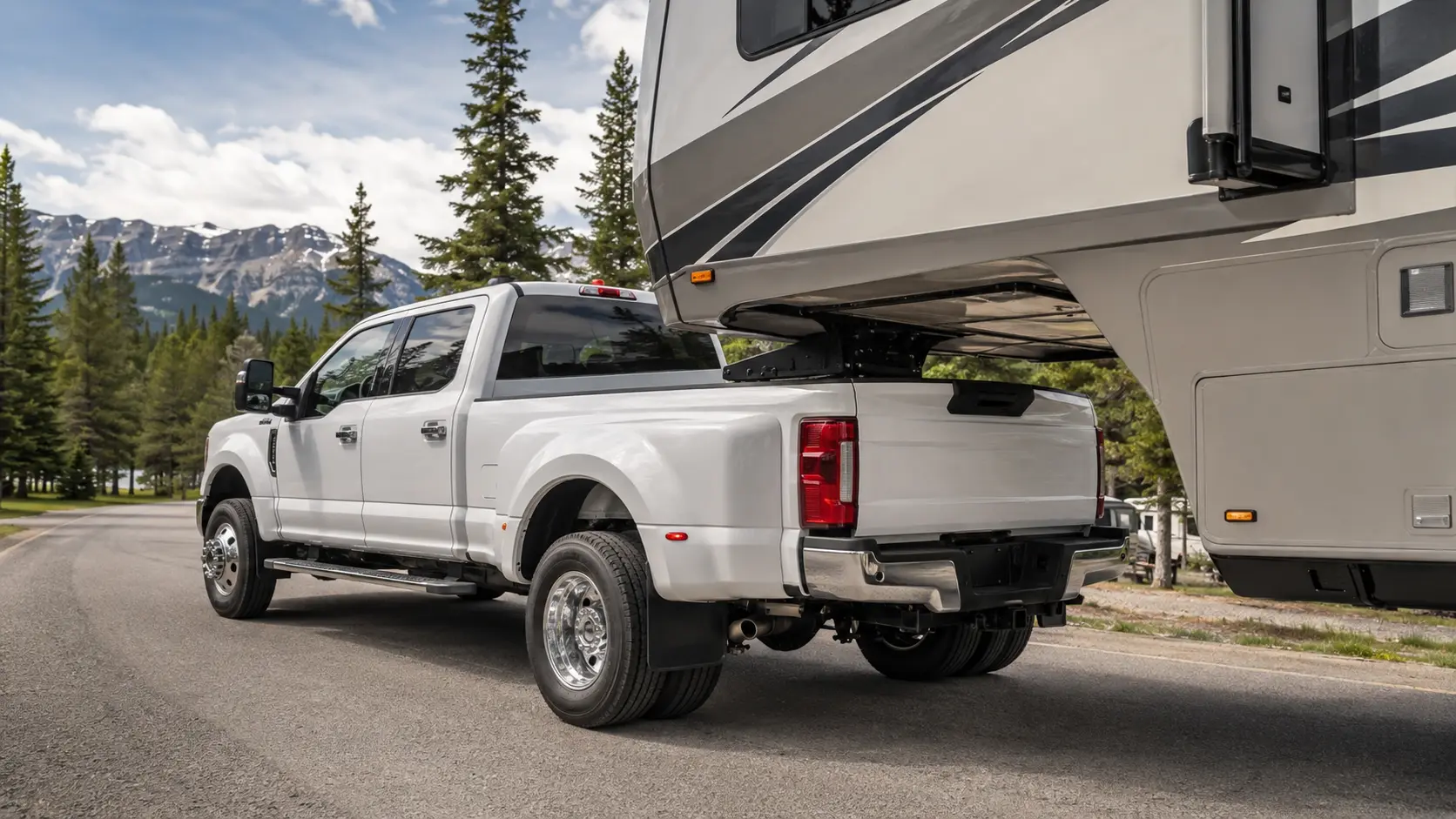
A diesel truck's GVWR, front and rear GAWR, and GCWR answer different questions. GVWR limits the loaded truck, each GAWR limits the load carried by that axle, and GCWR limits the loaded truck-and-trailer combination where the manufacturer specifies it. Passing one number does not prove the others pass. Use the exact truck's labels, the correct model-year configuration row, installed tire and hitch ratings, and measured travel-condition weights. Sources were checked on 9 September 2026.
Quick diesel truck weight-rating summary
GVWR is the maximum loaded weight assigned to the truck. GAWR is assigned separately to the front and rear axle systems. GCWR is the maximum loaded combination weight for the truck and trailer under the manufacturer's stated configuration and conditions. These are ratings, not estimates of what a candidate weighs today.
Payload is not another name for GVWR. It is the carrying allowance available on the truck under the applicable manufacturer definition, and people, tools, cargo, accessories, hitch hardware, tongue weight and pin weight all use it. A trailer maximum is also separate: it belongs to an exact configuration and hitch table, and the truck may meet it only when every truck-side and combination limit also passes.
Keep rating, measured weight and legal allowance separate
Do not substitute one column for another. Registration, road and licence rules can be lower or otherwise different from manufacturer ratings, while registration at a higher number does not increase a truck's GVWR, GAWR, tire, hitch or GCWR.
| Term | What it answers | Where to verify it | What it does not prove |
|---|---|---|---|
| GVWR | How heavy the loaded truck may be under its manufacturer rating | Certification label and correct manufacturer documents | Payload remaining, axle balance or trailer allowance |
| Front or rear GAWR | How much loaded weight may be carried by that axle system | Certification label, with tire/wheel/component checks | That total truck weight is below GVWR |
| GCWR | How heavy the loaded truck and loaded trailer may be together for the specified configuration | Exact model-year tow guide/build row | A permissible trailer maximum by subtraction alone |
| Actual axle weight | What one axle carries during a particular scale measurement | Certified or suitable public scale result | Future loading or the rating itself |
| Actual combined weight | What the complete combination weighs during measurement | Scale tickets for the loaded combination | That hitch, payload or axle limits pass |
| Registered or legal weight | What the responsible jurisdiction authorizes for operation | Current provincial/territorial registration and rules | A manufacturer rating increase |
GVWR governs the loaded truck, including trailer load carried by it
Start with the truck ready to travel: fuel, driver, passengers, tools, bed cargo, accessories and hitch equipment are already truck weight. Conventional tongue weight or fifth-wheel/gooseneck pin weight is then carried by the truck as well. Compare the resulting loaded truck weight with GVWR, but do not stop there.
The same total weight can be distributed differently. A rear-heavy fifth-wheel setup may remain below GVWR while exceeding rear GAWR, a rear tire rating or the in-bed hitch limit. A front accessory, plow or redistributed cargo can create a front-axle issue. Record both axle weights so a passing gross truck number does not conceal a failing axle.
GAWR is an axle-system check, not spare payload
Front and rear GAWR are separate ceilings. Adding the two ratings together does not create an allowable truck weight above GVWR, and subtracting an empty axle weight from GAWR is not a complete payload calculation. Truck GVWR, axle ratings, installed tire and wheel ratings, suspension and hitch constraints still apply independently.
Load placement matters. Cargo or pin load behind the rear axle can add rear-axle weight while unloading some front-axle weight; a weight-distributing hitch changes load distribution but must be selected and adjusted under the truck, hitch and trailer manufacturers' instructions. Never use scale arithmetic as permission to exceed a component rating or to improvise a hitch setup.
GCWR is not the same as towing capacity
A common planning subtraction is GCWR minus actual loaded truck weight. The result is only a combined-weight ceiling under the assumptions used; it is not automatically the truck's allowable trailer weight. The manufacturer may publish a lower configuration-specific trailer maximum, and payload, GVWR, rear GAWR, tires, hitch or trailer ratings may govern first.
Use the exact row. Ford's reviewed Super Duty guide separates model, engine, axle ratio, GCWR, cab, drive and wheelbase conditions. RAM's chart likewise changes engine, transmission, axle ratio, cab, box, drive, GVWR and curb-weight inputs. Chevrolet Canada's guide uses separate conventional and fifth-wheel/gooseneck matrices. A maximum from one row cannot be transferred to a visually similar truck.
Conventional, fifth-wheel and gooseneck loads reach the truck differently
Conventional tongue load is applied through a receiver behind the rear axle. Fifth-wheel and gooseneck pin or vertical load is carried through an in-bed coupling location. The hitch style changes load placement and which manufacturer table applies; it does not remove payload or axle checks.
Ford's 2024 guide uses 10% conventional tongue load and 15% fifth-wheel/gooseneck load in its published maximum calculations. Those are source-specific calculation assumptions, not a universal prediction for every loaded trailer. Use the actual trailer's loaded weight and measured or properly established tongue/pin load, then check the truck, hitch and trailer instructions.
A worked worksheet shows why the lowest limit governs
This is a method illustration, not a rating for any Ford, RAM, Chevrolet or GMC. A result can pass GVWR and GCWR while failing rear GAWR, tire or hitch capacity. Conversely, apparent payload reserve does not authorize a trailer beyond the manufacturer row or the trailer's own ratings.
| Step | Example planning value | Interpretation |
|---|---|---|
| Truck GVWR | 11,500 lb | Manufacturer truck ceiling for this hypothetical example |
| Measured loaded truck before coupling | 8,700 lb | Includes occupants, fuel, tools, cargo and installed hitch |
| Remaining to GVWR before trailer vertical load | 2,800 lb | Arithmetic only; rear GAWR and payload-label context still need checking |
| Measured loaded trailer | 14,000 lb | Actual travel-condition trailer in this hypothetical example |
| Measured pin load added to truck | 2,500 lb | Must fit GVWR, rear GAWR, tires and hitch |
| Coupled loaded truck | 11,200 lb | 300 lb below GVWR, but no conclusion until axle/component checks pass |
| Loaded combination | 22,700 lb | Compare with exact configuration GCWR and published trailer maximum |
Configuration choices can change several limits at once
Diesel engine, 4x4 hardware, larger cab, trim equipment, service body, auxiliary tank and hitch hardware can add truck weight before passengers or trailer load are counted. DRW equipment may provide a different rear-axle and tire context than SRW, but the badge alone does not supply its numbers. Pickup and chassis-cab documents must also remain separate.
Compare candidates with a configuration worksheet: model year, market, model, pickup or chassis cab, cab, bed/wheelbase, engine, transmission, axle ratio, 4x2/4x4, SRW/DRW, GVWR package, tire specification and hitch type. Then attach the label photos, manufacturer row and scale tickets that support the choice.
Use a repeatable scale process
Load the truck and trailer as they will travel, including people, fuel, water, tools and cargo. Record scale tickets that let you identify the truck's front axle, rear axle, total loaded truck and loaded combination. Depending on the hitch and question, more than one controlled weighing may be required; use a qualified scale operator or towing professional when the sequence is uncertain.
Keep dates and loading notes with each ticket. A scale result is a snapshot, so moving cargo, adding passengers, changing hitch setup or filling tanks can change it. Do not assume an empty-truck curb value from a brochure represents the actual modified used truck.
Used-truck and Canadian verification checklist
Photograph the complete certification and tire/loading labels and match the VIN to the ownership documents. Obtain the original build/configuration record where available, identify axle and tire changes, record installed hitch labels, and use the correct market/model-year tow guide. Treat unreadable or replaced labels, undocumented modifications and conflicting records as unresolved—not as zero.
For operation in Canada, separately confirm registration, licence, inspection, dimension and weight requirements with the responsible province or territory. U.S. manufacturer examples on this page explain row selection but do not establish Canadian VIN status. No legal allowance, VIN configuration or payload is inferred from a model badge.
GVWR, GAWR and GCWR questions
Can I add front and rear GAWR to find GVWR? No. Each axle rating and the truck's GVWR are independent limits; adding axle ratings does not authorize a heavier truck.
Can I subtract curb weight from GVWR to get my exact payload? Not reliably for a used or modified candidate. Use the exact label/manufacturer definition and actual travel-condition weights; curb definitions and installed equipment can differ.
Does GCWR minus truck weight equal towing capacity? It gives a combined-weight arithmetic ceiling, not automatic permission. The published trailer maximum and all truck, axle, tire, hitch and trailer limits still apply.
Can I tow at the advertised maximum if the truck is below GVWR? Not unless rear/front GAWR, tires, hitch, payload, GCWR, exact tow-row conditions and trailer limits also pass.
Does a higher registered weight raise GVWR? No. Administrative registration does not increase manufacturer or component ratings.
Which number usually limits a diesel fifth-wheel setup? There is no universal answer. Loaded pin weight, rear GAWR, payload, tires, hitch, GVWR, GCWR or the trailer row may govern depending on the exact combination.
The core ratings
GVWR is the maximum permitted loaded vehicle weight stated by the manufacturer. Front and rear GAWR apply to their respective axles. GCWR addresses the loaded truck and trailer combination where specified.
- Curb weight: the vehicle's baseline weight under the manufacturer's definition.
- Payload: occupants, cargo, accessories and vertical trailer load carried by the truck.
- Trailer rating: configuration-specific permitted trailer weight under defined conditions.
How the limits interact
Passengers, tools, bed cargo, hitch equipment and tongue or pin weight add to the truck and can reach payload, GVWR or rear-axle limits before the advertised trailer maximum.
Verify the exact combination
Use the certification labels, owner manual, model-year towing guide, hitch documentation and actual scale weights where appropriate. The lowest applicable limit governs the plan.
Why axle ratings cannot simply be added
Front and rear GAWR are individual axle limits. Their sum is not a replacement for GVWR. The loaded truck must satisfy GVWR and each axle limit at the same time, along with tire and wheel limits.
Likewise, GCWR minus the truck's actual loaded weight is only one combination check. It does not override the manufacturer's trailer limit, hitch rating or other restrictions for the configuration.
Keep ratings and scale readings in separate columns
A rating states a limit; a scale reading describes a load on a particular day. Record the source of each rating, the units used, who or what was aboard at weighing and whether the trailer was attached.
If the planned occupants, cargo or equipment change, revisit the calculation. Use a consistent loaded setup and the manufacturer or scale operator's procedure when comparing axle readings.
Run separate checks instead of one subtraction
GVWR limits the loaded truck, GAWR applies separately to each axle, and GCWR applies to the loaded combination in the manufacturer's specified configuration. Passing one check cannot cancel a failure in another. Use the same loaded state throughout your worksheet.
| Check | Compare |
|---|---|
| Truck gross | Front plus rear truck axle weights against GVWR |
| Front and rear | Each actual axle weight against its own GAWR |
| Combination | All truck and trailer axle weights against applicable GCWR |
| Trailer and connection | Loaded trailer and connection loads against applicable limits |
Avoid counting transferred load twice
With a trailer connected, the truck axle weights already include the load transferred to the truck. Add the trailer axle weights to obtain combination weight. Do not then add pin or tongue weight again. Separately identify the trailer's total weight for its own rating checks and the manufacturer's trailer-weight limit.
Evidence note: manufacturer documents establish the specific facts and applications cited. Buying workflows and cost scenarios are DieselTrucks.ca editorial guidance. These pages do not publish measured failure rates or confirm the condition, recall status or capacity of a particular truck.
Verify Before You Tow
Use the exact truck's labels and current manufacturer documentation. Do not transfer a model-family maximum to an unknown configuration.
General educational content for Canadian diesel-pickup research. Verify the exact truck, model year, certification labels, owner manual and manufacturer documentation, and obtain qualified mechanical or towing advice where appropriate.
Sources & Further Verification
Use the exact model year, VIN, truck labels and current manufacturer documentation when moving from general research to a purchase or towing decision.
- Ford towing guides and archive
- Ford 2024 Super Duty pickup towing guide — configuration tables and load limits
- Chevrolet Canada 2026 Trailering Guide — original Canadian conventional and in-bed configuration tables
- GM manuals and guides — model-year owner-literature lookup
- RAM 2024 Heavy Duty towing and powertrain chart — original manufacturer configuration matrix
- RAM towing terms