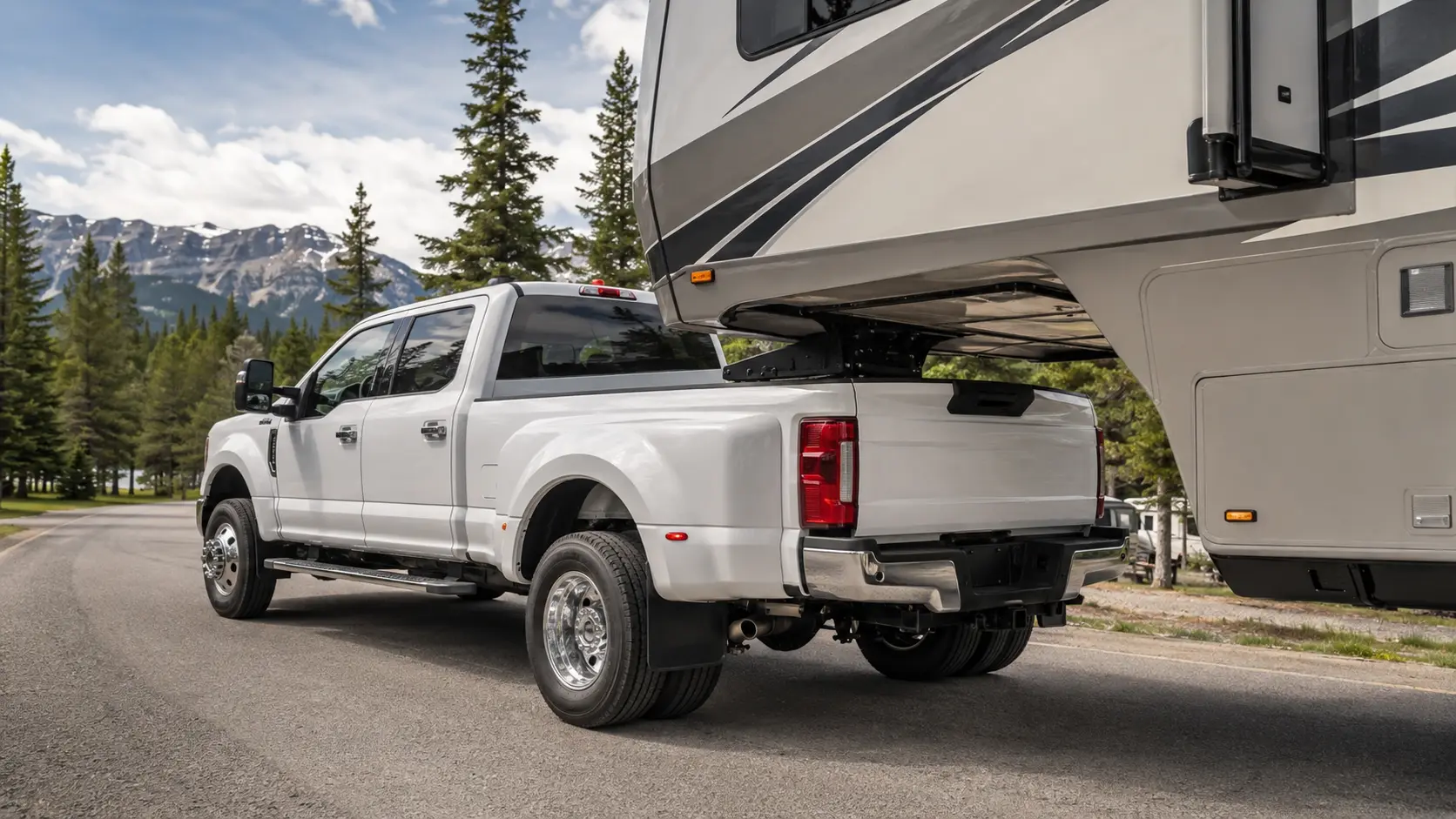
Diesel truck gooseneck towing is a load-and-workflow decision before it is an engine decision. Equipment, livestock, agricultural and commercial trailers can change weight distribution from one trip to the next, so begin with the heaviest ordinary loaded case and the way it will be operated. Diesel torque and grade-control features may suit repeated heavy work, but they do not create payload, rear-axle, tire, wheel or hitch capacity. Match the exact truck's market, model year, cab, bed, drive, SRW or DRW layout, engine/output, axle, GVWR, GCWR and packages to the manufacturer's gooseneck evidence; then close loaded vertical load, both GAWR values, components, installation, coupling, safety chains, brakes, clearance and current operating requirements. This page owns diesel-truck selection and recurring-work intent. The separate gooseneck capability worksheet answers whether one known combination passes, while the hitch comparison explains fifth-wheel versus gooseneck hardware. No Canadian VIN, reliability rank, failure rate, inventory, seller, dealer count, price, financing or offer is inferred. The protected /trucks marketplace remains the commercial authority.
Define the loaded job before comparing diesel trucks
Record trailer VIN and type, GVWR, representative loaded weight, loaded vertical load at the ball, trailer axle and tire ratings, deck or body dimensions, cargo positions, tiedown plan, water or auxiliary fuel, toolboxes and added equipment. For livestock, account for the intended animal load and movement within the trailer. For equipment, document the machine, attachments and placement that produce the most demanding ordinary case rather than relying on an empty trailer figure.
Add route, terrain, surface, grades, frequency, seasonal conditions, passengers, bed cargo, tools and loading/unloading routine. A truck that passes a highway scale case may still be a poor fit if the job requires tight farm turns, soft-site access, frequent uncoupling or bed space the hitch occupies. Keep work-fit questions separate from ratings: convenience cannot rescue an overload, and a numeric pass cannot prove the operating plan is practical.
| Job-file field | Evidence to collect | Reason it can change the truck |
|---|---|---|
| Trailer and body | VIN, type, GVWR, dimensions and modifications | Identifies the applicable load and coupling system |
| Travel load | Scale weight, cargo manifest and placement | Empty weight does not describe the job |
| Vertical load | Representative ball-load measurement or planning range | Consumes truck payload and rear-axle reserve |
| People and truck cargo | Occupants, tools, fuel, racks and bed equipment | Must be carried with hitch and trailer load |
| Route and site | Grades, surface, turning, access and frequency | Changes operating fit, not manufacturer ratings |
| Loading cycle | How cargo or livestock enters, moves and leaves | Can change distribution between trips |
Use eight independent gates for the shortlist
Every candidate must pass the same documented job. Missing evidence produces an unresolved candidate, not a favourable assumption. Use the lowest applicable truck, trailer, ball, coupler, hitch, chain-anchor, tire, wheel or other component limit. Do not average neighbouring source rows, fill a dash, move a rating across markets or use a maximum from another class because the diesel engine is shared.
Run the gates in a repeatable order so a high trailer number cannot hide the practical limiter. Carried load and rear GAWR often deserve attention early because the in-bed vertical force, hitch equipment, people and tools all reach the truck before ownership preferences are considered.
| Gate | Question | Evidence |
|---|---|---|
| Identity | Which complete pickup configuration is present? | VIN/build evidence, physical equipment and labels |
| Loaded job | What do trailer and cargo weigh in ordinary service? | Manifest, loading record and compatible scale readings |
| Carried load | Do people, cargo, hitch and vertical load fit? | Vehicle loading label and itemized worksheet |
| Truck ratings | Do GVWR and front/rear GAWR pass? | Certification label and loaded axle measurements |
| Components | Do tires, wheels, ball, hitch, coupler and anchors pass? | Markings, instructions and installation records |
| Exact gooseneck evidence | Does the selected hitch-method cell fit? | Original guide, headers, notes, packages and source market |
| Combination | Does truck plus trailer remain within GCWR? | Exact GCWR branch and compatible scale state |
| Operation | Do coupling, chains, brakes, clearance and rules pass? | Inspection, instructions and current official requirements |
Diesel duty fit comes after the weight case
Diesel torque, transmission behaviour and model-specific exhaust-braking strategies can support repeated grade work. Evaluate those features against trip frequency, speed, terrain, service access, idling and cold-weather routine. They remain operating characteristics, not permission to exceed trailer, payload, axle, tire, wheel or hitch limits. Trailer brakes and maintained service brakes remain necessary even when an engine-braking feature is present.
The diesel powertrain and its equipment also add mass. Compare the actual vehicle loading labels or compatible scale weights for equivalent trucks instead of assuming the diesel has more payload. Keep standard- and high-output diesel branches, transmissions, axles, GCWR values and pickup/chassis-cab calibrations separate. A model-family torque number cannot identify one truck's gooseneck rating or condition.
Manufacturer source structures prevent a false leaderboard
Ford's Super Duty selectors publish separate conventional, fifth-wheel and gooseneck matrices, allowing an exact gooseneck cell to be selected. RAM Heavy Duty matrices publish one maximum-trailer value for each configuration row and separate equipment notes; they do not supply three hitch-specific capacities. Chevrolet Canada's detailed matrix can combine fifth-wheel and gooseneck in one in-bed field, while exact-year U.S. selectors may split a specific top branch. Preserve the format the manufacturer actually publishes.
Retained 2026 examples illustrate the difference without ranking brands. Ford F-250 and F-350 gooseneck maxima are 23,000 and 38,000 lb on qualifying configurations. RAM 2500 and 3500 publish 20,000- and 36,610-lb maximum-trailer cells that are not relabelled as gooseneck-specific. A Chevrolet/GMC 3500HD Max Trailering branch can reach 36,000 lb with a gooseneck while its fifth-wheel result remains 32,000 lb. None applies to a different cab, year, market or unseen truck.
| 2026 source example | Published result or format | Boundary retained |
|---|---|---|
| Ford F-250 | 23,000-lb gooseneck maximum | 22,300 fifth-wheel and 22,000 conventional maxima remain separate |
| Ford F-350 | 38,000-lb gooseneck maximum | 35,000 fifth-wheel; adjacent 40,000-lb F-450 data excluded |
| RAM 2500 | 20,000-lb maximum trailer value | Single result column plus hitch-equipment notes |
| RAM 3500 | 36,610-lb maximum trailer value | Exact HO Cummins DRW cell; not relabelled gooseneck |
| Chevrolet/GMC 3500HD | 36,000-lb gooseneck package branch | Regular Cab long-bed 2WD DRW Duramax; fifth-wheel 32,000 lb |
| Chevrolet Canada matrix | Combined fifth-wheel/gooseneck field | Combined Canadian cells are not silently separated |
Choose 250/2500 or 350/3500 from vertical load and reserve
A 250/2500 diesel may publish a strong trailer result but have less remaining occupant-and-cargo or rear-axle reserve once hitch structure, passengers, tools and loaded vertical force are aboard. A 350/3500 can provide different GVWR, axle, tire, wheel, SRW and DRW branches, yet its badge is still not a load value. Compare the physical labels, exact source cells and loaded measurements for the same job.
Select the smallest configuration only after it closes every gate with the intended ordinary load. If the result depends on leaving essential tools behind, running at an estimate's low edge or changing cargo placement every trip, test a different configuration or trailer. Do not transfer a 350/3500 value to a 250/2500, or an F-450 value to an F-350, because the engine or cab appears similar.
Plan vertical load conservatively and replace the estimate
Ford's 2026 Super Duty guide uses 15 percent of loaded trailer weight as a planning convention for gooseneck and fifth-wheel towing. Chevrolet Canada's 2026 guide uses a 15–25 percent gooseneck/fifth-wheel kingpin range. These are manufacturer-specific planning conventions, not competing measurements of the same equipment and not a universal approval band.
For a hypothetical 20,000-lb loaded gooseneck, 15 percent is 3,000 lb and the Chevrolet 15–25 percent sensitivity range is 3,000–5,000 lb. Equipment or livestock position can move the real result, so use the range to screen truck classes and then obtain an appropriate loaded measurement. Never choose the low percentage simply to make a candidate pass.
| Planning basis | 20,000-lb example | Use |
|---|---|---|
| Ford 15% convention | 3,000 lb | Preliminary truck-load input |
| Chevrolet Canada 15% low end | 3,000 lb | Bottom of that source's planning range |
| Chevrolet Canada 25% high end | 5,000 lb | Sensitivity case that can change configuration |
| Representative loaded measurement | Use measured value | Valid for the documented cargo state only |
Calculate carried load and measure both axles
Suppose a candidate's vehicle-specific occupant-and-cargo allowance is 4,200 lb. Driver, passengers, tools, auxiliary fuel, bed equipment and installed gooseneck hardware consume 1,150 lb, leaving 3,050 lb. If the representative loaded trailer transfers 3,600 lb to the truck, the case is 550 lb over that allowance. It fails before the model-family gooseneck maximum or diesel performance is considered.
Replace every example input with the actual truck and job. A positive remainder would not prove front GAWR, rear GAWR, tire or wheel compliance. Obtain compatible axle readings with the truck in working condition and the loaded trailer coupled. Compare each physical value separately; a level stance, air springs or upgraded shocks are not measurements and do not revise the certification label.
| Worked job budget | Hypothetical value | Result |
|---|---|---|
| Vehicle-specific occupant/cargo allowance | 4,200 lb | Starting truck input |
| People, tools, fuel, equipment and hitch | −1,150 lb | 3,050 lb remains |
| Representative loaded vertical force | −3,600 lb | 550 lb over the allowance |
| Decision | Fail | Change truck, trailer or permitted load before work |
Select SRW or DRW from the same measured case
A DRW truck can provide a different rear-axle, tire and wheel configuration and may add reserve or lateral support for a demanding vertical load. An SRW truck can preserve width, manoeuvrability and access. Neither label answers the question alone. Compare exact GVWR, rear GAWR, tire/wheel ratings, gooseneck cell and measured axle loads under the same people, tools and trailer case.
Include gate openings, farm lanes, loading areas, parking, six-tire upkeep, matched tire condition and winter access in the operational comparison. Those considerations follow capacity verification. A wide dually that cannot reach the work site may be impractical, while a convenient SRW that exceeds rear GAWR is not an acceptable substitute.
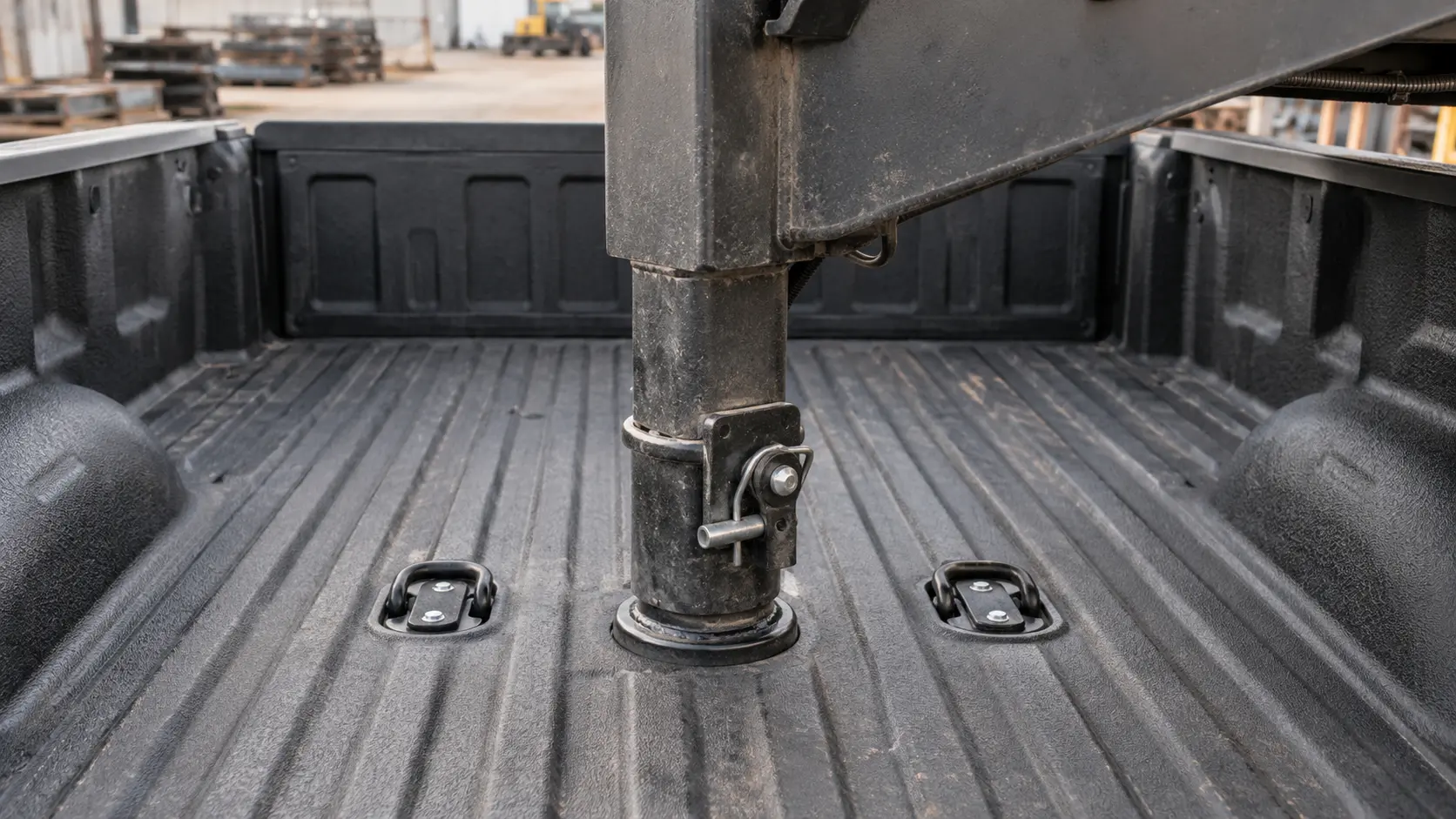
Verify hitch installation, coupling, chains and clearance
Identify the exact truck-specific under-bed structure, ball, retention mechanism, fasteners, safety-chain anchors and installation revision. Match the ball's marked size and capacity to the trailer coupler and verify the coupler's own adjustment, latch and lock instructions. CURT's manufacturer overview illustrates why a generic installation claim is insufficient: ball-hole location, under-bed access, crossmembers, heat shields, frame brackets and anchor work can be vehicle-specific.
Inspect corrosion, loose or distorted components, bed or frame damage, wiring, brake connections and interference with exhaust, fuel, brake or upfit parts. Measure trailer neck, deck, tailgate, bed, toolbox, landing gear, cab and rear-corner clearance through expected articulation and uneven sites. Verify safety-chain assemblies, hooks, anchors and attachment method against the installed products and current jurisdiction.
| System item | Evidence | Shortcut to reject |
|---|---|---|
| Under-bed hitch | Truck-specific part, brackets, fasteners and installation record | A hole in the bed proves rated structure |
| Ball and retention | Markings, correct seating and locked-position check | A compatible-looking removable ball |
| Trailer coupler | Marked size/rating, adjustment and latch instructions | Unknown adapter or incomplete latch |
| Safety chains | Rated chains, hooks, anchors and required attachment | Decorative loops or unknown hardware |
| Clearance | Measured articulated working geometry | One straight, level parked check |
| Brakes and electrical | Controller, connector, lighting and breakaway tests | Physical coupling completes the system |
Close GCWR, trailer systems and current operating rules
GCWR limits the exact loaded truck and trailer combination. Use compatible scale measurements and avoid counting vertical load twice when interpreting truck and trailer readings. GCWR minus actual loaded-truck weight can screen remaining combination capacity, but it does not replace the manufacturer's lower gooseneck rating, GVWR, either GAWR, tire, wheel, ball, coupler or hitch limits.
Confirm trailer GVWR, axles, tires, cargo securement, brakes, breakaway equipment and lighting. For livestock or shifting loads, follow trailer and operating guidance for distribution and handling rather than treating one static ticket as permanent. Confirm provincial, route, registration, licence, safety-equipment and commercial requirements through current official sources. This guide is not legal approval for an operation.
Use a documented Canadian selection sequence
First define the heaviest ordinary job and loading cycle. Second estimate a conservative vertical-load range and carried-load case. Third shortlist truck classes and SRW/DRW configurations. Fourth identify each complete truck and retrieve original Canadian model-year material where available, clearly labelling U.S. cross-checks. Fifth select the exact gooseneck evidence and every note. Sixth inspect truck, trailer, hitch, coupler, chains, tires, wheels, brakes and geometry. Seventh calculate carried load and obtain compatible axle and combined measurements. Eighth verify current VIN campaigns and operating rules.
Return pass, fail or unresolved for the stated job. Pass means every documented boundary and fit check closes, not that every future load is approved. Fail means one known limit is exceeded. Unresolved means a source row, label, component rating, installation record, measurement or rule is missing. Use the capability worksheet to close one chosen combination and recalculate whenever cargo, livestock, equipment, people, hitch, trailer or truck changes.
Evidence note: manufacturer documents establish the specific facts and applications cited. Buying workflows and cost scenarios are DieselTrucks.ca editorial guidance. These pages do not publish measured failure rates or confirm the condition, recall status or capacity of a particular truck.
General educational content for Canadian diesel-pickup research. Verify the exact truck, model year, certification labels, owner manual and manufacturer documentation, and obtain qualified mechanical or towing advice where appropriate.
Sources & Further Verification
Use the exact model year, VIN, truck labels and current manufacturer documentation when moving from general research to a purchase or towing decision.
- Chevrolet Canada — 2026 Trailering Guide
- Ford Canada — 2024 RV and Trailer Towing Guide
- Ford Canada — 2026 Super Duty RV and Trailer Towing Guide
- Ford — 2026 Super Duty Pickup Towing Guide
- RAM Canada — 2026 Heavy Duty Payload and Towing Matrix
- RAM — 2026 Heavy Duty Payload and Towing Matrix
- RAM Canada — towing preparation and weight terms
- Ford Canada — towing guides
- GM Owner Centre — manuals and guides
- Mopar — owner manuals
- CURT — gooseneck hitch installation overview
- Ford towing guides and definitions
- RAM towing terms