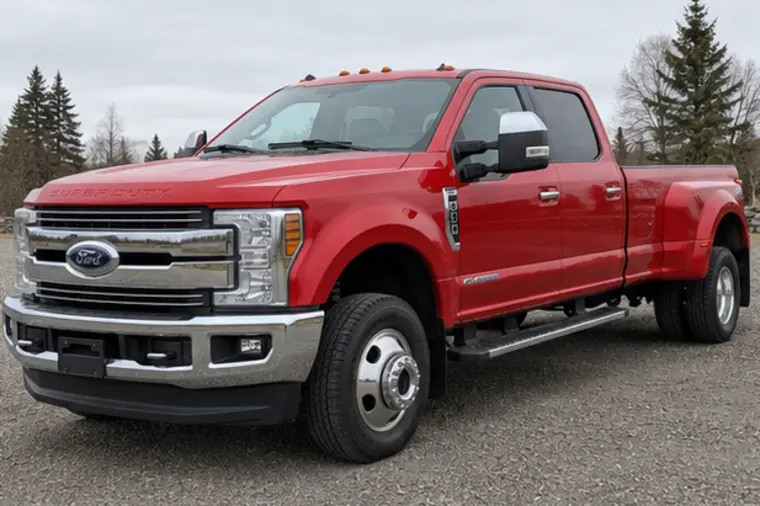
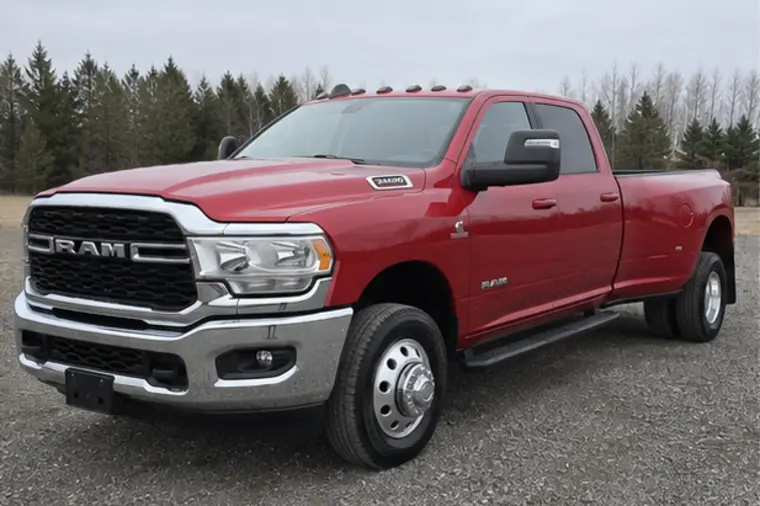
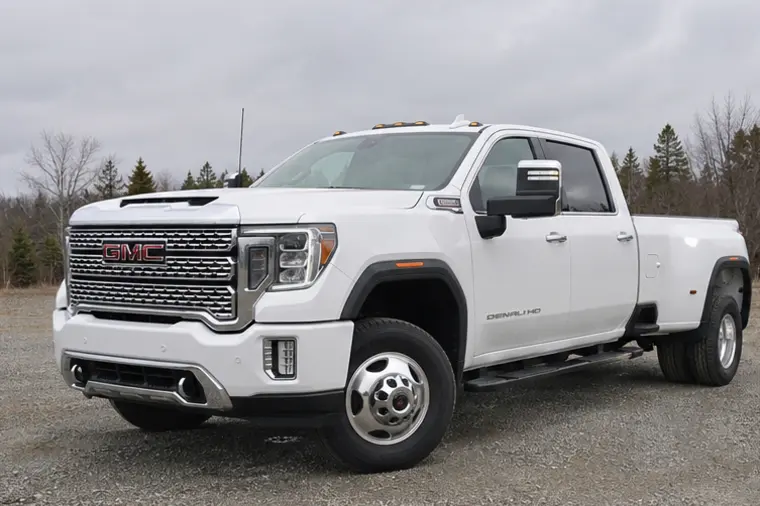
A dually diesel truck uses dual rear wheels, but the extra tire positions do not create one universal payload or towing number. DRW changes the rear tire footprint and is offered in specific pickup and chassis-cab configurations; engine, transmission, cab, bed or wheelbase, 2WD or 4WD, axle ratio, GVWR package, GCWR and hitch type still select the rating row. Start with the real load and compare exact manufacturer-supported configurations. Sources were checked on 9 September 2026.
Quick dually diesel decision
A diesel dually is a candidate when verified loaded pin, tongue, cargo or body weight requires a factory DRW configuration or when the buyer deliberately values the wider rear stance for the intended work. It is not automatically necessary because a trailer is large, and it is not automatically sufficient because the truck has four rear tires.
Write down the loaded trailer, actual vertical load, occupants, hitch, tools, body or camper, cargo and route conditions first. Then compare the candidate's payload label, GVWR, front and rear GAWR, installed tires and wheels, hitch, GCWR and exact trailer row. Choose the configuration with a documented reserve that fits the job and the places the truck must enter.
DRW describes the rear-wheel arrangement, not the complete truck
“Dually” is common shorthand for dual rear wheels. The rear axle has two tire positions on each side, normally with a wider rear body on a pickup. That identifies a wheel arrangement, not an engine, transmission, axle ratio, spring package, certified weight or trailer rating. Gas and diesel versions can share the body style, while a model family may include both SRW and DRW rows.
Keep pickup and chassis-cab evidence separate. A completed chassis cab may carry a service body, flat deck, dump body or other upfit and requires its final-stage certification and current weight. A pickup-box dually cannot donate its rating row to an incomplete or completed chassis, even when the badges look similar.
What DRW can change—and what it cannot prove
DRW does not raise a candidate's certified numbers after the fact. Adding wheels, springs, airbags, a hitch or different gears cannot by itself convert an SRW VIN into the manufacturer's DRW rating row. Modifications may also change service, insurance, inspection and component requirements.
| Question | What DRW can change in a factory configuration | Evidence still required |
|---|---|---|
| Rear carried load | Rear axle, wheel and tire package may be specified for a higher load than an SRW sibling | Exact rear GAWR, installed tire/wheel ratings, payload label and scale weight |
| Trailer selection | Manufacturer may pair DRW with different GCWR, axle ratio, package and in-bed trailer rows | Complete model-year row, footnotes and hitch type |
| Load response | Wider paired rear tires change the support footprint and may affect how the truck responds to a heavy body or pin load | Proper loading, inflation, component condition and road test |
| Daily use | Wider rear fenders and two additional tires change clearance, parking and service work | Measured access, local route, tire availability and ownership budget |
| Legal operation | Some configurations may fall into different registered or licensed weight contexts | Current province/territory rules and actual registration |
Representative manufacturer rows show why configuration matters
RAM's 2024 Heavy Duty chart reaches 37,090 lb only in identified 4x2 Regular Cab, 8-foot-box DRW Tradesman rows with the High-Output 6.7L Cummins, Aisin six-speed, 4.10 axle and 45,000-lb GCWR. Its standard-output Cummins/68RFE rows have a lower 22,660-lb reviewed ceiling. DRW alone does not bridge that difference.
GMC's 2026 Sierra 3500 HD matrix assigns 36,000 lb specifically to a gooseneck-equipped Duramax Regular Cab, long-bed, 2WD DRW truck with 43,900-lb GCWR and the Max Trailering Package; the same row caps fifth-wheel towing at 32,000 lb. Chevrolet Canada's 2026 guide publishes a 36,000-lb family headline while its detailed highest populated 3500HD cell is 35,500 lb, an unresolved discrepancy retained in the dedicated guide. These are source examples, not a cross-brand ranking.
Payload and rear GAWR often decide before the headline maximum
A fifth-wheel or gooseneck places substantial vertical load in the bed area. Add that real pin or vertical load to occupants, cargo, hitch hardware, accessories and any auxiliary tank or toolbox. Compare the result with the truck's occupant-and-cargo statement and loaded GVWR, then examine front and rear axle scale weights separately.
Four rear tires do not make rear GAWR spare payload that can be moved above GVWR. Nor does a positive payload subtraction prove the rear tires, wheels or hitch pass. Use the installed tire size, load index/rating and inflation instructions, keep paired tires correctly specified and maintained, and resolve mixed or damaged tire evidence before heavy use.
Fifth-wheel, gooseneck and conventional limits remain separate
DRW diesel pickups are often shortlisted for in-bed trailers, but coupling type still matters. A fifth-wheel kingpin and a gooseneck ball use different hardware and manufacturer table columns. GMC's cited highest row itself demonstrates that the gooseneck and fifth-wheel maxima can differ on the same stated truck configuration.
A conventional receiver trailer applies tongue load behind the rear axle and uses the conventional table and receiver conditions. Do not move an in-bed maximum to a receiver trailer. Verify hitch labels, installation, bed or frame compatibility, ball or kingpin equipment, trailer ratings, brakes and the actual loaded vertical load under the relevant manuals.
Choose cab, bed, drive and axle ratio together
Regular Cab, Crew Cab and other body choices change wheelbase, curb/payload context and populated tow-table cells. Long beds can provide different in-bed hitch clearance and are common in the highest DRW rows, but a long bed does not independently create a rating. Four-wheel drive, trim equipment and diesel hardware also add or redistribute weight.
Compare exact rows side by side: market and model year; pickup or chassis cab; engine/output version; transmission; cab; bed or wheelbase; 2WD/4WD; SRW/DRW; axle ratio; GVWR and GCWR; package; tires/wheels; and hitch type. A dash or blank cell means the manufacturer did not publish that combination in the reviewed table—never interpolate it.
Daily-use and access tradeoffs are part of fit
Measure the truck's actual rear width and compare it with the buyer's garage opening, parking spaces, drive-throughs, ferry or park constraints, job-site gates and storage route. Include mirror width and overall length separately. Confirm winter tire availability and service access for the exact wheel and tire specification before purchase.
Budget for six tire positions, inspection of the paired rear assemblies and the time needed to maintain correct condition and pressure. A dually can be entirely practical for a defined workload, but its wider rear body and additional tire positions remain present on every unloaded commute. Do not treat “daily-drivable” as universal; test the exact candidate on the real route.
Used dually inspection priorities
Photograph the certification, tire/loading, payload and any final-stage labels. Match the VIN and build record, then verify axle code, original wheel arrangement, tire sizes and ratings, spacer or wheel changes, suspension modifications, hitch installation and body or camper history. Inspect rear fenders and inner/outer wheels for impact or overload evidence.
Paired rear tires need compatible specification and condition. Look for uneven wear, debris damage between tires, rubbing, incorrect spacing, loose or damaged hardware, leaks and corrosion. Have a qualified shop inspect wheel mounting and torque procedures, brakes, bearings, axle, suspension, frame and hitch when the history or current setup is uncertain. No visual sign by itself proves an overload or diagnosis.
Pickup dually versus chassis cab
A pickup dually arrives with its manufacturer pickup box and pickup-specific labels and tables. A chassis cab is normally supplied for completion and can have different frame, axle, fuel-system, cab-to-axle, GVWR and towing documentation. Its installed body, equipment and final-stage manufacturer materially affect remaining carrying capacity.
For a chassis cab, collect the incomplete-vehicle document applicable to the VIN, final-stage certification, body and equipment records, hitch documentation and measured completed weight. The generic GM 2026 IVD has blank rating fields and cannot be used to invent a specific truck's payload. Keep commercial body-carrying work separate from pickup-box lifestyle assumptions.
Canadian buying worksheet
Manufacturer guides used here include U.S.-market Ford, RAM and GMC configuration examples plus Chevrolet Canada's 2026 guide. Use the exact Canadian or applicable market guide for the candidate and confirm current registration, licensing, inspection, dimension and operating-weight rules with the responsible province or territory. No Canadian VIN status or legal allowance is inferred from a dually badge.
| Evidence to record | Candidate value | Why it matters |
|---|---|---|
| Market/model year and VIN/build | Leave blank until verified | Selects applicable literature and configuration |
| Pickup or completed chassis cab | Leave blank until verified | Prevents cross-taxonomy rating transfer |
| Cab, bed/wheelbase, drive and DRW | Leave blank until verified | Selects body and wheel row |
| Engine/output, transmission and axle ratio | Leave blank until verified | Selects powertrain and GCWR row |
| Payload, GVWR and both GAWRs | Copy exact labels with units | Defines truck-side carrying boundaries |
| Tire, wheel and hitch ratings | Record installed equipment | Confirms component limits and conditions |
| Travel-condition axle/truck/combination weights | Attach dated scale tickets | Tests the real loading plan |
| Province/territory requirements | Cite current authority | Keeps registration and operating law separate from ratings |
Dually diesel truck questions
Does a dually always tow more than an SRW? No. Some DRW configurations publish higher ratings, but engine, cab, drive, axle, package, GCWR and hitch row decide the number.
Is a dually required for every fifth-wheel? No universal rule follows from trailer type alone. Use the trailer's loaded pin weight and the truck's payload, GVWR, rear GAWR, tires, hitch, GCWR and exact in-bed row.
Does DRW double rear-axle capacity? No. Use the certified rear GAWR and installed component ratings; do not multiply an SRW number or add tire capacities to invent a truck rating.
Can I convert an SRW truck to DRW and use the dually rating? Not from the wheel change alone. The VIN's certified configuration and complete component/package evidence still govern.
Which dually is best? There is no universal winner. Shortlist exact configurations that pass the workload with documented reserve, then compare condition, records, access, service and ownership fit.
Is a chassis-cab dually the same as a pickup dually? No. Completion and final-stage evidence are essential, and pickup tables must not be transferred to the chassis.
Where this category fits
DRW research is most useful when anchored to a known fifth-wheel, gooseneck, slide-in camper or commercial payload.
Decisions that change the answer
The right class depends on the actual trailer, payload, passengers, cargo, frequency of use and how the truck must work when it is not towing.
- Measure parking, driveway and job-site access.
- Budget for six tires and inspect matched tire condition.
- Compare real payload reserve, not only maximum trailer rating.
Research the exact configuration
Model badges describe a family of trucks. Payload and towing capacity can vary significantly within that family, so confirm the certification label, model-year guide and installed equipment on the exact vehicle.
Buy a dually for a demonstrated configuration need
DRW configurations deserve comparison when a carried load or trailer pin weight calls for their particular axle and vehicle limits. Run the actual calculations before choosing width and tire complexity that daily use may not need.
Obtain tire and service quotes for the installed equipment rather than assuming costs from an SRW truck. If the vehicle was converted, request qualified documentation of the resulting configuration. The extra rear tires alone do not establish a revised gross or towing rating.
| Ownership item | Evaluate during the viewing |
|---|---|
| Rear tires | Inner/outer condition, matching specifications and access |
| Body width | Parking, gate and work-site clearance |
| Load history | Hitch, axle and completed-body evidence |
Evidence note: manufacturer documents establish the specific facts and applications cited. Buying workflows and cost scenarios are DieselTrucks.ca editorial guidance. These pages do not publish measured failure rates or confirm the condition, recall status or capacity of a particular truck.
General educational content for Canadian diesel-pickup research. Verify the exact truck, model year, certification labels, owner manual and manufacturer documentation, and obtain qualified mechanical or towing advice where appropriate.
Sources & Further Verification
Use the exact model year, VIN, truck labels and current manufacturer documentation when moving from general research to a purchase or towing decision.
- Ford 2024 Super Duty pickup towing guide — original configuration tables and footnotes
- RAM 2024 Heavy Duty towing and powertrain chart — original manufacturer configuration matrix
- Chevrolet Canada 2026 Trailering Guide — original Canadian conventional and in-bed configuration tables
- GM Upfitter Incomplete Vehicle Documents — VIN-specific label and document request guidance
- GM Upfitter 2026 Silverado 4500/5500/6500 generic Incomplete Vehicle Document — certification and weight-label fields
- Ford 2024 Super Duty owner manual — vehicle-specific certification-label and payload instructions
- GM manuals and guides — model-year owner-literature lookup
- GMC 2026 Sierra 3500 HD trailering charts — original conventional and fifth-wheel/gooseneck configuration matrices
- Ford towing guide centre — current model-year guides, archived guides and VIN-calculator guidance
- RAM towing terms