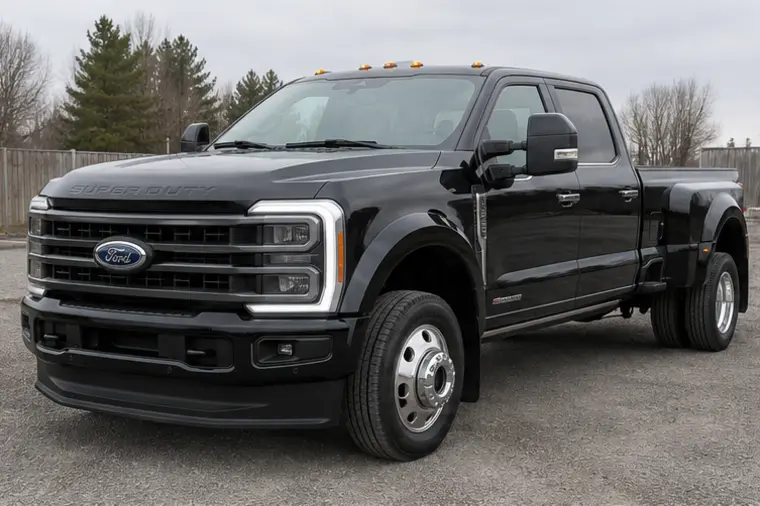
Ford F-450 problems research must first identify whether the vehicle is a factory pickup or a completed chassis cab. This guide focuses on the pickup buying decision. It combines applicable Super Duty campaign questions with the diesel, dual-rear-wheel and towing inspections that matter on an individual F-450; it does not transfer every F-250 problem or commercial upfit concern to the pickup.
Identify the F-450 before applying a problem list
Record the VIN, model year, pickup or chassis-cab identity, engine, transmission and installed body. A badge and a photograph are not enough to establish which towing documentation or campaign population applies. A flat-deck or service-body truck may have a completed-vehicle history that a factory pickup guide does not address.
For a pickup, retain its certification and payload-label photographs and the exact towing-guide information. For an upfitted truck, add the relevant completed-vehicle and body-installation documents. This distinction prevents an apparent capacity, wiring or body problem from being interpreted with information for the wrong vehicle type.
| Question | F-450-specific relevance | Evidence needed |
|---|---|---|
| Is it a pickup or completed chassis cab? | Determines the vehicle and body documentation | VIN/build information, labels and upfit records where applicable |
| Is the electric tailgate campaign relevant? | Specified 2017–2019 Super Duty electric-release equipment includes F-450 | Actual tailgate configuration and current Ford VIN record |
| Is the fuel-pump campaign relevant? | Defined 2020–2022 6.7L Super Duty population includes F-450 | Campaign applicability plus any fuel-system diagnosis |
| Is the steering-shaft campaign relevant? | Specified 2020–2021 Super Duty population includes F-450 | Manufacturer instructions and remedy completion |
| Does the F-250/F-350 oscillation bulletin apply? | TSB 19-2274 lists those two models, not F-450 | Current F-450-specific diagnosis instead of borrowing the bulletin |
Steering-shaft campaign: a safety question to resolve by VIN
Ford's 25S94 / U.S. 25V626 filing concerns an upper steering-column shaft that may separate in specified 2020–2021 Super Duty vehicles, including F-450. The described consequence is loss of steering, without an instrument-panel warning that can be relied on to identify the condition beforehand.
Have Ford confirm current applicability and completion for the candidate VIN, and follow the instructions it supplies for that vehicle. Ask for the recorded action and date rather than a general statement that the front end was serviced. Routine steering work and a campaign remedy answer different questions.
If a used F-450 has an unexplained steering symptom, address that present condition through a qualified assessment even when a campaign shows completed. The campaign record does not certify every joint, tire, wheel or suspension component. Do not take an unstable truck towing to see whether a heavy trailer makes the symptom better or worse.
Do not automatically import the F-250/F-350 steering bulletin
Ford TSB 19-2274 specifies 2017–2019 F-250 and F-350 four-wheel-drive vehicles with sustained steering-wheel oscillation after a defined road event. F-450 is not listed in that bulletin. The similarity of the Super Duty name is not sufficient to extend its diagnostic or repair instructions.
For an F-450 complaint, preserve the conditions under which it occurs: unloaded or towing, road speed, road surface, temperature and recent tire or suspension work. Provide those observations to the technician and obtain the diagnosis for the actual vehicle. A common online label for a symptom does not identify its mechanical cause.
Check whether the truck has nonstandard tires, suspension changes or accessory installations, and document those differences. The purpose is to help interpret the condition, not to assume that every modification caused it. Current F-450 service information and a physical assessment should determine the repair path.
Electric tailgate release: verify the actual equipment
The Ford 19S48 announcement covers specified 2017–2019 Super Duty trucks with electric tailgate release, including F-450, and includes Canadian vehicles. It describes water intrusion into the release-switch circuit that can trigger unintended release. The announcement excludes mechanical tailgate-release handles.
Inspect the candidate's present tailgate equipment and ask about replacement handles, wiring work or unexpected opening. A truck with a changed tailgate may need more documentation to establish what is installed and what campaign work was recorded. Do not infer completion from appearance alone.
For a tow pickup, also consider how the tailgate is used around the installed hitch and trailer. Inspect for damage and check the setup through the appropriate equipment guidance. Resolving a latch concern and confirming trailer clearance are separate tasks; one should not be used to explain away the other.
Diesel fuel-system symptoms and the 24S78 campaign
Ford's 24S78 / U.S. 24V-957 filing includes a defined 2020–2022 6.7L Super Duty population. It describes deposits in the high-pressure pump that can contribute to wear, debris and loss of motive power. Longer cranking, a check-engine light, unusual noise or reduced power are reasons for diagnosis, not proof of one particular failure.
Ask whether the truck's VIN is covered and whether a fuel-system fault has already occurred. Review any campaign entry separately from pump, injector or other component invoices. Have a diesel technician explain what was found and whether the documented repair scope leaves further questions about the system.
Use the current Canadian manufacturer record for the individual truck. A U.S. population description helps identify the issue to discuss but does not establish Canadian applicability. A completed campaign does not provide a blanket warranty that an F-450 will be available for every future towing trip.
Older diesel and emissions checks must match the installed engine
On an older F-450 fitted with the 6.4L Power Stroke, use the appropriate F-Super Duty diesel documentation. Ford's period supplement explains DPF operation and the difference between soot removed through regeneration and ash that is not removed by the same process. Ask for the actual warning history, diagnosis and service records rather than accepting a recently extinguished light as a complete result.
On a 6.7L pickup, identify the year and actual transmission before interpreting maintenance or repair claims. A long engine-family history does not mean every version shares the same output, transmission or service requirements. The relevant guide is the one for the candidate, not the newest brochure.
Verify the factory emissions equipment and calibration through competent inspection when there are signs or claims of alteration. If a seller says removal of a system permanently solved the truck's problems, ask for the original diagnosis and present configuration evidence. Do not replace an unresolved condition question with a reputation-based reassurance.
Dual-rear-wheel and hitch inspections deserve time
Inspect all six road tires, including the inner rear pair, with attention to suitability, wear, damage and the wheels themselves. Ask the technician to investigate unusual wear rather than assuming it is normal for a large pickup. Tire condition should be assessed as part of the complete operating configuration, not only as a line item in the purchase budget.
Examine the installed hitch, mounting points, bed and surrounding structure. Retain documentation for fifth-wheel or gooseneck equipment and inspect any changes to the truck. A heavy-looking hitch or an F-450 badge does not establish that a particular installation is correct or adequately rated.
Ask the seller what trailers and carried loads the pickup handled, then compare that account with records and physical condition. Evidence of towing is not proof of abuse. It is a reason to direct the inspection toward the equipment and systems that performed that work.
Separate a truck defect from an unsuitable towing setup
A loaded combination can create concerns that require more than an engine diagnosis. Verify passengers, bed cargo, hitch weight and loaded trailer transfer against the actual truck's limits. Check axle, tire, hitch, GVWR, GCWR and the appropriate trailer rating, retaining the source of each value.
Ford's pickup guide distinguishes conventional, fifth-wheel and gooseneck applications. Do not substitute one hitch-type rating for another or apply chassis-cab information to the pickup. A larger advertised maximum does not answer every capacity or clearance question for your combination.
If a complaint occurs only while towing, supply the technician with the actual loading and equipment information. Do not intentionally recreate a dangerous handling event to gather evidence. Resolve the relevant truck and setup issues before treating the combination as ready for normal travel.
Repair cost, availability and the purchase decision
Obtain a written scope for diagnosed faults and a separate plan for unresolved symptoms. Ask about parts availability and the expected diagnostic schedule. A general annual repair allowance is not a substitute for pricing a known problem before purchase.
For a large-trailer owner, establish whether a substitute vehicle would actually fit the assignment if the F-450 is unavailable. Matching the hitch, carried load and trailer requirements can matter more than finding any pickup to rent. Include the realistic interruption in the ownership plan without inventing a universal daily loss figure.
Move forward when the truck's identity, condition and load suitability can be supported. If a major safety or structural question remains open, a lower price alone does not resolve it. Compare the inspected candidate and its required work with another F-450 or a suitable one-ton alternative.
Common questions about F-450 problems
Are F-450 pickup and chassis-cab problem lists interchangeable? No. Some campaigns may include both populations, but body equipment, ratings and completed-vehicle responsibilities require the actual vehicle to be identified.
Does the F-250 steering-oscillation bulletin prove an F-450 has the same defect? No. The cited bulletin lists F-250/F-350. An F-450 symptom needs its own applicable service information and diagnosis.
Is an F-450 automatically a trouble-free tow vehicle because of its size? No. Tire, hitch, chassis, powertrain and loading evidence still matter. Capacity and mechanical condition are separate checks.
Can this guide confirm a recall is complete? No. Obtain the current Ford VIN record and keep it with the inspection documents. The guide explains issues to investigate, not a live status report for an individual truck.
Evidence note: manufacturer documents establish the specific facts and applications cited. Buying workflows and cost scenarios are DieselTrucks.ca editorial guidance. These pages do not publish measured failure rates or confirm the condition, recall status or capacity of a particular truck.
General educational content for Canadian diesel-pickup research. Verify the exact truck, model year, certification labels, owner manual and manufacturer documentation, and obtain qualified mechanical or towing advice where appropriate.
Sources & Further Verification
Use the exact model year, VIN, truck labels and current manufacturer documentation when moving from general research to a purchase or towing decision.
- Ford 25S94 / U.S. 25V626 filing — defined 2020–2021 steering shaft population
- Ford TSB 19-2274 — 2017–2019 F-250/F-350 4WD steering oscillation
- Ford 19S48 announcement — specified 2017–2019 electric tailgate latches, including Canada
- Ford 24S78 / U.S. 24V-957 filing — defined 2020–2022 Super Duty population
- Ford 2009 diesel supplement — F-Super Duty 6.4L and DPF sections
- Ford 2024 Super Duty pickup towing guide — original configuration tables and footnotes
- Ford owner manuals