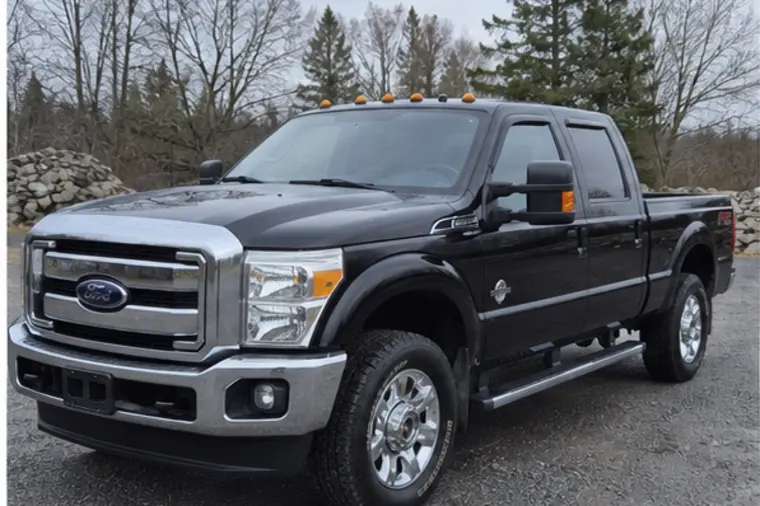
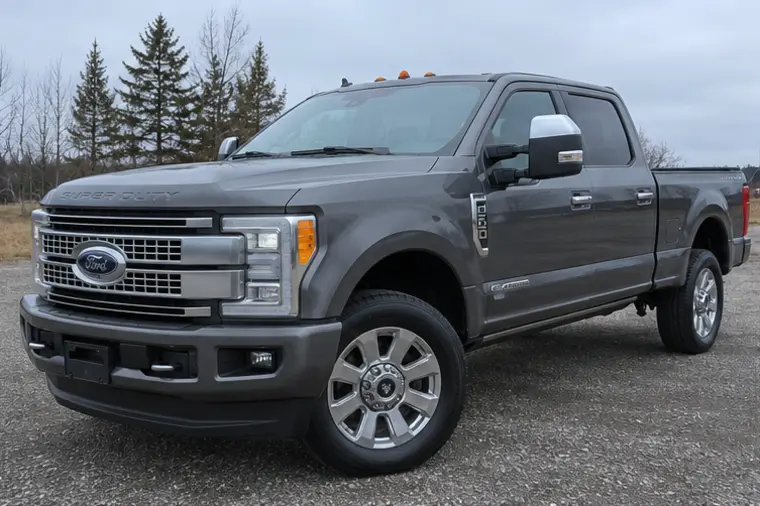
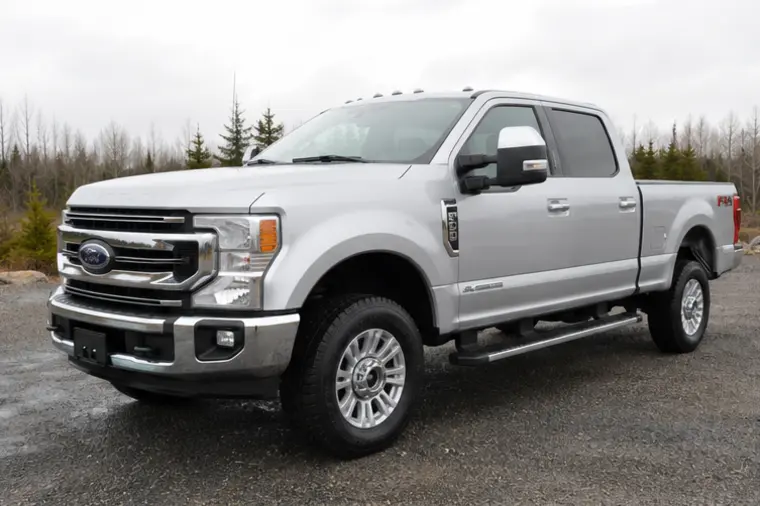
Ford's reviewed recent pickup evidence gives two distinct 6.7L Power Stroke horsepower answers, not one family-wide number. The standard-output engine is listed at 475 hp and the high-output engine at 500 hp. Ford's revised 2025 Super Duty guide and current 2026 Canadian page place both horsepower peaks at 2,600 rpm; the 2024 guide preserves the same output values but does not print peak-power rpm. These are factory engine ratings for identified Super Duty pickup applications. They do not complete the 2011-to-present model-year history or certify a Canadian VIN, installed calibration, wheel horsepower, dynamometer result, towing or payload rating, fuel economy, reliability, lifespan, inventory, price or offer.
Direct answer: recent standard output is 475 hp and high output is 500 hp
For the reviewed 2025 Super Duty pickup guide, Ford publishes 475 hp at 2,600 rpm for the standard 6.7L Power Stroke and 500 hp at 2,600 rpm for the 6.7L High Output Power Stroke. The current 2026 Ford Canada page preserves those two horsepower values and peak speeds.
The 2024 guide supports the same 475-hp and 500-hp split, but it does not print peak-power rpm. Keep that missing field missing instead of backfilling 2,600 rpm from a later guide. Each row below remains attached to its own publication year and application.
These are selected recent pickup rows. A year not shown in the table has not been assigned a value by this review. Use exact-year Ford literature and build evidence when another model year or body application matters.
| Source year | Application | Output tier | Published horsepower | Boundary |
|---|---|---|---|---|
| 2024 | Super Duty pickup | Standard 6.7L Power Stroke | 475 hp | Peak-power rpm not printed in reviewed guide |
| 2024 | Super Duty pickup | 6.7L High Output Power Stroke | 500 hp | Peak-power rpm not printed in reviewed guide |
| 2025 | Super Duty pickup | Standard 6.7L Power Stroke | 475 hp at 2,600 rpm | Pickup guide; not a VIN result |
| 2025 | Super Duty pickup | 6.7L High Output Power Stroke | 500 hp at 2,600 rpm | Pickup guide; not a VIN result |
| Current 2026 Canada | Super Duty family page | Standard 6.7L Power Stroke B20 | 475 hp at 2,600 rpm | Availability still requires exact build evidence |
| Current 2026 Canada | Super Duty family page | High Output 6.7L Power Stroke B20 | 500 hp at 2,600 rpm | Availability still requires exact build evidence |
Identify the exact truck before selecting a horsepower row
Start with model year, vehicle line, pickup or chassis-cab body type, engine output tier and original powertrain. A 6.7L badge confirms neither the standard-output nor high-output row. A Super Duty model name alone also does not prove that the engine presently installed matches its original build.
For a used truck, compare the private VIN and build record with engine labels, service records and current hardware. Record replacement engines, control modules, tuning, turbocharger changes and other modifications separately. Original specification identity and present configuration are different questions.
The current Ford Canada page is useful Canadian-market evidence, but this guide did not submit a VIN or retrieve a candidate build sheet. Leave the output tier unresolved when the identity chain is incomplete.
Standard and high output are separate factory rows
Ford labels the 475-hp engine as the 6.7L Power Stroke and the 500-hp engine as the 6.7L High Output Power Stroke. Preserve those names. Do not present 475–500 hp as a tolerance range for an unidentified engine or as two measurements from the same calibration.
The high-output label is an application identity, not permission to convert another engine with arithmetic. A seller's statement that a truck is high output should be checked against the exact build and current configuration rather than accepted from appearance or trim alone.
Both reviewed 2025 pickup rows appear with a TorqShift ten-speed context. Transmission identity helps define the vehicle package, but it does not independently prove the engine's output tier or current calibration.
The 25-hp difference is transparent endpoint arithmetic
Subtracting 475 hp from 500 hp gives 25 hp. Relative to the standard-output figure, the difference is about 5.3 percent. Those calculations compare two Ford-published factory endpoints; they are not new test results.
Do not describe 25 hp as an expected tuning gain, wheel-horsepower gain or annual improvement. It does not predict acceleration, grade speed, fuel consumption or towing capacity. Those outcomes depend on the complete vehicle, load, gearing, conditions and operating point.
The percentage is useful only after both candidates are assigned to the correct source rows. If either engine tier is unverified, the calculated comparison should remain conditional.
| Comparison | Arithmetic | Permitted reading |
|---|---|---|
| High output minus standard | 500 − 475 = 25 hp | Difference between two recent factory pickup rows |
| Difference relative to standard | 25 ÷ 475 ≈ 5.3% | Endpoint percentage, not a measured performance gain |
| Peak-power speed in 2025 | 2,600 − 2,600 = 0 rpm | Same published peak speed; complete curves still unresolved |
The 2024 guide preserves values but not peak-power rpm
Ford's 2024 guide states 475 horsepower for the standard diesel and 500 horsepower for the high-output diesel. The reviewed output panel does not attach an rpm value to either horsepower number. That makes the values usable while leaving their peak speeds unresolved for that source year.
A later document can show continuity without rewriting the earlier document. The 2025 and current 2026 sources support 2,600 rpm in their own rows; they do not prove that Ford intended an omitted 2024 field to carry the same value.
This source-year separation prevents a convenient modern table from becoming an invented all-years specification chart.
The 2025 guide supplies horsepower and rpm together
The revised 2025 pickup guide publishes a compact engine table. Its standard diesel row reads 475 hp at 2,600 rpm, while its high-output diesel row reads 500 hp at 2,600 rpm. The same table separately lists torque at 1,600 rpm.
Keep the pickup context and source revision with the numbers. The guide also contains configuration-specific towing selectors, but those rows must not be collapsed into the engine horsepower result. Horsepower identifies an engine output row; towing belongs to a properly equipped complete truck.
Ford's note says horsepower and torque are independent attributes and may not be achieved simultaneously. Therefore, do not combine the separate peaks as if they occurred at one test point.
Current Canadian evidence confirms the two recent tiers
Ford Canada's current 2026 Super Duty material identifies a standard 6.7L Power Stroke B20 at 475 hp and a high-output version at 500 hp. The detailed engine table places both horsepower peaks at 2,600 rpm and their separate torque peaks at 1,600 rpm.
This is useful Canadian-market evidence at the family-page level. It does not certify that every Canadian F-250, F-350 or F-450 can be ordered with both versions, nor that a particular VIN was built with one. Trim, package and configuration availability must be checked on the exact vehicle.
Promotional maximum and best-in-class language is retained only as manufacturer context. It is not independent comparative testing and does not alter the underlying 475-hp and 500-hp rows.
Equal peak speed does not mean equal power curves
The reviewed 2025 and current 2026 rows place both horsepower maxima at 2,600 rpm. That equality locates the two published peaks; it does not establish equal output below or above that speed, identical turbo response, identical calibration or identical transient behaviour.
A complete comparison would need application-matched curve data or controlled measurements across engine speed. None is manufactured here. Do not draw a smooth curve between zero and the headline maximum or estimate output at intermediate speeds from descriptive product language.
Keep three fields separate in a comparison sheet: maximum horsepower, rpm at that maximum and the full power curve. The first two are available for the reviewed 2025 and current rows; the third remains unresolved.
Horsepower and torque peaks occur at different operating points
Ford's 2025 table places peak horsepower at 2,600 rpm and peak torque at 1,600 rpm for both diesel tiers. That is direct evidence that the two headline maxima are not one simultaneous operating point.
The mechanical relationship between torque, rotational speed and horsepower is valid only when the inputs describe the same operating point and measurement basis. Multiplying the headline torque by 2,600 rpm or dividing headline horsepower by the torque peak would combine unmatched values and produce a fictional result.
Use a sourced curve when output at a specific rpm matters. The dedicated torque and specifications targets retain their own evidence and should not be absorbed into this horsepower guide.
Factory engine horsepower is not wheel horsepower
Ford's published numbers are factory engine ratings, not chassis-dynamometer wheel results. A wheel test reflects the complete tested vehicle, transmission, axle, tires, operating state, test method and correction choices.
Do not apply a generic driveline-loss percentage to manufacture wheel horsepower. If a seller provides a dynamometer sheet, record whether it reports measured wheel output or estimated engine output, along with vehicle identity, date, configuration, correction method and conditions.
A factory rating and a candidate-specific dyno result can coexist in a file, but they belong in separate columns. The difference is not automatically degradation, improvement or proof of a modification claim.
Horsepower alone does not set towing capacity
A 500-hp headline cannot override Ford's configuration-specific towing limits. Trailer ratings depend on the exact model, cab, bed, drivetrain, axle ratio, wheel and tire equipment, packages, hitch type, passengers and cargo.
Ford's towing guides explicitly say maximum towing varies with equipment and configuration. Use the correct selector row and controlling labels for the actual truck. Do not assign a family maximum to a candidate simply because it has the high-output engine.
Keep engine identity and towing suitability as separate findings. One can be known while the other remains unresolved.
Horsepower alone does not set payload
Payload is a complete-vehicle weight result. Engine choice can affect curb weight, but the horsepower number itself does not establish payload, GVWR, GAWR or available rear-axle capacity.
Read the candidate's labels and account for people, cargo, hitch hardware, accessories and trailer pin or tongue load. A promotional maximum belongs only to its qualifying configuration and cannot be transferred to a differently equipped truck.
For a chassis cab or upfitted vehicle, include final-stage manufacturer evidence and measured working weight. This pickup-focused horsepower guide does not assign a completed-vehicle payload.
Pickup and chassis-cab applications require separate evidence
The reviewed numerical rows come from Super Duty pickup guides and the current Canadian Super Duty family page. They are not a complete chassis-cab calibration table. F-350, F-450, F-550 and F-600 names can appear in multiple body and vocational contexts, so model digits alone are insufficient.
Do not transfer a pickup high-output rating to an incomplete chassis cab, ambulance, service body or other upfit. Retrieve exact-year chassis-cab literature and final-stage documentation for those vehicles.
When the application is ambiguous, mark the row unresolved. A smaller verified dataset is more useful than a complete-looking table built from crossed applications.
Modified or replacement engines break the simple lookup
A tune, turbocharger change, fuel-system alteration, engine replacement or control-module replacement can break the link between the original build row and present output. Do not add an advertised aftermarket gain to 475 or 500 hp.
Request invoices, part identifiers, calibration documentation and qualified inspection. If present output matters, use a candidate-specific test with a documented method. Even then, keep measured wheel output separate from the original factory engine rating.
Also preserve uncertainty about restoration to stock. A seller's claim that a tune was removed does not by itself prove current calibration, emissions compliance or mechanical condition.
Horsepower cannot rank reliability or best years
A larger output rating is not a failure-rate study. The 25-hp tier difference does not identify a more reliable engine, a best model year or a years-to-avoid list. It also does not predict remaining life for an individual truck.
Evaluate reliability using exact-year service evidence, maintenance history, duty, modifications, campaigns, qualified inspection and current symptoms. Keep unsupported population claims and forum anecdotes out of the specification table.
The dedicated problems, reliability, best-years and years-to-avoid pages remain distinct. This page links to them but does not merge or replace their intent.
Use exact-year literature for unreviewed years
This guide does not fill 2011 through 2023 or create a complete 6.7L Power Stroke horsepower chronology. Output can change by year, vehicle line, body application and calibration. An adjacent verified year is not evidence for a missing row.
Ford's towing centre provides current and archived guide access. Save the exact PDF, publication year, revision and applicable vehicle context with every additional row. If the guide omits rpm or an output tier, preserve the omission.
Search-result snippets, dealer summaries and unsourced charts can help locate primary literature, but they do not replace the manufacturer document in the final evidence chain.
Build a reproducible horsepower comparison
Use one row per exact source application. Record source year and revision, country or market, vehicle line, pickup or chassis cab, engine label, output tier, horsepower, peak rpm when printed, measurement note and unresolved fields.
For a candidate truck, add private VIN and build evidence, current engine and calibration evidence, modifications, transmission, axle, tires and the job being evaluated. This separates source facts from candidate observations.
Do not overwrite conflicts. Keep both values with their sources until the application difference or document revision explains them. An unresolved conflict is a useful decision flag, not permission to average the numbers.
| Field | Required evidence | Reason |
|---|---|---|
| Identity | Year, vehicle line, body application, VIN/build evidence | Selects an eligible source row |
| Engine tier | Exact standard or high-output label | Prevents a 475–500 hp range claim |
| Rating | Horsepower, rpm, source and revision | Keeps the number reproducible |
| Current state | Installed engine, calibration, modifications and records | Separates factory identity from present condition |
| Job | Load, route, duty, ratings and measured weights | Prevents horsepower from replacing suitability |
| Unknowns | Missing or conflicting evidence | Stops unsupported certainty |
6.7L Power Stroke horsepower checklist
Complete these checks before quoting a rating for a specific truck.
- Confirm model year, vehicle line and pickup-versus-chassis-cab application.
- Verify the exact standard-output or high-output engine tier from build evidence.
- Use 475 hp and 500 hp only within the reviewed recent source boundaries.
- Attach 2,600 rpm to the reviewed 2025 and current 2026 rows, not automatically to 2024.
- Keep the 25-hp and approximately 5.3-percent differences labelled as endpoint arithmetic.
- Do not combine the 2,600-rpm horsepower peak with the separate 1,600-rpm torque peak.
- Keep factory engine horsepower separate from wheel-dynamometer results.
- Use exact configuration tables and labels for towing and payload decisions.
- Record replacement engines, calibration work and modifications independently.
- Leave unreviewed model years and chassis-cab ratings unresolved.
- Do not infer reliability, lifespan, fuel economy or condition from horsepower.
- Do not certify inventory, sellers, dealer counts, prices, financing or offers from this research page.
Frequently asked questions
How much horsepower does a recent 6.7L Power Stroke have? The reviewed 2025 and current 2026 pickup evidence lists 475 hp at 2,600 rpm for standard output and 500 hp at 2,600 rpm for high output. How much more is high output? The published endpoints differ by 25 hp, or about 5.3 percent relative to 475 hp.
Does every 6.7L Power Stroke have 500 hp? No. Ford publishes separate standard and high-output rows, and older or other applications require exact-year evidence. Is 500 hp the wheel figure? No. It is a factory engine rating. Does the high-output engine automatically tow more? No. Towing follows the complete qualifying configuration and controlling limits.
Editorial conclusion
The defensible recent answer is two source-labelled pickup ratings: 475 hp for the standard 6.7L Power Stroke and 500 hp for the high-output version. Ford's revised 2025 guide and current 2026 Canadian page place both peaks at 2,600 rpm; the reviewed 2024 guide preserves the same values without printing peak rpm.
Keep those rows separate, label the 25-hp difference as endpoint arithmetic and use exact build evidence for a candidate. Do not convert a focused factory specification into an all-years chart, wheel-output claim, towing or payload rating, reliability verdict, Canadian VIN certification or marketplace offer.
Evidence note: manufacturer documents establish the specific facts and applications cited. Buying workflows and cost scenarios are DieselTrucks.ca editorial guidance. These pages do not publish measured failure rates or confirm the condition, recall status or capacity of a particular truck.
General educational content for Canadian diesel-pickup research. Verify the exact truck, model year, certification labels, owner manual and manufacturer documentation, and obtain qualified mechanical or towing advice where appropriate.
Sources & Further Verification
Use the exact model year, VIN, truck labels and current manufacturer documentation when moving from general research to a purchase or towing decision.