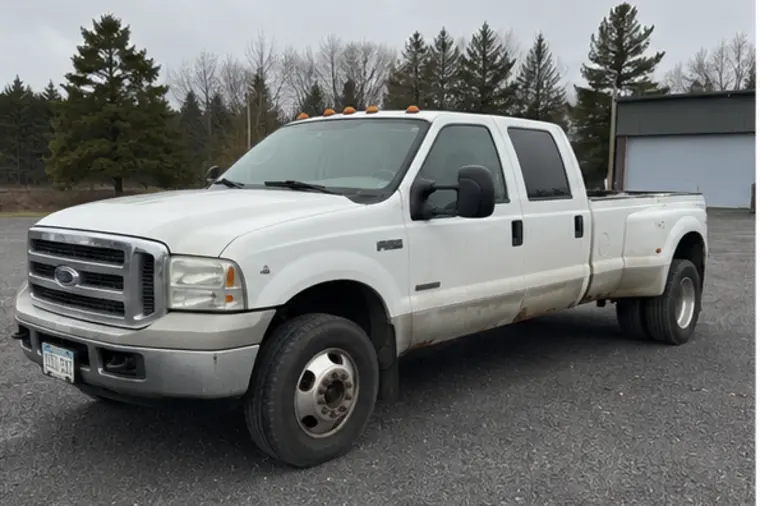
The 6.0L Power Stroke arrived during the 2003 model year and continued in Super Duty pickups through 2007. Transition-year identification and repair documentation deserve careful attention.
Use dated output anchors, not one specification for every 6.0L
Two period Ford documents show why the model year belongs beside the engine name. The original 2004 towing guide lists the 6.0L in its Super Duty pickup lineup at 325 hp and 560 lb-ft. The original 2005 guide explicitly raises the pickup torque figure to 570 lb-ft. These are archived manufacturer publications, not measurements of a present-day used engine.
The selected references establish a revision point, not a complete annual calibration history. We do not attach an unverified peak-torque rpm, wheel-horsepower number or E-Series rating to these pickup values. A replacement engine, controller or altered calibration also requires its own identification; a door sticker and an engine badge cannot settle every question about a modified truck.
When comparing two candidates, first establish application and build details, then separate factory specification from the seller’s claimed improvements. Ask whether the advertised output is a factory rating, an estimate or a documented test. Even a genuine dyno result would describe the tested setup and conditions, not increase the truck’s legal or manufacturer load ratings.
| Primary reference | Confirmed pickup information | What it does not establish |
|---|---|---|
| 2004 Ford towing guide | 325 hp; 560 lb-ft | Every 6.0L year or application |
| 2005 Ford towing guide | Torque increased to 570 lb-ft | A complete calibration map or present engine condition |
| 2007 Ford diesel supplement | Application-specific operating and service guidance | A new horsepower or torque rating |
Read the recall’s model year, not just the year on the letter
The July 2005 05S34 notification package illustrates a useful distinction. Its first letter addresses certain 2004 F-250/350/450/550 and Excursion vehicles with the 6.0L diesel. It describes possible FICM-harness chafing and an ICP sensor-connector issue. The E-Series letter has a different application and concentrates on the connector. The mailing date is not the affected model year.
The package also contains a cover sheet separating safety recall 05S34 from customer-satisfaction program 05B29 for a charge-air-cooler duct. Do not combine every item in the envelope into one safety recall or assume that the presence of a letter proves all work was completed. This is historical U.S. documentation, not a current Canadian VIN lookup.
For a candidate with starting, surging or stalling concerns, provide the relevant records to a qualified technician. Confirm campaign applicability and completion separately from diagnosing the current fault. A completed harness action does not rule out another electrical, fuel, oil-pressure or mechanical problem, and the campaign does not supply a failure rate for the engine family.
Match the maintenance record to the way the truck was used
Ford’s 2007 supplement distinguishes the normal oil-service maximum of 7,500 miles (12,000 km) or six months from the towing schedule’s 5,000 miles (8,000 km) or six months. The towing table also lists both fuel filters at 10,000 miles (16,000 km) or 400 engine hours, whichever comes first. Other special-use schedules have their own conditions; these examples are not a universal calendar for all 6.0L vehicles.
Use those distinctions to audit the record rather than to reconstruct maintenance from odometer distance alone. Ask when the truck began towing or stationary work and whether the service schedule changed with it. Long intervals between invoices may have different significance for a lightly used truck and a vehicle that spent substantial time operating without adding road kilometres.
The supplement explains that oil pressure actuates the injectors. That makes correct oil servicing relevant to the injection-system discussion, but it does not mean an oil change is the diagnosis or remedy for every hard start. Keep the maintenance timeline, actual symptoms and professional findings separate. Use the dedicated schedule and fluid guides to resolve the exact application before purchasing supplies.
Turn cooling, starting and repair claims into separate questions
An inspection brief should name what the owner has observed: coolant needing repeated top-ups, a difficult hot restart, a warning light, smoke under a described condition or a change after a repair. Ask the shop to explain what its tests establish and what remains uncertain. Do not replace that process with a list of expensive parts commonly discussed online.
For cooling or head work, request the diagnosed cause, repair scope and follow-up. For a no-start or injection complaint, request the relevant diagnostic record, not just an invoice for a module. For a replacement engine, establish what assembly was supplied and which accessories or systems were reused. These are different histories with different remaining questions.
Keep the truck’s chassis and transmission in the same purchase assessment. A well-documented engine repair does not renew brakes, steering, tires, hitch installation or the rest of an older pickup. Price the immediate work actually identified and decide whether the resulting vehicle is suitable for the intended duty before assigning value to a seller’s upgrade label.
Towing, fuel economy and lifespan need different evidence
To decide whether a 6.0L truck can tow a particular trailer, use the exact truck’s model-year guide, labels, configuration and loaded weights. The engine’s published torque is not a tow rating. Check both the trailer-weight ceiling and what the truck carries at the connection, including passengers, tools and the installed hitch. A healthy engine cannot compensate for an overloaded axle.
For fuel economy, record repeatable filled-fuel and distance measurements while identifying trailer use, idling and operating conditions. Do not mix an unloaded trip with a loaded working week and report the average as an engine-wide MPG promise. A prospective buyer should treat a seller’s consumption claim as an item to verify, not a guaranteed ownership saving.
For life expectancy, assess current condition and maintenance evidence instead of promising a mileage endpoint. Repairs can improve a particular vehicle without proving that every example will reach the same distance. The separate reliability and year-selection pages explain those decisions in more detail; this parent establishes the engine and its evidence boundaries.
Three systems that make the 6.0L inspection specific
Ford’s 2007 diesel supplement identifies both a primary fuel/water-separation unit and an engine-mounted secondary filter, describes oil pressure as necessary to actuate the injectors, and identifies PCM/FICM control of the fuel-injection system. These are distinct service and diagnostic questions.
Ask whether both fuel-filter services are documented, whether the oil-service history is traceable, and whether a starting or running concern was diagnosed with the correct engine data. Replacing a control module or injector without the diagnosis does not explain why the original complaint occurred. Use the F-Super Duty portions of the supplement; it also contains E-Series material.
Turn a repair history into an inspection brief
A 6.0L purchase often arrives with a list of repairs or upgrades. Ask what symptom prompted each job, which parts were installed, who carried out the work and what follow-up established the result. A short label applied to an engine build cannot replace that evidence.
Separate the seller’s claims into completed work, current observations and unanswered questions. Give the inspecting shop the invoices before the appointment so it can assess the present configuration. If the records name only aftermarket brands, ask for the actual part numbers and installation details.
| Evidence category | What it should establish |
|---|---|
| Diagnosis | The condition the shop was trying to resolve |
| Work performed | Parts, procedures, date and kilometres |
| Follow-up | Whether the original concern returned |
| Current inspection | What the truck does now, cold and fully warm |
Keep modifications in the valuation
The useful question is not simply whether a truck has been modified; it is whether the modification is identifiable, appropriate to the intended use and supported by service evidence. Ask the shop to distinguish an altered calibration from a factory configuration before interpreting output or drivability claims.
Do not add the seller’s total parts spending directly to the truck’s value. Assess the current vehicle and the work it still needs. A costly previous repair may resolve one condition while leaving unrelated age, chassis or transmission work outstanding.
Choose an ownership plan before choosing a bargain
For daily commercial use, document how the truck would be supported if it needed unplanned work. For occasional use, consider how storage, short journeys and the maintenance schedule fit together. The same candidate can be a different ownership proposition under those two patterns.
Use a written purchase budget that separates acquisition, immediate corrective work, scheduled maintenance and a reserve. Compare that total with an alternative truck that satisfies the same load requirements. If a specific engine or cooling concern remains unresolved, obtain a diagnosis before assigning it a repair figure.
Identify the exact truck
Confirm model year, build date, VIN, engine, transmission and whether the listing is a pickup or another commercial application.
Build a service timeline
Look for dated evidence covering cooling, oil and fuel service, diagnostic work, previous repairs and the reason each repair was performed. A parts list without context is not a complete history.
Inspect modifications and workmanship
Ask what is stock, tuned or replaced. A qualified diesel technician should assess current condition rather than accepting internet checklists as a diagnosis.
- Ask for dated maintenance and repair records rather than relying on a verbal summary.
- Evaluate a true cold start, warning lights, leaks, transmission behaviour and underbody condition.
- Confirm whether the truck has towed, carried commercial loads or been modified, and inspect accordingly.
- Verify emissions equipment, tires, suspension and the exact payload label on the truck itself.
Documented concerns and repair-claim verification
Ford's 2005 recall owner notification describes a scoped 6.0L wiring concern involving the fuel-injection control-module harness. This is documented campaign evidence for affected vehicles, not proof that every 6.0L has that fault. Check Canadian VIN applicability and completion separately.
For a truck advertised as upgraded or comprehensively repaired, request the actual invoice: diagnostic cause, parts, work performed and follow-up results. Head, cooling, injection or electrical work should be evaluated by its documented scope. A marketing label such as bulletproofed is not a standard inspection result and does not establish the condition of the rest of the truck.
If coolant loss, hard starting or an intermittent warning remains, commission qualified diagnosis before deciding the fault is minor or catastrophic. Keep the coolant history and scan findings together. A purchase decision should include unresolved work and repair time as well as the price of completed modifications.
Read repair claims as a connected system history
A 6.0L advertisement may list head, cooling, injection and electrical work together. Break that list into the complaint, tests, repair and follow-up for each system. The phrase bulletproofed does not tell the buyer which components remain original or why the work was necessary.
An unresolved coolant or starting symptom remains a purchase question even after extensive work. Commission a diagnosis before estimating its importance. The scoped wiring campaign discussed above should be checked independently through the VIN; it is not a general explanation for every 6.0L complaint.
| Repair area | Documentation that helps |
|---|---|
| Cooling or head work | Diagnosed cause, scope and post-repair observations |
| Injection or control electronics | Test findings, component identity and fault history |
| Engine replacement | Assembly source, included accessories and installation record |
Evidence note: manufacturer documents establish the specific facts and applications cited. Buying workflows and cost scenarios are DieselTrucks.ca editorial guidance. These pages do not publish measured failure rates or confirm the condition, recall status or capacity of a particular truck.
FIND TRUCKS USING THIS ENGINE
Connect the engine to a model year and exact truck.
Engine-family research is one part of the configuration. Use the explorer to connect model, year, transmission, cab, bed and rear-wheel context.
General educational content for Canadian diesel-pickup research. Verify the exact truck, model year, certification labels, owner manual and manufacturer documentation, and obtain qualified mechanical or towing advice where appropriate.
Sources & Further Verification
Use the exact model year, VIN, truck labels and current manufacturer documentation when moving from general research to a purchase or towing decision.