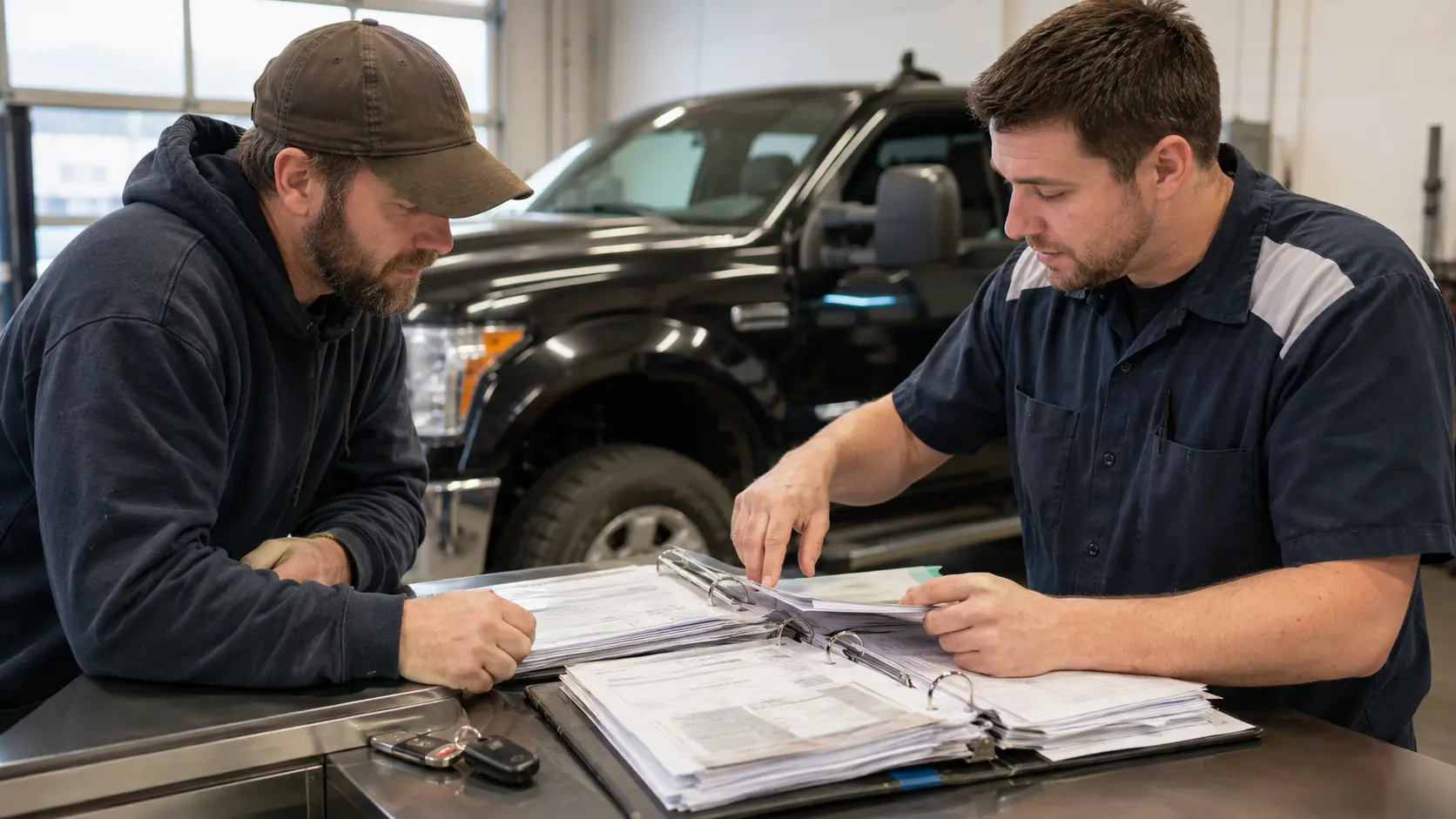
A useful reliability claim states what happened, to which vehicles, under what conditions and according to which evidence. A list of best or worst years often leaves those questions unanswered.
Build the buying decision
Classify the claim
Recall, bulletin, invoice or anecdote?
Check applicability
Year + engine + build/VIN + conditions
Assess this truck
Completion evidence + inspection + unresolved work
Separate four kinds of evidence
A recall identifies a safety-related campaign population and remedy process; it does not rank every engine. A technical service bulletin gives application-specific service information. A repair invoice records work on an individual truck. An owner story describes an experience whose wider representativeness may be unknown.
For example, FCA's U.S. Y78 report describes a scoped RAM fuel-pump campaign, while GM's PIP5007B addresses an exhaust-fluid diagnostic situation. Treating both as a count of generic engine failures would erase their different purposes and applicability.
Ask what a ranking would need
A credible comparison would need a defined population, number of affected vehicles, exposure such as age or usage, consistent failure definitions and a way to handle different maintenance and operating patterns. A collection of forum posts does not supply those controls.
Absence of a campaign is not proof that a vehicle has no reliability risk. Equally, a documented issue is not proof that every truck in the named family will suffer it. Avoid turning manufacturer repair instructions into invented failure percentages or guaranteed remaining kilometres.
Use the evidence on the truck for sale
Identify the year, engine and application, check Canadian VIN campaign status, review repair completion and commission an independent inspection. Ask the shop to state unresolved findings and the cost of further diagnosis.
A buying recommendation can then be conditional: this truck fits the work if its configuration is verified and the identified repairs are acceptable. DieselTrucks.ca's workflows are editorial guidance. They do not claim an independently measured reliability index or a universal best-year winner.
Evidence note: manufacturer documents establish the specific facts and applications cited. Buying workflows and cost scenarios are DieselTrucks.ca editorial guidance. These pages do not publish measured failure rates or confirm the condition, recall status or capacity of a particular truck.
General educational content for Canadian diesel-pickup research. Verify the exact truck, model year, certification labels, owner manual and manufacturer documentation, and obtain qualified mechanical or towing advice where appropriate.
Sources & Further Verification
Use the exact model year, VIN, truck labels and current manufacturer documentation when moving from general research to a purchase or towing decision.